Before “The Fringe” (And After)

When Britain’s legendary Satire Boom took off in the early 1960s, Ojai’s Peter Bellwood was right in the thick of it, hopping on one leg.

(From The Ojai Quarterly, Spring 2018)

By Mark Lewis

MANY people in Ojai are fans of the popular Netflix series “The Crown,” but few feel a personal connection to its subject matter. We’re contemporary Americans, watching a historical drama set in Britain the middle of the last century – a long time ago in a galaxy far, far away. But for the Brits in our midst, the series hits rather closer to home. Especially if, like Peter Bellwood, they spot some old friends among the characters on the screen.

Peter Bellwood
Peter Bellwood

Bellwood, an Englishman born in 1939, has never met Queen Elizabeth II, the lady who wears the crown in question. Nor did he ever meet the late Harold Macmillan, whose term as prime minister from 1957 to 1963 provides the setting for Season 2 of the series. But there’s a key scene in the season finale where Macmillan visits London’s Fortune Theatre to see a satirical revue called “Beyond The Fringe,” featuring four young men in gray suits. In real life, Bellwood knew the four performers well – especially Dudley Moore, who is shown seated at a piano, and Peter Cook, who is shown humiliating Macmillan with a deft and mercilessly phrased ad-lib.

Bellwood was not in the Fortune Theatre that night, but he was living in London at the time, and Cook soon would invite him to join the cast of another satiric revue, “The Establishment,” a major link in the chain from “Beyond The Fringe” to “Monty Python’s Flying Circus.” That was the beginning of Bellwood’s professional career in show business, which later brought him to Hollywood as a screenwriter, and eventually to Ojai, where his satirical columns enliven the pages of The Ojai Quarterly. But his connection to Cook actually went back several years before “Beyond the Fringe,” to his undergraduate days at Cambridge University — when the Satire Boom was still a squib, and Bellwood was present at the creation.

A YORKSHIRE LAD

Peter Bellwood was born and raised in York, where he attended St. Peter’s, a private school of ancient lineage where past alumni included the infamous Guy Fawkes, who tried to blow up Parliament in 1605. (It seems that Old Peterites are predisposed to booms, satiric or otherwise.) In the fall of 1958 he arrived at St. Catharine’s College at Cambridge University with a view to studying law. But fate diverted him to a different path, due to an unusual talent.

“Well, I played the ukulele,” he explains.

During his freshman year, a St. Catharine’s group called “The Midnight Howlers” put on a concert that included Bellwood with his ukulele, singing comical songs popularized by the entertainer George Formby. Adrian Slade, the president of the very prestigious Cambridge University Footlights Dramatic Club, happened to see the show, and was impressed enough that he recommended Bellwood to John Bird, who was directing the annual Footlights revue. Bird auditioned Bellwood, inducted him into the club and cast him in the show.

“It just fell out of heaven,” Bellwood says. “I was the first freshman ever invited to join.”

And so at a tender age he found himself among the players in “Last Laugh,” in June 1959. The revue’s other cast members included Bird; the actress Eleanor Bron; the future politician Geoffrey Pattie, who one day would serve in Margaret Thatcher’s Cabinet; and Peter Cook, who preferred tormenting prime ministers to serving under them.

Bellwood, right, in “Last Laugh,” photographed by Antony Armstrong-Jones

“Last Laugh” was no mere run-of-the-mill college revue. The performance was recorded for a privately pressed LP (Bellwood still has his copy), and the cast was photographed by Princess Margaret’s fiancé, Antony Armstrong-Jones (whose romance with the queen’s younger sister figures prominently in Season 2 of “The Crown”).

Cook was already a legend in the making. Cambridge was grooming him to be a diplomat like his father, but diplomacy was not his forte. Everything Cook encountered became grist for his comedy. Seemingly without effort, he churned out skit after skit, and not just for the annual Footlights revues – he also was supplying material for London stage revues.

“Peter was regarded as a phenomenon,” Bellwood says, “because he was an undergraduate making West End money.”

One of Cook’s most famous skits, “One Leg Too Few,” was inspired by the sight of Bellwood standing on one leg to scratch the sole of the other foot. Instantly, Cook invented a scene in which a one-legged actor auditions for a role that would seem to require the full complement of lower limbs.

“It just came out of his mouth,” Bellwood recalls. “He said, ‘Now, Mr. Spiggott, you are auditioning, are you not, for the role of Tarzan.”

Cook, left, and Bellwood in “One Leg Too Few” at Cambridge, 1960

When “One Leg Too Few” was performed in the 1960 Footlights revue, “Pop Goes Mrs. Jessop,” Bellwood himself played Spiggott, hopping about on one foot. In later years the role would be associated with Dudley Moore, who in 1960 was a recent Oxford graduate and an aspiring jazz pianist. At some point that year, Bellwood and other Footlights members opened a club room in their theater building. To launch it, they threw a party that drew jazz musicians from far and wide – including Moore, who showed up with his trio.

“It was now that he met Peter Bellwood,” wrote Moore’s authorized biographer, Barbra Paskin. In her book, she quotes Bellwood recalling the party as “wildly entertaining and never ending, with a jazz concert that continued through the early hours of the morning.”

Bellwood bonded with Moore, as he already had bonded with Cook – but not with David Frost, another Cambridge undergraduate and Footlights member.

“He was a creep,” Bellwood says of Frost. “He stole all of Peter Cook’s material.”

Cook served as president of the Footlights in the 1959-60 year, then made his big leap shortly after graduation. That summer, he joined the cast of “Beyond the Fringe,” a Footlights-style revue that debuted at the annual Edinburgh International Festival on Aug. 22, 1960. (The “Fringe” in the title referred to the Edinburgh Festival Fringe, an alternative arts festival that takes place each year at the same time as the more traditional festival.) The other three “Fringe” cast members were Dudley Moore, Alan Bennett and Jonathan Miller. Together with Cook, they comprised a cultural pivot point in Britain’s postwar history.

“It created an explosion,” Bellwood recalls.

So much so that in May 1961, “Beyond the Fringe” took up residency at the Fortune Theater in London’s West End, where it was such a hit that Harold Macmillan came to see it, having heard about Cook’s impersonation of him. Spotting the prime minister in the audience, Cook ad-libbed a new line, which he delivered using Macmillan’s plummy upper-crust accent:

“When I’ve a spare evening, there’s nothing I like better than to wander over to a theater and sit there listening to a group of sappy, urgent, vibrant young satirists with a stupid great grin spread over my silly old face.”

As “The Crown” would have it, Macmillan was deeply embarrassed. In real life, the PM apparently was a better sport. (Queen Elizabeth also saw “Beyond The Fringe” during its London run and she reportedly enjoyed it.)

Cook’s irreverent humor suited the times. The Suez Crisis of 1956 had stripped Britain of the illusion that it was still a first-class world power. The British had won World War II but lost their empire, and now found themselves playing second fiddle to those upstart Yanks across the pond. As a result, the traditional deference given to establishment institutions like the monarchy, and to upper-class statesmen like Macmillan, was curdling into something far less respectful.

Bellwood points out that Cook’s humor owed a great deal to the anarchic antics of Spike Milligan, Peter Sellers and others on the popular 1950s BBC radio program “The Goon Show,” which was more surreal than satirical. But in Cook’s hands, British humor acquired a political edge that had much to do with the nation’s suddenly diminished place in the world. His Macmillan impersonation called to mind an out-of-touch aristocracy in the process of passing from the scene. Hence the sting of his ad-lib at the Fortune Theatre that night.

Back at Cambridge, meanwhile, Bellwood was now a senior, and had succeeded Cook as president of the Footlights. One day he and Frost, the club secretary, were invited to a cabaret revue that featured future Monty Python stalwart Graham Chapman, who was angling for a Footlights audition.

“We gave them gallons of claret and didn’t start until they’d drunk at least a bottle each,” Chapman recalled in the book “Pythons: The Autobiography, By the Pythons.”

Whether it was the claret or his performance, Chapman did wangle the coveted invitation from Bellwood and Frost to audition. So did John Cleese, another future Python.

“I impersonated a carrot and a man with iron fingertips being pulled offstage by an enormous magnet,” Chapman recalled. “In the same set of auditions John Cleese did a routine of trampling on hamsters, and can still do a good pain-ridden shriek. We were both selected and very soon were able to wear black taffeta sashes with Ars est celera artum (the art is to conceal the art) on them.”

Bellwood by this point had switched from law to history but was devoting most of his time to the Footlights and to having fun, to the point where he was in danger of being sent down before he graduated. But the head of his college noted that Bellwood was the first St. Catharine’s undergraduate to serve as president of the Footlights, which constituted a feather in the college cap. So he was allowed to graduate with his history degree in 1961.

Going up to London, he found a flat in Notting Hill and a job in advertising, producing TV commercials for laundry soap. His flat-mates included his old Footlights comrades John Bird and John Fortune, who were now performing on a London stage. Bellwood soon moved to grander digs on Prince of Wales Drive in Battersea, which he shared with Peter Cook and others.

The success of “Beyond the Fringe” prompted Cook and another old Cambridge pal, Nicholas Luard, to found The Establishment, a nightclub on Greek Street in Soho. The main stage featured Bird, Fortune, Eleanor Bron and Jeremy Geidt performing a “Fringe” style satirical revue, while the basement stage featured jazz musicians. (In this article, “The Establishment,” within quotation marks, refers to the revue; The Establishment, without quotation marks, refers to the nightclub.)

A new world was stirring. Cook & Co. came into their own during the early ‘60s, “between the end of the Chatterley ban and the Beatles’ first LP.” The Satire Boom was now in full swing, and not just on the stage. There was also a new satirical magazine, Private Eye, and a new TV show, “That Was The Week That Was,” hosted by David Frost. And everyone who was anyone hung out at The Establishment – including the “Fringe” cast members, who came to the club after concluding their evening performance at the Fortune Theatre. Greek Street was jammed nightly with club-goers hoping to rub elbows with hip young movie stars like Michael Caine and current Ojai resident Terence Stamp, or with the supermodel Jean Shrimpton. Celebrities and would-be celebrities alike crowded into the club to be part of the scene.

“They all came to The Establishment,” Bellwood says. “They all wanted to be seen and be written about in the society columns.”

“Beyond The Fringe” moved on to America in the fall of 1962 with its four original cast members, who scored a big hit on Broadway. Building on this success, Peter Cook decided to replicate his London nightclub success in New York. He acquired the original site of the storied El Morocco nightclub on East 54th Street, lately converted into an imitation English music hall called The Strollers Theatre Club. Cook then summoned the original “Establishment” cast – Bird, Fortune, Bron and Geidt – and installed them in The Strollers. They were a hit, giving Cook two simultaneous hit shows in New York, but also giving him a problem: He needed to recruit a replacement “Establishment” cast for his original club back in London.

“Peter called me from New York,” Bellwood says. “And I said yes.”

This was a pivotal point in Bellwood’s life. He was 24, and making good money in advertising. Did he really want to chuck it, and commit himself to the vagaries of a show-business career? Indeed he did. Performing at The Establishment offered all the fun of being in a Footlights revue while also getting paid for it, and winning applause from the great and the good of Swinging London.

“I thought I’d died and gone to heaven,” Bellwood says.

And so Peter Bellwood stopped selling soap and became a professional entertainer – and soon a journalist as well, when he agreed to write for Nicholas Luard’s new Scene magazine. His first assignment involved a different sort of satirist: Lenny Bruce.

GET HIM TO GREEK STREET

Bruce had come to London to play The Establishment in 1962, and was booked for a return engagement in April 1963.

“I loved him,” Bellwood says. “A very sweet, charming guy.”

Bruce was less sweet on stage. He was famous – or infamous – for “sick humor,” foul language, and his heroin habit, which led to frequent arrests. His satire was much harsher than Cook’s.

“He went after sacred cows without caring whether he was upsetting people or hurting their feelings,” Bellwood says. “Whereas Cook wasn’t going for the jugular, he was just making fun of things and people. While Bruce may have been savage in his satirical take on the world around him, Cook was really very benign.”

Bruce had made quite an impression on his previous London visit, so much so that when he returned, the Home secretary ordered him deported back to New York as an undesirable alien. As it happened, Cook was attending a dinner party that evening at the Manhattan home of Joseph Heller, the celebrated author of Catch-22. But Cook ended up spending the entire evening on the phone to London, hatching a scheme to get Bruce back into Britain via a back-door arrangement. He had Bruce fly from New York to Dublin, where he was met by Bellwood, whose assignment was to get Bruce back to London by hook or by crook, and then write up the entire saga for Luard’s magazine. Inevitably, given Bruce’s notoriety, this escapade became international news.

“Mr. Bruce was met in Dublin yesterday by Peter Bellwood, a writer and performer at The Establishment,” The New York Times reported. “Early today they hired a car and drove across the border at Belfast.”

Cook’s idea was to exploit a loophole in British law that made it easier to enter the country by crossing the border from Ireland to Northern Ireland. Alas, the scheme failed. When Bellwood and Bruce arrived in London, the authorities deported the controversial comedian back to New York for the second time in a week. He never did play that return engagement at The Establishment. But at least Bellwood had a good story to write up for Scene.

CROSSING THE POND

Six months later, Bellwood boarded his own flight to New York. Peter Cook, ever the Satire Boom impresario, had sent the original “Establishment” cast on tour and imported a new cast, including Bellwood, to hold down the fort at the Strollers Club on East 54th Street. Cook got Bellwood a room at the legendary Chelsea Hotel on West 23rd Street, a Bohemian establishment well stocked with colorful characters, many of them artists. (The writers James G. Farrell and Brendan Behan were among those in residence at the time.) From there it was a short subway ride uptown to the Strollers, where Bellwood made his New York debut on Oct. 31, 1963.

“A new troupe took over ‘The Establishment’ last night,” the New York Times announced. “Peter Bellwood does fine as a straight type who tells the sad tale of how heterosexuality brought his downfall.”

Cook still was starring in “Beyond The Fringe” on Broadway with the other members of the original cast. Late in its New York run, they revamped the show by adding new sketches, including one that actually was an old sketch: “One Leg Too Few,” which Cook and Bellwood had performed together while at Cambridge. Now it was Cook and Dudley Moore who paired up for the skit, with Moore portraying Mr. Spiggott, the one-legged actor who wants to play Tarzan.

“This pairing was very much the beginning of the Cook-Moore partnership that went on to dominate British comedy throughout the rest of the Sixties,” Cook’s biographer Harry Thompson would write.

The original Spiggott, Bellwood, continued to appear in “The Establishment,” and to enjoy life in New York. After concluding their respective evening performances, the casts of both British satire revues would hang out together, often convening at Barbetta, an Italian eatery on Restaurant Row, west of the theater district. Right across the street was the famous Broadway hangout Joe Allen, where Bellwood met his future first wife, Pamela, in the bar.

When Cook married his own first wife, Wendy Snowden, in a Greenwich Village chapel in October 1963, all the up-and-coming young Brits in New York were there, some already famous, some soon to be. Dudley Moore played the organ, and Bellwood served as best man.

“The two Peters, handsome and dashing, were like magnets drawing me up the aisle,” the bride recalled in a book. At the reception, she wrote, “Peter Bellwood was witty too and made up all sorts of stories about Peter’s and my childhood and our time in Cambridge.”

Peter Cook returned the favor a few years later, standing up for Bellwood when he married Pamela. Bellwood recalls Cook’s typically irreverent approach to his best-man duties: “He leaned into my ear and said, ‘Are you sure you know what you’re doing?’ ”

Bellwood grew close to Dudley Moore during these New York years, in part because they both enjoyed socializing with jazz musicians like Paul Desmond, whose alto-sax solo on “Take Five” by The Dave Brubeck Quartet remains one of the defining melodies of the early ‘60s. But music was changing, a point driven home to Bellwood one evening when he and Desmond walked past the Warwick Hotel and found it besieged by screaming teenage girls. It seems that the casts of “Beyond the Fringe” and “The Establishment” were no longer the most popular British performers in New York. A new quartet from England was staying at the Warwick. Their names were John, Paul, George and Ringo.

“I remember seeing Ringo waving to the crowd from a hotel window,” Bellwood says.

Back in Britain, the Satire Boom was running out of steam. But in America, British comedy was bigger than ever, thanks to the Beatles. The Fab Four arrived New York in February 1964 for their epochal “Ed Sullivan Show” appearance, and from their first press conference it was clear that their appeal was not limited to their music. They were funny, and in a way that seemed utterly fresh to Americans, few of who had ever heard “The Goon Show” or seen “Beyond The Fringe.” It was the Beatles’ humor and charm that made their first film, “A Hard Day’s Night,” such an enormous hit.

The British Invasion was in flood tide, and Bellwood was along for the ride. After “Beyond The Fringe” and “The Establishment” ended their New York runs in the spring of 1964, Cook and the others went home to London. Bellwood remained. He was already home.

“I’d always wanted to be here, in America,” he says. “I wanted to stay.”

IMPRESARIO

Deciding that he wanted to be a producer rather than a performer, Bellwood joined the Establishment Theater Co., which Cook had created with the stage producer Ivor David Balding and the independent film producer Joseph E. Levine. The actress Sybil Burton (recently divorced from Richard) signed on as artistic adviser. The idea was to import cutting-edge plays from London and produce them at a new off-Broadway theater that Cook had built right above the Strollers on the same site. (He christened it, with stunning originality, the New Theater.) To helm the new venue’s first production, Balding and Bellwood lined up the hottest young theater director in New York.

“We did ‘The Knack,’ with Mike Nichols directing,” Bellwood says.

“The Knack,” by Ann Jellicoe, was an import from London that opened in the New Theater on May 27, 1964, and became a major success, making a star of George Segal. The Establishment Co. next imported “Serjeant Musgrave’s Dance” by John Arden, which failed to make a star of Dustin Hoffman because the then-little-known actor was fired during rehearsals. (This play did, however, boost the career of another cast member, the young Roy Scheider.)

Meanwhile, downstairs from the theater, in the space formerly occupied by the Strollers and before that El Morocco, Sybil Burton created New York’s first discotheque. Its name was suggested by Mike Nichols, inspired by the scene in “A Hard day’s Night” in which a supercilious journalist queries George Harrison about his mop top.

“What would you call that hairstyle you’re wearing?”

“Arthur,” Harrison replies, in the anarchic “Goon Show” spirit.

Arthur, the disco, was phenomenally popular. As with The Establishment club in London three years earlier, everyone in New York flocked to East 54th Street to be part of the new scene. Arthur was the hardest club in town to get into, yet Bellwood was a regular, hanging out there with the likes of Nichols and the English film star Rita Tushingham. Bellwood had only been in New York for a year, but he most definitely had arrived, and he was rubbing elbows with the right people. People associated with the Establishment Theater Co. were going places, and they helped each other out. Case in point: Joseph E. Levine hired Nichols to direct the film “The Graduate,” and Nichols cast Hoffman as the lead.

Bellwood’s own dream project involved making a film out of Bruce Jay Friedman’s novel “Stern.” He acquired the movie rights, offered Alan Arkin the title role, and approached Richard Lester to direct it and Terry Southern to write the screenplay. Everybody said yes except Southern, so Bellwood wrote the screenplay himself, and started shopping the project around to the money men.

He had not completely turned his back on performing. Periodically he went out on short tours with “The Establishment.” One such venture loomed in the summer of 1965 – but only three former “Establishment” players were available, so the tour’s producer began casting around for another Brit with satire chops who could fill the fourth slot. The pickings were slim, apparently, but finally the producer heard about an actor who might be suitable.

AND NOW FOR SOMEONE COMPLETELY DIFFERENT

John Cleese had caught the tail end of the boom in Britain when he co-wrote and starred in the 1963 Footlights revue, “A Clump Of Plinths.” A hotshot London producer renamed it “Cambridge Circus” and transferred its cast to a West End theater, where Graham Chapman joined the lineup. A year later the show landed on Broadway for a short run. After it closed, Chapman went back to London, but Cleese stayed on in New York. He appeared in a Broadway musical, “Half A Sixpence,” and then he gave journalism a go, hiring on at Newsweek. That did not work out well, and Cleese quit before he was fired.

Rather than go back to performing, Cleese decided to find himself a serious job, perhaps in a bank or an advertising agency. But before he could follow through on that decision, he had lunch with the above-referenced producer, who offered him the fourth “Establishment” slot. Having just renounced show business a few days earlier, Cleese was all set to decline the offer, until he found out who else would be in the cast.

“The group of four included Peter Bellwood, who had been president of the Footlights in my first year at Cambridge, and who was an immensely likeable and amusing fellow,” Cleese wrote in his autobiography. “I knew it would be a pleasure to work with him, so I said ‘yes’ over the coffee, and agreed to start rehearsing the very next day.”

This production of “The Establishment” was a mini-tour with two stops, Chicago and Washington. It opened in July 1965 in a small theater in Hyde Park, near the University of Chicago. Inevitably, the sketches included one that lampooned Queen Elizabeth.

The Queen: “Philip, what is an anachronism?”

Bellwood, as Prince Philip: “You’ve been reading again, haven’t you.”

The show was such a hit that it was held over for a week and attracted the attention of the novelist Saul Bellow, who lived in Hyde Park.

“I had just finished reading “Henderson The Rain King,” recalls Bellwood, who was nonplussed when the book’s famous author came backstage before the performance to meet the “Establishment” cast.

“I heard you guys are funny,” Bellow said.

When the show was over, Bellwood recalls, the novelist came backstage again to deliver his verdict: “He shook all of our hands and said, ‘You guys are funny.’ ”

Bellow was not the only one who thought so.

“The critics were surprisingly enthusiastic about our performances, too, singling out Peter Bellwood in particular,” Cleese wrote. “He had a very engaging, relaxed style, with a wry affability that concealed his precision.”

Bellwood returns the compliment, describing Cleese as “one of the funniest men, after Cook, I’ve ever known.”

Cleese enjoyed this “Establishment” tour so much that he never followed through on his decision to leave show business. When the tour ended, he went back to London and accepted an offer from David Frost to join the cast of a new BBC TV show, “The Frost Report.” That show reunited him with Graham Chapman, who was one of the writers; the others included Eric Idle, Terry Jones and Michael Palin. These five, plus the American Terry Gilliam, would go on to create “Monty Python’s Flying Circus.”

Here is irony. It was the prospect of working with Bellwood that had induced Cleese to do the mini-tour, the success of which prompted him to continue as a performer, which in turn led him to “The Frost Report,” which led directly to “Monty Python.” Yet Bellwood, despite his excellent notices, made the opposite decision: After the mini-tour ended, he turned away from performing to focus on producing “Stern.” Unfortunately, he never managed to get the project funded.

“I came close, but it didn’t happen,” he says.

But the script he wrote for it impressed Arkin, who showed it to his agent, who offered to represent Bellwood as a screenwriter. Bellwood landed a job co-writing “Annie: The Women in the Life of a Man,” a TV special that was to star Anne Bancroft and a long list of Hollywood luminaries. Meanwhile, he also was writing the book for a star-studded Broadway musical, “Gantry,” based on the Sinclair Lewis novel Elmer Gantry, with Robert Shaw and Rita Moreno as the leads.

That was the week that was: “Gantry,” after playing four weeks of previews, officially opened and closed on Valentine’s Day 1970. Four days later, “Annie” aired on CBS and was a success, eventually earning Bellwood an Emmy as co-writer. And so in 1971 he left Broadway behind, and went out to Hollywood to do a rewrite job on someone else’s screenplay.

“The film was never made,” he says, “but it got me going as a screenwriter.”

And that, to cut to the chase, is how Peter Bellwood gave up performing and producing for writing, the trade he still plies today.

ROLL THE CREDITS

During the course of his long Hollywood career, he co-wrote the film “Highlander,” an enduring cult classic. His current project is “Monster Butler,” which is to feature his friend Malcolm McDowell, who has lived in Ojai even longer than Bellwood has. (McDowell will also serve as the film’s producer.)

Peter and his wife Sarah (also a screenwriter, and a cartoonist to boot) moved to Ojai from L.A. in 1992 to raise their daughter, Lucy, in these bucolic surroundings. (These days Lucy is a self-described “professional adventure cartoonist” based in Portland, Ore., where she creates comics and graphic novels.)

Once settled in Ojai, Bellwood resumed performing, mostly in his adopted hometown and mostly for the fun of it. As an actor, he has trod the boards at Libbey Bowl, the Art Center Theater and other local stages. As a singer and ukulele player, he performs with the popular Household Gods group. As a raconteur, he is in demand as a master of ceremonies for local charitable events. As a visual artist, he shows his vibrant collage work in local venues. As a journalist, his column, “The Bellwood Chronicles,” has been an Ojai Quarterly mainstay since the magazine’s 2010 debut.

WAIT, WHATEVER HAPPENED TO THE SATIRE BOOM?

The movement’s brighter lights kept working in comedy after the boom petered out circa 1964, and they enjoyed considerable long-term success, especially in Britain, where Peter Cook and Dudley Moore worked together as a duo for many years. They returned to Broadway in triumph in 1973 with their two-man show “Good Evening.” Later in the ’70s, Moore moved to Hollywood to act in comedies such as “10” and “Arthur.”

“Dudley became a star,” Bellwood says. “Peter was very jealous of this, although he never admitted it.”

Cook was tall, handsome, charismatic, and a prodigiously talented comedian. But he could not credibly deliver lines written by anyone other than himself, and he preferred ad-libbing to following a script.

“He wanted to be a star,” Bellwood says. “He wanted to be Cary Grant. But he was not an actor. He was an improviser.”

Cook succumbed to alcoholism-related illnesses in 1995, at the age of 57. Moore also suffered from substance abuse and died relatively young, at 66, in 2002. Bellwood remained friends with both men until their deaths.

David Frost moved on from satire to forge a long and successful career as a TV interviewer, living long enough to see himself immortalized on stage and screen in “Frost/Nixon,” and to accept a knighthood from Queen Elizabeth. He died of a heart attack at the age of 74 in 2013, while traveling on a cruise ship named for the queen.

“Monty Python,” of course, became an international phenomenon as a TV show, a film franchise, and eventually a Broadway musical. John Cleese went on to co-create at least two more classics – “Fawlty Towers” on television and “A Fish Called Wanda” in films. He lived in Santa Barbara for many years, until an expensive divorce forced him to sell his beachfront mansion in Montecito, whereupon he moved back to England.

Most of the hip young satirists of the 1957-1963 period are now rather long in the tooth, if still above ground. But their former target, the queen, is still going strong in Buckingham Palace at the age of 91, as is her curmudgeonly consort, Prince Philip, age 96. Helen Mirren won a best-actress Oscar several years ago for playing Elizabeth in “The Queen,” and Claire Foy garnered honors for playing her in “The Crown,” but neither “Queen” nor “Crown” is satire. They take Elizabeth seriously and portray her respectfully.

We’ll give the last word to Peter Cook’s favorite target, Harold Macmillan. When Frost’s “That Was The Week That Was” debuted on the BBC, the minister in charge of broadcasting took offense at its satire and threatened to take it off the air. The prime minister told him to leave it alone.

“It is a good thing to be laughed at,” Macmillan said. “It is better than to be ignored.”


Ojai’s first newspaper proclaims high hopes for the future of valley

The following article first appeared in the March 18, 1970 edition of the Ojai Valley News in the “Ojai Yesterdays” section. The article is reprinted here with the permission of the Ojai Valley News.

Ojai’s first newspaper proclaims high hopes for the future of valley
by
Ed Wenig

“THE OJAI makes its first appearance . . . to keep alive before the world the knowledge of the great unrivaled healing climate, the superior home advantages, and the bright business possibilities of the country from which it derives its name.”

Thus wrote Leverett Messick, founder of the THE OJAI in its first edition on October 27, 1891. As editor he had proudly composed the masthead: “THE OJAI . . . For the good of mankind, but telling of the greatest sanitarium for throat and lung troubles in the known world — the famous Ojai Valley.”

“THE OJAI” newspaper office on Matilija st. about 1892. Middle man on the porch is editor Leverett Messick.

THE OJAI continued publication through the peaceful and stormy period of the 1890’s under several editors, each leaving an imprint of his philosophy and each reflecting the changing times. Letters to the editor were faithfully printed, presenting both sides of various topics of discussion.

But apparently the life of an editor of THE OJAI had its perils no matter how hard he tried to be fair to all. In February of 1900 Editor Randolf Freeman wrote an article bearing the headline: “THE OJAI is for sale.” Said he, “Within four years assaults with intent to kill me have been three in number, all unprovoked, and I have never said anything in the paper concerning them, because my adversaries have themselves had no paper of their own, and it would hardly be fair… However, the blow I received on the head this week has shattered by nerves to the extent of incapacitating me for work.”

C. E. Bundy, who took over THE OJAI in September, 1901, wrote, “THE OJAI will exist solely to publish the news of interest to its patrons. It will be found advocating all measures and reforms that will benefit the Valley and its people, but will not be in any sense a censor, morally or socially. No petty personalities will be indulged in by the editor.”

However, when Morrison Swift, a socialist lecturer, came to the valley and began attacking President McKinley in vile terms, continuing his tirades even after McKinley’s assassination, Mr. Bundy threw aside his self-imposed restraints in an unusually strong editorial which concluded as follows: “THE OJAI has a good stout four-by-four with the angles all intact. It will present this to any party of citizens that will give this Swift hombre a ride out of the valley on its corners.” Within two hours after the paper was printed Morrison Swift was arrested and securely locked in the county jail.

Members of the Thacher family were frequent contributors to THE OJAI, and Sherman Thacher, with the cooperation of prominent local citizens published the paper for a few years in the early 1900’s.

The files of THE OJAI published in the 1890’s and early 1900’s form the principal source of information concerning the valley during this era, and make fascinating reading for one who is interested in the local history of this period.

Don’t ruin the grass at Zaidee Soule’s farm

This article was first run in the Wednesday, February 8, 1978 edition of the Ojai Valley News on Page A-12 under “Out of Bounds”. It is reprinted here with their permission.  The photo of Zaidee Soule and its caption were added by the Ojai Valley Museum.  


Pete Horner
Pete Horner

Don’t ruin the grass on Zaidee Soule’s farm
by
Pete Horner

Al Herman, long time valley resident, remembers the day back in 1962 when the Soule Park Golf Course first opened for play. “All of the big shots were there,” Herman recalled the other afternoon while looking through the pages of a scrapbook he keeps for the Soule Park Senior Men’s Golf Club. “Ken MacDonald (former supervisor and assemblyman) hit the first shot. After all the dignitaries and people like that went out in the first couple of foursomes, the rest of us got a chance to play.

“The course was beautiful. We had a great time. Of course, most of the local boys were novices. We didn’t know too much about golf. But there was a great spirit among the members of the men’s golf club that year. We used to meet with the head pro, Bill Martin, once a week for dinner and he would spin some tales. He gave us some golf tips. And he told about etiquette on the course. He used to say never, never, never pull your cart between the sand traps and the green. Ruins the grass, he would say, ruins the grass.”

GREEN FEES back then were $2 on weekdays and $2.50 on weekends. It cost a buck to play on weekdays after 4 p.m. Today, despite the fact that the green fees have doubled, the total number of rounds played each year is approaching the designed maximum of 75,000.

By all accounts, Soule Park, proclaimed “one of the best public golf courses in the world” by former golf professional Doug Sanders, has been a monumental success. But how many of those thousands and thousands of golfers who tee up at Soule Park each year know they are standing on what was once a 210 acre farm owned by the Soule family?

THE SOULE PARK Golf Course story involved a number of characters, not the least of whom were Zaidee Soule, Doug Jordan and Art Johnson. Old-timers like Al Herman knew these people well and appreciate all they did to make the golf course a reality.

It seems that Jordan, an avid golfer and local store owner, was appointed by then-Supervisor Bob Andrews to serve on a sports advisory committee for the county in the late 50s. After a number of meetings and studies, the committee recommended the creation of a county-owned golf course. But for several reasons, not the least of which was a lack of money, the supervisors turned down the suggestion.

About this time Jordan and his wife, Claudia, became good friends of Zaidee Soule, who lived with her sister on a 210-acre ranch in the heart of the Ojai Valley, property inherited from their father, and early pioneer rancher.

According to an account in the Ojai Valley News several years ago, Jordan went to Zaidee and said, “How about letting the county have it (the land) for a park?” and she replied, “Well, Doug, it would make a beautiful park and golf course.”

But nothing happened until about a year later when Zaidee walked into Jordan’s store and said, “Doug, you can have your golf course and park any time you want now.”

JORDAN relayed the news to Johnson, at the time the manager of the Bank of America and the President of the Rotary Club. The “man-behind-the-scene”, Johnson worked to bring the various parties, private and public, together. During the negotiations, Johnson’s enthusiasm and leadership proved instrumental in overcoming any problems that arose. Billy Bell, the famous golf course architect, was brought in to design the course. Construction began in 1961 and the course was ready to play in late spring of 1962.

Unfortunately, Johnson died shortly before the course opened. The Art Johnson Memorial Golf Tournament was started in honor a year later. The first winner of the tourney, incidentally, was OVN Editor Fred Volz.

Jordan became the first president of the Soule Park Men’s Golf Club. He later helped found the Soule Park Senior Men’s Club and served on its board until his death in 1975. Zaidee Soule died in 1962, but her portrait still hangs in the Soule Park clubhouse. Hardly a day doesn’t pass when a newcomer doesn’t look at the portrait and ask, “Who is Zaidee Soule?” And then Al Herman or another of the old-timers will have to sit them down and tell them the whole story.

Reminiscences of Early Ojai (No. 7)

The following article was written by Howard Bald and appeared in the December 6, 1972 edition of the Ojai Valley News. It is reprinted here with their permission. Bald titled his many articles with the same title. So, this article has “(No. 7)” added by the Ojai Valley Museum.  All photos have been added by the Ojai Valley Museum.  

Reminiscences of Early Ojai (No. 7)
by
Howard Bald

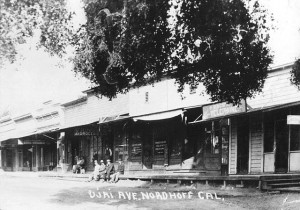
Nordhoff (now Ojai) has generally been described as a quiet, peaceful little place, and generally it was. Several oak trees strung along Main street from Tom Clark’s livery stable to Schroff’s harness shop furnished the only shade, for there was no Arcade until about 1918-19 [1917].

Waiting for the train to arrive.
The business district on the north side of Ojai Avenue (aka: Main Street) in Nordhoff, California before the Arcade was built in front of the stores.

There were three gaps in the row of buildings on the north side of Main street. One was between Lagomarsino’s saloon and Archie McDonald’s blacksmith shop at the east end of the business block, about the location of the Edison office (which recently moved), and Barrow’s hardware store stood alone. There was an alley on both the east and west side of that building, which I think was the site of the present hardware store.

Downtown Nordhoff looking east.

The east alley was used by pedestrians. I think the board sidewalk prevented vehicles going through. But the sidewalk ended at the west corner of Barrow’s hardware, so that alley was quite generally used by horsemen as well as pedestrians.

Main Street in downtown Nordhoff, California. The photo is looking west.

West of that alley was Bray’s plumbing shop, and from there on to Signal street was the livery stable with its buggy sheds, corrals and hay sheds. West of Signal on the site of the Oaks Hotel stood a small, whitewashed, clapboard building where Chet Cagnacci was born at the turn of the century and later, I believe, Tommie Clark.

1900's horse and buggy stage making its daily stop at the livery stable, now the Ojai Village Pharmacy, corner of Ojai Avenue and Signal Street.
1900s horse and buggy stage making its daily stop at the livery stable, now the Ojai Village Pharmacy, corner of Ojai Avenue and Signal Street.

Across the street about the site of Van Dyke’s Travel Agency stood Dave Raddick’s residence, then easterly a break, then the meat market. On the southwest corner of Signal and Main was The Ojai newspaper printing office where the theatre now stands and easterly across the street, where the present post office is located, was Charley Gibson’s blacksmith shop. There was quite a gap between the blacksmith shop and Lauch Orton’s plumbing shop, the barber shop and post office. Through that gap could be seen the Berry Villa, which is now the post office employee parking place.

Nordhoff Post Office at the turn of the century in downtown Nordhoff, now Ojai

A little distance east of the post office, briefly, stood C.B. Stevens little grocery store, then the entrance and exit to the Ojai Inn which is now our city park. A leaky, redwood horse trough and a hitch rail extended onto the barranca. It was always shady, and teams, horses and buggies were customarily tied there while the out of town folk did their shopping.

The Ojai Inn.
The Ojai Inn.

I once had a Plymouth Rock hen who would bring her brood through the alley between the saloon and blacksmith shop to scratch around where the horses were tied. Sometimes she would miscalculate and be overtaken by darkness, so hen and chicks would simply fly up on a vacant spot on the hitch rail and settle down for the night. Our stable and chicken coop was just back of Dr. Hirsch’s office and more than once at about bedtime, I would carry them back to their own nest.

Schroff’s harness shop east of the barranca stood high enough from the ground that one could step from a saddle horse onto the porch, which was convenient for ladies riding sidesaddle to dismount and mount.

The corner of South Montgomery and Main was open and was used mainly by Thacher boys to tie their horses while attending services at the Presbyterian church, which stood where the Chevrolet parking lot now is. That building is now the Nazarene Church on N. Montgomery and Aliso.

Presbyterian Church on southeast corner of Main & Montgomery.

I could go on and on and on with details of the village of Nordhoff at the turn of the century, but I fear that would become too boring, so will get on with some of my memories of the activities on that time.

Howard Bald at Pierpont Cottages in 1916. Notice that Bald has a holstered pistol on his waistband.

Just sniff the valley’s air to detect crisis

The following article appeared in the Wednesday, February 15, 1989 Edition of the Ojai Valley News on Page A-10. It is reprinted here with their permission.  Photos were added by the Ojai Valley Museum.  

Just sniff the valley’s air to detect crisis
by
Bob Bryan

Special to the News

Emperor Hirohito of Japan was coming to visit this country but where would we put him up for the night?

Blair House in Washington, D.C. would not do for various reasons. But there was Williamsburg, the reconstructed colonial village, where the emperor’s safety could be secured and where His Divinity could taste something of early America and its charms.

Williamsburg is a national treasure and was restored through the generosity of the Rockefeller family. Another dream American treasure, the National Gallery of Art, was brought about through the generosity of the Paul Mellon family.

On a smaller scale but with generosity of spirit to equal those millionaires, we have our Edward Drummond Libbey, who drove West with John, his chaffeur, in his Packard limousine (Libbey sat in the front seat with his driver) and fell in love with the Ojai Valley. Our park, our post office, the Arbolada, to mention only a few, are because of this man.

Edward Drummond Libbey

And now the community and the valley that Libbey fell in love with faces crisis. The word crisis is not idly used. Just check out Ojai Avenue most any hour of the day or drive to Ventura in the morning or evening. Or take a good sniff of our air on certain days. Something quite deadly is happening to our valley.

They say that a frog placed in a frying pan filled with boiling water will jump out immediately. But put the frog in a pan of unheated water and slowly but surely heat it up and the frog will not seek to escape until it’s too late.

Frog in a frying pan.

Are they turning up the air and the traffic in this frying pan of a valley? And are some of us frogs jumping before it’s too late, jumping to Oregon where, they say, the water is pure and the air clean? Or jumping to the Midwest where report has it that houses are cheaper and the neighbors friendlier?

Of course, the temptation to jump is there for all of us as our citrus orchards skyrocket in value or our homes come to represent small fortunes. (“Let’s leave, Gertrude, while we can still get through Casitas Pass.”)

Some nights, when I can’t sleep, I ponder the problem of our valley. What to do? Perhaps, we could get a present Midas, say a Donald Trump, to simply buy up the Ojai Valley and declare it off limits except to specially designated visitors who would have parking permits, like at the Getty Museum in Malibu. We natives, on designated hours, could engage in cottage industries for the benefit of the gawkers. (“Is he really writing a novel, Mummy?”)

Another idea that comes to me in the quiet reaches of the night is to bring back the old Burma Shave signs? Remember those? You probably don’t but either one of your grandparents can tell you about them. They were the literature of our youth.

The Burma Shave signs were strategically placed along the highway, where, traveling at a modest and legal forty miles per hour, they could be easily read. They rhymed and were pithy and pungent statements on a variety of subjects, all humorously presented. And with a final pitch for Burma Shave.

Example of a "Burma Shave" sign.
Example of a “Burma Shave” sign.

Here’s a “Burma Shave sign” we might place at staggered intervals along the entranceways to the Ojai Valley:

“Don’t be a frog and jump the pan; Be a pal and turn around and go home.”

Does that rhyme?

Mother Dies, Family Critically Hurt In Holiday Accident

The following article appeared on the front page of the Thursday, January 7, 1954 edition of “THE OJAI” which is now called the “Ojai Valley News”. It is reprinted here with their permission. The author is unknown. Photos have been added by the Ojai Valley Museum.

Mother Dies, Family Critically Hurt In Holiday Accident

Still on the critical list of Southland hospitals following a New Year’s Day accident which killed Mrs. Jewell T. Mashburn, 49, Ojai, are four members of her family, her son Harold, 28, his wife, Arlou, 23, and their two children, Thomas [“Thomas” is a first name, but the boy goes by his middle name, “Drew”], two, and Michael [“Michael” is incorrect;  “Mitchell’ or “Mitch” should have been used], seven months.

The head-on collision occurred on Highway 101 at Malibu when the Mashburn car traveling south struck another car going north driven by Robert Jenning, 74, Sierra Madre, which swerved across the highway into the path of the Mashburn car. The Jenning car apparently swerved to miss hitting another car which had suddenly stopped in front of it. Both Jenning and his wife were uninjured.

Mrs. Mashburn, wife of Ojai real estate broker Clyde Mashburn, was killed instantly while the family was taken to Santa Monica hospital for treatment. The Mashburn’s were enroute to visit Mrs. Mashburn’s niece in Los Angeles.

Funeral services were held Tuesday afternoon for Mrs. Mashburn at the Loma Vista chapel of the Mayr funeral home.

Born Sept. 17, 1904, in Pleasant Hope, Mo., she had been a resident of Ventura County for 25 years. Besides her husband, Clyde, she is survived by her son, Harold of Ojai; a daughter, Mrs. Betty Jean Loomis, Ojai; three brothers, Charles Teeters of Ivanhoe; Glenn Teeters of Lynwood, and Fred Teeters of Ojai; three sisters, Mrs. Nora Voris and Mrs. Verda Barton, Ivanhoe, and Mrs. Willa Buckner of Santa Paula; her father, Thomas Teeters, Ivanhoe; and two grandchildren.

Rev. Emmett Parks officiated at the services. Burial followed in Ivy Lawn cemetery.

FROM LEFT to RIGHT: Drew, Jewell, Mitch and Harold Mashburn at Jewell's (Harold's mother) S. Lomita Avenue home in Meiners Oaks. This photo was taken on the morning of New Year's Day 1954.
FROM LEFT to RIGHT: Drew, Jewell, Mitch and Harold Mashburn at Jewell’s (Harold’s mother) S. Lomita Avenue home in Meiners Oaks. This photo was taken on the morning of New Year’s Day 1954.
FROM LEFT to RIGHT: Drew, Jewell, Mitch and Arlou Mashburn sitting on the front porch of Jewell's S. Lomita Avenue home in Meiners Oaks on the morning of January 1, 1954.
FROM LEFT to RIGHT: Drew, Jewell, Mitch and Arlou Mashburn sitting on the front porch of Jewell’s S. Lomita Avenue home in Meiners Oaks on the morning of January 1, 1954.
Clyde Mashburn and his daughter-in-law, Arlou Mashburn, months after the horrific automobile accident. Notice Arlou is using crutches. This photo was taken just days after Arlou was released from the hospital. Photo taken at Clyde's S. Lomita Avenue home in Meiners Oaks in 1954 or 1955.
Clyde Mashburn and his daughter-in-law, Arlou Mashburn, months after the horrific automobile accident. Notice Arlou is using crutches. This photo was taken just days after Arlou was released from the hospital. Photo taken at Clyde’s S. Lomita Avenue home in Meiners Oaks in 1954 or 1955.

Dennis Shives His Way

This article appeared in the Fall 2017 issue of The Ojai Quarterly, and is posted here with permission. “The Art of Dennis Shives” exhibit is on view at the Ojai Valley Museum from Oct. 14, 2017 through February 25, 2018.

Dennis Shives His Way

by

Mark Lewis


For the better part of seven decades, self-taught Ojai artist Dennis Shives has followed his own path, often while going barefoot. Now, that long and winding road has led this notable free spirit to the Ojai Valley Museum, which this fall is honoring him with a career-retrospective exhibit. After forging a career on his own terms, far from the art-world limelight, Shives finally is ready for his close-up.

Shives banner 2

THE BUILDING was nondescript, an unassuming stucco affair fronting on El Roblar Drive west of Padre Juan Street in Meiners Oaks. But its display window was lit up at night, and something in it caught the eye of the artist Gayel Childress as she passed by one evening in the early 1980s.

“There was this wonderful wooden Gatling gun in the window,” she says. “I said I had to meet whoever made that.”

The creator turned out to be Dennis Shives, an artist and woodworker who used the building as his studio and the window as his gallery. Childress discovered to her delight that Shives’s hand-cranked Gatling gun actually worked, except that it fired rubber bands rather than bullets. He had crafted it a few years earlier using wood left over from another project – oak, ash, a bit of walnut – and part of a bronze light fixture he had salvaged from the Smith-Hobson House while it was being converted into Ojai’s City Hall. Childress was charmed by this whimsical, one-of-a-kind creation, and by the man who made it.

“I’ve been a fan ever since,” she says. “He really is a wonderful artist.”

That’s high praise coming from Childress, a co-founder of the Ojai Studio Artists group. Nor is she the only one who thinks so.

“A really incredible talent,” says Khaled Al-Awar, who in years past has featured the Gatling gun and other Shives pieces in his Primavera Gallery in the Arcade.

“He’s brilliant,” agrees Danna Tartaglia, who sells Shives prints, and framed photographs of his “Making Faces” rock art, in her Tartaglia Fine Arts gallery. “He’s an original – maybe the original Ojai artist.”

But Tartaglia and Al-Awar agree that Shives is not the easiest artist to represent, because of his unconventional attitude toward his career. He insists on asking dauntingly major-league prices for his major pieces, in part because of all the work he puts into making them, and in part because he seems too attached to his creations to let them go.

Partly as a result, Shives has struggled all his life to make a decent living, and to win wide recognition in the art world. Nevertheless, he has remained true to his chosen vocation. And now, on the eve of his 70th birthday, the spotlight finally has found him, in the form of a career-retrospective exhibit opening Oct. 14 at the Ojai Valley Museum. Which prompts the question: After a lifetime of wandering in the wilderness, is Dennis Shives ready for the red carpet?

"The Art of Dennis Shives" at the Ojai Valley Museum.
“The Art of Dennis Shives” at the Ojai Valley Museum.

BORN in Santa Paula in 1947, Shives mostly grew up in Ojai’s Upper Valley, where he attended the Summit School. Later he attended Matilija Junior High and Santa Paula High, from which he graduated in 1965. As a child he was drawn to art, due in part to encouragement from his maternal grandmother, a talented amateur painter.

“I always knew I would be an artist,” he says.

But he hated the art classes he took in high school and at Ventura College. There were too many rules about how to make art, and too much emphasis on how to make a living from it.

“I really didn’t learn anything in school,” he says. “So actually I’m self taught.”

The point of art classes, as Dennis saw it, was to tame the wildly creative urges that welled up within him, and channel them in approved directions. He declined to submit. He was a classic case of the child who refuses to color inside the lines.

“They are trying as hard as they can to kill that thing within you,” he says. “You’re supposed to be who you are. People need to do what they need to do, instead of sitting and copying other people.”

Despite his interest in the visual arts, the first career he pursued that of a musician. A true child of the ‘60s, Shives grew his hair long and tried his hand at rock ‘n’ roll, playing harmonica and singing with the Ojai All Stars, the house band at a rowdy, rough-and-tumble dive called the Ojai Club (located where Ojai Pizza is today). This was a fraught period when the local flower children and the local rednecks were frequently at odds.

“We were the hippies and they were the alcoholics,” Shives says. “This was a drunk cowboy town. There was a brawl every Saturday night.”

The All Stars’ lineup also included local guitar legend John Orvis, along with the brothers Norman and Curtis Lowe and others.

“We had a great time,” Shives says. “But then I switched into the arts.”

He took up woodworking, sculpture, painting, and whatever else intrigued him. He was a craftsman too, creating gold and silver jewelry, custom-carved rifles, exoticlooking furniture, even a house in Alaska for his Ojai friend Jack Estil. He never worried about not being formally trained. He just plunged in, and figured it out for himself.

“What the process is all about is learning not to be afraid,” he says. “Fear is the biggest killer of creativity.”

His longtime friend Sergio Aragones, the famous Mad Magazine artist, admires Shives’s extraordinary versatility.

“He’s the true Renaissance man,” Aragones says. “He’s a man who can do everything – and well! He has spent his life perfecting every craft.”

And to what end? To amuse himself, and other people, by telling stories that make everyone smile. There is an implied narrative embedded in most Shives pieces, whether it’s a painting of snails in a garden eating a flower, or a carved-wood door featuring a charging rhinoceros, or a soapstone sculpture of an octopus going for a walk.

“It was the storytelling process that I was interested in,” he says. “You’re playing with the story. It’s a way of entertaining people.”

When Shives turned his hand to creating parade floats, he entertained the entire town. People in Ojai still talk about the one he and his friend Rick DeRamus came up with in 1984, the year the Los Angeles Summer Olympics held rowing events at Lake Casitas. Shives’s float for that year’s Fourth of July parade was inspired by the legend of Old Hoover, the monster-sized largemouth bass said to lurk in the Casitas depths, too wily for any angler to hook.

“All the local kids dressed up as minnows and frogs,” he says, “and we chased ‘em down the street with the fish.”

The first Old Hoover float in Ojai's 1984 Independence Day Parade.
The first Old Hoover float in Ojai’s 1984 Independence Day Parade.

For the 1986 parade, Shives and DeRamus constructed an even more elaborate version of Old Hoover. This second mechanized fish float was 40 feet long, 10 feet wide and 14 feet high, with a tail that wagged, gills that emitted air bubbles, and a huge mouth that swung open and shut as the bass pursued a man in a frog costume riding a bicycle along Ojai Avenue.

This was classic Shives: He put in seven months, uncompensated, to create Old Hoover II, then spent his last $5 on gas so he could drive it in the parade. People loved the float, of course, but they didn’t pay anything to see it.

“I never did anything that made me money,” he says. “I just barely scraped by.”

That period in the early ‘80s when he had the building on West El Roblar Drive was an anomaly. Generally, Shives has made his art in borrowed spaces, or at home. These days his studio is the house on Willow Street he shares with his life partner, the acupuncture provider Laurie Edgcomb. Here, Shives is surrounded by his sculptures, paintings, carved masks, bubble-blowing devices and fanciful furniture pieces. Many have attracted the attention of collectors, but Shives seems reluctant to part with them.

“Making art is completely different from making money,” he says. “I’m not doing this to sell stuff. I’m doing this because it makes me want to get up in the morning.”

On the other hand, he concedes, “You need to make a living.”

Indeed, and making a living as a working artist poses enormous challenges. Those who succeed usually find that they must put as much time and energy into marketing their art as they do into creating it.

“I guess you have to go out and seek it and chase it down,” Shives says, with a noticeable lack of enthusiasm. He’d much rather drive his ancient Volkswagen van out to the East End, take off his shoes, and go for a walk in Horn Canyon.

Shives is not averse to making a buck or two, if he can do it his way. He sells hand-carved wooden walking sticks, baby spoons and magic wands (a Shives specialty). He also sells copies of his charming 2014 book, “True Stories To Be Read Aloud,” a collection of autobiographical stories. (A follow-up collection is due out this fall.) And, while he seems reluctant to sell his paintings, he happily sells prints of them at Danna Tartaglia’s gallery. She says they are popular choices with visitors looking for something Ojai-esque to take home with them – such as “Smudgepot Bears,” featuring merry ursine revelers cavorting in an orchard on a cold winter’s night, with Chief Peak providing the backdrop.

The Smudging Bears by Dennis Shives.

“I’m not sure what success is,” Shives says. “I do what I do, and feel pretty successful in my own little realm.”

Case in point: Shives is spectacularly successful at sand sculpture. He has a shelf full of first-place trophies won at contests held at Cayucos Beach and elsewhere. This probably is the art form for which he is best known outside of Ojai, but these are things he cannot sell – and that’s partly what attracted him to sand sculpting in the first place. He creates a large-scale piece in a few hours, takes a photograph, and walks away.

“If these things last the afternoon, they’re lucky,” he says. “Nothing lasts forever.

Dennis Shives and MAD Magazine cartoonist Sergio Aragones in a sand sculpture car by Shives.

SHIVES is a familiar sight in Ojai: tall and tanned with long white hair, a flowing beard and a gentle smile, he favors khaki work shirts and cargo shorts, and gives the impression that he has never owned a pair of socks. If you want to walk a mile in his moccasins, you’ll have to do it barefoot, for when Shives hits the trail in the Los Padres National Forest he does it sans shoes.

“For two years, I took every Wednesday off and walked with him,” Khaled Al-Awar says. “This man has an incredible knowledge about nature.”

Roger Conrad of the Ojai Valley Museum says that Shives’s art is powerfully informed by his strongly felt connection with the natural world.

“His vision is derived from nature with childlike enthusiasm to see, touch, and create vivid experiences for himself and those that interact with his art,” Conrad says. “Whimsy is his language to find the spiritual in all living things. His message is that the lives of all creatures matter.”

“Whimsical” is a word often applied to Shives, and it’s not one that connotes serious artistic purpose in today’s high-powered art world. Untutored artists like Shives who lack academic credentials often are pigeonholed as outsider artists or folk artists. But Gayel Childress says Shives falls into none of these categories.

“I love outsider art, but his is quite sophisticated,” she says. “He has that outsider spirit, but his art is certainly not naïve. I don’t think there’s a term for Dennis. He’s one of a kind – part inventor, part engineer, part dreamer, part carpenter, part painter. Little touches of everything.”

Conrad, who is helping to organize the museum’s upcoming Shives exhibit, is similarly unwilling to hang a label on this unique artist.

“His art defies categorization,” Conrad says. “Some of his work seems primitive but other works display the hand of a seasoned artist. He pleases himself and dismisses being labeled. Above all else his art is enchanting and fun.”

The museum exhibit is a big deal for Shives, and his friends and supporters are thrilled for him.

“It’s his time,” Childress says. “I really want everyone to see this show. I want everybody in Ojai to know about him. I just want to see him honored because he surely deserves it.”

“It’s about time,” Aragones says. “He deserves it because of the variety of his art.”

To be clear, Shives had not exactly spent the past few decades hiding his light under a bushel. He creates his strikingly original artworks and steampunkish devices, and puts them out there. He writes and publishes his stories and reads them aloud to audiences. He paints frogs and other fanciful figures on classroom walls at the Monica Ros School. He shapes his sand sculptures for all the beach-going world to enjoy, if only for an afternoon. And everyone who drives along Ojai Avenue through the center of town has seen his work – he crafted the replacement lion’s face for the Pergola water fountain, after the original deteriorated.

Shives also provided facelifts for the stone lions at the entrance to Foster Park, and he designed the life-size sleeping bear that reposes near the front door of the Ojai Valley Museum (one of his “Specialty Monuments” for Rodger Embury’s Rock & Water Creations).

Bear sculpture in the museum's front courtyard.
Bear sculpture in the museum’s front courtyard.

“The most important part of the whole thing is to stay an artist,” he says. “Most of the people I know who went to art school don’t do art anymore.”

Remaining an artist allows Shives to wake up in the morning knowing that he will spend the day doing what he wants to do, and being who he is. “Then I feel as good as I can feel.”

Shives is pleased about the upcoming exhibit in part because he hopes to inspire other would-be artists to follow their own paths, as he did.

“What you’re doing is inventing your life,” he says. “Anyone can do this if they really wanted to. You sit down and figure out how to do it. But most people are too smart for that. They go for the money.”

Not Dennis Shives. He chose freedom instead. He’s happy with the way things have worked out for him, and he thinks more people should make the same choice, so that they “can have a great life too.”

“I had a wonderful time,” he says. “I really did.”

Clowns, Weight Lifters Shine at Aliso Street Kids Circus

The following article was run in the March 12, 1959 “The Ojai Valley News”. It is reprinted here with their permission.

Clowns, Weight Lifters Shine at Aliso Street Kids Circus
by Arlou Mashburn

COMPLETE WITH A STRONG MAN, clowns, tight rope walker and puppeteers, a one-ring circus was presented by four for the younger set on Aliso street Saturday afternoon. Shown above, the kids guessing how many marbles are in the jar.

“Ladeez and gentlemen! We are proud to present the ‘East Aliso Street Circus’ “.

With that shouted salutation, a seven-year-old’s excited voice announced to an audience numbering approximately 30 persons a combination circus-puppet show planned and staged by seven neighborhood youngsters aged four to eight years old.

Prompted by the John A. Strong Circus which was recently presented in Ojai, the backyard performers utilized several acts they had seen the professional clowns and circus folk present.

Also benefiting from more experienced show people’s talents, the young puppeteers had borrowed a number of ideas from the puppet show recently held in the valley which the Ojai Festivals sponsored.

Spirits exalted by the carnival atmosphere, many youthful observers suddenly found themselves “carried away” and in front of what remained of the audience. It was rather difficult to determine at times who was “audience” and who was “show”.

Recorded music offered background atmosphere. Due to lack of calliope selections, such songs as, “Doggy in the Window” and “Davy Crockett” from the limited record collections of the children participating sufficed. As the energetic performers grew more and more enthusiastic…and of course, noisier…the music was dispensed with entirely since it was inaudible anyway.

PRIZES

Audience participation was rewarding materialistically as well as self-satisfactorily with balloons awarded as prizes. Young Blaise Castren, who journeyed three blocks with his younger brother, Chad, to attend the Saturday afternoon affair, was winner of the marble-guessing game.

Paying one penny to guess how many marbles were in a jar proved to be one of the most popular events of the day. Six-year old Donna Phillips was in charge of the money-making game.

STRONG MAN

“Strong Man” Clark “Corky” Davis, 4, amazed all with his astonishing strength when he hoisted a 500 pound barbell above his head not once, twice, but ten times! “Muscles” fashioned from inflated balloons inserted in his shirt sleeves, were eagerly touched by “Corky’s” many admirers… at no extra cost.

Mark Phillips’ over-sized tennis shoes, worn for his role as the hobo clown portrayed by Emmett Kelly, became entangled with the spurs worn by animal-trainer, Mark Kingsbury. Although the stunt was completely unrehearsed, it brought forth chuckles from the exuberant crowd of onlookers.

Pretty Kathy Nickerson, bedecked with earrings, lipstick, and flowers in her tresses, offered the glamorous touch necessary to all circuses. She won great applause as she daintily tiptoed across the “tight rope” (which instead of being suspended in the air was placed on more substantial territory, the ground in this case), balancing a parasol above her head.

Kathy’s brother, Danny, the oldest member of the troupe, was the unsung hero of the day as the behind-the-scenes worker, generally known in the circus world as a “roustabout”. Always there when he was needed, eight-year-old Danny arranged seats for the customers, carried refreshments to the pop-corn-punch-and-cookies table, and aided in the clean-up following the showing.

With poster paint on his face, Greg Davis was barely recognizable. But the make-up was all it took to throw the first-grader into the role of a clown, costume or no costume. His antics amused all.

INSTIGATOR

Instigator of the planned-for-a-week-in-advance adventure was Drew Mashburn, in whose backyard the one-ring circus was held. Drew, due to the unexpected absence of two members of the troupe, Sandy and Mike Payton, found himself a true showman, living up to the old adage, “The show must go on”, as he not only acted as puppeteer but as ringmaster and ticket-taker as well.

Drew’s younger brother, Mitch, a kindergartner, learned to his dismay upon donning a long-cherished pirate costume he had worn with great pride on previous Halloweens, that circuses do not have pirates. So, relinquishing his part in the show, Mitch appointed himself chief-cookie-passer-outer. His enthusiasm was again thwarted when he was told that the refreshments were not free, but were to be sold at the close to the show. He then resigned himself to the fact that he was not the circus type, and became a member of the audience.

Perhaps the amateurish efforts of the youthful troupe would win no blue ribbons, but in the hearts of the mothers who watched the eyes of their youngsters sparkle as they talked about the anticipated “Big Day”, and as they listened to the squealing voices of these same kids as they presented the hour-long show, there is no prize worthy enough for the memories they will all cherish from now on.

And what makes the parents even prouder is that the children, themselves, decided from the beginning that the money earned from the circus would be given to some deserving charity, rather than be kept for themselves. And they say youngsters of today will grown up to be unfit adults!

Contributions needed — Museum set for expansion

The following article first appeared in the December 20, 1967 edition of the Ojai Valley News on its front page.  It is reprinted here with their permission.

Contributions needed
Museum set for expansion
by
Mel Remsburg

The Ojai Valley Museum brings to a close, at the end of this month, its first year of service to the valley. The future looks even brighter, with expansion as the goal for the 1968 year.

This week, officers and directors launched the museum’s contribution membership drive, which is expected to finance the operation in the coming year. The proposed budget for the next 12 months is $2,638. Last year’s expenses were about $200 less.

Fund chairman A. C. Dahlgren announced that membership applications may be obtained by writing to the Ojai Valley Museum, 841 E. Ojai ave., Ojai. Many of the applications have already been sent to prospective members and to those who participated in its founding.

Also sent to charter members and now available to interested persons is the museum’s 1967 yearbook, telling of the expansion ahead and the services offered the public by the museum.

The expansion program provides for the removal of the existing wall at the museum, to open up the rear room for additional displays. The project, including construction of new partitions, painting, and tile floor, is expected to cost $375, with voluntary labor.

New display cases are also planned, including those of subdued lighting for the expanded area. Cost is estimated at $725.

In addition to these plans for improvement of display facilities, the museum is interested in two other phases of development. The first is the broadening of its function to include an historical association, with the museum acting as a display facility and storehouse for records, artifacts, and other material. The museum officers are also planning for the organization of a Junior Museum for the benefit of the youth in the Ojai and Cuyama valleys.

OJAI VALLEY MUSEUM --- The museum has completed its first year of operation and is now seeking contribution-memberships to help finance its proposed growth and expansion. Connie Davis, the new assistant to Chamber secretary-manage Betty Fielder, examines an antique stove, one of the many historical items that have been donated to the museum.
OJAI VALLEY MUSEUM — The museum has completed its first year of operation and is now seeking contribution-memberships to help finance its proposed growth and expansion. Connie Davis, the new assistant to Chamber secretary-manager Betty Fielder, examines an antique stove, one of the many historical items that have been donated to the museum.

This proposal was made at the time of formation but the directors have been without the guidance and assistance of individuals who could successfully plan and conclude such a function. Directors invite the assistance of individuals who would pursue either of these plans.

Robert O. Browne, museum president, said, “Generous contribution – memberships have made this a successful year. We solicit your membership or renewal in order to continue the operation of the museum in the years ahead.”

“Your museum is sustained only by the financial and physical help of civic minded individuals in the community. With your support the museum will grow and continue to provide the only existing local depository for items of historical significance in our community and for the documentation of history of this area. The Ojai Valley Museum, Inc. is organized as and educational, charitable institution. Contributions made are deductible by donors; bequests, legacies, transfers or gifts are deductible for federal estate and gift tax purposes,” the president revealed.
On Nov. 14, 1966 the Ojai Valley Museum was born. John Shea chaired the first meeting on that date. Committees were appointed to formulate by-laws and articles of incorporation.

Its purpose was fourfold;
1) To establish a museum in the valley.
2) To encourage study and research in the field of California’s history with special emphasis on the Ojai and Cuyama valley, to collect historical material including manuscripts, documents, books, pictures and artifacts and make them available for study.
3) To restore and preserve landmarks and sites of historical value in the valley.
4) To cooperate with the other organizations doing work of a related nature.

Two open meetings were then scheduled and the public was invited. The flame began to burn brighter and in March, 1967, the first annual meeting was held, Officers and directors were elected and plans for the displays were formulated.

On April 18, the official opening exercises were held. Assemblyman Ken MacDonald and Supervisor Ralph “Hoot” Bennett were among the 200 visitors.

The directors are indebted to the many individuals who provided the funds for this first year of operation and to the many craftsmen who supplied the labor and materials without cost.

The museum is in a sublease agreement with the Ojai Valley Chamber of Commerce. The chamber not only provides for keeping the museum open during the week, but also shared in the expense of the operation. A review of the budget discloses that the financial help which the museum can seek for 1968 amounts to $2,638 or approximately $7.25 per day.

Officers of the museum are R. O. Browne, president; B. A. Lawrence, secretary; A. C. Dahlgren, treasurer. Directors include Effie Skelton, Tyrus Kahman, Lois Powers, William Magill and Elizabeth Thacher.

Judge held court under an oak tree

This article first appeared in the January 7, 1970 edition of the Ojai Valley News. It is reprinted here with their permission.  The photo of the elderly Judge McKee was run with the article when it appeared in the 01/07/1970 edition of the Ojai Valley News.  

Judge held court under an oak tree
by
Ed Wenig

It was in the eventful year of 1887 that James McKee, Civil War veteran, one-time school teacher, and Indiana judge, came to the Ojai Valley, expecting to regain his health in idyllic rural surroundings. The solid citizens of the community elected the frail, scholary man to be their Justice of the peace, a post which he continued to hold until his death in 1904.

It was no easy task to be a judge in pioneer days in the Ojai, when everyone knew everybody else.

One particularly knotty problem arose in the nineties when 13 exuberant men and a few boys got into trouble with the law by carrying out the old pioneer custom of surprising a newly-wed couple in the middle of the night with a “shivaree.” This consisted of surrounding the home and shooting blasts from a shotgun in the air, accompanied by unearthly yells and other noise-making. This traditional expression of good will was not appreciated by the newlyweds. In fact, they swore out complaints against all the thirteen, charging them with disturbing the peace and illegal entry.

It ended well

One by one each of the 13 went to Judge McKee and pled “Not Guilty.” It is said that one of the first to arrive was Bob Clark who later became a U. S. Marshal.  John Thompson, at boy at the time, and one of the indicated, recalled being taken to Judge McKee by his father and waiting outside the Judge’s home in fear and trembling, while his father and Judge McKee had a long and friendly talk.

A Ventura lawyer, Judge Shepard, was engaged to defend all the accused. In the meantime, a large group of women in the valley planned a big dinner and social evening in anticipation of the celebration of the acquittal of all. But when the district attorney examined the evidence and circumstances, and refused to prosecute, the ladies cancelled their plans. It all ended happily for the defendants, each paying $1.75 apiece as his portion of the lawyer’s fees.

According to all who remember him, Judge McKee was a very devout and kindly man, always ready to help those who went to him for advice or for assistance in drawing up legal documents. The story is that he once risked his life to ride horseback through the swollen river to Matilija to draw up a will for a dying man.

Most of the time Judge McKee tried cases in his own home, but on warm summer days, he sometimes moved his court into his yard under a big oak tree.

Judge James McKee Photo from the Ojai Valley News

Judge McKee’s daughter, Mrs. Emily Courtney, now lives in Ventura. His granddaughter, Mrs. Catherine Craig, formerly postmaster of Ojai, lives in the Ojai Valley.