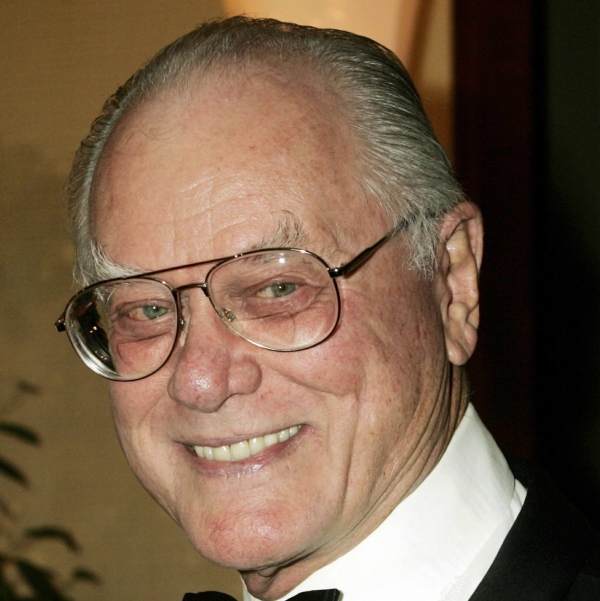
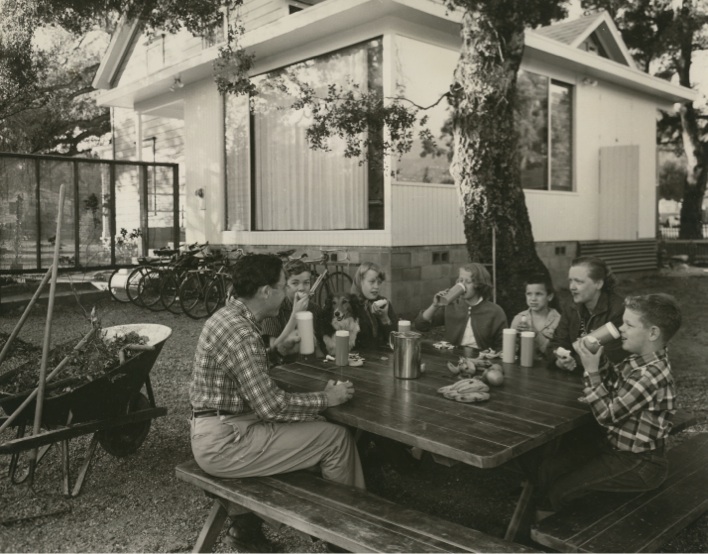
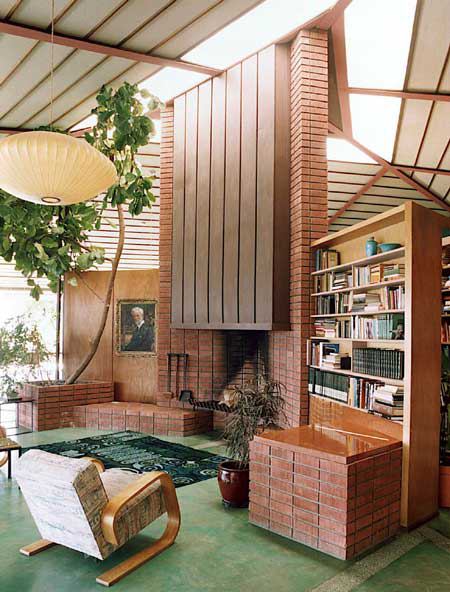
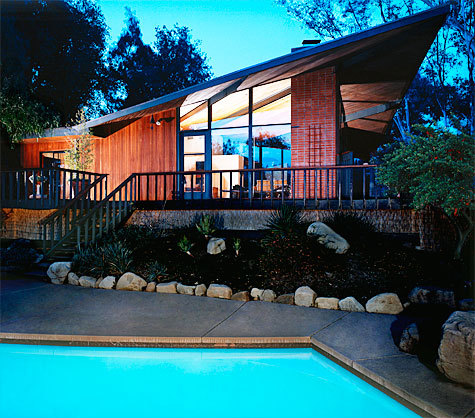
Larry and his wonderfully cheerful wife Maj were long-time friends and protectors of Ojai. They opened-up their grand home “Heaven” on the top of Sulfur Mountain, on countless occasions in support of issues and candidates that might benefit the Ojai Valley.
One of those events quietly yet strategically may have played a vital role in the defeat of Waste Management’s attempt to develop one of the largest landfills west of the Mississippi at the southern entrance to the Ojai Valley’s air-shed at Weldon Canyon.
With just a couple of weeks before the Ventura County Board of Supervisors would vote whether or not to approve the ruinous, polluting boondoggle Larry and Maj hatched a plan: They would host a simple, casual lunch “outside on their home’s patio” for the five County Supervisors who would soon cast their votes whether to approve the Weldon Dump project.
Besides the delicious, classy food and wine, Larry arranged for five tripod-mounted, powerful-military-grade binoculars to be assembled and locked into place, all facing south. At the appointed time he invited each of the County Supervisors to stroll over to take a look out from these binoculars.
As they gazed through the powerful magnification Larry explained that besides the spectacular views of
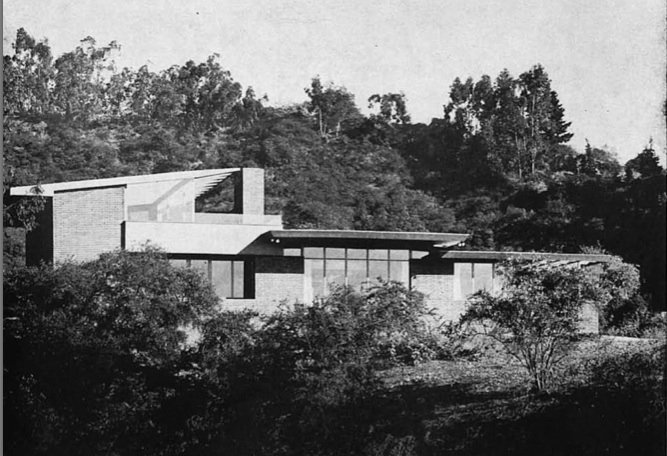
Larry Hagman’s house on Sulphur Mountain Road
the southern slope of Sulphur Mountain, the Ventura Beaches, the blue Pacific and the Channel Islands floating in the distance, that just a few miles away (as the crow flies) was Weldon Canyon. In fact, that’s where the binoculars had been focussed on.
Larry shared that given that he and Maj owned perhaps one of the largest parcels of property in Ventura County “with a considerable annual property tax assessment” he felt as if the proposed Weldon Dump would basically destroy their home’s value and adversely affect the healthy and welfare of anyone breathing the air around there, as well as most of the Ojai Valley given that daily prevailing breezes would carry tons of particulate matter annually into the Ojai Valley’s air-shed.
It must have made an impression: On the eve of the Supervisor’s vote a few weeks later Waste Management withdrew their application when they realized that they simply did not have the votes for approval. However, that didn’t yet stop them: Waste Management then decided to make an end-run around the administrative process and try getting the horrid dump proposal approved in a County-wide ballot initiative with millions of dollars to pay political consultants and lawyers to wage the campaign.
Larry and Maj once again stepped-up to the plate and hosted an intimate yet spectacular benefit concert with Kenny Loggins, David Crosby, Chris Hillman (of the Byrds) and Bernie Leadon (of the Eagles) performing in their living room. The proceeds from the concert helped kick-off the Dump Weldon Coalition’s own campaign to defeat Waste Management at the polls a year later.
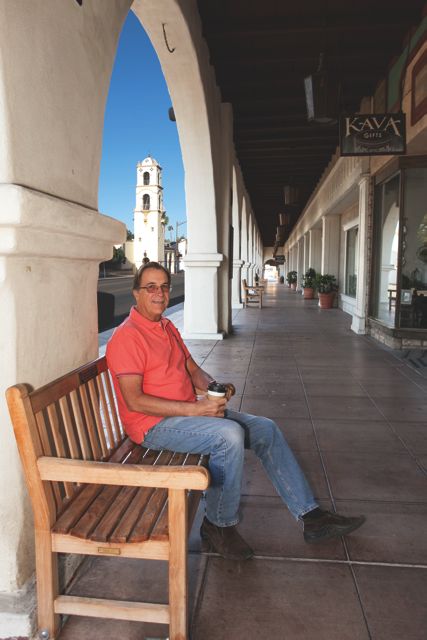
Years later when I’d just returned from my first of many end-of-summer journey’s to Burning Man I bumped into Larry at Ojai’s downtown arcade and shared some of my experiences of my first venture at Burning Man. I recall pointing out to him that he had the most perfect Burning Man home in his spectacularly restored minted Airstream RV which I’d seen years earlier.
I must have planted the seed, for a year later, as I was riding my bike around Blackrock City (Burning Man is held on the great Blackrock Desert Wilderness and is highly organized into a bone fide “city”) I accidentally rode past a most wonderful sight: Larry Hagman, adorned in a kaftan and turban and holding court outside his vintage airstream designed like part of the set from I Dreamed of Jeannie, right there at Burning Man!
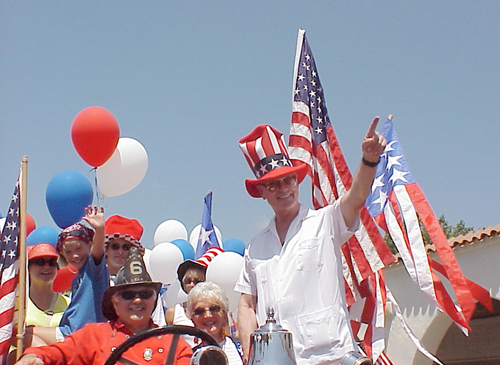
Larry Hagman in the Ojai July 4th Parade.
Larry is best remembered by me as an older man who had never allowed his ‘inner child’ to depart from his being! Those of who had the change to interact with Larry and Maj will surely miss them and those exciting days frolicking with them in “Heaven” right here on earth!
Civic Improvement Ojai, California
How an Old, Uninteresting Town Was Made Beautiful
By FREDERICK JENNINGS
Architect & Engineer August, 1919
LESS than three years ago what is now the quaint mission village of Ojai, California, was a ramshackle old town called Nordhoff in a mountain pocket forty miles south of Santa Barbara. It was an eyesore to the owners of the beautiful estates in the vicinity, and one of the owners, Mr. Edward D. Libbey, undertook to remedy the evil. His hopes for the town’s rehabilitation were grounded in a belief in the psychological effect of good clothes, translated in terms of architecture.
It happened that all of the stores stood on one side of the street, and Mr. Libbey’s first step was to purchase ten acres of ground on the other side, which included a number of dilapidated old shacks. This accomplished, the task of beautification was begun. The old buildings were torn down and in their place appeared a garden and tennis courts. A grandstand was erected, and along the edge of the park which fronted the street was built a Spanish pergola. But before this work was completed it began to be borne in upon the store keepers that their buildings looked disreputable in contrast, and at the psychological moment Mr. Libbey proposed that he would give them the park and tennis courts, and a new post office building, if they would join together and freshen up the appearance of their store buildings. The offer was accepted and Mr. Libbey thereupon engaged the services of Messrs. Mead and Requa, architects of San Diego, to plan a new business thoroughfare for the town. It was discovered that by a slight expenditure on the part of each store owner, a uniform front could he built on all the stores. So the workmen were called in and the task was begun. The store buildings themselves were not disturbed, but an arcaded plaster front was built on all of them. The transformation was complete. Each store owner put up a few hundred dollars, and in return became the possessor of a building enhanced in value and beauty beyond all proportion to the amount of money spent.
But the idea which created the transformation, the idea of giving a man good clothes and seeing him live up to them, did not stop there. Ojai’s fame as a village has spread. Committees of citizens have visited it from various places in the state, and already half a dozen small villages are planning to do what Ojai has done.
Writing of civic improvements in general and the Ojai community in particular, Mr. Richard S. Requa says:
“A great deal of attention has been given during recent years to the matter of Civic Improvements. Volumes have been written on the subject, committees and conventions have frequently met for its discussion, and almost every progressive American city has either its city planning commission or has under consideration plans prepared by authorities on city planning and beautification.
“In almost every instance, however, the larger cities only have agitated or attempted plans or work along these lines.
“The village or small town has received slight encouragement and has shown little disposition to initiate the movement. This is not because the resident of small communities does not appreciate or enjoy well-planned and beautiful surroundings, but because the expense entailed is usually considered far beyond the amount they could raise for such purposes. The small town is usually burdened to the breaking point providing funds for the erection and maintenance of schools, fire stations and other administrative and public buildings. In a large majority of cases, however, a careful study of the situation would demonstrate that a great deal could he done in the way of unifying and transforming the ugly and jarring elements of a village street into a harmonious and pleasing group at a cost no greater than would be necessary to remodel and modernize the individual store fronts. Public service corporations, banks, realtv firms and other firms and individuals interested in the growth and development of the community will be found most willing to contribute to the undertaking.
“So far as I know, the credit for initiating the movement for small town improvements should be given the village of Ojai (formerly Nordhoff) in the Ojai Valley, Ventura County, California. This community is so small it is not incorporated, has no local government and no means of raising money except by voluntary contributions. Fortunately it is most favorably situated in a beautiful valley at the terminus of a concrete highway, fifteen miles from the sea and the city of Ventura. Lofty and picturesque mountains hem it in on all sides and nature has embellished it with running brooks, giant oaks and semi-tropical flora. The only discordant note in the valley, the one blot on the landscape, was the business section of the village, a collection of nondescript and ramshackle buildings with ugly metal awnings, disjointed sidewalks and crude, staring signs. A partially wrecked livery stable and a dilapidated blacksmith shop occupied the two most prominent corners of the town.
“Mr. E. D. Libbey of Toledo, Ohio, a winter resident of the valley, possessed the foresight and imagination to realize the possibilities of unifying and beautifying the conglomeration at a surprisingly small expense compared with the result obtained, fie appealed to the public-spirited residents and property owners to aid in the undertaking and by way of encouragement proposed to buy and deed to the community a beautiful tract of ten acres (an old hotel site) in the center of the business section, as a civic and recreation center and also to erect a post office on the site. The appeal met with instant cooperation and success. Each shop owner agreed to pay a certain pro-rata share of the expense, and the balance of the amount required for the improvements was contributed by property owners and business interests in the valley.
“The Spanish Colonial, or the so-called Mission style was decided upon as the logical and best adapted treatment for the regeneration. Within three months after the idea was proposed, the money was raised, the plans were completed and the actual work commenced. The construction is fireproof and permanent; hollow tile, reinforced concrete and stucco being the materials used.
“The local benefits, however, are insignificant compared with the example set and the incentive given other towns to improve and beautify their surroundings.”
In designing and planning the village hotel or tavern for Ojai, the special problems to be given careful and special consideration and study were: a building thoroughly modern and up to date and meeting the requirements of the discriminating traveler; a plan and arrangement that will furnish suitable accommodations “for the commercial man, the casual visitor and the tourist, and also provide a pleasant, restful home for the guest who desires to extend his sojourn over weeks or months; a structure that will be sunny, warm and comfortable during the cool days of winter and also be cool, airy and restful during the heat of summer; a’ design conforming and harmonizing with the present civic improvements, of which it forms a part ; and providing by means of treillage, pergolas and broad, plain wall surfaces the greatest facility for the growth and development of the vines, plants and shrubs so essential for maintaining the verdant charm and country atmosphere of the village.
Before the plans were started, the most successful Southern California hotels were visited and hotel men of experience and authority were consulted, and the practical knowledge thus gained was used in developing a plan which meets in the highest degree possible, in a building of its modest size and cost, the needs and desires of the traveling public.
The very essential matters of light, heat, ventilation and view were carefully considered and adequately worked out. A large, comfortable, homelike lobby and out-door sitting room have been provided to tempt the guest to prolong his stay. The dining room has been made especially airy and attractive. The two sides of the room facing east and south are practically all glass, looking out upon an interesting California garden and commanding a most fortunate view of the post office tower, the park, the pergolas and arcades of the main street and the wooded hills beyond. The entire east side opens, by means of French windows, onto a generous pergola-covered terrace, shaded and sheltered by a large spreading live oak.
The building and the enclosing garden walls have been designed in the spirit of the early Spanish Colonial and California Mission architecture to fit into and form a part of the already completed civic improvement scheme. The main features are the plain, modeled, plastered wall surfaces, dull varicolored roofing tiles; quaint, overhanging balconies, interesting window lattices and grilles and rustic log-covered pergolas, all so reminiscent of the early Spanish inhabitants and fitting so harmoniously into its semi-tropical environment. A simple, vet imposing Mission arch breaks and relieves the straight lines of the enclosing garden walls and serves as the main entrance to the grounds and the tavern.
The Transformation of Ojai, by Richard Requa
San Diego Union 1925
One morning in early spring, some 10 years ago, two men were sitting on the edge of a raised rough plank sidewalk in front of a dilapidated shack.
A remnant of a sign over the battered, creaking door informed the curious visitor in letters hardly legible, that hte shanty housoed the Nordhoff postoffice. It was but one of a group of decaying structures that formed the business center of a small community all but hidden among the trees of a magnificent grove of liveoaks in one of the most picturesque of California’s foothill valleys.
Few people outside of Ventura county had ever heard of this beautiful little valley whose quaint name, Ojai, meaning nest, was given it by its original inhabitants, the Indians.
PROJECT PRACTICAL
The two men were E. D. Libbey, glass manufacturer of Toledo, and his life-long friend, H.t. Sinclair. Both had found the valley quite by accident and had become so impressed and charmed with its beauty, they built winter homes there.
Seated on the plank walk they were silently contemplating the row of ramshackle shops across the road. On one corner was a livery stable in advanced stages of decay, and opposite stood the remains of the village blacksmith shop, both reminiscent of the days of horse-drawn vehicles. Suddently Mr. Libbey turned to his companion and remarked that he would like to do something for the community, something original and worthwhile.
“Why not make it over into a quaint Spanish town, in the spirit of the early California and Mexican settlements,” replied his friend. “A splendid idea,” rejoined Mr. Libbey.
In response to a telegram, I appeared on the scene the next day, and the feasibility of the scheme was discussed. After several days of study and sketching, the project was found to be entirely practicable and in addition, the transformation could be made at a surprisingly small cost considering results attainable. All but a few of the store buildings occupied one side of the main street and extended some 500 feet in almost a continuous line. The opposite side was given over largely to a spacious grove of oaks and sycamores in which stood the ruins of the old village hotel.
CRITICS OVERRULED
Mr. Libbey agreed to purchase this site and dedicate it to the community as a public park in addition to erecting a new postoffice and otherwise improving that side of the street, providlng the property owners in the valley would raise funds sufficient to make over the store buildings.
His generous offer was eagerly accepted and in less than a month the obscure village was a scene of boom-like activity.
On the site of the stable rapidly rose the walls of a modern garage, while the blacksmith shop gave way to the new postoffice with its picturesque Spanish tower. The stores were relieved of their ornate cornices, iron awnings and other incongruous embellishments, and brought into harmony and unity by means of the familiar Spanish arcades.
Six months from the date of its inception the wonder had been wrought and the transformation was complete. Brick, tile, concrete and wood, fashioned into arches, dressed and aged with stained warm-toned stucco had performed the modern miracle.
Critics and skeptics who had dubbed the venture an impractical, idealistic dream were soon to realize the error of their predictions. Hardly had the work been finished when the county of Ventura voted bonds to build at great expense a concrete highway into this mountain valley. The fame of this novel and worthy achievement spread with gratifying rapidity.
Newspapers and magazines pictured and extolled its charms and beauty. Even writers of popular fiction referred to it in their romantic tales.
FAVORABLE ADVERTISING
As an inevitable result of such favorable advertising many visitors became property owners in the valley, materially stimulating and raising the values of real estate. Men of wealth have purchased estates and established winter residences there. The steady gain in population has been marked with increasing building activities. The majority of the new homes are fine examples of California architecture, designed to harmonize with the civic improvements. Lately a country club and golf course, one of the finest in America, has been added to the many recent attractions.
So successful has been this experiment of enhancing the natural advantages and beauty of a community with consistent and harmonious architectural development that the neighboring city of Santa Barbara has created a civic center designed in similar spirit of the early American ranchos.
This plucky, far-sighted and public-spirited little city is carry on a campaign of popular architectural education that is producing splendid results.
The reconstruction of their business street, made necessary by the earthquakes, is being done as far as possible in the harmonious architectural style of the civic center. Santa Barbara bids fair to emerge from her recent disaster one of the most interesting, picturesque and architecturally beautiful of American cities.
Almost at the threshold of the city of San Diego a most unique, ambitious, and successful and development project has been quietly under way for some two years. Ushered in without brass bands, tent meetings or other spectacular stunts and accomplishments, the work has gone steadily forward along a definite and practical though strikingly original, plan.
DREAMS REALIZED
Greatly impressed with the success of the Ojai venture, the Santa Fe Railway company decided to attempt an even more novel and educational experiment in developing their extensive properties, an original Spanish grant, located some seven miles northeast of Del Mar.
Starting with a clean canvas, they determined to create there a business and civic center in the material form as well as the spirit of the early Spanish American ranchos. The surrounding property, some 900 acres, would be divided into small ranch tracts, served by an excellent system of highways leading from the civic center. Every house and other structural improvement must be designed to conform and harmonize with the general scheme.
The railroad’s dream is proving a reality. People seeking congenial homesites and environment, and the health-giving advantages of outdoor life are being attracted there from all over the nation. Building operations have been continuous since the start of the work and many fine homes in the beautiful southern California style are crowning the knolls and enlivening the landscape.
Perhaps you are wondering what the recital of these architectural exploits has to do with the subject of this article. It has indeed a most vital bearing on the particular point I want to make.
These illustrations are most pertinent in evidencing the fact that appropriate and harmonious architectural developments in any southern California community pays, and pays handsomely, to an extent that no other enterprise or amount of advertising can do.
1922 Biography of Richard S. Requa from Clarence A. McGrew, City of San Diego and San Diego County, Volume 11 (Chicago and New York: The American Historical Society, 1922, pages 32-33.)
RICHARD S. REQUA is senior member of Requa & Jackson, architects, which recently succeeded the firm of Mead & Requa. The public generally not only in the West,. but in the East, has been made acquainted with these firm names and Mr. Requa’s name in particular by some distinctive achievements that have been widely described and illustrated and have been hailed by competent critics as a distinctive California style of architecture, involving a felicitous handling of lines and details inspired by and suggestive of early Spanish work, hut lacking the crudities of the older so-called Mission style.
Mr. Requa has been a student of the environment in which his work has been done for over twenty years. A son of Edward H. and Sarah J. (Powers) Requa, he was born at Rock Island, Illinois, March 27, 1881. His father was a merchant at Rock Island, but four years later moved to Norfolk, Nebraska, and in 1900 the parents came out to San Diego, where Edward H. Requa died at the age of sixty-four. The mother is still living.
Richard S. Requa is the oldest of three sons and three daughters, all living, and was reared and educated in Nebraska. He attended Norfolk College and early took up the study of electrical engineering. He was nineteen years of age when he came to San Diego in 1900, and he followed the general lines of his earlier professional training here until 1907, when he became associated with Irving J. Gill, then a well known San Diego architect. In 1912 he opened his own office and two years later became associated with Frank Mead as Mead & Requa. The partnership was continued until May, 1920, although during this time Mr. Mead devoted considerable attention to Government work, in which he was interested. Since then the partnership has been known as Requa & Jackson. Mr. Herbert L. Jackson was a silent member of the firm for five years before his name was added to the partnership.
The best commentary that a layman can make on Mr. Requa’s work is to point out some of the notable commissions handled by his firm.
In 1913 Mr. Requa was given practically carte blanche in re-creating and re-building the town of Ojai in Ventura County. It was the first project of the kind ever undertaken in this country. Since then Mr. Requa has been almost continuously employed in similar projects, a work that has taken him all over Southern California. In the fall of 1917 he was appointed Government Architect associated with Albert Kahn, of Detroit, for the construction of the buildings at Rockwell Field, at North Island, and these duties of a patriotic nature employed much of his time until the end of the war.
The Nurses’ Home at the County Hospital, designed and constructed by Mead & Requa, is regarded as one of the most perfect examples of that type of construction in the West. Mr. Requa was architect for the Fallbrook High School and the La Mesa Grammar School, built the Krotona Institute of Theosophy at Hollywood, and a number of residences there. One of these residences was selected by the House Beautiful Magazine as one of the three best homes in Southern California; selected by the Committee of the American Institute of Architects to go on the honor roll as one of the most perfect examples of architecture in the Los Angeles district. Some of the special characteristics of his work as evidenced at San Diego are the Paloma Apartments, the residence of A. H. Sweet, the Barie residence at Coronado. Mr. Requa is now building the San Diego Country Club at Chula Vista.
Mr. Requa is a prominent member of the American Institute of Architects, Southern California Chapter, is a member of the San Diego Arts Guild, and the Archeological Institute of America. During 1914, while touring through Cuba, Panama and the North Coast of South America he prepared a set of slides and has since used them in a number lectures to illustrate the architecture of those countries. Mr. Requa is a member of the San Diego Chamber of Commerce, and the Advertising Club of San Diego.
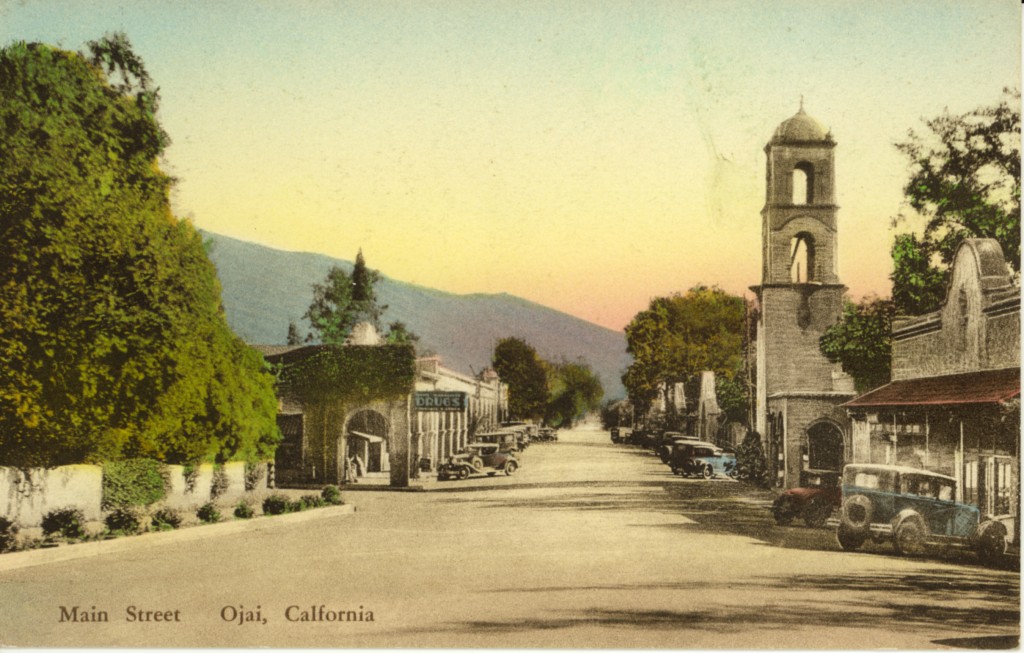
Downtown Ojai in 1920s. Courtesy Ojai Valley Museum
Ojai Day celebrates the 1917 transformation of Ojai from a dusty, ramshackle collection of old West shops into unified design of public architecture and parks, with converging perspectives of arches and towers. What inspired Edward Libbey to transform Ojai into an architectural jewel? Mark Lewis interviewed Craig Walker, who revived the Ojai Day celebration in 1991, for this in-depth look at the origins of Ojai Day. Craig traces the impetus to the Chicago World’s Fair of 1893, an epochal event that launched the City Beautiful Movement, made Libbey a vast fortune and introduced him to Mission Revival architecture.
The original plan was to call it Libbey Day, to honor the man who had transformed the dusty, dowdy, backwater burg of Nordhoff into the model Mission Revival village of Ojai. But Edward Drummond Libbey was having none of it. He was proud of his role as Ojai’s guardian angel, but he preferred to celebrate the town itself on the occasion of its rechristening, rather than focus on his role in the process. As usual, Libbey got his way. And so, on April 7, 1917, some 2,000 people crammed themselves into the town’s brand-new Civic Park to celebrate Ojai Day.
“We are celebrating here today the fulfillment of a conception,” Libbey told the crowd. On every side stood examples of his handiwork: The Arcade, the Pergola and the Post Office Tower, all immaculately sheathed in sparkling white stucco or plaster.
“There has been too little attention paid to things aesthetic in our communities and in our homes,” Libbey said. “The time has come when we should encourage in ourselves thoughts of things beautiful, and the higher ideals which art encourages and promotes must awaken in the people the fostering of the love of that which is beautiful and inspiring. We must today decry with contempt and aversion all that is cheap, vulgar and degrading.”
That night the new buildings were illuminated with white light, rendering them incandescent. The effect must have reminded some onlookers of similar illuminations they had witnessed at the Panama-California Exposition, a world’s fair of sorts that had just closed on January 1, after a successful two-year run in San Diego’s Balboa Park.
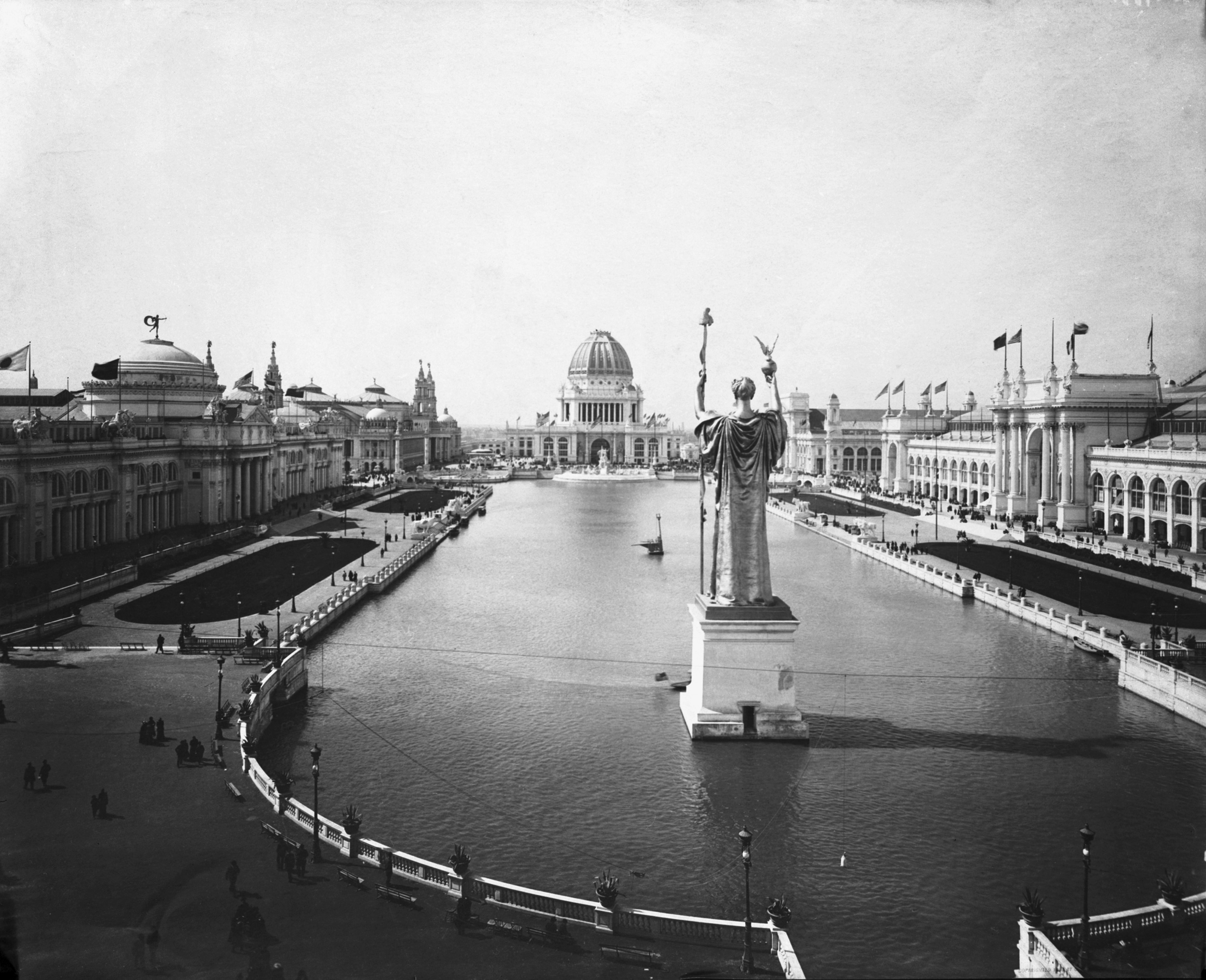
Looking back at these events across a distance of 95 years, it seems clear that Libbey’s Ojai project was heavily influenced by the San Diego fair. The Panama-California Exposition had popularized the new Spanish Colonial Revival style, a baroque offshoot of the Mission style and Ojai’s Post Office Tower would have looked right at home in Balboa Park. But one local history maven, Craig Walker, traces Libbey’s original inspiration further back, to an earlier world’s fair: Chicago’s legendary World’s Columbian Exposition of 1893, better known as the White City.
White City at 1893 Chicago World’s Fair. Photo: Chicago History Museum Collection
The Chicago fair had an enormous impact, and still lingers in the national memory. It is the subject of Erik Larson’s hugely popular nonfiction book The Devil in the White City, first published in 2004 and still going strong on the paperback bestseller lists almost a decade later. The book focuses on a serial killer, Dr. H.H. Holmes, the eponymous “Devil” of Larson’s title, who preyed upon fairgoers. But for most people who visited the White City, it looked more like heaven than hell.
It was there, on the shore of Lake Michigan, that Edward Libbey witnessed a testing of the hypothesis he would propagate in Ojai two decades later: that beautiful buildings inspire people to become better citizens. To judge by Chicago’s less-than-sterling reputation over the years as a bastion of civic virtue, the original experiment was rather a bust. Ojai would turn out to be a different story.
MAKE NO LITTLE PLANS
The World’s Columbian Exposition originally was scheduled to open in 1892, to celebrate the 400th anniversary of Columbus discovering the New World. But its organizers got carried away. Led by the architect Daniel Burnham, they turned the fair into an epic celebration of modern America and its apparently limitless potential. “Make no little plans,” Burnham famously said; “They have no magic to stir men’s blood, and probably themselves will not be realized.”
Big plans take time to develop. As a result, the fair did not open until May 1893. But it was worth the wait. Burnham & Co. had built an entire model city in Jackson Park. This was in effect a Hollywood set, made up of temporary buildings molded out of a kind of stucco and painted white to look like marble. Nevertheless, the effect was stunning especially at night, when they were bathed in electric light. Collectively they comprised the White City, and people looked upon them in wonder.
Some 27 million people visited the fair that year, the equivalent of a third of the country’s population. Among them was the future author L. Frank Baum, for whom the White City would serve as the model for the Emerald City in The Wonderful Wizard of Oz. Another onlooker was Elias Disney, a carpenter who had helped to build the White City; his son Walt would one day build his own White City in Anaheim and call it Disneyland. Even the notoriously cynical historian Henry Adams was impressed with what Burnham had wrought.
“Chicago in 1893 asked for the first time the question whether the American people knew where they were driving,” Adams later wrote. The answer was still unclear, but at least the question was framed intelligently. The White City, Adams wrote, “was the first expression of American thought as a unity; one must start there.”
All sorts of people beat a path to Chicago in 1893, including the theosophist Annie Besant, who was on her way from Britain to India. She stopped off in Chicago long enough to attend the fair’s Parliament of Religions, during which Swami Vivekananda introduced America (and the West in general) to Vedanta and yoga. Such epochal goings-on were routine at the Chicago World’s Fair, which also introduced America to the Ferris Wheel, Cracker Jack candy and Pabst Blue Ribbon Beer. But its most far-reaching legacy was the City Beautiful Movement, which the White City embodied.
“The industrial cities of the 1870s and ’80s had little planning “they evolved as crowded, ugly, haphazard affairs,” Craig Walker said. Burnham built the White City to show that there was a better way. “The belief was that cities built as a unified, planned development, with beautiful public buildings and parks, would inspire civic pride and moral virtues that would bring social reform,” Walker said. “The exposition was the blueprint for modern America; it had a major influence on art, architecture, city planning, business and industry.”
Ah yes, business and industry. The exposition was not entirely about art and moral uplift. Commerce also was highlighted, and many manufacturers built exhibits to showcase their wares. Among them was a certain glass manufacturer from Toledo, who saw the fair as his chance to hit the big time.
Edward Drummond Libbey was born in Chelsea, Massachusetts in 1854. He followed his father into the glass business and by 1892 was the head of Libbey Glass. The firm had moved in 1888 from New England to Ohio, where it struggled for a few years before finding its footing. Now Libbey saw the World’s Columbian Exposition as opportunity to establish his firm as the premier national brand for high-quality cut glass tableware. But his board of directors balked at investing big bucks to build a first-class exhibit. So Libbey borrowed the money himself and built it anyway. It was a full-scale glass factory situated on the Midway Plaisance, west of the fairgrounds proper. Libbey’s gamble paid off: The Libbey Glass pavilion was a huge success with fairgoers.
Libbey spent a lot of the time at the fair, living above the store, so to speak, in an apartment built into the pavilion’s second floor. The building was located half a mile east of the Ferris Wheel and just short walk west from Stony Island Avenue. On the other side of the avenue lay the shimmering White City.
Most of the fair’s buildings showcased the neo-classical Beaux Arts style, which America’s leading architects had studied in Paris. Among the more notable exceptions was the California Building, which stood less than a quarter of a mile away from the Libbey Glass exhibit. Paris had never seen its like. Nor had Chicago, for that matter. The California Building introduced America, and Edward Libbey, to a new architectural style called Mission Revival.
ENTER RAMONA
California had not always celebrated its Mission Era heritage. After the gold rush petered out, the state’s boosters needed to give people from back East a different reason to migrate west, and California’s Spanish and Mexican heritage did not seem like a selling point for white Protestant Americans. On the contrary, the state’s boosters feared that all those Spanish-style churches and forts made California seem too foreign and too Catholic. “From the 1840s to the early 1880s, the American immigrants did everything they could to eradicate the state’s Old World Spanish architecture,” Craig Walker said. “The missions and presidios were abandoned and destroyed.”
Casting about for a viable marketing angle, California’s railroad barons brought in the travel writer Charles Nordhoff to publicize the state’s natural beauty and healthy climate. Nordhoff hit the mark with his book California for Health, Pleasure and Residence (1872), an enormous success that induced thousands of Americans to move west. Some of them ended up in the sparsely Ojai Valley, where a real estate promoter named Royce Surdam was promoting a new town site. The settlers decided to name this town Nordhoff, to honor the man whose book had lured so many of them to California.
Nordhoff’s founders took no cues from the few remaining adobe structures they encountered in the vicinity. Their new town was built out of wood, and looked like it had been plucked from Kansas or Iowa and replanted in the Ojai Valley. But not every visitor from the East was averse to adobe. When the author Helen Hunt Jackson passed through Ventura County in 1882, she ignored Nordhoff but made a point of lingering in Rancho Camulo, a Spanish-style ranch near the present-day town of Piru. Rancho Camulo served Jackson as a model setting for Ramona (1884), her melodramatic novel about a young Indian woman who lives on a California ranch during the early years of statehood.
Ramona changed everything. A runaway bestseller, it sparked a national fascination with California’s Mission Era. The state’s boosters reversed course and embraced the old missions as iconic symbols of a romantic (and mostly spurious) past. “They just rode this Ramona thing,” Walker said. In the end, Jackson’s book lured even more people to California than Charles Nordhoff’s had.
Meanwhile, California architects concocted the Mission Revival style to create new buildings that harked back to the period in which Ramona was set. Naturally, when it came time to design a California exhibit building for the World’s Columbian Exposition, state officials chose a Mission Revival motif. The California Building was hardly the first example of this new style, but it was the first one to win nationwide acclaim. It made a big splash at the fair.
“It really was the building that got America’s attention,” Walker said.
Did it get Edward Libbey’s attention? He could hardly have missed it, given its close proximity to the Libbey Glass pavilion. Was he impressed? There is no way of knowing. All one can say with confidence is that Ojai’s future benefactor first encountered the Mission Revival style in Chicago in 1893.
The World’s Columbian Exposition also put Libbey on the path to extraordinary wealth, due to the success of his glass-making exhibit. “His whole glass empire just took off,” Walker said. “It propelled him to the top of America’s glass manufacturers, and he became one of the wealthiest businessmen in the country.”
And, crucially, the fair exposed Libbey to the full effect of the City Beautiful Movement. Before long he began applying its precepts to Toledo, where in 1901 he co-founded the Toledo Museum of Art. But Toledo turned out to be too big a city for one man to beautify. Libbey continued to support the museum, but he spent more and more of his time in Southern California. In 1908 he discovered Nordhoff, and built himself a winter home high up on Foothill Road. He loved the valley’s climate and mountain scenery, but was less impressed by its tacky architecture. Eventually, it occurred to him that Nordhoff, too, could benefit from the Libbey touch.
The town of Nordhoff before Mr. Libbey’s improvements.
THE VILLAGE BEAUTIFUL MOVEMENT
Nordhoff’s ramshackle business district did not amount to much: a forgettable stretch of uninspired wooden storefronts, indistinguishable from a thousand other hick towns languishing in the boondocks. In short, Nordhoff was homely. Libbey had a remedy. He had internalized the great lesson of Chicago, which was that art and human progress were inextricably linked. And among the arts, architecture was especially effective at creating a physical context for uplift. What had been true of Athens and Rome could become true of Nordhoff: Beautiful buildings would inspire civic virtue among the inhabitants, and make the town a better place in every sense. In April 1914, Libbey called a meeting of Nordoff’s leading citizens to offer a suggestion: They should essentially scrap the town they had, and build a new one.
“Make no little plans!” That was Daniel Burnham’s advice to the city planners of America, and it was Edward Libbey’s advice to the burghers of Nordhoff. His wildly ambitious proposal evidently stirred the blood of every man at that meeting, for they voted unanimously to embrace it. Why would they not, given that Libbey and his rich friends would provide most of the funds? And so the great experiment began.
There were still a few details to fill in. First and foremost, who would be Libbey’s architect, and what style would he employ? The choice ultimately fell upon Richard Requa of San Diego, whose firm, Mead and Requa, did some work for the Panama-California Exposition of 1915. Libbey evidently visited the San Diego fair, was impressed by its Spanish Colonial Revival motif, and hired Requa to create something similar in Nordhoff.
But the sequence of events suggests that Libbey already had settled on the Mission style for Nordhoff, well before he ever set foot in Balboa Park. After all, he had been familiar with the style at least since 1893, when he first clapped eyes on the California Building at the Chicago World’s Fair. And he no doubt had admired the Thacher School’s administration building, a Mission-style structure built in 1911. Significantly, the first major new building erected in Nordhoff in the immediate aftermath of that April 1914 meeting was a Mission-style movie theater, the Isis. (It’s still there, almost a century later, only now it’s called the Ojai Playhouse.) Given the town’s enthusiastic embrace of Libbey’s plan, it seems most unlikely that someone would have built a major new building in the downtown district without first vetting the design with the man from Toledo.
Libbey did have other architectural choices. The most impressive-looking building in downtown Nordhoff in 1914 was the Ojai State Bank, a stately brick pile in the neoclassical mode, complete with Doric columns. Theoretically, Libbey could have put up a neoclassical village to match the bank. But that would have looked bizarre, given the region’s historical context. The closest points of reference were Ventura and Santa Barbara, each of which dated back to the Mission Era and boasted an authentic mission building. Mission Revival was the obvious choice for Nordhoff. It seems likely that Libbey had made that decision even before he called that meeting.
Libbey of course was no architect. He left the design details to Requa, who used a mixture of Mission style (e.g., the Arcade) and Spanish Colonial Revival style (the Post Office Tower) to bring Libbey’s vision to life. Meanwhile, in March 1917, the town completed its Ramona makeover by changing its name to Ojai. Now it had a Spanish-sounding name to complement its new look. (The name, like the architecture, is not actually Spanish; it’s derived from the name of one of the Chumash Indian villages that once dotted the valley.) Thus it was Ojai Day, rather than Nordhoff Day, that the town celebrated a few weeks later on April 7.
At the opening ceremony, Libbey handed the deed to Civic Park to Sherman Day Thacher, who accepted it on behalf of the newly formed Ojai Civic Association. A reporter for The Ojai newspaper recorded Libbey’s speech, an earnest paean to the power of art:
“Art is but visualized idealism, and is expressed in all surroundings and conditions of society,” he told the crowd. “From the earliest age to the present time, art has been to the races of men one of the greatest incentives toward progress, refinement and the aesthetic missionary to the peoples of the world.”
Did the townspeople take Libbey seriously, with all his high-falutin’ rhetoric about Greece and Rome and beauty and virtue? Relatively few people in the crowd knew him well. He was only a part-time resident, after all. But clearly he was sincere, and most of his listeners were grateful that he had taken Ojai under his wing. Heads nodded in agreement as he launched into his peroration:
“Thus we are today celebrating, in the expression of this little example of Spanish architecture in Ojai Park, a culmination of an idea and the response to that spark of idealism which demands from us a resolution to cultivate, encourage and promote those things which go to make the beautiful in life, and bring to all happiness and pleasure.”
The crowd gave Libbey a huge ovation. And then the party began.
“Last Saturday a new epoch in the social and industrial life of the rejuvenated and resuscitated ancient Nordhoff, under a new title and new conditions, was ushered in and welcomed with joyous acclaim and much felicitation,” The Ojai reported in its next issue. “It was the most memorable day in the history of the Valley. New life, new ambitions and greater accomplishments will date from April 7, 1917.”
THE LIBBEY LEGACY
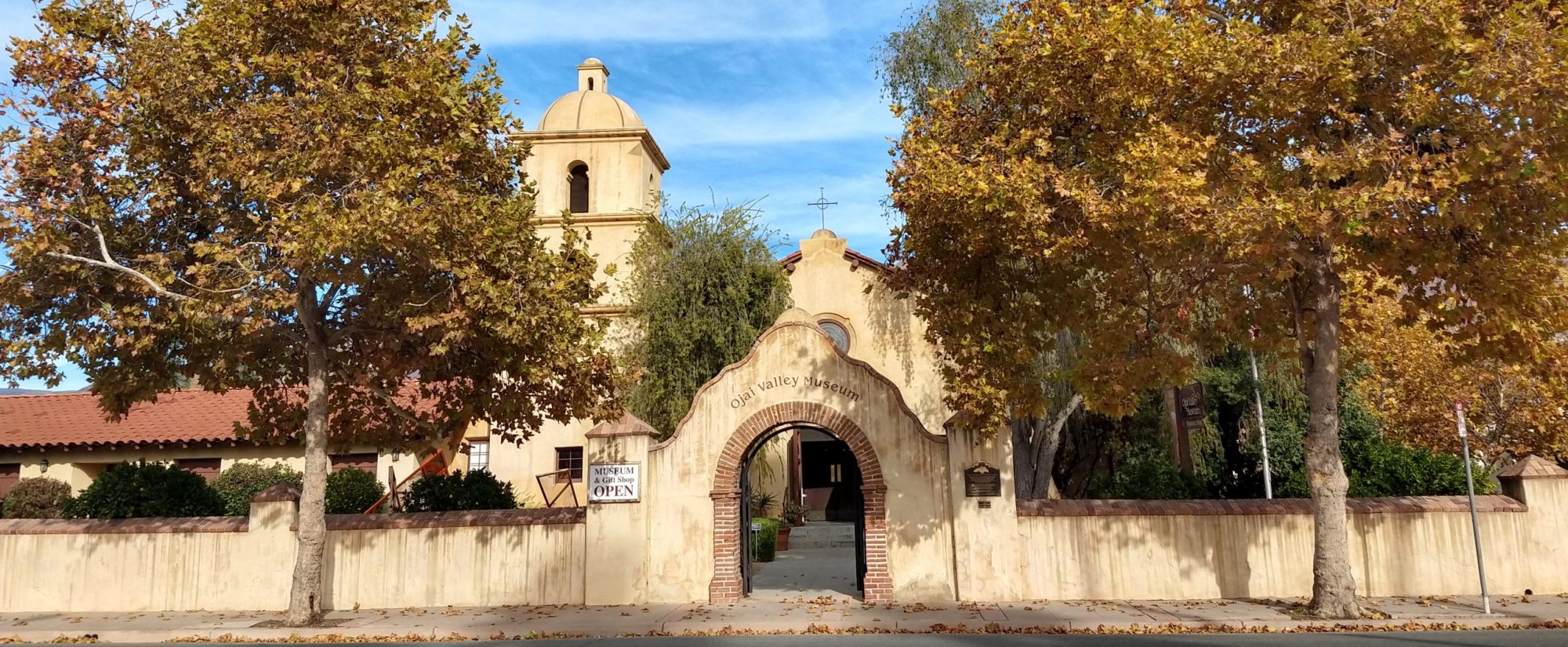
Ojai Day was not celebrated in 1918, due to America’s participation in World War I. But it returned in 1919 and became an annual event, as Libbey’s influence provided the town with more new buildings to celebrate: The St. Thomas Aquinas Chapel (now the Ojai Valley Museum) in 1918, the El Roblar Hotel (now the Oaks at Ojai) in 1920, the Ojai Valley School in 1923, the original Ojai Valley Inn clubhouse in 1924. Then Libbey died in 1925. The town continued to celebrate Ojai Day until at least 1928, but at some point after that, the tradition was abandoned.
The buildings, of course, remained. But as the decades passed, some of them fell into disrepair. The original Pergola was demolished in 1971, the same year Civic Park was renamed Libbey Park. “And we almost lost the Arcade in 1989,” Walker said.
Walker is a retired Nordhoff High School history teacher and an expert on the valley’s architectural history. (He inherited some of that expertise from his late father, the noted architect and longtime Ojai resident Rodney Walker.) He was a member of the citizens group that saved the Arcade, by raising funds to refurbish it and bring it up to code. In the wake of that effort, Walker led a move to bring back Ojai Day. The event was revived in 1991, and now is celebrated each year on the third Saturday of October.
Craig Walker. Photo: Raijmakers Photography
Walker also was among the people who brought back the Pergola in 1999. As a member of the Ojai Valley Museum board, he continues to lend his expertise to the museum’s projects. It was while researching a talk about Ojai architecture that Walker learned that Libbey had been an exhibitor at the World’s Columbian Exposition, where he would have been exposed to both the Mission Revival style and the City Beautiful Movement. Walker already was familiar with Libbey’s Ojai Day speech from 1917, but now he viewed those words in a new light.
“The words just echoed the real heart of what the City Beautiful Movement was all about,” Walker said. “On that day in 1917, the architectural and social ideals of the World’s Columbian Exposition were expressed in a beautiful new civic center that was created by a man who owed his own success in large part to that same Chicago exposition.”
Did Libbey achieve his dream for Ojai? Certainly his influence on the look of the town has been enormous. Walker points to all the beautiful Mission- or Spanish-style buildings that other people erected in the valley after Libbey worked his magic downtown. These include the Krotona Institute of Theosophy, Villanova Preparatory School, the Ojai Presbyterian Church, the Ojai Unified School District headquarters (formerly Ojai Elementary), the Chaparral Auditorium, and many, many others.
But an Ojai building need not be Mission style or Spanish style to reflect Libbey’s legacy; it need only be beautiful. Nor is his influence limited to architecture. Today the town is known as a mecca for artists, and Libbey, in a sense, was their prophet. He called for the community to pay more attention “to things aesthetic,” and his call has been heeded.
“It all goes to show, first of all, that one man can make a difference,” Walker said. “Libbey’s ideas must have infected the people of Ojai.”
In one way, Libbey outdid Daniel Burnham. The glorious White City burned down in 1894; only one of its buildings remains standing in Jackson Park. But Libbey’s buildings still stand along Ojai Avenue, and still perform their intended function. Burnham’s lost masterpiece was a blueprint for future cities that were never built, except, perhaps, by L. Frank Baum and Walt Disney. But the Emerald City is imaginary, and Disneyland is a theme park. Ojai is a real town, where people live. If today Ojai prides itself on its beauty and on its highly developed sense of civic virtue, then much of the credit must go to Edward Drummond Libbey, who set out to build a better town, and succeeded.
“I think it helped people realize that they live in someplace special,” Walker said. “This was Libbey’s stated intention “to inspire people to these higher ideals of civic involvement. One could say that his intention has been borne out.”
(Originally published in the Ojai Quarterly’s Fall 2012 issue. Republished with permission.)
Shangri-la: Ojai’s Untold Stories, the final exhibit for 2012 at the Ojai Valley Museum, will run for three months, October through December 30, 2012. It features historical, primarily unknown personalities, who were directly related to Ojai and who have had great influence on the town and the nation. The five “Untold Stories” featured in this exhibit highlight the lives of Ethel Percy Andrus, Benedict Bantly, Edward Libbey, Effie May Skelton and Edward Jacob Wenig; all of whom were tenacious, passionate, political, fearless, selfless, and adventuresome movers and shakers in a wide variety of fields and endeavors.
This tour de force, original history exhibit is comprised of text and three-dimensional installation/tableaux chronicling the five personalities, plus six short stories about additional influential individuals and little known tidbits of Ojai history. The primary stories about the three men and two women, all of whom had ties to Ojai, serve to educate, enlighten, surprise and impress. Visitors will be enriched by the information within these stories and their awareness of this community will be greatly expanded.
The concept for this exhibit – to relate stories about Ojai that are not known by most people – was conceived several years ago. Four Community Curators, Patricia Atkinson, Laura Crary, David Mason and Craig Walker, researched and wrote the texts and gathered supportive ephemera for each individual/person featured in the exhibit. Michele Ellis Pracy, Ojai Valley Museum Director, curated each of their contributions to form the overall group exhibition.
Contributors to the Shangri-la exhibit include: AARP, The Gables of Ojai, Ojai Community Bank, Ojai Estate Sales, Treasures of Ojai, Jim McCarthy and Christine Brennan, La Piu Bella Tavola, Tony and Anne Thacher, Bob and Alyce Parsons, Christine Fenn, Veronica Cole, Ojai Valley Inn and Spa, Angelique LaCour, Teri Thomson Randall, Barbara and Sandy Service and Lily Liu.
The museum is located at 130 W. Ojai Avenue, Ojai, CA. Admission: free for current 2012 members, adults – $4.00, children 6-18 – $1.00 and children 5 and under free. Gallery hours are Tuesday – Saturday 10 a.m. to 4 p.m., Sunday, noon to 4 p.m. Tours are available by appointment. Free parking is available off Blanche Street at back of museum.
The Ojai Valley Museum, established in 1967, is generously supported in part by Museum Members, Private Donors, Business Sponsors and Underwriters, the Smith-Hobson Foundation, Wood-Claeyssens Foundation, City of Ojai, Rotary Club of Ojai, and the Ojai Civic Association.
For more information, call the museum at (805) 640-1390, ext. 203, e-mail ojaimuseum@gmail.com or visit the museum website at: OjaiValleyMuseum.org
A while back the Ojai Valley Land Conservancy (OVLC) purchased a ranch near the entrance to the Ojai Valley. Just opposite Casitas Springs this ranch lies nestled between Santa Ana Road and the Ventura River. The OVLC’s purpose in purchasing this ranch was to gain access to the Ventura River in order to continue their mission of restoring and conserving it for the use of future generations.
By purchasing the ranch, however, the OVLC also gained a beautiful ranch house which, county permitting, may be added to the register of Ventura County Historic Landmarks. It was called the Hollingsworth Ranch, purchased in 1877 by its namesake Mr. Jack Hollingsworth.
This article is not in any way a comment on the plans and actions of the OVLC. Instead, the purpose is to share with you a little bit of Ojai Valley history from a part of the Valley which does not receive much attention, historically or otherwise.
The Hollingsworth Ranch was originally part of the Rancho Santa Ana land grant. After changing hands three times, Jack Hollingsworth purchased the ranch in 1877. Jack would remain at the ranch for the rest of his natural life, becoming a local fixture. He was known for his integrity, sensibility, and his penchant for practical jokes. One such prank was recounted by an aging grandchild:
“Apparently Jack was on his ranch when a pair of hunters ventured onto the ranch grounds. The intruders seemed sure that they could hunt game while passing through the ranch “Jack was not so sure. He had an idea and instructed his teenage son, Laurence, to run down a row of fruit trees and then drop down dead when he fired his rifle. Grandpa Hollingsworth was well [known] as a crack shot. Laurence ran off like a bat out of hell. Jack picked up his riffle [sic] and shouted, ‘there goes that dam [sic] boy.’ When Laurence reached the end of the long row of trees he fired a shot and the boy dropped like a stone. The two hunters, horrified that they had witnessed a murder, took off like rabbits and ran all the way [into Ventura]. When they found the local authorities they hurriedly related the story of the ‘shooting in the orchard.’ When the locals figured out where the shooting had taken place they merely laughed and shook their heads before informing the wild-eyed hunters that Jack Hollingsworth had played one of his infamous pranks.”
During this period, the Hollingsworth Ranch was little more than a small ranch house with a few nearby buildings, ‘storehouses’ mostly. When Jack Hollingsworth’s son took over, however, things began to change.
James C. Hollingsworth (Jim) was not the rancher that his father was. While he did spend his childhood on family farms, Jim was well educated for a young man in the 1910s. He attended USC for two years in preparation for a law degree, but was called to serve in France during WWI. After being honorably discharged he returned to San Buenaventura and set up a law practice with his partner Edward Henderson. Due to his success in law, Jim Hollingsworth became district attorney for Ventura County in 1927, unfortunately taking office in time to preside over the St. Francis Dam Disaster. The disaster did not hinder his career, and Jim Hollingsworth was able to live out the remainder of his life at the Hollingsworth ranch, bequeathed to him after Jack Hollingsworth’s death.
Under Jim Hollingsworth’s supervision, the ranch became less of an agricultural venture and more of a comfortable home. The old ranch house was demolished and replaced with a larger stone building. The surrounding grounds were augmented with entertainment facilities, such as a large barbecue and patio, a swimming pool, and a shaded masonry grove near the river.
The house has since endured with but minor alterations. Although not fully visible from Santa Ana Road, Google Maps has a beautiful aerial photograph of the ranch if you wish to see the beautiful building. [In Google Maps, search on Hollingsworth Ranch Road, Oak View, CA; then click on “Satellite”]
Sources include:
Ojai Valley Land Conservancy tour of the Hollingsworth Ranch
“Grandpa Hollingsworth” by Southern Courtney, date unknown
Sheridan, Sol; History of Ventura County, vol. 2; The S. J. Clarke Publishing Co; Chicago, 1926; p. 260-3
Wheeler Hot Springs: New Owners Confront Old Issuesby Mark Lewis
From TheOjai Quarterly, Spring 2011 issue.
Most Ojai visitors arrive from the south on Highway 33 and turn right at the Y, heading toward the Arcade or the Ojai Valley Inn. But there was a time, not all that long ago, when many of these drivers would turn left instead, and smile gratefully at the highway marker proclaiming that Wheeler Hot Springs was only six miles away.
“It was almost a pilgrimage for me,” said Arthur von Wiesenberger, co-publisher of the Santa Barbara News-Press, as he recalled his regular Sunday trek over Casitas Pass and up the Maricopa Highway to take the waters at Wheeler. “I looked forward to Sunday,” he said. “There was a special energy there. I’d come back and face the week rejuvenated.”
Wheeler nostalgia is not confined to out-of-towners. Many local residents flocked to the resort to soak in its spring-fed hot tubs and enjoy a massage, followed by dinner and perhaps a jazz concert. “It was awesome when it was open,” recalled Jerry Kenton, co-owner of the Deer Lodge. “I used to go there on dates. It was great.”
When the resort closed in 1997, many people assumed that it would eventually reopen under new management. But a decade passed and nothing happened. Then, late in 2007, Wheeler began to show signs of life.
No announcement was made, but the resort had acquired new owners: Daniel Smith, a dentist who lives in Malibu and practices in Agoura Hills, and his wife, Maureen Monroe-Smith, who according to her Linked-In profile is an editorial assistant at Momtastic.com and the owner of Zuma Canyon Vineyards. For a while, to judge from the construction activity at the site, they seemed to be putting a lot of money into the place. But three-and-a-half years later, Wheeler has yet to reopen, and the new owners have yet to make their plans public.
“They try to keep it real private,” said Kenton, who co-owns a rental property right across the highway from Wheeler. “He [Smith] doesn’t want any publicity.”
The Kenton property is listed for sale with Sharon MaHarry of Keller Williams Realty, so MaHarry is often on the site. She said she never notices any activity at Wheeler, and has no idea what the Smiths have in mind.
“It’s a mystery to everybody in town,” she said.
Nevertheless, Smith was reasonably forthcoming when the Ojai Quarterly telephoned him last October to ask about his plans.
“We’ve been doing a tremendous amount of work to improve the property,” he said. “Unfortunately, the county has made it extremely difficult to re-open it.”
Smith said he would consider doing a sit-down interview on the Wheeler site. But when we got back to him a few weeks later to set it up, he asked us to hold off on our story.
“We’re at kind of a crucial point here,” he said. “At this stage, I don’t really think we want to put people on the property. What we’re doing is not really defined yet. We’re just not sure on direction yet.”
If the OQ would wait for a month, Smith said, he would tell us what was going on. So we waited more than a month, until January, and then we called him back. He did not return our calls.
It seems that the Smiths have run into a bit of bad luck at Wheeler. (See below.) But they are hardly the resort’s first owners to find themselves in this predicament. For more than a century, Wheeler Hot Springs has been luring visionary developers into the Santa Ynez Mountains only to break their hearts. Yet Ojai would not be what it is today without Wheeler, and the other hot-springs resorts that once graced the area. Lanny Kaufer, whose family operated Wheeler on and off from 1969 through 1993, notes that the resort will continue to loom large in Ojai’s history, even if it never reopens.
“The hot springs were the major draw that brought people to Ojai in the first place,” he said. “That’s what put Ojai on the map.”
Deer Hunter Discovery
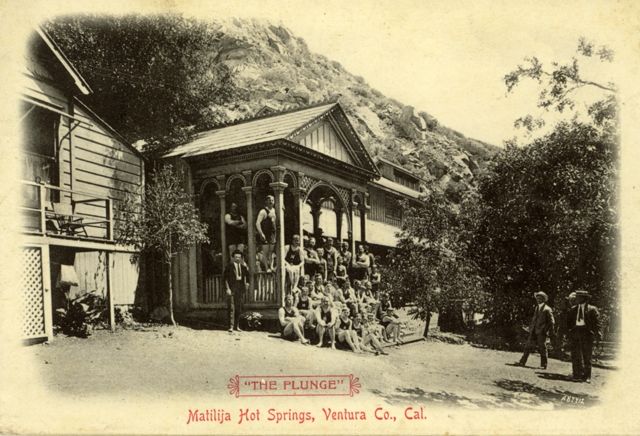
The Chumash phrase for hot springs translates into English as “tears of the sun.” It is often assumed
“The Plunge” at Matilija Hot Springs
in Ojai that the Wheeler hot springs were sacred to the Chumash, but this cannot be confirmed: No archeological evidence for the Indians’ presence at the site has turned up thus far, and Chumash elder Julie Tumamait-Stenslie knows of no ancestral stories about the springs that have been passed down to her generation.
“The stories were lost,” she said. “We don’t know of anything documented. You want to trace legends and lore, but I’ve always come up to a dead end.”
Nevertheless, there was a Chumash village nearby, so it seems reasonable to theorize that the Indians knew of the springs, and that they considered the site a special place. There are those in Ojai who would go further, and assert that a Chumash curse afflicts anyone who tries to exploit the springs for commercial purposes. Tumamait-Stenslie said she does not know whether her ancestors put a hex on the place. What she does know is that over the years, the site has been extraordinarily unlucky for its would-be developers, and for other people as well.
She did not name names, but anyone who delves into Wheeler’s tangled history can identify many people who came to grief there — beginning with Wheeler C. Blumberg, for whom the springs are named. Wheeler was born in Clarence, Iowa in 1863. His father, Abram, was a lawyer. When Wheeler was 9, the family moved to Los Angeles for the sake of his mother’s health. She had read a book by the travel writer Charles Nordhoff, who touted Southern California’s climate as a cure-all. When her health failed to improve in L.A., she and Abram decided to try their luck at a new town site that R.G. Surdam was developing in Ventura County.
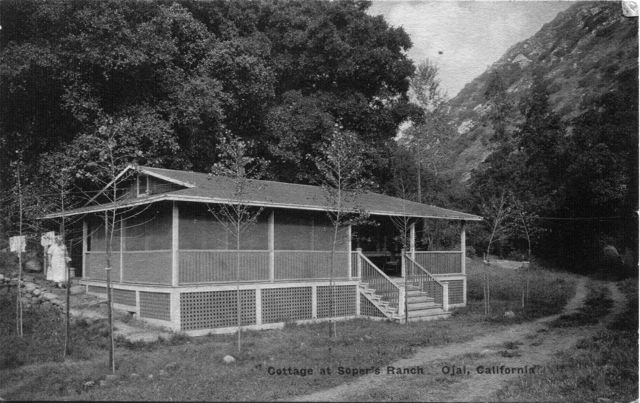
Soper’s Ranch at Ojala.
These were the great days of the famous spa towns such as Vichy, Marienbad, and Saratoga, where upper-crust tourists “took the cure” by soaking in thermal springs and sipping mineral water. Surdam no doubt had pricked up his ears in 1872 when he heard that hot springs had been discovered in Matilija Canyon. Someone else already was developing a health resort at the springs, but Surdam was free to found a town in the nearby Ojai Valley. He found a useful ally in Abram Blumberg, who agreed to build a hotel on the present site of Libbey Park. It was Wheeler’s mother who suggested naming the town Nordhoff, in honor of the writer. But the Blumbergs did not linger long in the town they co-founded. By 1887, Abram had sold the hotel and opened his own health resort, Ojai Hot Springs, in Matilija Canyon.
Abram advertised his springs far and wide as a cure for pretty much whatever ailed you, including syphilis and cancer. Wheeler drove the stagecoach that met their guests at the train station in Ventura and brought them to the resort. Wheeler was notorious in Nordhoff for his reckless driving. “Women and dogs had to scramble out of the way when he came barreling through,” said Wheeler’s grandniece Ginger Morgan.
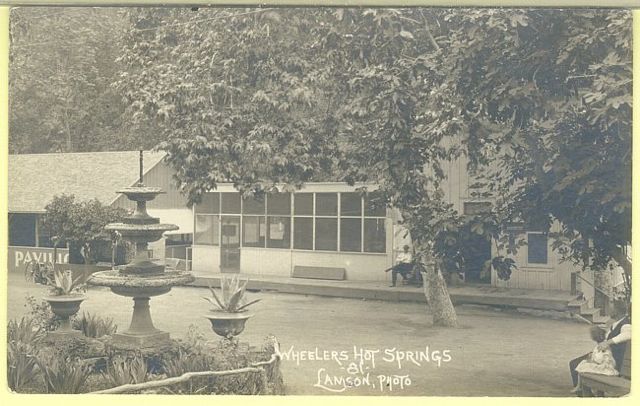
The road from Nordhoff to Matilija Canyon terminated at Lyon Springs, a smaller resort further up the canyon from Abram’s place. Beyond that point, there was nothing but an old Indian trail into the mountains. Wheeler Blumberg went up that trail with a rifle one day in 1888, and shot a deer near the North Fork of the Matilija Creek. The deer hit the ground near a bubbling hot spring. A second hot spring burbled nearby. Right there and then, in the middle of that unspoiled wilderness, Wheeler had his epiphany. He filed a homestead claim on the springs site; extended the road from Lyon Springs to his new property; and installed a spring-fed swimming pool, a bathhouse, and fourteen guest cabins. By 1891, Wheeler’s Hot Springs was open for business.
The springs were not the only attraction: Wheeler also offered fishing, hunting, camping, trail riding, swimming, and nightly dances. He even used hydropower from the creek to power his own electrical plant, which bathed the resort in electric light while the rude village of Nordhoff still got by with kerosene lamps.
Wheeler’s Hot Springs was a success from the start. But in 1894, Wheeler began to behave erratically. “It seems that he thought his wife’s heart was on the wrong side and he began
pounding on her chest to put it right,” wrote Patricia L. Fry in The Ojai Valley: An Illustrated History. Wheeler was committed to an insane asylum, but he soon recovered and was back at his resort.
The Blumberg family sold Ojai Hot Springs after Abram’s death in 1899. (It was later renamed Matilija Hot Springs, and it’s still there, although currently not open to the public.) Wheeler held on to his own resort, which continued to prosper. It was not all smooth sailing: In 1904, the Anti-Saloon League of Southern California caused a sensation when it engineered Wheeler’s arrest for selling liquor without a license. But those temperance crusaders could not keep him down for long. He built a sizeable house on a cliff overlooking his resort, and tried to persuade his adult children to live there with him and be his partners.
“I don’t care to have outsiders in with me, so I thought it best if it all seemed satisfactory to all of you to incorporate it in the family,” he wrote to his eldest son, Clarence.
But then Wheeler suffered another breakdown — and this time, it made news all over Southern California.
“Wheeler Blumberg, proprietor of the springs bearing his first name, has been a raving maniac in the hands of the sheriff since he was incarcerated in the county jail yesterday morning,” the Los Angeles Times reported on May 21, 1907. “Blumberg is a desperate man, and for days he has produced a reign of terror at his springs resort, where he locked himself in his room with two or three guns and pistols and with big knives. He shot 15 holes through the walls of his room, and would occasionally make sorties outside, when everybody about the place would take to the hills.”
A posse managed to capture Blumberg alive and bring him to Ventura, where he was stuffed into a straitjacket, heavily sedated, and strapped to a couch in a padded cell. The sedative had little effect: According to the Times, he continued to scream at the top of his lungs and strain desperately against his bonds until the following morning, when he died “from utter exhaustion.” He was 43 years old.
Wheeler Hot Springs
The Fires Up Above
After Blumberg’s death, the resort’s name contracted from “Wheeler’s” to “Wheeler,” as control passed to the founder’s son-in-law. Webb Wilcox was a young man from Illinois who had hired on in 1903 to drive the resort’s stagecoach. Two years later he married the boss’s daughter, Etta Blumberg. By 1913, when he was named postmaster of the newly established Wheeler Springs Post Office, Wilcox was clearly the man in charge.
The stagecoach era had passed. The railroad now delivered the resort’s guests all the way to Nordhoff, where they boarded a big Stanley Steamer motor coach for the short, scenic drive out to Wheeler Springs. The resort was thriving and so was the town, and this was not a coincidence.
“Being situated as Nordhoff is, the railway station for the three great health resorts — Matilija Hot Springs, Lyon Springs, and Wheeler Hot Springs — our beautiful and fertile valley gets a great deal of advertising and comes to the notice of many people who would not otherwise come this way,” The Ojai newspaper noted in 1913.
Wheeler clearly was the newspaper’s favorite: “Situated in another canyon, a little at one side of the main Matilija Canyon, but reached by a pretty mountain road, is the famous Wheeler Springs, under the management of that prince of good fellows, Webb Wilcox. Hot and cold mineral springs, fine trout fishing, commodious camp grounds and good treatment have been prime factors in establishing the fame of Wheeler’s Springs. While this place has not been open as a resort for so many years as the other two, it has been popular from the first. As seasons pass the crowds increase, and the resort is becoming more and more popular for winter guests.”
Then in June 1917, a carelessly maintained campfire near the resort touched off the epic Matilija-Wheeler Fire, one of the worst forest fires in California history. The town, which had just changed its name to Ojai, almost saw its brand-new Arcade go up in flames.
“With 200 men we worked like demons for five days and five nights before we got the best of that blaze,” the legendary forest ranger Jacinto Damien Reyes recalled years later. “But it was not until 30,000 acres was a blackened waste. In that fire we had a terrific battle to save the buildings of the Wheeler Springs resort and while we were busy at that the fire burned out of the forest and into the town of Ojai.”
The flames roared over Nordhoff Ridge and down into the town, but were stopped short of the Arcade. Even so, the fire killed five people, destroyed 70 houses and other structures, and forced many terrified residents to flee the valley in panic. Future historian Walter Bristol recorded his reaction: “The glow of the flames reflected by the smoke-filled air made the scene an inferno never to be forgotten by those who witnessed it.”
Ojai rebuilt, the forest regenerated, and Wheeler Springs continued to attract tourists from all over Southern California–and sometimes from further afield. During the 1920s, heavyweight-boxing champion Jack Dempsey stayed there while he trained at Pop Soper’s, just down the road.
Wilcox Resort
In 1926, Webb Wilcox reaped a potential bonanza when the state agreed to pay for the proposed Maricopa Highway to connect Ventura with Bakersfield. The new road would allow Wheeler to draw visitors from the north as well as the south. Thinking big, Wilcox sold a half-interest in Wheeler to R.F. Just, proprietor of the Battle Creek Sanitarium of Long Beach. They planned to build a similar sanitarium at Wheeler. Apparently that plan fell through, because in August 1929 the Times reported Wheeler’s sale to resort developer L.W. Coffee, the future founder of Desert Hot Springs.
Coffee envisioned Wheeler as a mountain resort along the lines of Lake Arrowhead. He drew up plans to subdivide part of the property for vacation homes. But his investment was poorly timed. Two months later, the stock market crashed, the nation tumbled into the Great Depression, and Coffee’s plans came to naught. In 1934 the Times reported that Wheeler was “back under sole management of Mr. and Mrs. Webb Wilcox.”
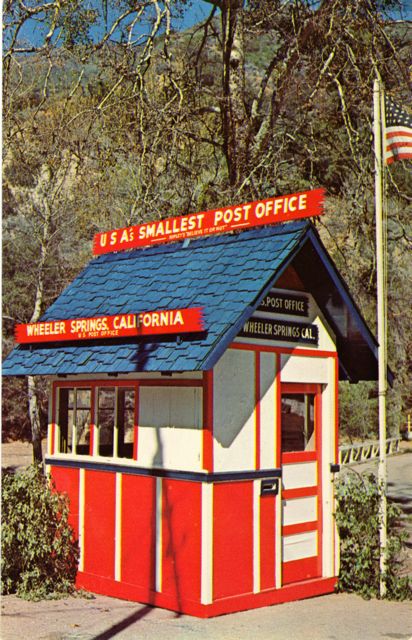
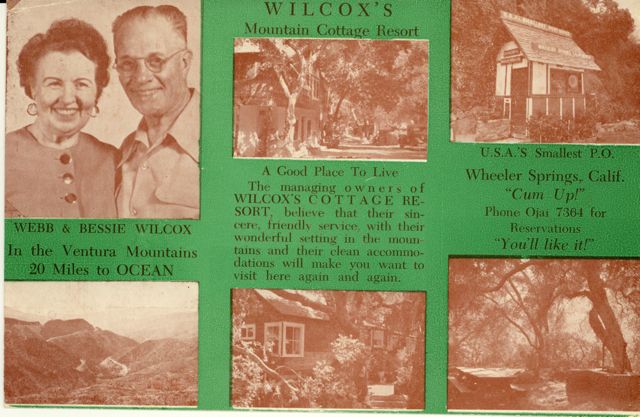
Smallest Post Office at Wilcox Resort
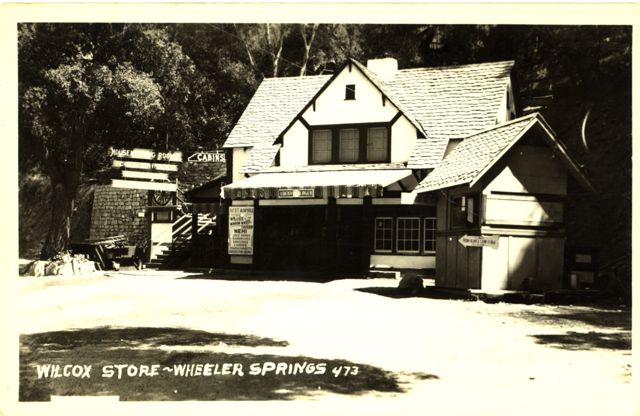
Not for long. With the recently completed Maricopa Highway running right through the middle of Wilcox’s property, he found himself in possession of some prime highway frontage. In 1935, he built a new “Cottage Resort” just east of the road. Essentially a motel, it consisted of a handful of cottages perched precariously atop a terrace carved into a steep hillside, supported by a massive retaining wall that reared up dramatically from the highway. At the base of that wall he built the Webb Wilcox Cafe, and next to the cafe he installed his tiny Post Office building, which was little more than a glorified shack. (“Ripley’s Believe it or Not” designated this structure “the U.S.A.’s smallest Post Office,” and Wilcox — ever the promoter — placed a sign to that effect on its roof.)
Having created a new fiefdom east of the highway, Wilcox disposed of his interest in the old resort, which was on the west side of the road. And with that, Webb Wilcox parted ways with Wheeler Hot Springs. By 1943, if not earlier, it had been acquired by one L.E. Needham, who apparently had little luck with it.
Wheeler was hit hard by the great flood of 1938, and again by World War II, when gasoline rationing kept many would-be tourists at home. (It is said that during the war years, an enterprising Nordhoff High School student operated a weekend bordello in the resort’s vacant cabins.) When the war ended, the picture seemed to brighten, due in part to the construction of Matilija Dam. Wheeler faced less competition after the new dam obliterated Lyon Spring and blighted the prospects of Matilija Hot Springs. But the polio scare was a severe blow, because people were afraid to patronize resorts with swimming pools.
A bigger blow was imminent. Three decades had passed since the 1917 fire, and the brush had grown back. In September 1948, a butane leak in a shed near the Wheeler swimming pool touched off another catastrophic blaze. Once again, the citizens of Ojai looked up to see flames descending upon them from Nordhoff Ridge. A sudden shift in wind direction saved the town from destruction, but not before 13 homes were destroyed, and a man died of a heart attack while fighting the flames.
Wheeler Springs survived, but the resort was on a downward spiral. In 1953, a retired Los Angeles produce wholesaler named Sam Sklar acquired control and announced plans to put up a 400-room hotel. It was never built, and Sklar soon went bust. The next owner was none other than Art Linkletter, the famous radio and television personality. Inspired perhaps by the opening of Disneyland in 1955, Linkletter spent a lot of money on a new Wheeler Springs attraction called Kiddie Land, adding rides and other features that appealed to children. He failed to prosper.
“We saw Linkletter several years after at a party and asked him about Wheeler,” wrote Fred Volz, the longtime Ojai Valley News editor, in a column. “He just grimaced, turned away and started to talk to a friend. We later heard he dropped a bundle.”
Meanwhile, Webb Wilcox continued to preside over his “Cottage Resort.” Etta Blumberg Wilcox died
The Wheel
in 1941, and Rose Blumberg (Wheeler’s widow) in 1947, but the Blumberg clan was still represented in the neighborhood by Etta’s younger brother Carl, who lived in Wheeler’s old house on the cliff. “It was filled with antiques,” said Ginger Morgan, who recalls many family gatherings there. “It was nice.”
The house passed out of the family after Carl’s death in 1959. As for Wilcox, he finally retired in 1960 and moved into a trailer house near his old cafe, which now had new owners. None of his children had stayed in the area, so when Wilcox died in 1962 at the age of 81, it marked the end of an era. That same year, Wheeler Springs lost its status as a U.S. Post Office, due to a lack of business. The resort was still open, but its glory days were long past.
The Turning of the Wheel
For Evelyn Landucci, it was love at first sight. The year was 1969, and Evelyn, a devotee of the Human Potential Movement, wanted to establish a New Age “growth center” in Southern California. She and her husband, Frank Landucci, had driven up from Los Angeles to check out Wheeler Hot Springs as a possible site.
“My mother had been going to Esalen,” said Lanny Kaufer, Evelyn’s son from an earlier marriage. “She envisioned an Esalen South.”
The Esalen Institute in Big Sur was an old hot springs resort reborn in the early ’60s as a New Age retreat. Wheeler Springs in 1969 was mostly a trailer park plus a few dilapidated relics left over from the resort’s heyday, including a lodge, a cafe, a dancing pavilion, the swimming pool — and Webb Wilcox’s old postal shack, still topped by that sign proclaiming it “the U.S.A.’s smallest Post Office.” All in all, the resort was not an impressive sight. But the hot springs still burbled, the mountain scenery remained unspoiled, and some of the buildings looked salvageable.
“It seemed like the perfect spot for what they had in mind,” Kaufer said.
The karma was not perfect, given that Wheeler’s previous owner, Rollen Haslam, had shot himself to death at the resort a few years earlier. But the Landuccis took the plunge and acquired Wheeler Springs from Haslam’s widow. (Or technically from Art Linkletter, who still owned the mortgage.) A few weeks after escrow closed, the canyon was scoured by the great flood of ’69, which turned the creek into a raging torrent. When the waters receded, the resort was pretty much gone.
The Landuccis soldiered on, with help from the Small Business Administration. The SBA was dubious about funding a “growth center,” so instead the Landuccis rebuilt the ruined lodge as a gourmet Italian restaurant, which opened in 1975. Their children — Lanny, Michael, John and Gilda — pitched in to help. “It was a family operation,” said Lanny Kaufer, who waited on tables.
One of their regular customers was the rock star Jimmy Messina (of Loggins & Messina), who owned a ranch in the area. Messina urged the Landuccis to divert the hot springs water from the old swimming pool to a spa stocked with redwood tubs. “They’re all the rage these days,” he said. The Landuccis took his advice and added spring-fed tubs to the mix. Between the restaurant, the spa, and the big dances they hosted, Wheeler Hot Springs was now back on the map, especially for people who lived in the area. But the Landuccis needed to expand their reach.
“The business was doing well, but not nearly as well as it could have in its fully realized form as a resort,” Kaufer said. “They had always intended to have overnight guests and knew that was the key to success. Without it, Wheeler was predominantly a weekend business. And although they were making slow progress, it was a time-consuming, expensive process to try to get the county’s approval for their plans.”
Enter Roger Bowman, a Wheeler regular with an entrepreneurial bent. He offered to help the Landuccis find a buyer for the place, and ended up buying it himself around 1980.
He put a lot of money into retooling the restaurant and spa as “Bowman’s at Wheeler Hot Springs.” His then wife, Ojai clothing store owner Barbara Bowman, contributed her designer’s touch to the project. “When we had it, it was fabulous,” she said.
The Bowmans emphasized the site’s presumed connection to the Chumash. They marketed their restaurant and spa as “built on an ancient Indian healing ground,” where the Chumash once visited the springs “to cleanse and purify their spirits.”
“The thought to incorporate an Indian motif had nothing to do with marketing,” Roger said. “It was the natural feeling of the property. This is where Barbara came into play. She was able to capture and embellish that feeling. It wasn’t just using an Indian motif. It was to be much higher order, much more spiritually oriented, than that.”
Early on, while researching the Indian connection, Roger encountered a devotee of Chumash lore who warned him that the place was cursed. This amateur shaman offered to help Roger ward off the evil spirits by performing an esoteric ceremony involving an eagle feather and an abalone shell. Roger politely declined.
“Do I believe in curses? Well, obviously I don’t, because I ignored the rite and went into it,” he said. “Maybe I should have listened to him.”
The Bowmans’ version of Wheeler Springs offered a vivid contrast with their neighbor across the highway. The old Webb Wilcox Cafe had long since evolved into the Wheel, a lively roadhouse operated by Mary Sullivan. It too was packed on weekends, especially on Sunday afternoons when Jerry Pugh’s rock band, Studebaker, played its regular gig. “I played there for 11 years straight,” Pugh said. “It was good times.”
The Wheel’s clientele mostly arrived on motorcycles, and they drank a lot of beer and ate a lot of Wheelburgers. They also made a lot of noise, especially on certain holidays. The neighbors noticed.
“On St. Patrick’s Day you knew you wouldn’t get any sleep,” said Joe Barthelemy, the proprietor of Serendipity Toys. Joe and his wife, Lilly, had bought the old Blumberg house in 1977, expecting to raise their family in tranquil surroundings. Lilly had enjoyed playing pool in the Wheel back in the early ’60s when she was a teenager. Those were the days when Johnny Cash had a house down in Casitas Springs, and he is said to have been a regular at the Wheel’s bar. But by the ’80s, the Wheel was a much noisier — and rowdier — place. “It just got worse through the years,” Lilly said.
The Wheel was a less-than-ideal neighbor for Roger Bowman as well, but he had a bigger problem. His restaurant and spa were doing well, but the 85-acre Wheeler site was very expensive to maintain. “Just to clean the palm trees cost $10,000,” Barbara Bowman noted. So, like the Landuccis before him, Roger Bowman sought the county’s approval to take in overnight guests. His plan was to put in yurts, in keeping with the resort’s esoteric motif. “We needed to expand to have the property be financially viable,” he said. But county officials resisted, due to concerns about waste disposal.
Bowman also had to fend off a wrongful-death suit involving a gruesome after-hours accident at Wheeler in which a fast-moving car ran into a chain strung across a roadway, with fatal results. Bowman said he ultimately prevailed, but fighting the lawsuit took its toll. As his Wheeler losses mounted, Bowman grew increasingly frustrated. “It was a lot of work and a lot of money,” he said. Around 1983 he shut it down and reconveyed the property back to the Landuccis, to their chagrin.
In retrospect, Bowman thinks that amateur shaman may have had a point about the Wheeler site. “It has an ongoing history of people encountering disasters there, and I was just one of a series of them,” he said. Yet in a way, he was lucky: “I only lost money.”
The Curse Continues
The Landuccis were not thrilled to have Wheeler Springs back on their hands. But Evelyn’s youngest son, John Kaufer, stepped into the breach. Having worked in the film industry, he envisioned a resort that would appeal to Hollywood types and other well-heeled Angelenos. The spa reopened in 1985, and among the employees was Julie Tumamait-Stenslie.
“I was a receptionist there,” she said. “John wanted to build cabins. He was starting to get the restaurant on the map and get the L.A. crowd up.”
According to an Ojai Valley News account, John signed the papers to take control of Wheeler on July 1, 1985. Just a few hours later, people at the resort began smelling smoke. Tumamait-Stenslie was there that day with her then-husband Jerry Pugh. “We had just had a hot tub and massage,” Tumamait-Stenslie recalls. “We looked up and saw a wall of flames coming down from the north.” They raced across the highway to rescue Studebaker’s equipment from the Wheel.
The Wheeler Fire, as it is known to history, was touched off by an unknown arsonist just north of the resort. Once again, as in 1917 and 1948, a fire that began at or near Wheeler Hot Springs quickly burned its way to the top of Nordhoff Ridge and threatened Ojai with destruction. Firefighters put up a desperate fight and the town was saved, with no loss of life. But at least one ghost was evicted from his old haunt. Among the structures that burned was Wheeler Blumberg’s old house, the one he had shot full of holes back in 1907. As the flames closed in, Joe and Lilly Barthelemy and their family were forced to evacuate. When they returned the next day, only the chimney was left standing.
Wheeler Springs itself survived (as did the Wheel), so John Kaufer proceeded with his plans. The restaurant reopened with a new feature: performances by well-known jazz musicians. “And it really took off, and began to attract people from Los Angeles,” Lanny Kaufer said.
But the Wheeler Fire had not yet claimed its last victims. On a rainy Friday afternoon in October 1987, a problem developed with the line that supplied the resort with water from a cold spring in the hills above. John and two employees, Cristina Gilman and Kenny Farchik, trudged up to take a look. Looming over them was a big oak tree. It looked healthy from the front, but its uphill side had been gutted by the fire of 1985. As John and his helpers grappled with the water line, they heard a loud crack as the oak abruptly collapsed on them. “The tree leaped like a dragon,” Farchik told the News. Gilman was killed instantly. John died the in the hospital the next day. He was 31 years old.
“From that point on, my parents just wanted to sell the business,” Lanny Kaufer said.
Enter Tom Marshall. As described in a Los Angeles Times article in 1993, Marshall was a Brooklyn native with a checkered past as a stockbroker and restaurant promoter. His biggest claim to fame was as a co-founder of Broadway Joe’s, a short-lived chain of restaurants associated with Joe Namath. By 1987, Marshall had reinvented himself as a Hollywood producer, although one with few films to his credit. That fall, not long after John Kaufer’s death, Marshall heard about Wheeler Hot Springs and drove up from L.A. to steep himself in a tub. He was smitten by Wheeler’s beauty and serenity–and by its possibilities. After a long courtship, he struck a deal with the Landuccis to sell him the place in 1993, although they retained a major financial interest.
Marshall, like all his recent predecessors, wanted to restore Wheeler to its original status as a full-fledged destination resort. His was the same vision, essentially, that had inspired Wheeler Blumberg when he first stumbled over the hot springs a century earlier. Marshall wanted to add cabins, a banquet hall, and meeting rooms; expand the restaurant and spa; and build a bottling plant so he could sell Wheeler-branded mineral water. Arthur von Wiesenberger, who was (and still is) a bottled-water expert, did some consulting for Marshall at the time. “I think Tom was trying to bring [Wheeler] to a different level,” von Wiesenberger said: Less rustic, more upscale.
That would take money. Marshall’s first plan was to sell stock in his venture. When that didn’t pan out, he turned to private financing. His biggest and least likely investor was the Dewar Foundation of Oneonta, N.Y. Dewar had been founded decades earlier by an heiress whose money came from the company that evolved into IBM. In 1993, Dewar’s guiding spirit was Frank Getman, an Oneonta mover and shaker who shared Marshall’s enthusiasm for Wheeler’s potential. Getman steered $1.5 million of Dewar’s money into Wheeler, and threw in some of his own.
But Marshall, like his predecessors, encountered resistance from Ventura County officials, and meanwhile his cash-flow problems mounted. At some point he apparently stopped paying his withholding taxes. Then his paychecks started bouncing. In the fall of 1996, he was charged with passing bad checks to his employees, and the Internal Revenue Service seized Wheeler Springs to auction it off for unpaid payroll taxes.
To forestall that move, Marshall had Wheeler declare bankruptcy.
According to news reports at the time, Marshall resolved the bad check charges by pleading guilty to one misdemeanor count and paying a $330 fine. He later left town, and the Ojai Quarterly could not determine his current whereabouts.
Several people interviewed for this story portray Marshall as the villain of the piece, and wonder how he managed to evade prison. His former attorney, Paul Blatz, is more charitable. “I don’t think he was a crook,” Blatz said.”I think he just got over-extended.”
The resort limped along under Chapter 11 status until Jan. 23, 1997. On that day the federal bankruptcy trustee shut it down, putting some 60 employees out of work. “The cash-flow problem was difficult,” the trustee’s attorney told the Ojai Valley Times. “That doesn’t mean the place will be closed forever.”
Enter Eliot Spitzer
When the dust settled, the new owner of Wheeler Hot Springs was the Dewar Foundation, which had no interest in running a resort. Dewar immediately starting looking for a buyer, with no success. Meanwhile, Frank Getman ran into the Wheeler curse in the person of New York Attorney General Eliot Spitzer. In June 1999, Spitzer’s office sued three Dewar board members, including Getman and his son Michael, for allegedly mismanaging the foundation’s assets by investing in Wheeler Springs.
“It is the responsibility of my office to protect the assets of charities which are created to do good in our communities,” Spitzer said in a press release. “Because these individuals acted irresponsibly, they do not deserve, nor can they be trusted to oversee the millions still left in the care of this foundation.” In particular, Getman and his fellow board members were accused of “imprudent loans to a risky start-up mineral water business in California–Wheeler Hot Springs.”
This was a humiliating experience for Frank Getman, a prominent citizen in Oneonta. In 2002 he resolved the matter by resigning as Dewar’s president and agreeing to pay the foundation $500,000. The settlement included a provision that would allow Getman to recoup some of that money if Wheeler ultimately sold for more than $2 million. That was considered highly unlikely: Spitzer’s office said the Wheeler property was not worth more than $750,000.
Years passed, and Spitzer found bigger fish to fry. His high-profile probes of Wall Street heavyweights propelled him into the New York governor’s mansion. Meanwhile, Dewar kept trying to unload its Wheeler white elephant. According to Michael Getman, they came very close to a sale several times over the years, but something always went wrong at the last minute.
Meanwhile, rumors periodically swept Ojai that some potential white knight was kicking the tires out at Wheeler Springs. “I heard a brewing company was going to buy it,” Julie Tumamait-Stenslie said. “Then I heard Oprah was going to buy it.” One rumor she knew wasn’t true was that the Chumash would buy Wheeler with profits from their Santa Ynez casino. “They’re not interested,” she said.
At one point, Roger Bowman was contacted by a friend who asked his opinion of Wheeler as a potential investment. Bowman said he described the site’s fraught history, “and concluded that from my point of view, the property has certain barriers it presents to owners. I have concluded that this was due to Indians protecting against commercial enterprise on their ritual ground.” His friend did not pursue a deal for Wheeler.
For a few years, Mary Sullivan at the Wheel had that stretch of Maricopa Highway all to herself. In 1998 she brought back Studebaker as the house band, but that didn’t last long. Jerry Pugh did not care for some of the shady characters who now hung around the Wheel and its cottages. “It wasn’t the same element,” he said. Sullivan was now over 70 and in declining health. She seemed less up to the challenge of running a respectable biker bar, and things began to get out of hand. “There were some horrifying things that happened at that place,” Tumamait-Stenslie said.
County health inspectors finally closed it down in November 1999 when they discovered that it no longer had a source of potable water. Sullivan apparently could not afford to fix the water problem so she retired, after 30 years at the Wheel. The property soon acquired a new owner, Bob Hope. (No, not that Bob Hope.) He and his wife, April, live with their family in a house up the hill from the bar. But the Wheel has never reopened.
Eventually, Wheeler Hot Springs acquired a new owner too. It sold in the fall of 2007 — for $3.3 million. Improbably, the Dewar Foundation ended up making a tidy profit on its investment. Frank Getman died in 2009, but not before seeing his faith in Wheeler vindicated. (Getman had the further satisfaction of seeing Eliot Spitzer brought low by the sex scandal that forced him to resign as governor in 2008.)
Which brings us back to Dan Smith and Maureen Monroe-Smith. Like Marshall and Bowman before them, the Smiths first encountered Wheeler Springs as customers rather than as potential investors. “My wife and I used to go there all the time when it was open,” Smith told the OQ last fall (before he stopped returning our calls).
Disappointed when Wheeler closed, the Smiths eventually became curious as to why it had never re-opened. Maureen did copious research, and the couple ended up buying the place. Dan said their plans for it include making Wheeler energy self-sufficient by generating their own electricity at the site. They also plan to market bottled water with the Wheeler Springs brand. And, unsurprisingly, they want to add overnight accommodations.
But before they can even reopen the restaurant, they will have to bring the resort up to code. “They would have to put up some sort of sewage treatment plant,” said Steve Offerman, an assistant to County Supervisor Steve Bennett.
Working with the county on this issue “has been a very difficult process,” Smith said, echoing the complaints of previous owners. But county officials note that they have received no formal application regarding Wheeler. “The ball’s still in their court,” said Winston. “It is all dependent upon what they propose.”
Across the street, Bob and April Hope have the same problem as the Smiths. They want to reinvent the Wheel as a bed-and-breakfast place, and Bob said he has long since fixed the potable water problem that drove Mary Sullivan out of business. But to reopen the Wheel would require a new septic system, and the Hopes and county officials do not see eye-to-eye on how that should be accomplished. The Hopes want to use a kind of septic system which they said is legal in Malibu and in Santa Barbara County, but not here. “Ventura County won’t even look at it,” Bob said bitterly.
In separate conversations, both Bob Hope and Dan Smith alluded to the possibility that they might resolve their problems by combining their properties (and thus reuniting what Webb Wilcox tore asunder back in 1935). “If they were united it would be easy,” Smith said. But he scoffed at the $3 million that Hope (at the time) was asking for the 40-acre Wheel property. “It’s a little unreasonable,” Smith said.
That’s how things stood last October, when Smith (in a second, much shorter conversation) declined to provide a tour of his property and (as it turned out) cut off any further communication with the OQ. Four months later, the Smiths’ neighbors know of no new developments since the fall concerning Wheeler Springs. Which is not to say that there have not been any.
“No one really knows what’s happening across the street,” April Hope said. “They’re very, very tightlipped.”
Maureen Monroe-Smith finally broke radio silence in mid-January when she responded to a Facebook message. But her reply only added to the mystery surrounding Wheeler. At the moment, she wrote, “there is really nothing for us to report back to you on any future plans for the property. [And] our partners in this property are not granting site visits to anyone at this time.”
Who are these partners? Apart from the Smiths, the only other person listed in Ventura County property records for the Wheeler address is Rickey M. Gelb, a prominent commercial real-estate developer based in the San Fernando Valley. When contacted by the OQ, Gelb said that he owns 50 percent of Wheeler Hot Springs LLC, while the Smiths, who are the managing partners, own the other 50 percent.
The three partners originally acquired Wheeler Springs at the height of the real estate bubble in 2007, only to see the economy tumble into the Great Recession. Gelb said that after laying the groundwork for reviving Wheeler as a full-fledged resort, he and the Smiths hoped to bring in another partner “who has the expertise to bring it to the next level.” But the recession interceded, and now the project is “on hiatus.”
“I’m not sure what we’re going to do with it, to tell you the truth,” he said. “We don’t have the dollars to bring it to a finished product.”
Further complicating the situation, Gelb added, is that the Smiths have separated. “That did slow things down,” he said.
The Smiths decline to be interviewed, so there is no way to determine whether they would agree with Gelb’s assessment. Nor do they appear to have taken any of their neighbors into their confidence. So the mystery endures, and Wheeler Springs remains padlocked.
“It’s like a chess game,” April Hope said. “Everybody’s waiting to see how it plays out.”
Wheeler Springs Hopes Eternal
The highway sign is still there at the Y, but it tells a lie: Wheeler Springs is not really six miles away. For all practical purposes, there’s nothing there.
“It would be fantastic for Ojai if that thing came back to life,” Sharon MaHarry said. “People would come from all over, as they once did.”
To Barbara Bowman, the solution is clear: The county should ease up and work with Wheeler’s owners, “rather than putting stumbling blocks in the way.” She points to the Ojai Valley Inn, the town’s biggest employer and a magnet for visitors who spur the local economy. “That’s a huge draw for Ojai,” she notes. “We could use another one like it.”
Wheeler Hot Springs “could be an outstanding destination point,” she said. “It was a big draw in our day, and Ojai is much more famous now.”
But Julie Tumamait- Stenslie recoils from the idea of a Wheeler aimed at upscale out-of-towners. That would price out the locals. “Make it a place where anyone can come,” she said. “Build something that is actually community based and a healing center that can actually benefit people.”
If that sounds impractical, she said, then consider Wheeler’s track record: In recent decades, owner after owner has tried to turn the place into a full-fledged resort of one kind or another, and all have failed. “There it sits, with nothing going on. There’s something there that prevents it from becoming a 5-star place or a 4-star place.”
There’s also something there that keeps tempting new owners to try their luck, despite the history. Even if Gelb and the Smiths end up falling short, someone else will surely pick up the dice. Eventually, someone might even succeed in reopening the place. Then all the old Wheeler Springs regulars would come out of the woodwork and head up Highway 33, eager to reconnect with whatever it is that makes the resort special. Even after a 14-year hiatus, Wheeler still exerts its pull. Were it to reopen tomorrow, von Wiesenberger said, “I’d be coming back up there next week.”
Walker Built Homes on Cutting Edge of Day’s Designby David Mason
“What man has learned about himself in the last five years will, we are sure, express itself in the way he will want to be housed in the future.” Arts & Architecture – January 1945
After World War II, the newspaper and magazine were full of advertisements for new homes being built for the returning servicemen. They were often written to where it seemed as if the postwar houses were, ultimately, what the war had been all about. Only rarely did they use the old, cozy imagery of home and hearth. The magazine, House and Garden wrote in 1945 that modern architecture was “a continuing struggle for growing liberty.” They felt that “For some, if soldiers were to return to old-fashioned houses and enclosed rooms, the fight would have been as good as lost.”
In 1945, the publication; House Beautiful presented a house in Beverly Hills, and wrote that “it was the house to which Johnny dreams of marching home to,” and that this was, “one of the ideals these veterans have fought for and which they can now look forward to attaining.”
The same year, the popular magazine; Arts & Architecture, thinking it might stimulate the sale of their publication and promote house sales, they announced their Case Study program. It was the California sun rather than the hearth that was at the base of the program. A five-acre piece of land was acquired, a site overlooking the ocean on the palisades above Santa Monica Canyon, and nine architects were invited to join the program. There were no restrictions on what type of houses they designed. The Case Study houses were open to the public and introduced experimental materials and the new modern forms. One of the finest designers of this important postwar program was the 35 year old, Rodney Walker.
Although he was born in Salt Lake City in 1910, Rodney was mostly raised in the town of Ely, Nevada.
Rodney & Dorothea Walker in 1952
In his younger school years, he showed a great interest in music, dramatics and sports. Walker went to the Pasadena City College to study engineering with the hopes of eventually transferring to Cal Tech. These ideas were changed when he was lucky enough to receive an athletic scholarship to UCLA. At UCLA, Walker studied the arts and during his senior year, he met and married his wife, Dorothea, who was also a UCLA student.
They built their first Los Angeles home in 1937. Rodney Walker did the design, and together with his new wife, they did all the construction work themselves, except for the electrical and plumbing. The satisfaction of completing that first house instilled in Walker that this would be the perfect occupation for him.
By the time America entered into World War II, Walker had designed and built a dozen houses around Los Angeles for his clients. During the war, with construction at a stand still, he worked for an airplane company and continued his architectural studies. Every spare moment was used visiting prominent buildings in the Los Angeles area to familiarize himself with the style and techniques of the city’s major architects.
When the war ended, the young couple were able to purchase a parcel of land in the hills above Beverly Hills, and built a new house for themselves on this important piece of real estate. The house was extremely modern and had over 2000 square foot of floor space with a sweeping view from the city to the sea. It was a striking home.
When the Walkers were asked by Arts & Architecture if their home could be used as one of the original
Rodney Walker’s CSH #18
Case Study houses, they consented. The idea of the Case Study houses was that people would not really understand modern architecture unless they saw it, and they weren’t going to see it unless it was built. The Walker’s house would become the first house to be shown to the public and to be covered exclusively in publications. The Walkers enjoyed being in on the ground floor of such an exciting time in California architecture. Within a short time, their home was featured on the cover of the Los Angeles Times Home Section, and the narrow mountain road leading to their home, was congested with an estimated 4000 people driving into the hills to catch a view of this spectacular home.
Walker designed two more of the Case Study houses. He used his own construction crew and he joined them in the actual building of these fine houses.
For the next 10 years, Walker continued to work in the Los Angeles area, mostly building the houses that he had designed, however, occasionally, he would do the design and just supervise the construction. Most of the time, he preferred to do the actual building himself.
One of Rodney Walker’s policies was the construction of two houses at the same time. One would be for the client, and they got top priority, while the second house would be built for spec, and was primarily to keep his crew busy while waiting for the plumber and electricians to finish their jobs.
Walker refused to accept more than two jobs at a time. He enjoyed his time; “in overalls on the job,”
Walker’s Case Study House #16
for it was during these construction times that he felt that he was really able to work out the details of his designs. During this period in time, it wasn’t considered professional for architects to do the actual building themselves, so rather than give up the construction end, which he felt was such an important part of his final architectural product, he chose to remain a builder-designer.
Walker continued to work on various ways to make his houses truly outstanding in design and by using the latest products he was able to make the houses more reasonably priced so that everyone could own and enjoy his art.
UCLA had a gallery showing of his works in 1948 and it brought this designer to the attention of the Southern California media. Home magazines were noticing this very talented designer and many publications were featuring his work. House Beautiful worked for a solid year, photographing the Walker house in the various seasons and holidays in order to devote an entire issue of their magazine to this modern home. After the publication hit the stands, the Walkers received mail from all over the world. The people of the country were ready for a change, and this new modern design was very exciting to them.
In 1955, the Walkers took time off to travel north to Ojai. Their first visit would cause them both to fall in love with the serenity of this valley. The thoughts of purchasing property here became a reality in a very short time.
Walker added this modern addition onto the old farmhouse at 308 Signal.
Their first Ojai property, bought with the idea that it would be used for a week-end house, was an older Victorian on North Signal Street. The remodeling job of this house, featured in Better Homes and Gardens brought the artistic family even more recognition. Their love of the valley was so strong that in 1956, they decided to make Ojai their permanent home. They felt that it was a perfect place to raise their 5 children, and they wanted to get involved in keeping the Ojai Valley the wonderful place that welcomed them when they first arrived.
During the next two years, Walker finished up the commitments he had started in the Los Angeles area, and started accepting a few designing jobs in the Ojai Valley.
One of his early designs was a Thacher Road weekend house for Elsa Pehrson, a resident and doctor of San Francisco, built in 1957. The house is an L shape with wide overhangs. It is constructed of concrete block and floor to ceiling glass walls. The house was oriented on the lot to take advantage of the mountain views and magically, it captured the excitement of the period.
The Walker home in Ojai
Walker then decided to build another house for his own family on a large parcel of land on the west side of the Arbolada. The house would be his masterpiece. It set on top of a low hill that had a breathtaking view of the Ojai Valley. Hexagon in shape, it was constructed of steel and glass. The exterior walls were totally made of glass to provide for an uninterrupted flow from the interior rooms to the outdoor living areas. It is truly a modern palace.
At the same time, another commissions had come his way, the 1959 Ojai Valley home for Dr. David Harvey and his family. This house was also constructed of steel and glass, and featured a prominent projecting roofline on both the front and back. Full-length glass walls produce an open effect. This spectacular building was featured in Sunset Magazine and the Los Angeles Times.
Anther Ojai home was for Dr. Kurt Semmel. This single-story building featured a modern massive pointed roof that sweeps upward and out, extending over a raised wood balcony. The wide brick chimney provides a corner feature, with tall glass walls on either side, so that a view of the Ojai Valley and the rugged landscape below can be enjoyed from inside the house. Walker’s attempts at drawing the outside in, through the use of glass walls, were very successful.
Once Walker’s own personal home and the commissions were completed, he decided to take a rest. The
The Kurt Semel House.
family departed the valley for a year’s trip around the world. During this time that the family was together, Rodney Walker decided to retire from the business of designing houses and work more toward protecting the quality of life that he had come to enjoy in the Ojai Valley.
One of his local projects was the re-opening of The Oaks Hotel. He spearheaded the idea of getting 200 local citizens to chip in and purchase the hotel block that was standing in the center of town, closed. He served as chairman of the board of the hotel for several years, until 1971, when he decided to retire from civic affairs.
In 1971, Mr. and Mrs. Walker opened The Cello Collection, a unique and interesting gift shop in the downtown section of Ojai. Rodney had become an expert at the art of designing gold and silver jewelry, and his works were featured in their stores, here and in Montecito.
The Walkers purchased condominiums in the Hawaiian Islands and with the yearly decorating and other maintenance of the condominiums, and the exquisite jewelry that he was designing, Walker was able to fulfill that wonderful creative and artistic desire that had been the love of this talented man’s life.
The beautiful homes in Southern California, constructed by this famous designer are highly respected by their owners as the great creation of art that they are. One yearly reminder of this highly respected gentleman, are the beautiful Christmas lanterns hanging in the arcade, which were designed by Rodney Walker.
The Faria property along Ojai Avenue is now the location of Cluff Vista Park. The Faria family patriarch, Manuel del Terra Faria, was a Portuguese immigrant from the Azores. The family built their home in Ojai during the 1920s. There was a main house and guest house at the back of the property along Rincon Street. Mrs. Faria couldn’t stand the summer heat in Ojai, so the family moved to a beach house at what is now Faria Beach. They rented their Ojai property to the Erburu family who lived there for many years. Lawrence Erburu, a son, was killed in WWII and is memorialized on the WWII memorial next to the east pergola arch. The other son, Robert, is a retired businessman who once served as President of the Times-Mirror Corporation.
Adamson’s Shell Service Station
Many older Ojai residents will remember when the Faria property was the location of Adamson’s Shell Service Station. It was featured in the film, “Smokey and the Bandit.”
Today, it is Cluff-Vista Park, Ojai’s newest park.
Thanks to David Mason for the photo and information.