The Ojai Pharmacy. Until the 1960s, the arcade was Ojai’s primary business district, catering to the everyday needs of local residents. One such business was the Ojai Pharmacy. In addition to filling prescriptions, it featured a full soda fountain and lunch counter. Howard Nelson Rockafellow, a colorful Ojai personality, started the business in 1927. Over the next 30 years he helped organize the Ventura River Municipal Water District, served as President of the Lions Club and Chamber of Commerce, and sat on the City Council. Rockafellow single-handedly thwarted a move by the Ventura Chamber of Commerce to rename Lake Casitas “Lake Ventura”. Ironically, while giving an autobiographical speech to the Retired Men’s club at age 71, he ended with, “I expect to live the rest of my life in Ojai”–only to be struck dead by a heart attack at that very moment.
The above is an excerpt from Ojai: A Postcard History, by Richard Hoye, Tom Moore, Craig Walker, and available at Ojai Valley Museum or at Amazon.com.
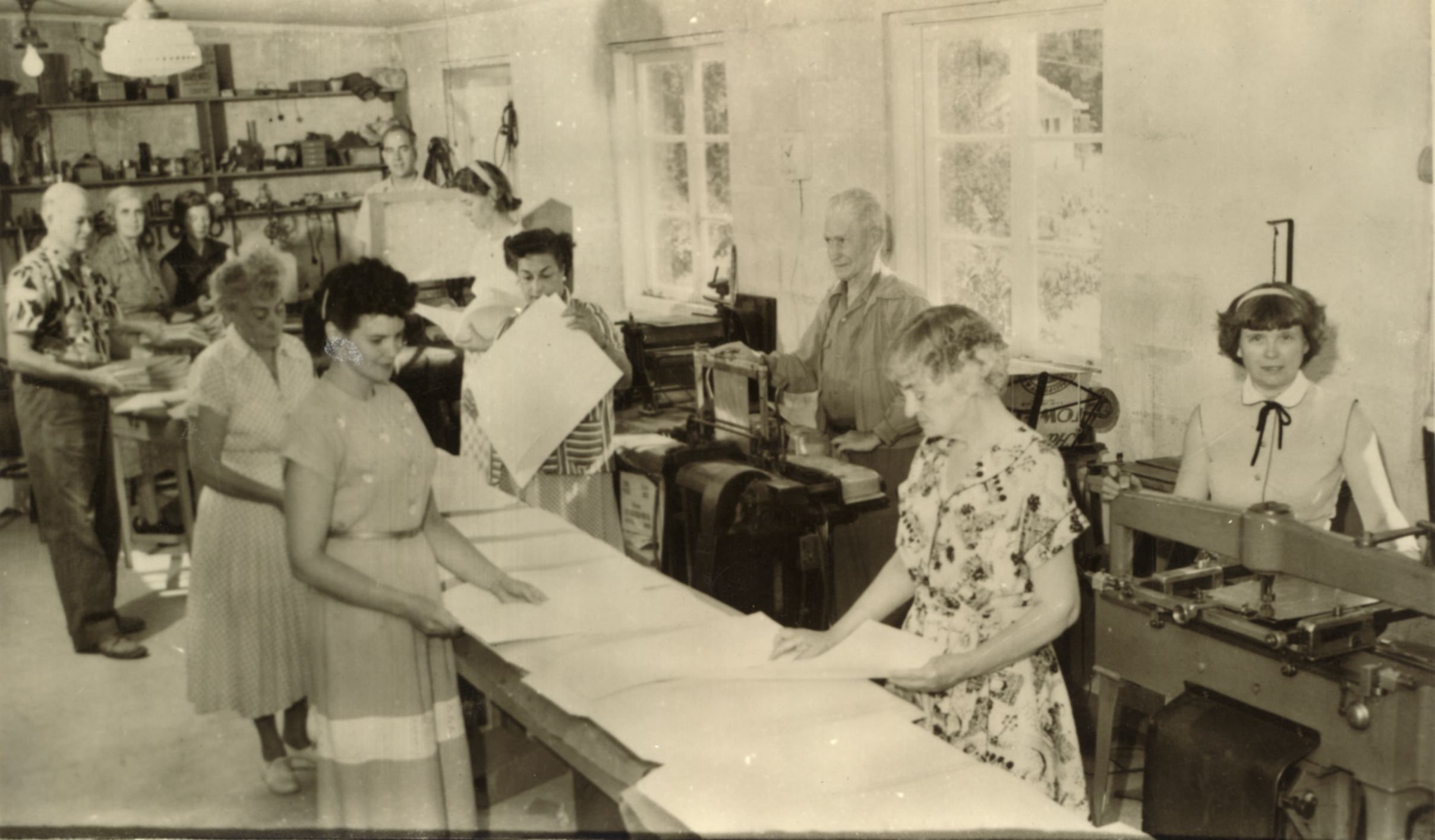
Krotona Braille Institute. Founded in 1910 in Boston, the Theosophical Book Association for the Blind moved to Hollywood in 1917, where it became the Krotona Braille Institute. Roy and Flavia Snyder (seen operating the Braille presses on the right) moved the Krotona Braille Institute to Ojai in 1947. The Institute consisted of a Braille publishing house and the Baker Memorial Library, which loaned Braille books throughout the world.
The above is an excerpt from Ojai: A Postcard History, by Richard Hoye, Tom Moore, Craig Walker, and available at Ojai Valley Museum or at Amazon.com.
Wheeler’s Hot Springs Auto Stage Lineby Richard Hoye
Wheeler Blumberg homesteaded property in Matilija Canyon in 1888, and he constructed an access road. He then opened his Hot Springs to the public in 1891, offering a hotel with dancing pavilion, a swimming pool, a briskly running stream, fishing and great scenery.
Travel from the village of Nordhoff to the popular resort was provided by horse-drawn coaches of all types, large and small, carriages, tally-hoes, etc.
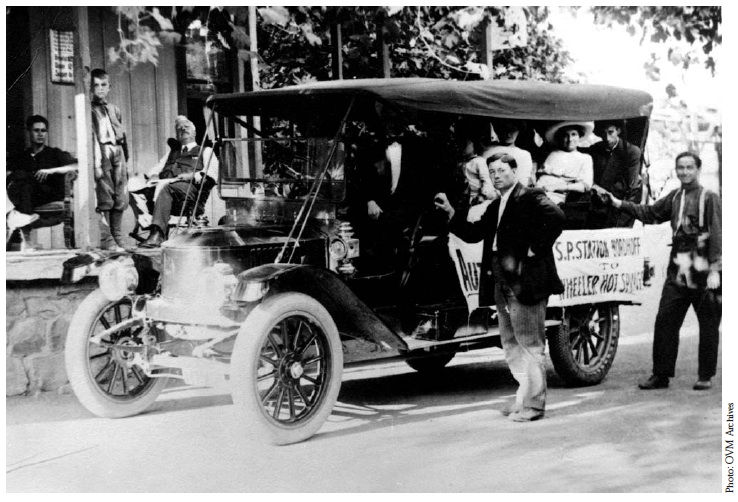
Visitors would arrive in the valley by railroad and then be taken to Wheeler’s along a pleasant scenic route. However, after 1900 interest turned to mechanized travel, and auto stages were introduced.
The resort came into the possession of Webb Wilcox after Wheeler Blumberg’s death in 1907. Wilcox had married Wheeler’s daughter, Etta, in 1905, so Wilcox was Wheeler’s son-in-law. The resort thrived under Wilcox’s management, and he continued to manage it until 1935. By 1924, Wilcox was offering auto transportation for the entire distance between Los Angeles and the resort.
In this photograph, an autobus is clearly marked “S.P. Station, Nordhoff, to Wheeler’s Hot Springs.” Guests have been seated, and the driver is ready to embark from the village to the resort. When the weather permitted, the top of the autobus could be removed, and passengers would ride in the open air.
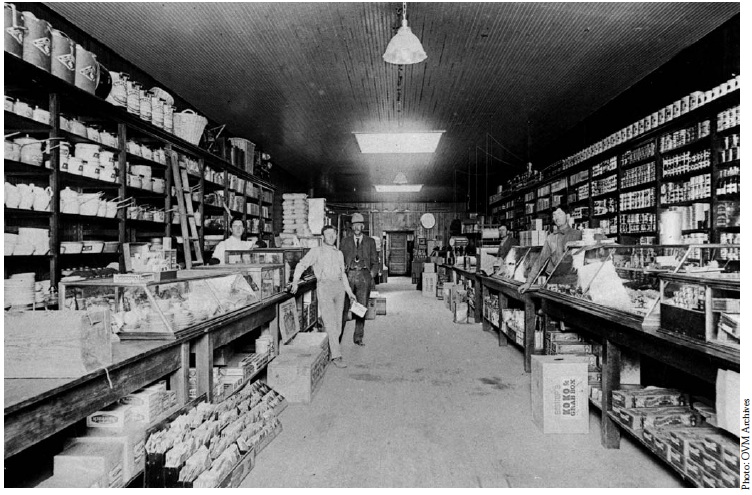
Clyde Stewart opened a store at the center of the village of Nordhoff in 1910, and his business was listed in the telephone book that year. An advertisement, carried in The Ojai newspaper in 1917 read:
We carry a full line of
GROCERIES
and solicit your business,
satisfaction
GUARANTEED
C.A. Stewart, Grocer.
6 Years in Business
Nordhoff, California
In this photograph, we see Stewart with his staff of clerks. The array of goods on display is typical of most of the grocery and general merchandise stores of the day. Packets of seeds rest in racks on the floor to the left of the aisle. Pots and pans are on the shelves above. At the rear, a large clock hangs on the wall.
Note the sky lights at the center of the ceiling. Those same sky lights can be seen today at Vesta Home & Hearth (previously Tottingham Court).
Howard Bald wrote of an incident that occurred at Clyde Stewart’s store about 1910:
About this time, “one smart aleck rode into Clyde Stewart’s grocery store (on a horse) and roped a fellow and dragged him over the counter…that smart aleck…was myself.”
Howard was only eighteen years old at the time. His behavior must have created quite a stir.
Clyde Stewart ran for and won the office of City Clerk for the newly incorporated City of Ojai in 1921, becoming the first in the city to hold that office. He was later active in the Ojai Orange Association and was secretary of the Association in 1934. He owned a ranch on McNell Road.
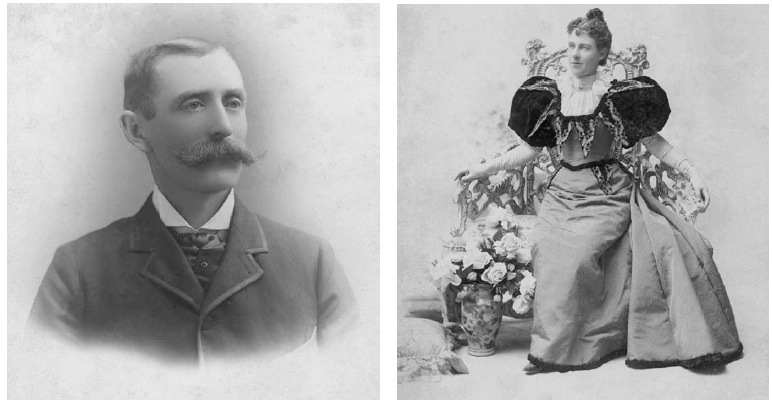
Orestes Orlando Orr, who was born in Illinois, arrived in the county in 1878 to teach school on the Avenue. His real interest however was to become a lawyer. He was admitted to the bar in 1881 and became a member of the first law firm in Ventura County. He was elected District Attorney in 1884 at age 27, and he held the office for three terms.
He married Ella Mae Comstock in 1881. She had been born in Oskaloosa, Iowa. The lives of the couple entered a new phase when Orestes ran for the office of State Senator in 1892. The Ojai reported on November 5 of that year that “The Republican meeting at the school house last Saturday night was a rousing one. Orestes Orr made many votes for himself by his manly talk . . . .” He was elected. While serving in the State Senate, he held the chairmanship of the Roads & Highways Committee, a prominent position considering the great drive for good roads at the time. A couple of years later, he chaired the Senate Committee on Corporations.
The photographs above may have been wedding photographs, but a note on the back of Ella’s states that her dress was typical of what she would have worn to official functions in Sacramento. Unfortunately, Ella Mae died young, at age 41 in 1908. Orestes continued to practice law in Ventura County.
His son Harold held the position of Ventura City Attorney for 35 years. Harold received Earle Stanley Gardner into his Ventura law firm in 1915. Orestes’ son Charles owned the Hermitage Ranch in the East Valley, and Orestes himself lived on Signal Street at the time of his death in June of 1915.
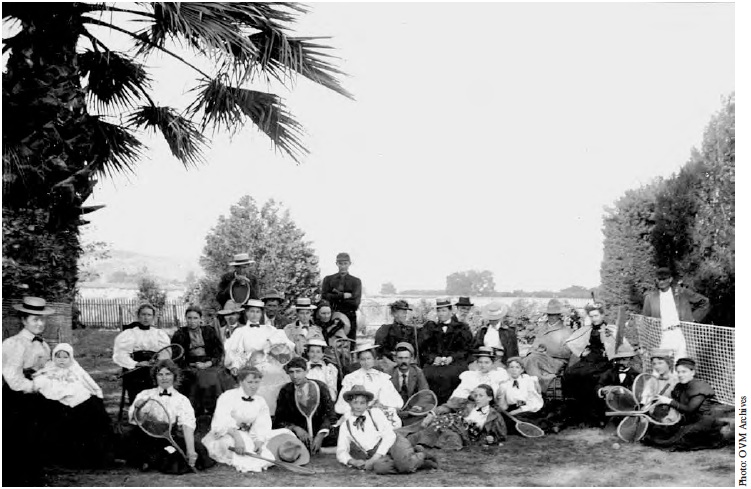
The Dennison family is seen here gathered at their ranch in the Upper Valley in 1897, possibly for the celebration of New Year’s Day. The younger members are prepared to play tennis, while the older members are seated on chairs alongside the court, well-wrapped against the chilly air. Seated at the rear center is a bearded man, Henry Jackson Dennison, head of the family. He looks old in this picture, but he lived another twenty years. He and his wife had many children, grand-children and inlaws, as this photograph attests.
The Ojai Valley Tennis Club had been formed about a year earlier, and its first Valley-wide tournaments were played in 1896. Nina and William Soule were the first mixed-doubles champions that year. It seems probable that some of the persons seen in this picture participated in those first tournaments.
Three of Henry Jackson’s sons stand at the rear, from left to right: Rapp, Schuyler and Waldo (behind the net). At the far left is Henry’s daughter, Lulu Dennison Mallory, holding her daughter Margaret on her lap. The infant was born in October 1896. At the lower center of the picture is a young woman who romantically holds a bouquet of flowers on her lap. At the far right is a smiling young woman wishing us good luck by displaying a four leaf clover constructed of tennis rackets. Note that the Dennisons seemed to have had trouble properly trimming their palm tree.
Tennis anyone? Can you find the tennis ball in the picture?
Nordhoff Cemetery: Frank Frost by Patty Fry and Dennis Mullican
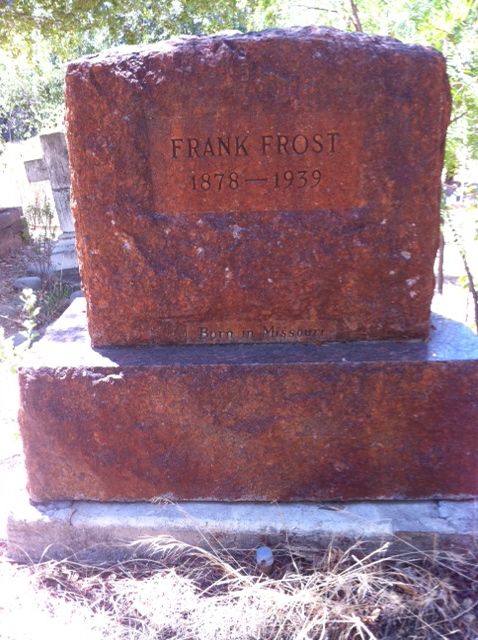
Died April 14 (or 17), 1939 at the wheel of his automobile from a heart attack. Born in Missouri in 1878, Mr. Frost was a graduate of the University of Missouri. He became a teacher. He also did some mining in the west and banking in New York. Mr. Frost talked Edward Yeomans into starting Ojai Valley School and he built the first dormitory there, still known as Frost Hall. He was also instrumental in organizing the Frost-Coolidge Music Festival in 1925. Funeral Services for Mr. Frost were in San Francisco and he was buried in the Nordhoff Cemetery. Mr. Frost left five children, Morris, Emily, Frank Jr., Robert, and Anne. Mr. Frost was so well known in fine music circles that his obituary was reported in newspapers in San Francisco, Los Angeles, New York, Washington DC as well as Palo Alto and Ojai. Mr. Frost was reportedly buried in his favorite red plaid shirt and brown suit which was handwoven from Norwegian homespun yarn. One of his sons said at the time of his burial that the Nordhoff Cemetery was just the sort of place Frank Frost would have loved. And that he would have been pleased by the fact that three Scotchmen are buried near him.
The above is an excerpt from Nordhoff Cemetery, Book Two, by Patricia Fry with Dennis Mullican.
Matilija Stage Coach. The Ventura Signal reported on July 26, 1873, that a stage line had been opened between Ventura and Matilija Hot Springs. Andy Van Curen opened a line between Ventura and the valley in the summer of 1875. Various lines operated thereafter. This photograph shows a stage at the second site of Matilija Hot Springs and dates from around 1910.
The above is an excerpt from Ojai: A Postcard History, by Richard Hoye, Tom Moore, Craig Walker, and available at Ojai Valley Museum or at Amazon.com.
Bathing Girls at Wheeler’s Hot Springs. There was no reason to be morose about the ultimate destiny of the springs. Here was one way of having fun. The women have arms and legs uncovered, so the photograph must be sometime during the 1920s.
The above is an excerpt from Ojai: A Postcard History, by Richard Hoye, Tom Moore, Craig Walker, and available at Ojai Valley Museum or at Amazon.com.
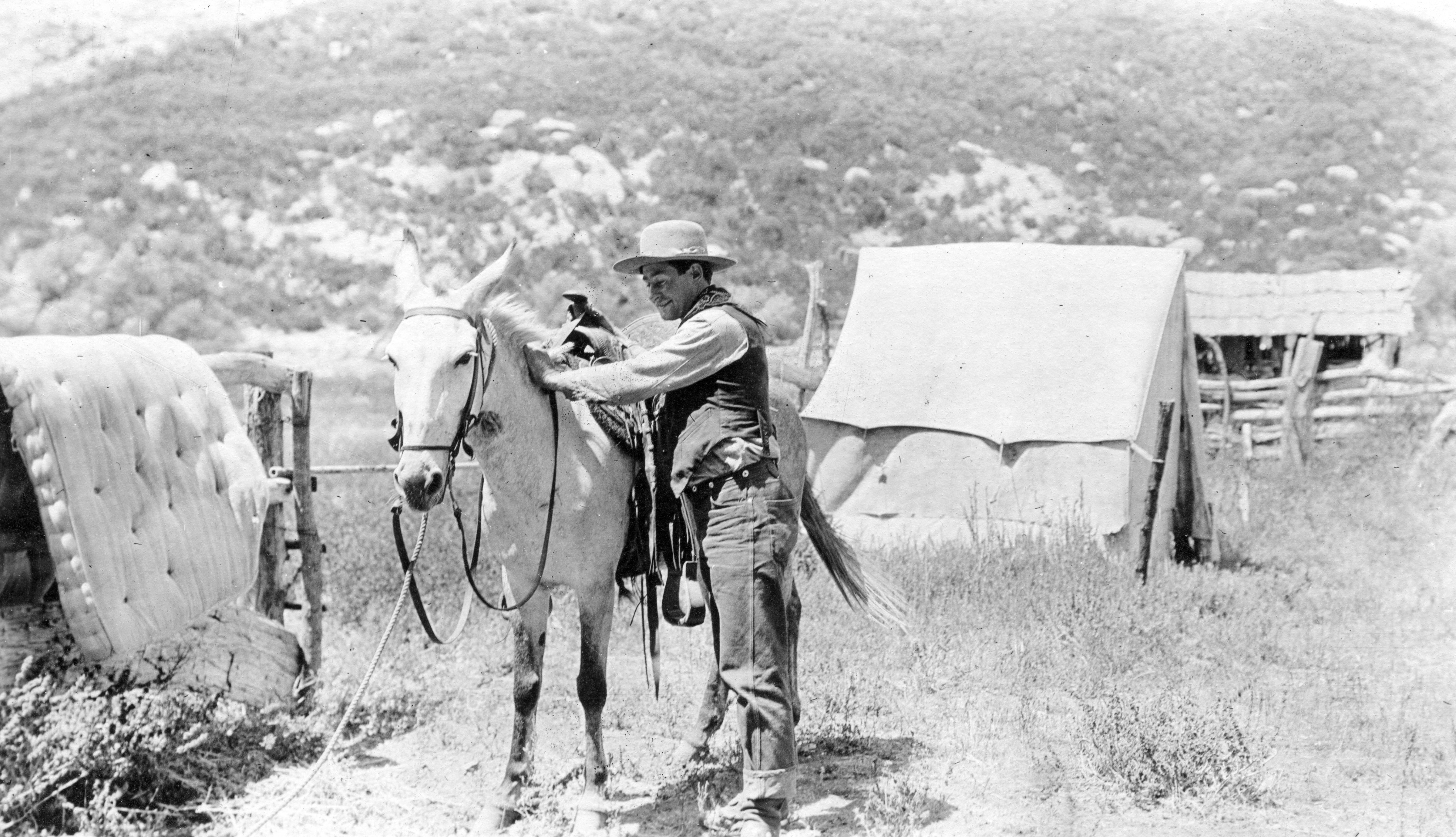
Note: Howard Bald was an early Ojai resident. His reminiscences were written in the early 1970s.
About the middle of that first decade of the century [1905], an occasional automobile would appear in Ojai. Naturally there was some friction between auto drivers and horsemen. Generally, the automobile people were quite understanding and would often pull to the side of the road, shut off the motor and even lead a fractious horse past the auto.
One farmer had quite a smash-up. The motorist went to his assistance and did all possible to straighten things out, but the irate farmer was not satisfied and insisted on fighting. The motorist backed off, saying, “You don’t know me.” The farmer didn’t care who he was and kept advancing and swinging.
Finally, the motorist struck one blow and the farmer went down in a heap. That motorist was Joe Rivers, a world-famous prize fighter of that day, who was training at Wheeler’s Hot Springs. He fought several battles with Ad Wolgast, who held the crown, but just didn’t make it.
The Pierponts were among the first of that day to have an auto. Phil and Austin came bowling down Ojai Avenue looking neither right nor left. Fred Houk and I were riding up on horseback, and our horses shied off the road at their approach.
I don’t think we were much inconvenienced, but we were incensed at being “run off the road” by those “stuck up so-and sos.” We turned about and galloped into town, vowing to show them a thing or two. We were doubtless relieved when arriving to find that they had not stopped and were probably headed for Ventura. Phil, Austin and I have had some good laughs over it.
I can’t refrain from relating one more horse-auto episode, even though it occurred in the middle of the second decade [1910-1919]; and I am trying to confine myself to the first decade [1900-1909]. I bought a rather attractive colt for a few dollars, because of her questionable character. After several months of training and a little expense, she became quite a docile animal. I had an interested buyer who offered quite a substantial sum of money, considering what I paid for her.
Before the deal was closed, I was riding up the upper Ojai grade with a young lady, when an auto crowded us into the bank and rammed into my colt. As a result, she developed an everlasting fear of the chugging monsters, and of course, ruined my sale.
At the time, Earl Stanley Gardner was practicing law in Ventura (that was before he took up writing). We had been on several expeditions in the Sespe and Pine Mountain country and had become quite friendly. When he heard of the incident, which was months later, he said, “Let’s sue them.” “Them” was the Bartlett Music Company.
The trial that followed was one of the funniest events that was ever staged in Nordhoff [now Ojai]. Court was held in the rear of what is now Bill Burke’s offices [the Ojai Realty Company in the arcade], and Judge [Harrison] Wilson was on the bench. At times he was practically on the floor from laughter.
The defense had gone to a great deal of expense and time, procuring evidence and witnesses to prove that the animal was a confirmed outlaw, and I was reputed to be the best rider in the county, that at one time I was unable to ride her, and that I paid only 37 dollars for her. My witnesses were winter tourists of the Foothills Hotel and Pierpont Cottages, who all volunteered their services.
All of the defense witnesses’ testimony was really a help to me, and for the sake of brevity I will eliminate details; but Judge Wilson decided in my favor. Gardner would take no pay from me. He just had the satisfaction of beating Earl Moss, who was a young Ventura lawyer, not to be taken lightly. The Ventura newspaper (I don’t remember its name) gave the country boy [Howard Bald] quite a panning for trying to hog the road with old Dobbin [“the confirmed outlaw”].
I faintly remember the furor that went up at about the turn of the century over women riding cross saddle. My mother and aunts were among the first to change. The garb they wore was a long, voluminous, divided skirt, that reached almost to their stirrups. One prominent citizen threatened to take his wife and sister off their horses and spank them if he caught them riding “astride.” Our family had several side saddles around for years, but whatever became of them, I don’t know. They would be valuable antiques today.
“Reminiscences of Early Ojai” by Howard Bald, 1973
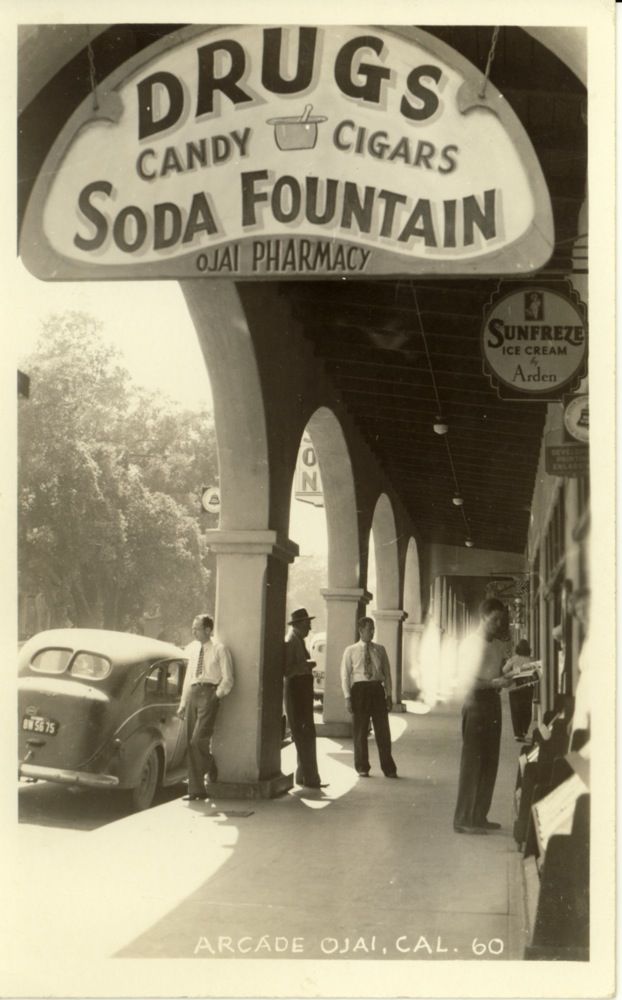 The Ojai Pharmacy. Until the 1960s, the arcade was Ojai’s primary business district, catering to the everyday needs of local residents. One such business was the Ojai Pharmacy. In addition to filling prescriptions, it featured a full soda fountain and lunch counter. Howard Nelson Rockafellow, a colorful Ojai personality, started the business in 1927. Over the next 30 years he helped organize the Ventura River Municipal Water District, served as President of the Lions Club and Chamber of Commerce, and sat on the City Council. Rockafellow single-handedly thwarted a move by the Ventura Chamber of Commerce to rename Lake Casitas “Lake Ventura”. Ironically, while giving an autobiographical speech to the Retired Men’s club at age 71, he ended with, “I expect to live the rest of my life in Ojai”–only to be struck dead by a heart attack at that very moment.
 The above is an excerpt from Ojai: A Postcard History, by Richard Hoye, Tom Moore, Craig Walker, and available at Ojai Valley Museum or at Amazon.com.