Early Ojai Stories, Part VI (More on Ojai Train)by Howard Bald
Howard Bald describes life in turn-of-the-century Ojai in these articles from 1972.
The Ojai-Ventura Train.
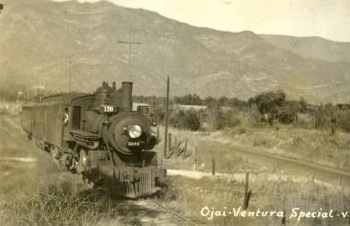
There were other incidents in connection with the “Ojai Flier” or”The Cannon Ball” that might be worth mentioning. One of the train crew lived with his family on Signal Street, the old two-story house now occupied by a masseur [Inn Harmony]. His daughters in the evening would hitch the old white mare to the buggy and park them near the side door. When they heard the train whistle in the distance, one or all three daughters would jump in the buggy and dash off to meet their daddy.
One evening a daughter went out, and finding no horse and buggy waiting, decided that one of the other sisters had gone alone and thought nothing of it. When father checked out from his “run”, he found the horse and buggy in the customary place. After looking around and finding no daughters, he drove home alone. Later it was revealed that the old white mare was seen jogging down Signal, up Main Street to Fox, and down to the depot on her own.
A few years later my young sister decided to make Peggy, our two year old colt, acquainted with the train. Margaret was riding bareback with only a hackamore. Peggy took a pretty dim view of the hissing monster, putting on quite a scene, and at one time was in the middle of someone’s buggy. But through it all, Margaret stayed astride her.
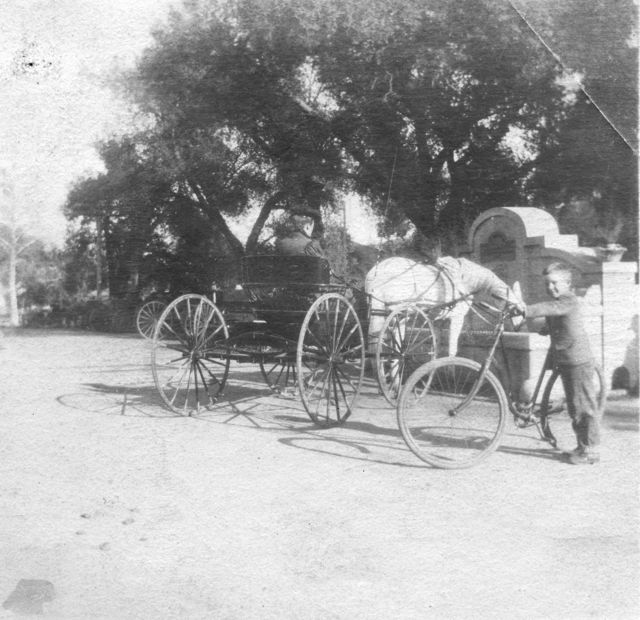
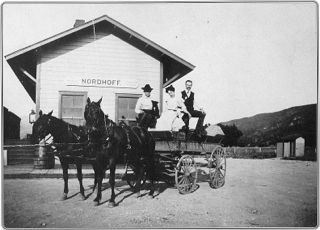
A horse and buggy in downtown Nordhoff.
One time I was sent from the livery stable with a horse and buggy to meet a domestic of the Edward Thachers on Topa Topa Ranch coming in on the train. It was winter and, of course, dark when the train came in. We soon had the old gal and her belongings loaded and were off up Ojai Avenue. By the time we turned off onto Reeves Road (it wasn’t much more than a narrow, winding, rocky trail then and I don’t believe it had a name) the poor old Scandinavian was having some misgivings as to the reliability of her escort. She couldn’t understand why I didn’t drive faster.
I did my best to reassure her, pointing out that the road was rocky and narrow. When we turned up McAndrew road and the horse travelled even slower, she was really convinced that I was lost. There was nothing, though, that she could do, for it was pitch dark and I don’t suppose she even ha a pair of reins in her hands. It probably wasn’t eight o’clock when we drove into Topa Topa yard, and Mr. and Mrs. Thacher appeared with coal oil lanterns. But that lady, I guess, considered it a harrowing experience.
It was wintertime when once my mother, my sister and I were going someplace by train. As we groped our way on foot from Signal to Fox Street in the dim dawn, we heard the locomotive give some sharp whistles, but we sauntered along until we discovered the train was at the Fox Street crossing. Mr. Spence, the engineer, knew we were no aboard and was waiting there for us.
Another time most of Nordhoff went to Santa Barbara to a circus. We arrived via train in Ventura at 7 a.m. and had quite a wait there for another train, but were in Santa Barbara in time for the parade, saw the afternoon performance, then took a southbound train back to Ventura, arriving in time to catch the Ojai Flier home. I am not sure but what it had to wait for us in Ventura.
Mr. Spence, the engineer, was a kindly old gentleman, and once he took me with him on the locomotive, a cod burner, to Los Angeles and back, a two-day trip with 24 hours of travel. It was one of the events of my young life (I was probably 10 then), but alas it was somewhat marred by my introduction to indoor plumbing. I had never seen or heard of anything of the kind, and the whole thing was too embarrassing for words. No one knew how I suffered. Mr. Spence doubtless thought me a very unresponsive and unappreciative youngster. It was my first experience with electric lights, too. In the center of each room a cord hung from the fixture in the ceiling.
Well, so much for railroading. We will next dwell on the village of Nordhoff.
Early Stories of Ojai, Part V (The Ojai Train) by Howard Bald
Howard Bald recounted life at turn-of-the-century Ojai in these articles from 1972.
Much has been written over the years about leading citizens of the Ojai Valley and their contributions to the community. What I propose to do is to try and present a picture of the everyday citizen, something of what life was like at the turn of the century and the decade that followed, of some of the industry and activities that have long been forgotten.
Unfortunately, there are not many left to help me on points that have become dim in my memory. I trust, though, that there will be no more inaccuracies in my statements than there have been in statements made by people who are better qualified to be historians than I am.
For instance, at the dedication of the new post office a few years ago it was stated that the new building stands on the same spot the post office stood at the turn of the century. Another person in her memoirs stated that Ojai (Nordhoff) never had a saloon. Also the Ojai newspaper wrote an account of Mr. Gridley murdering a Basque sheepherder in the Sespe. All of which I know to be absolutely inaccurate. But more on those subjects later.
Now it is not my purpose to start right in criticizing others, but to show how easy it is to make misstatements. I will doubtless make my share of them.
Arriving in the village of Nordhoff (Ojai was Nordhoff until the time of the first World War) in the spring of 1900, I was a scrawny, squint-eyed eight yar old with a supposedly short time to live because of TB. The long severe winters of northern Washington and Idaho kept me wrapped up in bed a good part of the year, so a mild climate with plenty of freedom was recommended by the doctors.
Well, I took full advantage of the freedom and in that way gained a wider knowledge of what was going on than the average boy of that time.
One of the things that stands out in my memory was the Nordhoff train. It was not until I had grown up that I realized that the train had arrived only two years before my arrival in the Ojai Valley.
Two trains plied between Los Angeles and Nordhoff. As the train left Nordhoff at 6 am, its sister train left Los Angeles. They crossed at Moorpark, where the crews had their lunches, then continued on to their respective destinations. So each train took 12 hours to make the one way journey.
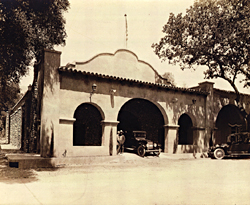
On long summer evenings one popular source of entertainment for certain men, boys and dogs was to sit on the board sidewalk, where the arcade is now, and at the sound of the train whistle down near Grants Station [where Rotary Park is now], all would take off on a trot for the [Nordhoff] Depot.
Near Schroff’s Harness Shop (where the Ojai Cleaners now is) we cut down Montgomery Street and below the lumber yard, now Wachters, we went across to Fox Street.
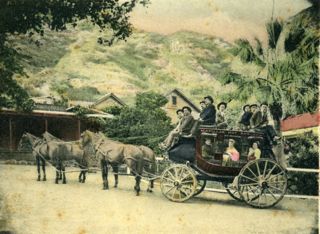
At the same time the Matilija Hot Spring’s big lumbering overland stage, driven by either John Oretega, Bill Olivas (father of the Billy Olivas who is currently making headlines at Matilija Hot Springs) or Bob Clark would wheel in a cloud of dust, followed by Wheeler Blumberg with his four white horses hitched to a four-seated buckboard. Nordhoff’s taxi, which comprised a team of horses attached to a buckboard, would be there along with an assortment of country folk with a horse and buggy to meet incoming friends or family.
The Matilija Stage
As the train crossed S. Ventura, S. Montgomery and Fox streets huffing and puffing, with steam jetting from both sides and the bell clanging, there was general pandemonium, for many of the country horses were terrified of such a monster and resorted to lunging, bucking and rearing. Not infrequently would be heard snap of a buggy shaft or a wagon tongue amid the barking of dogs and shouting of women and children on the ground greeting incoming family.
When the Matilija and Wheeler Hot Springs guests were all loaded there would be a popping of four horse whips, as the stages departed through town on a dead run. In later years I have wondered just when the horses settled down to a jog trot, for certainly they couldn’t endure such breakneck speed for long.
The Taxi
Finally as broken harness and buggy shafts were mended and the more terrified horses were led out across the bridge and all the passengers had departed, the boys and dogs would straggle off to their respective homes and the men back to their visiting along the boardwalk or to Dave Raddick’s pool room. I don’t believe the patron’s of John Lagomarsinoa’s card house were ever diverted from their evenings carousel by the arrival of a train.
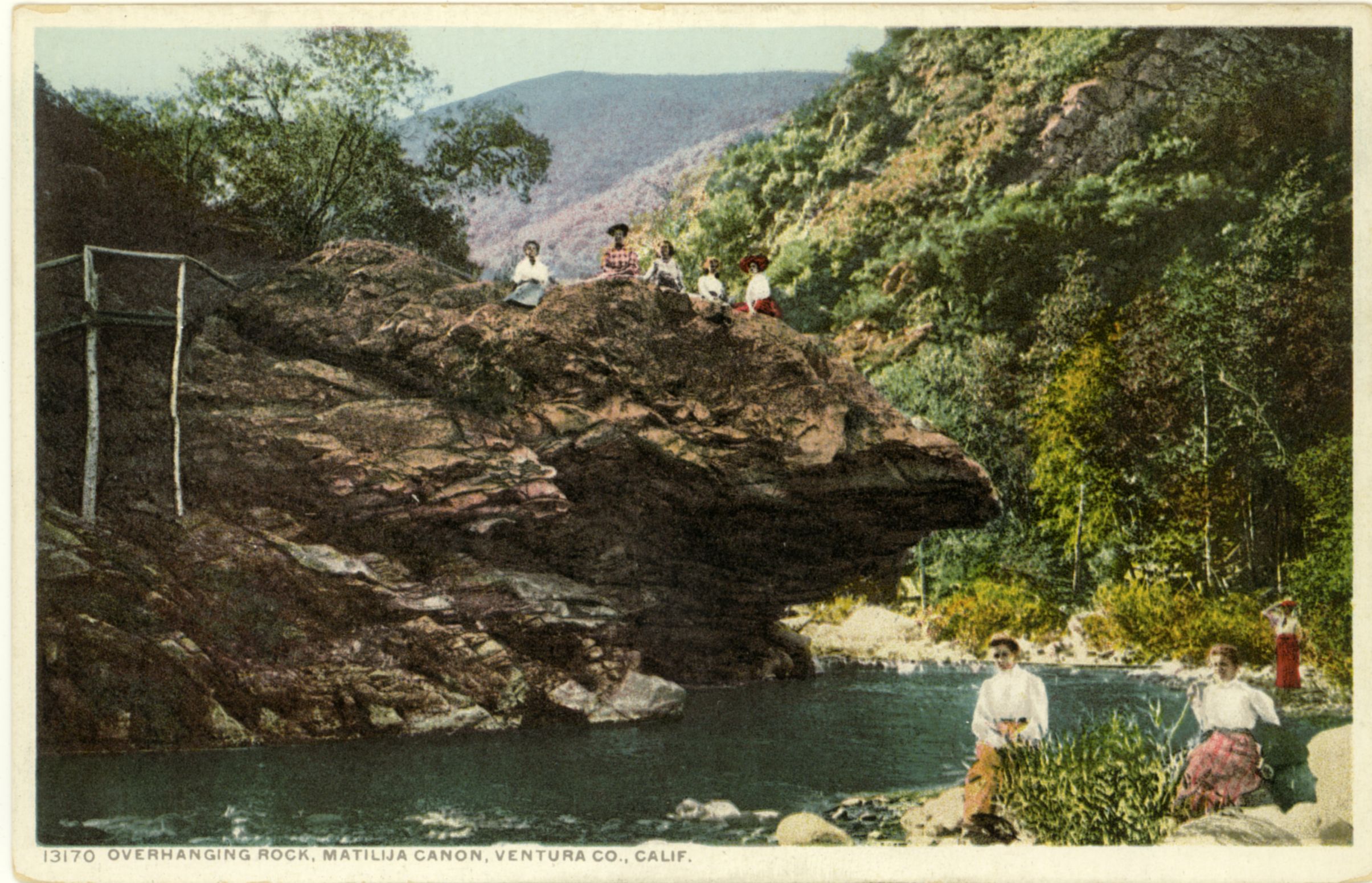
I’d like to go to hanging rock today,
Just as I did in that far other day,
To sit and dream in the deep canyon’s shade
Beneath the towering crags rising rugged above
The tumbling waters of the river,
In wondrous Matilija.
Twas very long ago, in flaming youth,
We two sat side by side beneath
The great moss-covered stone
A trysting place sought out in those old days
By the swift river waters where trout sprang
Glinting in the sunlight
In Matilija.
With devil’s slide across the way,
And dotting the declivities
The snow-white Spanish daggers reared their heads
Boldly in the upper reaches of the sun
On the canyon steeps,
And bird song filled the air, and calling quail
And murmuring dove were in Matilija.
It’s well-remembered by the young of then,
That old hanging rock,
By those of now who are with us
Those of now with grandchildren
Toddling about their knees, and whose mirrors
Bring a sigh as a memory travels back.
And where are the lovers of yesteryear,
Lovers of olden Matilija.
NOTE: Hanging Rock was covered by Lake Matilija when Matilija Dam was built in the 1940s. Where do young couples go to tryst now that Hanging Rock is gone?
Early Stories of Ojai, Part IV (Nordhoff Rangers)by Howard Bald
Note: Howard Bald was an early Ojai resident. His reminiscences were written in the early 1970s.
In 1898 the Santa Barbara National Forest (now Los Padres) was created with headquarters in Nordhoff. Willis M. Slosson was sent out from the east as supervisor. The boundaries extended from Castaic up into San Luis Obispo County and north into Kern County.
Men were recruited from all parts of the back country, and they were largely homesteaders, cowboys, miners, and such. Their pay was $60 per month. They had to own at least two horses and maintain them. Generally the ranger (they were all rangers then) had to provide his own quarters. There were no fringe benefits.
With Nordhoff the national forest headquarters, and since the only means of getting around was via saddle and pack horses, there was a great deal of forestry activity in the valley, that is, mountain men coming and going. A more rugged, hardy, self-sufficient, picturesque group of men would be hard to imagine. Though as a whole they were rather short on formal education, they accomplished a prodigious amount in the way of trail building, and maintaining, investigating mines and homesteads, issuing grazing permits and performing fire suppression.
They were also deputy and game commissioners.
Of course thee were no telephones at first, no lookout stations, no airplanes or helicopters, or radios, and but few trails. Sometimes a ranger would ride a day or more to get to a fire. The nearest ranger to a fire might recruit a few men—homesteaders, cattlemen or miners, and with just a few simple tools attack the fire.
One wonders now how they accomplished so much with so few men and little equipment, when one hears of the hundreds of men, bombers, fire engines and other sophisticated equipment that is employed to suppress the same fires today and at a cost of hundreds of thousands of dollars.
Among some of the more colorful men of that period was Jacinto Reyes, who to this day is a legend among people in the back country, not only for his fire fighting but also for his horsemanship, endurance, rescue work, and ability to settle sometimes violent disputes among homesteaders, cattlemen, or miners. Then there were his brother Geraldo Reyes, Frank Ortega (father of ex-Ventura postmaster Melito Ortega) and Fred de la Riva. They were what we called in that day “California Spanish.” They were great horsemen and very capable.
My father, George Bald, became one of them in 1903 and until the mid-twenties was chief ranger of this area. Trever Isenberg, Jerome Larmer, Bob Clark, Bob Miller, Bill Herbert, the Leiber brothers, Tom Dunsmore, Gene Johnson were among others of that day I remember. They were what one might call, at that time, “real Westerners.”
There is, to me, an amusing story that might give an idea of how that breed of men could impress the uninitiated easterner. In later years it was recounted to me many times.
Sarah McMullen was a nurse who came to take care of Loring Farnum, a semi-invalid who bought our Rinconada Ranch (J.D. Reyes and I gave it that name), later the Orchid Ranch, which is now owned by Camp Ramah. She always began the story with: “The worst fright I ever had was being confronted at Mr. Farnum’s front door by three of the awfullest looking men I ever laid eyes on!” Then there would be a detailed description of the three. “Two were huge, very dark complexioned men with high cheek bones and dark, piercing eyes. The third man was short with a sandy complexion and legs like a pair of ice tongs.” The refrain would be: “And that was your father!”
They wore broad-brimmed, low-crowned hats and red bandanas, and, of course, were unshaven. They curtly asked to see Mr. Farnum. I was trembling so,” said Sarah, “I could hardly speak when I went back to Mr. Farnum’s room and said there are three of the most terrible men I ever saw who said they want to see you. Mr. Farnum said, ‘Well, show them in!'”
As I pictured the scene, Jacinto and Geraldo Reyes and my dad were returning from a week camping in the mountains. They were tired, dusty and, of course, thirsty, and they knew that Mr. Farnum was always generous with the drinks.
“Reminiscences of Early Ojai” by Howard Bald, 1973
Early Stories of Ojai, Part III (Chinese in Ojai)by Howard Bald
Note: Howard Bald was an early Ojai resident. His reminiscences were written in the early 1970s.
Many Chinese as well as Italians were employed in wood cutting operations in the valley around the first of the century. Some Chinese lingered on as domestics or in other capacities for a decade or so.
My grandmother had one who baked delicious bread. The loaves were always a beautiful deep brown. But the Chinese and my grandmother suddenly parted company when it was discovered that he would fill his mouth with water and squirt it over the loaves during the baking.
There was always a Chinese vegetable wagon pulled by two horses, or sometimes one horse, that came around once a week. (There were never fresh vegetables in the grocery story that I remember.) A carrot or a turnip to each of us youngsters was always a treat, but the Chinese vendor didn’t always have them.
At this period no one can tell me where the vegetables were grown, probably near Ventura. A special treat that we youngsters looked forward to about Christmas time was Chinese nuts, or litchi nuts. They were delicious.
And there was the Chinese laundry that at one time was operated by Wah Lee. It was located east on Ojai Avenue just west of the bridge, and on the north side of the property on Mrs. Gally’s property, mother of Howard Gally. Wah Lee went about with a covered wagon drawn by one horse. His business survived on into the second decade. In fact, during prohibition times, he probably made more money bootlegging than doing laundry. I faintly remember a little stir that was caused by Mrs. Gally refusing to put him out when the local officers were unable to catch him.
Chinese were said to have built the first stone walls in east Ojai valley. It seems to me that the walls looked as old at the turn of the century as they look now. Those walls don’t include the ones on east Ojai Avenue, east Grand, north Carne and the one on the Twin Peaks Ranch. I have been told that these Chinese received 50 cents a day.
There was not too much law enforcement in that day, and the poor Chinese sometimes had a pretty rough time of it. I have heard my mother tell of her brother Tom roping (lassoing) one as he plodded along the dusty road. Tom was riding a colt and couldn’t manage the rope and the colt at the same time, with the result the Chinaman climbed up the rope and took it away from him. Tom dismounted, my mother (Katie) held the colt, while Tom tussled with the man and retrieved the rope.
Later the fellow returned with a shotgun, but Tom had ridden off to the Upper Ojai, while Katie’s mother hid her in a clothes closet and locked all of the doors. That house was the two story, yellow building south and east of the Ojai lumber company yard, a mile and a half east of Ojai.
Well, that fellow had the last laugh. Some time later the boys who had taken his laundry were swimming in the creek beyond what was Clausen’s dairy on the Pirie ranch. This same laundryman slipped up and stole all of their clothes. Needless to say, they were not returned nicely laundered.
There were many other incidents of that nature, some funny, some not so funny, dependent largely on one’s point of view. But just one more Chinese anecdote: A group of rowdies one dark night surrounded the wash house and began firing guns into the air. The occupant of the house opened the door and returned the fire. In the rowdies haste to clear out, one was almost decapitated on a clothes line.
“Reminiscences of Early Ojai” by Howard Bald, 1973
My Chumash Ancestral Legacyby Julie Tumamait-Stenslie
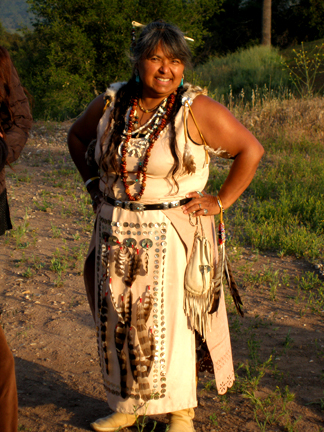
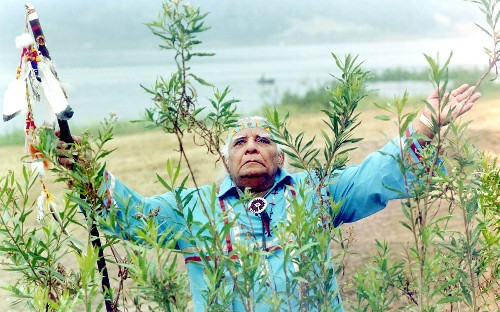
Julie Tumamait
As a Chumash descendant, it is my belief, and that of many other Chumash people, that we have always been on this land. Anthropologists (scholars who study the remains of past societies) do not know for sure when the ancestors of the Chumash arrived in this area. Theories claim that they may have arrived somewhere between 12,000 and 27,000 years ago.
Recent studies on human remains that have been in the possession of the Santa Barbara Museum of Natural History have been dated 13,000 years ago. These bones belong to one person, a woman who lived on Santa Rosa Island, one of the islands belonging to the group of islands known as the Channel Islands off the coast of Southern California. This places her as the oldest recorded human being on the North American Continent.
Scholars theorize that the people migrated across a land bridge called the Bering
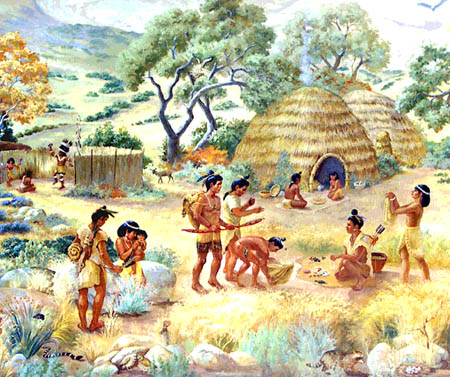
Typical Chumash Village
Strait, a strip of land from Siberia to Alaska. In the Chumash oral tradition, we have creation stories where the people of the upper world, Mishupashup, created man from a table made of marble and then, after it was decided what kind of hands man should have, he was placed in this world, Itiashup.
The decision on the kind of hands for man came about when Snilemun (Sky Coyote) argued with Sun that man should have hands like his; then it was decided. As Snilemun was ready to put his paw down, a lizard ran around behind Snilemun and put down his hand, and with that action, we have hands with fingers instead of paws.
Another more modern creation story came out of Santa Barbara around the 1930s “the Rainbow Bridge Story” in which Mother Earth, or Hutash, planted seeds in the ground on the island of Limu, which means “In the Sea” (Santa Cruz Island), and up sprouted these people, strong and handsome. She gave them many gifts, items for them to survive on. When the island became too heavily populated, Hutash called them to the highest point of the island and told them that she was going to make a bridge out of a rainbow and that they were to cross over to a new land. This bridge connected this this land that spreads out for hundreds of miles in all directions. As the story goes, Hutash gave a warning stating that if the people looked down off the bridge, they would fall off and drown in the sea. Some of the people did look down, and as they fell Hutash heard the cries for help, so, out of pity, she turned them into dolphins.
So, with these stories in place, we Chumash people believe in these origins. My heritage comes from my father, Vincent Tumamait, and my mother, Lucy Castro Tumamait, whose parents come from Guajuanto, Mexico. They settled in Camarillo. My mother and father married in 1942 at the Mission Santa Barbara and made their home in Ventura. Family stories, baptism records and interviews with anthropologist have helped our family trace our lineage throughout Chumash territory.
Our family descends directly from Santa Cruz Island. In 1811, Juan de Jesus Tumamait was baptized in the San Buenaventura Mission, which was established in 1782. He was raised by his grandparents, who were two people among hundreds to be removed from the island to become part of the labor force that built the mission in Ventura. As an adult, Juan de Jesus became a captain for that area, helping maintain order and peace between the native people and the missionaries. He also played a violin in the mission orchestra.
As an adult, he took back his native name of Tumamait, which through research we have found to mean “orphan”. He tried to set an example for the other people to tell them that they should not let go of their culture so quickly, but assimilation was rapidly descending upon the people. As a result, our family is the only one who has a Chumash name as a surname. Juan de Jesus was our great-grandfather.
Vincent Tumamait. Photo by Juan Carlo.
My father Vincent moved us into the Ojai area in 1952. I grew up in the river bottom of Meiners Oaks, off the north end of Rice Road. As a child, I loved this area, being near the river and the mountains. Later, I would learn that our family descended from the people who lived in the village there. Juan de Jesus’ mother, Maria Ricarda (her native name was Alulalmegue, which means “one who drags their feet”), was born here at the village called Matâ’ilha, or as we know it today, Matilija, which means “division”. She was born about 1786. The village proper was situated where the present-day historical Lopez Adobe is; in 1830 it was a fort. In 1925, it was sold to Louise McCaleb.
It was in the 1830s that soldiers witnessed the Chumash people, hunting and gathering along the river, making temporary camps and performing ceremonies. Recently, workers were pulling rocks out of a stream bed just up from the former village of Matâlha to use for building a rock wall. One of the workers picked up a rock about the size of a frying pan, and when he turned it over, he saw some painting on it. It turned out to be a ceremonial stone with painted Chumash symbols on it. There has been only one other such stone found and we cannot explain them. This stone was donated to the Santa Barbara Museum of Natural History.
Throughout Chumash territory there are select places where cave paintings can be seen. We do not know all there is to know about them, but we do know that these caves are sacred and that visitation is not encouraged. This ceremonial stone was found near a spring, which is consistent with the painted caves. The closest cave that we know of in our area is in a place called Mutah Flats, named after William Mutah, a homesteader who lived in the area of Pine Mountain. This cave is a beautiful example of the intricate designs that the Chumash used to express their visions.
One reason that we will never fully understand these symbols is because the person or persons painting these symbols were sometimes under the influence of a hallucinatory drug, a special potion made up of the Datura plant. When drunk, the person went into a coma-like state. Upon awakening, the person would then tell the medicine man, or the “alaqlapsh”, his or her dreams. It is at this point that we lose the knowledge as to who actually painted the symbols.
When we take a look at Ojai and its power spots, we have to first acknowledge the great Topa Topas. The name comes form the Chumash word “sitop topo,” which means “much cane.” This type of cane was used for arrows and for small tubes about 2 inches long used to hold tobacco and then the person would pierce it through the ear lobe.
The village of “Awhay,” which is where the name Ojai comes from, was situated in the upper valley and, from ethnographic reports, it was said that crystals were gathered from the Topa Topas. Our oral traditions tell us about men who would dress in bear skins and travel from the villages of Sisar (eyelash) Sespe (kneecap) down the grade to villages in the lower valley all the way to the village of Matilija.
Little is known about the life of the Chumash in the Ojai Valley during the pioneer days. Some of the Chumash became cowboys and ranch hands; others picked the fruit from the orchards. Like my grandparents, they would belong to a family who put them to work on their ranch. Then, when they were finished, they would be “lent” out to another ranch.
Very little archaeology has been done in the downtown Ojai area. We all know about the Soule Park Golf Course site; it has no village name, only a number. It is only by looking at the collections at the Ojai Valley Museum that we can get an idea of what was in people’s back yards.
When Caltrans was doing trenching along Ojai Avenue near the El Camino Motel [Chantico Inn] and dirt was being loaded on dump trucks, the person monitoring this dig asked to look in the back of the truck. While sifting around with a shovel, a sandstone bowl was found. This bowl would have been used for pounding acorns into flour.
My brother and I do monitoring of construction sites, and it is in talking with different men who we are working with that we get a lot of after-the-fact news about village sites that were destroyed, or cemeteries that were plowed through. We heard how Lake Casitas and the Ojai Valley Inn were both built on former village sites. This was at a time when there were no laws in effect to prevent it. Communication with native people wasn’t done then and sensitivities weren’t as strong as they are today.
During the Ojai Valley Inn’s new construction, they hired a monitor. When we experience any drought years, people call me to say how artifacts are washing out of the banks at Lake Casitas, but my only concern is that no human remains are being exposed there.
A village by the name of Kashomshomoy (kind of animal) was located at the Ojai Honor Farm site (now HELP of Ojai West).
When I was a child, we spent a lot of time at Matilija Hot Springs and Wheeler Hot Springs, both have the healing waters that made Ojai famous.
The Matilija Hot Springs were discovered in 1873 by J.W. Wilcox, and were purchased by R.M. Brown in 1895. It was sold again in 1877 to a Mr. Gardner who opened it to the public. It remained open for several decades, but in 1988 it was closed to the public. It is now owned by a couple who allows groups to come in, though it is still closed to the public.
In my mind, this should always remain a healing place. I always feared the Matilija area for reasons I couldn’t explain to anyone. Through my learning process, I can now explain those feelings. This is a very powerful medicine place, and I feel that people should only enter this place at certain times with great respect.
We grew up hearing about Chief Matilija and his group of warriors who tried to fight off the ever-present armies. In the myth, the story goes on to tell of Chief Matilija’s daughter, Amatil, who was very much in love with the handsome warrior, Cocopah. Tragically, he was killed in the final battle. Amatil’s love was so deep and so pure that she she laid upon her lover and there she died. What remained of that love was a beautiful flower with pure white petals symbolizing their love and a yellow center to represent the everlasting brilliance of their love.. We know this flower as the Matilija Poppy.
Even though Chief Matilija was a fictional character, his curse still lives on. Many people have asked me about this. I don’t know when it began, but it focuses on the Wheeler Hot Springs several miles up the road from Matilija Hot Springs. The curse states that anyone who uses this land for ill gains shall perish. In our oral stories, we have a special one called “Gain Is All” that talks about the results of too much profit.
“A man once played on his four-holed flute: ci winu hayaya, winu winu hayaya, gain or profit, will always exist. He was a very close observer, and he began to study the world. He found conflicts that went so far as people killing one another, and the cause of it all was gain. He stopped playing this flute, put it to his ear, and listened to the world. And he heard that all was gain. Then he played the tune again and listed again, etc. And this is all—the hole in the flute is the pathway to thought. After figuring it all out, the man concluded that profit is the voice of all. All the time, it is a single voice-like humming of the air. Gain is the touchstone of the human heart. This story was published in 1975 by Thomas C. Blackburn in his book December’s Child: A Book of Chumash Oral Narratives.
Wheeler Blumberg built a bathhouse at Wheeler’s Hot Springs in 1888. He died in 1906, leaving the place to his daughter and son-in-law Webb Wilcox. It was sold many times and had a number of disasters befall on it. In 1917, five people died in a fire, and a flood in 1935 nearly destroyed it. A mobster was hiding out in one of the cabins when it blew up, killing him. One of the owners in the 1960s committed suicide. The flood of 1969 again put Wheeler’s out of commission for several years.
In 1985, as I was visiting the spa, I had just started my shower after a wonderful massage and hot tub, when I heard the sound of a fire engine. I looked out the window and the fire truck was pulling up in the parking lot. You never saw anyone get dressed so quickly! As we ran out of the building and out onto the road, we could see the fire coming down toward us.
At the time my now ex-husband was playing in a band at The Wheel bar across the street on Sunday afternoons. Well, this was a Monday when the fire started so all of the band’s equipment was still in the bar. We found some people who were visiting and had them fill their cars with all the instruments to take them down the hill to our house. The hot tub buildings did catch fire, but were not destroyed.
The worst tragedy was the death of owner Frank and Evelyn Landucci’s son John in 1987. He and a friend were killed when an oak tree fell on them. It had been hollowed out by the 1985 fire.
Wheeler’s is now closed due to a number of financial problems. The latest news that I have heard was that someone wants to turn it into an Indian casino and I’ve been asked if I would be interested in joining up and being a part of it. “No, thank you!” Some people just don’t get it. Wheeler’s has so much power that we will never be able to capture its full potential; we have seen the full potential of its wrath.
This place as to remain what it had been for thousands of years, a healing place of humble origins, a place where friends and families can go and be healed. Great respect should be given when thinking of developing the land. When disturbing ancient sites, in some cases, there is retribution.
As we come back down the hill along the Ventura River, we come to everyone’s favorite gathering spot. As we talked about earlier, the shell beads that the Chumash made can be found everywhere in this valley, especially after it rains. These beads were made only on Santa Cruz Island, so when found on the mainland, one can say that they were a trade item. The Chumash people would bury the shell beads with the dead. So, when people tell me about the collection of pretty beads they have and where they found them, I have to ask them how their luck and health have been lately. I tell these people that the best thing to do is to go back to the spot and bury what they found, say a prayer, and ask for forgiveness. People who have not heeded the warning often fallen ill and died or they kill themselves.
Some may find this superstition, but, you see, we do not have much proof. Somehow man has learned that it is not OK to dig into modern cemeteries, so they don’t. We don’t know what effect that would have on a person. On the other hand, it seems to many that it is OK to go looking for the pretty beads and other things that are considered ceremonial and funeral-related.
There are other places we must mention which can occur anywhere; they are prayer spots. We can be walking down a trail and all of a sudden spot a carved stone item. This is an atishwin, a supernatural dream helper obtained by a vision quest and used as a charm. The person who made this fetish is long gone, but, for all we know, his or her power still remains. So, when you find these items, place them back in the ground and say a prayer.
One of the reasons I love living here in Ojai is the people and their concern about the land. People here are always ready to put down their hard-earned money to purchase land to be preserved as open space. For me and my descendants, it will be wonderful legacy to be able to learn and know about the ancestral villages and be able to look out over an open meadow instead of a mall.
History Fire Station 23, Oak Viewby Ventura County Fire Department
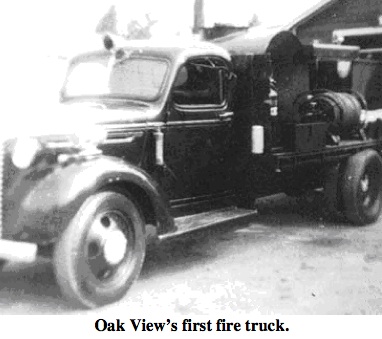
Oak View’s first fire station was established in 1938, when the County Fire Protection District delivered a flat bed Chevy truck, with a 300-gallon water tank and a 500 gallon-per-minute pump driven by a Chrysler auxiliary engine, to the Oak View Road station. A small amount of hose was also carried on the truck.
In 1946, Engineer Wayne Troxell was put in charge of the Oak View station and its volunteer group.
The title, Engineer, was later changed to Captain and the titles of the four Captains in charge of the four districts in the county were changed to Battalion Chief. The Engineer’s title was not used again until 1962.
At that time working hours were reduced from four 24-hour days on and 48-hours off to a schedule of two 24-hour days, one eight-hour day on, and 48-hours off. The new engineer position covered the station Captain’s two days off and worked with the Captain only eight hours of his three days on.
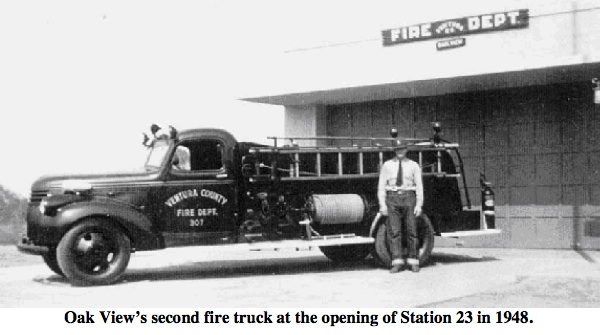
Troxell, his wife, and children lived in a small trailer parked behind the station. In 1948 a new two-stall fire station with living quarters for Wayne and his family was built at 15 Kunkle Street in Oak View. In 1952, Troxell resigned and built a number of buildings and homes in the county, including Station 20 and Station 35.
Glen Tremain, the second man hired for Oak View, lived at the station with his wife in an eight-by-ten room, cooking meals on a small two-burner stovetop.
Glen served the district for a number of years until he retired as Captain of the Ojai fire station.
The Oak View fire station has the distinction of owning the first resuscitator unit in service in the fire district. Donated by the local Lions Club, it marked the beginning of other service clubs donating resuscitators to their local fire stations.
In 2000 the station was demolished for today’s Station 23 on the same site. The crew operated out of a trailer across Kunkle Street, in a vacant lot, until the new station was finished.
“The writer, at 3 o’clock Saturday afternoon, counted (including Fords) 157 automobiles – the greatest number of machines in the valley at one time, within the memory of man.”
—The Ojai (during Tennis Tournament week) April 21, 1916
The automobile would make front-page headlines in The Ojai newspaper as well as across the United States. Stories involving the automobile were constantly being reported as the latest news.
As early as 1904, the papers reported, “A number of automobiles have been plying between Ventura and Nordhoff (now Ojai) the past weeks. Thus far no casualty from frightened horses worth mentioning.” Also automobile trips made the news, “A party of automobilists ventured from Hotel Foothills to Wheeler’s Hot Springs. When they returned from their trip without being dashed over the Matilija grade (now Maricopa Highway), they experienced a pleasant sensation of relief, something similar to what we experience when we have passed the horse-scaring auto everywhere on the roads, in safety.”
Mr. and Mrs. Theodore Roosevelt Jr. motored into the Ojai Valley from Carpinteria in 1910 and expressed themselves as “delighted with what they saw.” By 1910, North America had 80 automobile manufacturers, but cars weren’t being mass produced until Henry Ford introduced his new technique for commercial production in 1913.
In 1916: “E. D. Libbey Motors into Town…arrived here yesterday in one of the family Packards, driven by chauffeur Johns.” Mr. Libbey’s arrival in the valley was a highly anticipated event for Mr. Libbey had been the Ojai Valley’s greatest benefactor.
During Ojai Day 1917, front-page news was “The auto parade through Mr. Libbey’s park was a delight, hundreds of cars and five times as many people participating.”
The automobile also would bring another type of crime to the valley, such as the headlines: “Ford Car Stolen From Wheeler’s.” The article told how “early last Sunday morning, car thieves were busy and appropriated Webb Wilcox’s Ford car and up to this writing not the slightest trace of the present where-abouts of the car has been obtained by the sheriff’s office.”
And 1917 daily life news items: “…family horse ran away with Mrs. Holsten the only occupant of the rig. Facing the danger bravely, Mrs. Holsten kept a stiff rein and cool head, and succeeded in stopping the frightened steed. Mrs. Holsten was no more excited than if she had dropped a stitch in knitting. But Mr. Holsten has more faith in a motor car than a kicking mare and the following day brought home a dainty little Briscoe car, the horse was displaced and disgraced.”
Clark's Auto Livery
Naturally, with more cars in the valley, the need for service facilities increased. Auto garages opened up, mostly with gas pumps to keep the machines running. The Ojai Garage was built on the southwest corner of Ojai Avenue and Fox Street, now Go-Fish restaurant, the first Ford dealership opened for business in the Ojai Garage in 1926, the Clark’s Auto Livery was on the northeast corner of Ojai Avenue and Signal Street , now the Ojai Village Pharmacy, the City Garage opened on the southwest corner of Ojai Avenue and South Montgomery Street, now the Ojai Cleaners, and the Hunt’s Auto Livery was at 110 No. Signal Street, now Gem Quests. The Ojai Valley was indeed ready for the “Motoring Era.”
In the early days there was of course, some friction between auto drivers and horsemen. Generally, the automobile people were quite understanding and would often pull to the side of the road and shut off the motor until the horse had passed.
One memorable incident involving a horse and automobile collision would become part of the valley’s history.
Howard Bald, a member of one of the valley’s pioneer families, bought a rather attractive colt for a very few dollars because of her questionable character. After several months of training and a little expense, she became quite a docile animal. Mr. Bald was known in the valley for having a special way with animals and was in the process of trying to sell this horse.
He found an interested buyer who offered him quite a substantial sum of money for the animal, but before the deal was closed, Mr. Bald was riding the animal up the grade road, now Dennison Grade, and an auto was coming down the grade. The auto crowded Mr. Bald and the horse into a bank and rammed the horse. As a result, the animal developed an everlasting fear of the chugging monsters and, of course, the pending sale was off.
Howard Bald decided to sue the driver of the automobile. The trial was held in the Nordhoff Court, which was in the back of the Ojai Realty building. Mr. Bald obtained the services of Earl Stanley Gardner, a prominent Ventura attorney. Gardner had not become famous for his “Perry Mason” novels at that time so he was quite happy to take on this “major suit.”
The trial that followed was one of the funniest events ever staged in the Nordhoff Court. Judge Wilson was on the bench but at times, he was practically on the floor from laughter.
The defense had gone to a great deal of expense and time, procuring evidence and witnesses to prove that the animal was a confirmed outlaw and that Mr. Bald was reputed to be the best rider in the country and that at one time even Mr. Bald was unable to ride this outlaw horse. Also, the defense claimed that Mr. Bald had paid only $37 for her. Many witnesses were called, and the trial lasted for hours.
In the end, the horse and rider won the suit: however the county newspaper gave Howard Bald quite a lecture in their editorial about his “hogging” the road.
Over the years, the automobile would continue to make front-page news. In 1920, state speed cops from the Automobile Club of California came to the valley on a regular basis to explain and to enforce traffic laws.
At the same time, elaborate brochures advertising that to reach the Ojai Valley from Los Angeles, there were choices of “three concrete highways.” Our whole world seemed to be centered around the automobile, which in earlier years had been thought of as only a fad.
Editor and Mrs. William Randolph Hearst formed a motoring party to the Ojai Valley in 1924 and drove around the valley, they were “delighted with its picturesquesness.” Mrs. Andrew Carnegie, widow of the nations greatest benefactor in public gifts, drove over to view the town of Ojai from Santa Barbara and enjoyed her day as a guest of Mr. and Mrs. Edward Libbey. The automobile was certainly bringing important visitors to the valley.
Street signs and Boulevard stop signs became a necessity by 1926. The original street signs were 5 1/2 inches high by 2 1/2 feet long, they had the name of the street in dark blue on an orange background and were placed on each corner of the town. The signs cost the city $40 per hundred and an additional $25 per hundred to have the names printed on them. The Boulevard stop signs were placed on poles at the corner of each street leading into Ojai Avenue. The usual custom of painting stop signs on the roads could not be used as the streets leading into the main street were not paved. A new law to provide penalties for violations of the new stop sign ordinance was enacted.
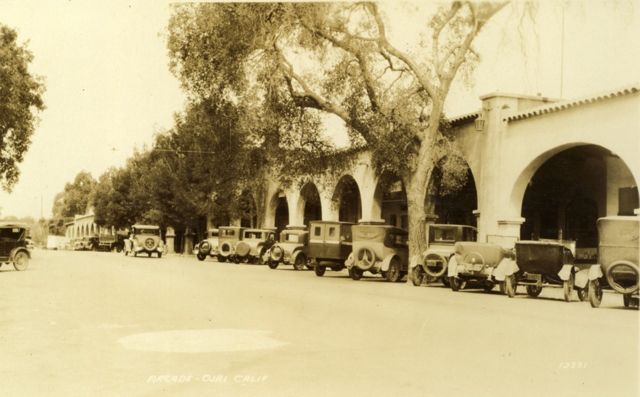
The stately oaks and sycamore trees that stood along the main street in front of the Arcade became victims of the automobile in 1926. The city decided to remove the trees, that Mr. Libbey had protected so dearly when building the arcade, because they were a menace to traffic and that the city would possibly be liable for damages to cars should they collide with them.
In 1927, notice was served on the California driving public that the new law setting the maximum speed limit on public highways at 40 miles an hour, was to be rigidly enforced. “Forty miles means 40 and not 45,” was the terse order given to traffic officers. There was to be no tolerance permitted. The speed limit had been 35 miles an hour for many years, but “thousands of motorists have for years technically violated the law by driving up to 40. It will now be possible for them to enjoy this extra five miles and still drive within the limit.” The state believed that this increase would give the drivers a greater respect for the law.
A service station and fruit stand, now Boccali’s, was constructed at the foot of the Santa Paula grade on Ojai Avenue in 1927. The station provided the services needed for the ranches in the east-end. It also had a large picnic area under the trees. The next year Reeves Road was built to give better access to the ranchers living in that part of the valley. Everything was changing to accommodate the automobile and its driver.
Along with the increase of automobiles came the billboards along the highways. The problem was so out of hand that by 1930 the National Automobile Chamber of Commerce had to step in, “Advertising billboards erected in large numbers along and adjacent to the highways unnecessarily mar the appearance of the countryside and detract from the pleasures of motoring.” They also felt that the billboards were a positive menace to the safety of operators and users of motor vehicles, by distracting the attention of drivers and contributing to the amounts of accidents.
During the World War II, speed limits were reduced and high penalties were given to the offenders, their names appeared in newspapers and they were turned over to the County Civilian Defense coordinator as traffic violators. Three violations and they were turned in to the war rationing board so they could “bear in mind that these persons had violated laws and hindered the rubber conservation program.” Should the violators have appeared before the rationing board for rations, their cases would receive little if any help because of their violations.
Today, the automobile is certainly a major part of our society. Without it, most of us would be lost. However, over the years, many of our historical buildings have been lost because of a need to create still one more parking lot.
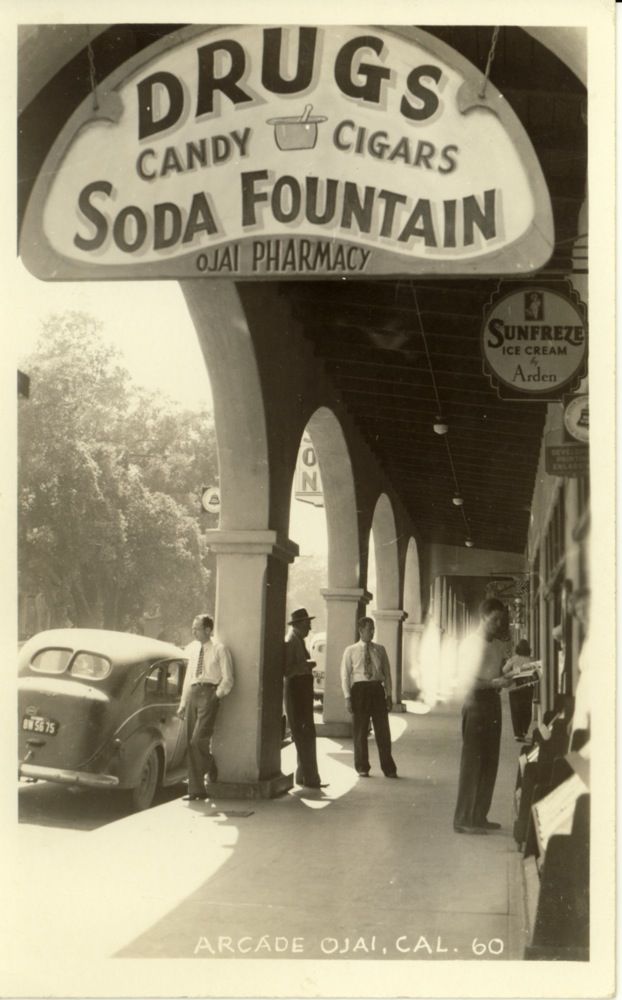
The Ojai Pharmacy. Until the 1960s, the arcade was Ojai’s primary business district, catering to the everyday needs of local residents. One such business was the Ojai Pharmacy. In addition to filling prescriptions, it featured a full soda fountain and lunch counter. Howard Nelson Rockafellow, a colorful Ojai personality, started the business in 1927. Over the next 30 years he helped organize the Ventura River Municipal Water District, served as President of the Lions Club and Chamber of Commerce, and sat on the City Council. Rockafellow single-handedly thwarted a move by the Ventura Chamber of Commerce to rename Lake Casitas “Lake Ventura”. Ironically, while giving an autobiographical speech to the Retired Men’s club at age 71, he ended with, “I expect to live the rest of my life in Ojai”–only to be struck dead by a heart attack at that very moment.
The above is an excerpt from Ojai: A Postcard History, by Richard Hoye, Tom Moore, Craig Walker, and available at Ojai Valley Museum or at Amazon.com.
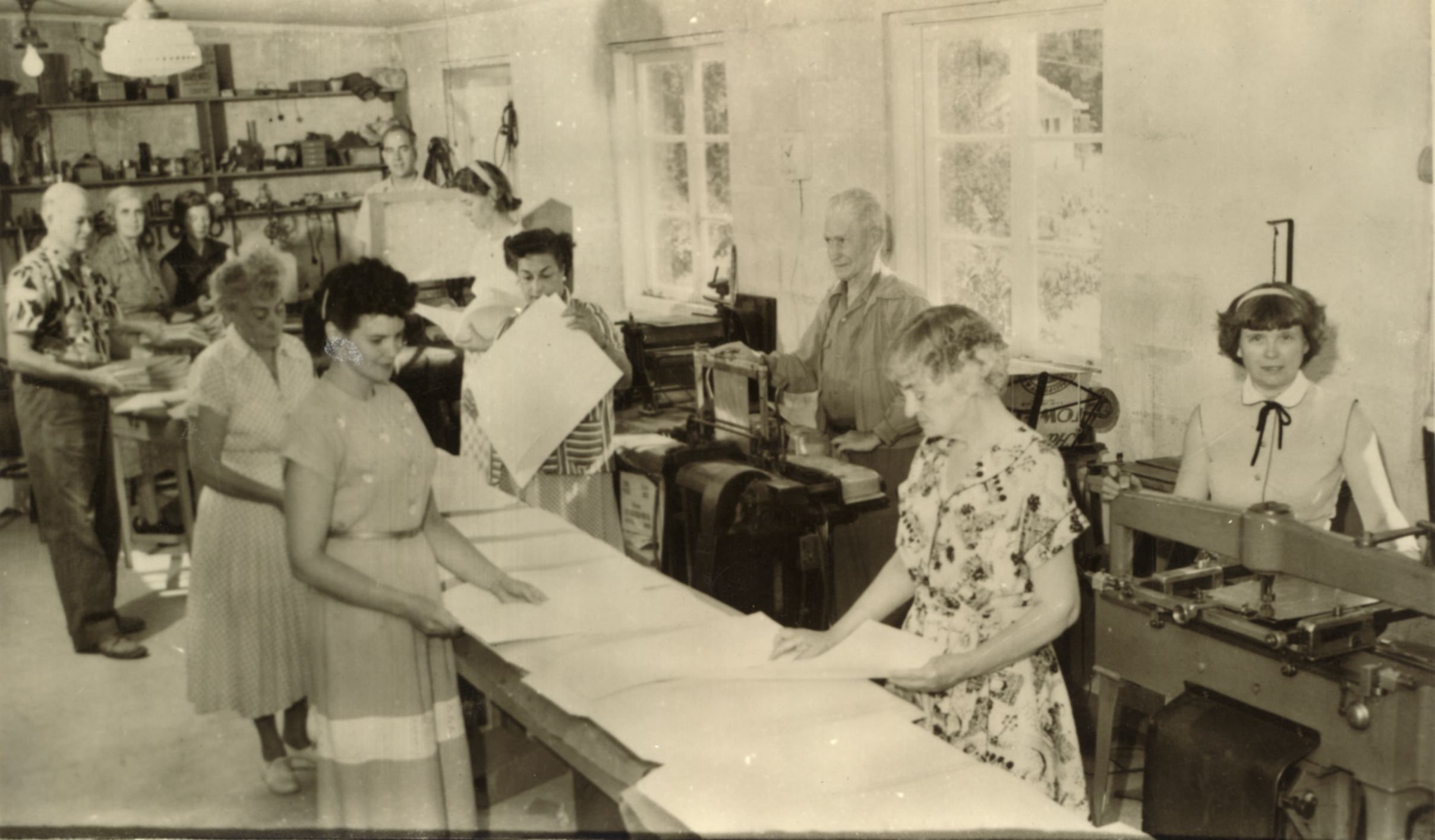
Krotona Braille Institute. Founded in 1910 in Boston, the Theosophical Book Association for the Blind moved to Hollywood in 1917, where it became the Krotona Braille Institute. Roy and Flavia Snyder (seen operating the Braille presses on the right) moved the Krotona Braille Institute to Ojai in 1947. The Institute consisted of a Braille publishing house and the Baker Memorial Library, which loaned Braille books throughout the world.
The above is an excerpt from Ojai: A Postcard History, by Richard Hoye, Tom Moore, Craig Walker, and available at Ojai Valley Museum or at Amazon.com.