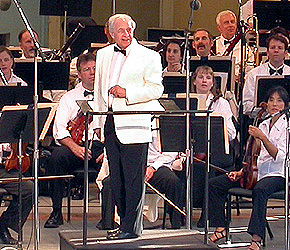
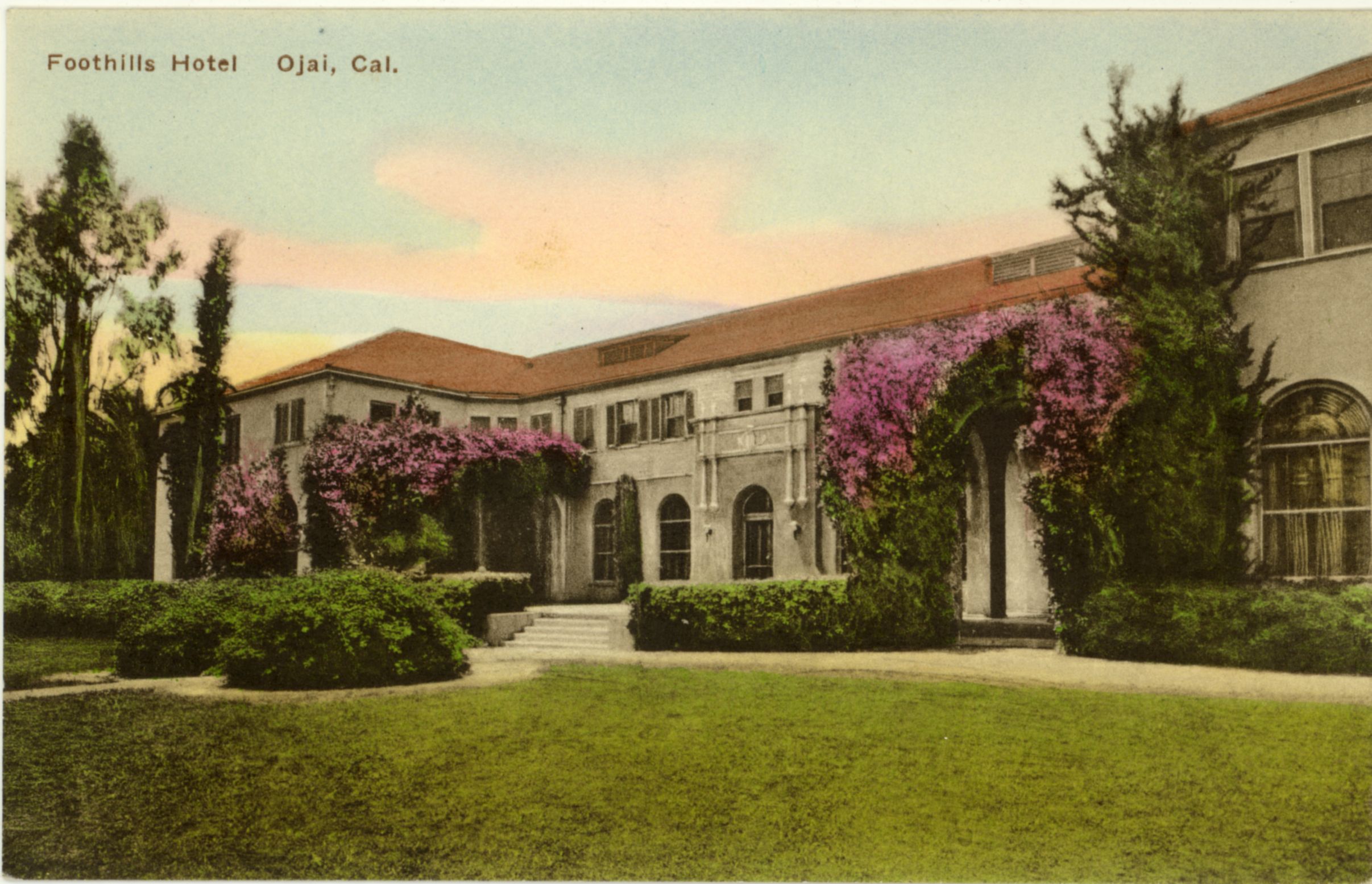
The Frost-Coolidge Music Festival. Although the Foothills Hotel catered to wealthy Easterners, Ojai residents often benefitted from the cultural and social events held there. A good example was the Frost-Coolidge Music Festival of 1926. Elizabeth Sprague Coolidge, who had a winter home in Ojai, was one of America’s foremost promoters of chamber music. She teamed up in 1926 with another Ojai resident, Frank Frost, to create a three-day chamber music festival at the Foothills Hotel. Two-thirds of the audience was Ojai residents. When the festival concluded, The Ojai proclaimed, “One of the greatest musical events that has ever taken place in America came to a close on Sunday evening with the final concert of the Ojai Musical Festival.” Many consider the Frost-Coolidge Music Festival to be the forerunner of the current Ojai Music Festival.
The above is an excerpt from Ojai: A Postcard History, by Richard Hoye, Tom Moore, Craig Walker, and available at Ojai Valley Museum or at Amazon.com.
“Baton Not Tuned To Train’s Wail” Ojai Valley News, June 3, 1989 By Bob Bryan
Pierre Boulez (C) 2003 Daly Road Graphics
The year was 1967, and the Ventura-Ojai orange train—locomotive, one freight car and a caboose—was coming ’round the bend making less than 90 miles an hour when its whistle broke into a deep-throated blast. It was a familiar sound, even appreciated by some as it floated up the Ojai Valley. There, Maestro Pierre Boulez, standing on the podium with baton raised, prepared to give the downbeat that would begin that year’s Ojai Festival.
The opening number was listed as the Schoenberg String Quartet No. 2, arranged for string orchestra; its harmonics, according to the program notes, would be “unconventional, even irrational.” Nobody had said anything about a whistle.
When train whistle and raised baton coincided for the third time, Maestro Boulez walked off stage with just a touch of Gallic impatience. He was replaced, after a hurried conference backstage, by Ted Lillefelt, that year’s festival president.
An apology was offered and a question posed to the assembled music lovers: Would it not be better if the opening number of the Ojai Festival 1967 were delayed until such time as the orange train could continue on to Ojai’s packinghouse, as it was required to do daily? There it would reverse itself and come through town again, passing once more to the rear of the Festivals Bowl.
The first-night audience clapped its approval.
About 10 minutes later the orange train passed through once again, hooting jubilantly as if wishing well to the proceedings. There was an answering applause from the audience, and then everybody settled down to give Schoenberg his turn.
Open-air concerts in Ojai’s Festival Bowl have included the gentle ostinato of resident crickets and birds, a feature that Oliver Messiaen, a composer who has written music in honor of birds, found to his liking during his tenure as resident composer of the Ojai Festival.
The birds still sing, but some things that once were are no longer. There will be no freight train whistle this weekend in Ojai for Maestro Boulez or, for that matter, any future conductor of the festival. The orange train doesn’t run here anymore.
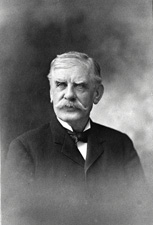
Sharp & Savvy: Thomas R. Bard (1841 – 1915) by David Mason
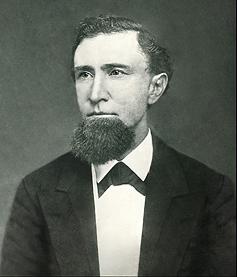
Thomas Bard
Mr. Bard arrived in Southern California in 1865. He was sent to this area as a representative of Thomas Scott, acting Assistant Secretary of War under President Lincoln and he was also president of the Pennsylvania Railroad. Mr. Scott’s responsibilities in the east made it impossible for him to oversee his land holdings in the west. Thomas Bard was sent to the area to manage the 350,000 acres that Mr. Scott owned.
While taking care of Mr. Scott’s property in the Ojai Valley, Mr. Bard quickly became a pioneer in the development of oil fields. He was living in a charming Swiss chalet that Mr. Scott had built for him near Sulphur Mountain, one-quarter mile from the Arnaz adobe.
Mr. Bard was also here to drill for oil, which he did with very little success. When he did find oil, it was not of a good grade, so it was decided that any fortune would have to be made in the sale of land.
It then became the responsibility of Mr. Bard to subdivide the Ojai Valley for Mr. Scott. The land was sold in small parcels and large ranches.
In 1868 Thomas Bard was elected supervisor for the county of Santa Barbara and was instrumental in forming the county of Ventura in 1873, which had originally been part of Santa Barbara County.
Mr. Bard had a varied political career that influenced much of the development of the west, including agriculture, ranching and railroading. In 1872, he partnered with Royce G. Surdam to purchase 1,400 sheep to graze on his land in the Ojai Valley.
In 1900, the Republicans backed him for U.S. Senator. In those days, senators were selected, not by the people, but by the state Legislature. Mr. Bard was selected and served a six year term. There had never been a senator from Ventura County and the excitement caused the county to celebrate with bands, cannons booming and church bells ringing.
Thomas Bard was a remarkable man, quiet and direct, his influence reached far and wide, even to the construction of the Panama Canal. His faith in what he was doing set an outstanding example for all of Ventura County. Mr. Bard died in his final home: “Berylwood” in the town of Port Hueneme, which he had founded.
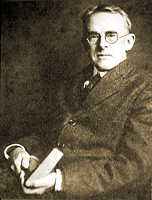
Sharp & Savvy: Sherman Day Thacher (1861 – 1931) by David Mason
Sherman D. Thacher
It was in 1888 that Sherman Thacher took up a homestead claim of 160 acres in the Ojai Valley. At first he thought he might teach as a side line which would furnish him some means of livelihood.
The idea of a school was gradually developed and the first pupil came to the “Casa de Piedra” ranch in 1889, and while being educated by Mr. Thacher, he was given the opportunity to develop a wholesome outdoor life.
Mr. Thacher’s original plan was not to remain in the valley, but to stay only temporarily, then journey on to destinations unknown. As fate would have it, the beauty and charm of the valley grew on him. He soon noticed that the outdoor life agreed with him and he saw success ahead which spurred him on.
His teaching began with the one pupil from the east and eventually, more came. Sundays, holidays and off school hours were devoted to improving his property. He even built a house with his brother’s help.
His brother, William, was also involved in civic activities and was responsible for founding the famous tennis tournaments held annually in Ojai.
With the addition of more pupils the ranch soon developed into a full time school. More suitable buildings were added year after year.
Mr. Thacher was certainly well qualified to run a school, he had graduated from the Yale University in 1883, in 1884 entered the law department of Yale University, graduating in 1886. He practiced law in Kansas City, Missouri, and in 1887 came to the town of Nordhoff in the Ojai Valley.
In 1896, he married Eliza Seely Blake, a native of San Francisco who was a graduate of the University of California in 1895. They would become the parents of six children.
Mr. Thacher served as headmaster of the school until his retirement in June, 1931. He had been associated with the scholarly and cultured life from his early childhood.
He was a kind and generous man and a valley leader. Along with his school he had been; president of the board of trustees of Nordhoff High School from 1908 until 1922, trustee of the San Antonio school district from 1898 until 1912. He was a member of the Ojai Valley Men’s League from 1910 until 1920, director of the Ojai Civic Association, and a member of the Ojai Valley Presbyterian Church since 1887. Mr. Thacher worked closely with his friend Edward D. Libbey, to change the entire face of the downtown of Ojai.
He was the paternal great-grandson of Roger Sherman who was born in 1721 and best recognized as one of the founding fathers who helped draft and sign the Declaration of Independence and laid the foundation for our current-day Treasury Department.
Many men prominent in business and the professions, not only in California but
Sherman Thacher
throughout the world, acknowledge their debt to the Thacher School for a wholesome education that has been an opening to the resources of a broad and fundamental life.
Before his death in 1931, his devotion to the valley that he loved was without thought of personal gain, he created a school of high scholastic standing, a lasting monument so recognized by educators of renown to be one of the finest schools to ever serve the students that arrive yearly from all parts of the world.
Sharp & Savvy: Royce Gaylord Surdam (1835-1891) by David Mason
Royce Gaylord Surdam
An ambitious businessman, Royce Surdam also liked to deal in real estate. In 1874 he purchased a large track of land in the Ojai Valley and immediately started advertising in the county newspaper, the Ventura Signal, of his new town to be built in the beautiful valley. He explained all about the grand public square with a fountain, a wonderful academy, a town hall and a chapel.
He then advertised that he would give 20 acres of land to anyone who would build a hotel. He advertised the availability of his beautiful land of small city lots and five and ten acre parcels, in the newly named town of Nordhoff.
The Ventura Signal told its 400 subscribers in January, 1874: “The prospect of a rapid growth and settlement of the valley is now better than ever. Soon there will be a post office and a mail line established and the new hotel will be up and occupied”.
Mr. Surdam’s lots were being purchased by several parties, a new road from the Ventura Mission to the valley was being laid out and in March of 1874, Washington approved a post office for the new town, which was a great advantage to the citizens, tourists and invalids that were coming to the valley.
Although Mr. Surdam’s plan was a great success, his personal speculation failed to meet the success he anticipated. People did not rush to buy the small city lots when large broad acres were available on the outskirts of town. In December of 1874 Mr. Surdam sold his entire holdings of land in the valley.
Royce Gaylord Surdam, a man that who had a dream of a beautiful town in the center of the Ojai Valley, could not keep up his once ambitious spirit and his life came to an end with an overdose of morphine and a coroner’s inquest.
Sharp & Savvy: John Meiners (1827 – 1898) by David Mason
Mr. Meiners was born in the town of Oldenberg, Germany, and received his early education and business training there. In 1848, he immigrated to America and settled in the town of Milwaukee, Wisconsin.
He built a starch factory and sawmill, both of which he sold in 1860 to invest in a distillery. The company distilled wines, alcohol, spirits and whiskey. Their trade was mainly local, but occasionally items were shipped to France and Germany. By 1861, the distillery was operating at its capacity of 500 bushels per day.
Mr. Meiners acquired his property in the Ojai Valley in the 1870’s, sight unseen as a result of an unpaid debt. Mr. Meiners had never been to California and wasn’t sure if he had struck a good or bad deal, but, nonetheless, the deed was done.
He became aware that a banker friend was planning a trip to the area, so he asked if his friend could locate the 1,200 acres and let him know how it appeared. When his friend arrived in Santa Barbara, he was able to secure transportation over the mountains to the little valley where the Meiners’ land was located. It was in the westerly portion of the Ojai Valley. What his friend wired to Mr. Meiners was just a very few words; “it was the most beautiful valley he had ever seen”.
Within a few years, John Meiners moved his family to California and to their new ranch. He built a large house on a bluff overlooking the ranch and named it “Cheery Acres.”
He then put the ranch into production, planting fruit trees, wheat and barley. The center of the ranch was covered by a thick forest of oak trees, which he fenced off from the rest of the ranch to raise hogs.
Mr. Meiners found that the climate in the Ojai Valley was also good for his asthma and he longed for the day he could spend more time here. For years, he continued to commute between his California ranch and Milwaukee.
Since the ranch continued to produce excellent crops, Mr. Meiners planted even more and then put in several hundred acres in oranges, lemons, olives, prunes, apricots and apples.
Finally turning over his Milwaukee business to his son Gustave, Mr. Meiners was able to stay in California and work the ranch he enjoyed so immensely.
In December of 1898, John Meiners passed away and his heirs continued to operate the ranch until 1924. The ranch was then incorporated by the Ojai Ranch and Development Company, which subdivided 800 acres.
Today, Meiners Oaks is still sheltered by the towering oaks that led the friend to say; “it was in the most beautiful valley he had ever seen”.
Sharp & Savvy: John J. Burke (1862 – 1952) by David Mason
Mr. Burke was born in Picton, Ontario, Canada. In the early days of apprenticeships, young Mr. Burke went into the dry goods business until the age of 18, when he left Canada for Emporia, Kansas. It was here that he met Sherman Thacher [correction: Edward Thacher] who would remain a close friend for the rest of his life.
In 1887, the doctors in Kansas told Mr. Burke that he would most likely not live to see his 30th birthday; he was only 25 at the time. He immediately wrote to his friend, Mr. Thacher who by this time had settled in the beautiful valley of Ojai. Mr. Thacher urged him to come to the peaceful valley. He arrived here in the same year, never to returned to his adopted town of Emporia, Kansas.
As a member of the community, he contributed time, knowledge and his assets to the improvement of the Ojai Valley. He was responsible for the Ojai Power Company, which first illuminated the homes of the valley residents. He became one of the proprietors of the Ojai Valley House, which was the new name of the old Blumberg’s hotel, and advertised it as “a homelike place for families and pleasure-seekers, situated in the famous Ojai Valley”.
When a railroad to the valley was needed, it was Mr. Burke who worked hard until it became a reality.
In 1900, Mr. Burke organized the Ojai Improvement Company, which established the Foothills Hotel. Being one of the first realtors of the valley, he was responsible for the development of the early residences on Foothill Road.
He started the Ojai State Bank and served as cashier for many years and eventually became Vice President of the bank, which sold to Bank of Italy before becoming Bank of America.
He was the first to see the future in olives in this area and started the Ojai Olive Mill. He was an important person in the creation of the Gridley Water Company, which furnished the precious liquid to the valley.
He was responsible for the building of the theatre in town and headed up the drive to raise money for the purchase of land for Villanova School.
Mr. Burke attended the first Ojai Tennis Tournament club meeting where he was elected their secretary.
When Mr. Edward D. Libbey wanted to beautify the valley by building arcades, parks and hotels, it was Mr. Burke he called upon to gain the cooperation of the people living in the valley and financial help from the business community. He was one of the early presidents of the Ojai Civic Association, and an officer of the board of trustees of the local library.
Exactness and thoroughness had characterized all of his attainments, for he believed in doing well whatever he undertook and this undoubtedly was the keynotes of his success. His death came at the age of 90, and at the time he was referred to as: “The leading citizen of Ojai”.
Sharp & Savvy: Fernando Tico (1798 – 1861) by David Mason
Fernando Tico was born in the small town of San Francisco on April 9, 1798, at 8 o’clock in the morning. He was baptized the next day and given the names:
Fernando Jose Maria Ignacio Martin Tico.
Mr. Tico married Maria Margarita Lopez at the Santa Barbara Mission in 1821 and they had three children. He also served as mayor for the town of Santa Barbara.
Tragedy entered Mr. Tico’s life in 1834 when his wife died. Soon afterwards, Mr. Tico married Maria de Jesus Silvestra Ortega and twelve children were born of that marriage.
The Rancho Ojai was granted to Mr. Tico in 1837, by Governor Juan B. Alvarado. At that time, the Ojai Valley was part of Santa Barbara County, and the Mexican land grant consisted of 17,716.83 acres.
With the cession of California to the United States following the Mexican-American War, the 1848 Treaty of Guadalupe Hidalgo provided that the land grants would be honored. As required by the Land Act of 1851, a claim for Rancho Ojai was filed with the Public Land Commission in 1852.
In the transcripts of the proceedings, depositions were taken to insure Mr. Tico’s rights to the Ojai Valley. Andrus Pico wrote: “My name is Andrus Pico, my age is 42 years. I was born in California. I know the Ranch called Ojai; it is in Santa Barbara County. Fernando Tico first occupied it in 1831 and has continued to occupy it ever since with cattle, horses, a house and corrals”.
The deposition of Pedro C. Carrillo was somewhat longer.
“Question: Will you now state what you know concerning the occupation and inhabitancy of this Rancho by Fernando Tico?”
“Answer: Tico established himself on the Rancho Ojai by permission from Padre Blas Ordaz in the year 1836. He built a corral and a house or hut built of sticks in which he lived with his family. In the year 1837 he got a grant from the Governor and built a fine adobe house about three miles to the westward of the house he first occupied and I have known him to live in it ever since that time in the Rancho with his family, cultivating, having cattle, horses and sheep in the place.” Mr. Tico’s land grant was approved by the Public Land Commission.
Mr. Tico served as Constable in the town of Ventura, he was the Justice of the Peace and in the same year he was elected to the first Santa Barbara County Board of Supervisors [in 1854].
In 1853, Mr. Tico sold the Rancho Ojai to Henry Starrow Carnes of Santa Barbara.
Fernando Tico died on December 29, 1861; and his body was the last to be buried in the cemetery at the Ventura Mission.
Sharp & Savvy: Edward Drummond Libbey (1854 – 1925) by David Mason
Edward Drummond Libbey
Mr. Libbey, east coast millionaire and philanthropist, is credited with transforming the typical western town of Nordhoff into the civilized, elegant village of Ojai in 1917.
Born in Chelsea, Massachusetts in 1854, Mr. Libbey became a partner with his father in the glass business in Toledo, Ohio. By 1883, he was the sole proprietor of The Libbey Glass Company.
Since he loved beautiful things and possessed the wealth and power to obtain them, he founded the Toledo Museum of Art in 1901 and was President for many years.
In 1907, Mr. Libbey’s friend, Mr. Harry T. Sinclair, invited Mr. and Mrs. Libbey to winter in Nordhoff at the beautiful Foothills Hotel, which was only open during the winter months.
While Mr. Libbey fell in love with the beauty of the Ojai Valley, he was not pleased with the “ramshackle” town where the stores had false fronts and metal awnings, and the sidewalks were slatted boards.
Libbey's Transformation of Downtown Ojai
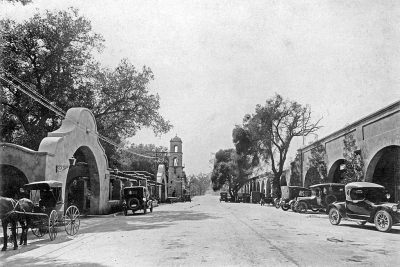
With his combination of money and imagination, Mr. Libbey created what we now enjoy about downtown Ojai. In 1916 he began to acquire land. He held progressive conferences with Nordhoff “movers and shakers” including Sherman Thacher, Walter Bristol, John J. Burke and Harry Sinclair. Together, they hired San Diego architects Richard Requa and Frank Mead for suggestions to make Nordhoff a distinctive cohesive and beautiful town.
He began with the building of a Spanish arcade that would cover the false fronts on the stores. In front of the Blumberg’s old hotel, a wisteria covered pergola was built and the centerpiece was to be a beautiful tower for the post office.
Mr. Libbey developed several hundred acres into the Arbolada for home sites for those wanting to come to the valley and build a house. He donated part of his land for the development of the Ojai Valley School.
After a fire that destroyed the Catholic Church, Mr. Libbey helped with the reconstruction of the church with the help of architects Requa and Mead.
He developed the Ojai Valley Inn and Country Club with the help of architect Wallace Neff. The golf course would become one of the most outstanding in America.
The El Roblar Hotel was another important element of Mr. Libbey’s plan for the Ojai Valley.
Mr. Libbey, pleased with the final results of the town of Ojai said: “There has been too little attention paid to things aesthetic in our communities and in our homes. The time has come when we should encourage in ourselves, thoughts of things beautiful… and also of higher ideals which encourages and promotes in the people the fostering of love of that which is beautiful and inspiring.”
Even after the death of Mr. Edward Drummond Libbey in 1925, his estate donated the land for a new library in Ojai and contributed $10,000 towards the construction of the building, designed by Carleton Winslow.
Richard S. Requa, the main architect for the downtown of Ojai, and many of the homes built during the same period said: “The simple lines and curves, the early mission arcades, and Portales, the red terracotta roofing tiles, the wrought iron grilles and balconies and the modest Spanish tower, all seemed to take their places among the trees and shrubs as though they had been placed there by nature when, in one of her happy moods, she fashioned and adorned the valley.”
*To honor Mr. Libbey, the 1917 Nordhoff High School yearbook printed this tribute:
To Edward Drummond Libbey
We dedicate this yearbook
A man whose practical idealism,
Whose love of the beautiful,
Whose vision of altruistic service,
Has inspired and brought to pass
A great work in the Ojai Valley–
All esthetic endowment of such
Wondrous value
That no man can contemplate it
Without
Spiritual uplift.
Sharp & Savvy: Dr. Benjamin Levan Saeger (1853 – 1934) by David Mason
Dr. Saeger received his medical degree from the University of Michigan and had opened his first office in Pennsylvania. His life would take a dramatic change when his friend, Dr. Wilson P. Kern, the only local doctor in the Ojai Valley became ill.
Dr. Kern requested that Dr. Saeger come to the valley to fill in during his illness. He arrived in 1889 and what was to be a temporary job, turned into a practice lasting for 45 years. His first home was a room in the Blumberg’s hotel and his room and board amounted to $20.00 per month.
After the death of his friend, Dr. Kern, he decided to stay. In 1892 he opened the Ojai Drugstore along with his “country doctor” practice. The drugstore’s shelves were covered with all that was available at the time to restore one to good health. A soda fountain was also in the building. The doctor’s typical ad in the local newspaper read as follows: “We carry no groceries, hardware, nor general merchandise. In drugs and stationery we solicit the public patronage.”
In 1896, the Sunset Telephone and Telegraph Company of San Francisco asked Dr. Saeger to become their agent for the town. He was then the first person in the valley to have a telephone. It would serve the valley as a direct link to the outside world. The doctor would send the message out of the valley by turning the crank on the strange device and when someone miraculously answered, he would give them the message.
Before the citizens of the valley were accustomed to the invention of the telephone, someone invented the automobile. Dr. Saeger was the first person in the valley to own one, a Buick Blue Streak.
In 1903, Dr. Saeger was part of a small group that formed the Ojai Publishing Company and started printing the local newspaper; The Ojai, now the Ojai Valley News. Dr. Saeger was the paper’s first editor.
The drugstore then doubled as the newspaper office. One could drop off articles, advertisements and pay for subscriptions while filling their prescriptions.
In 1934, the stores in the town of Ojai were closed. The people of the small valley had lost their beloved doctor. The report that Dr. Benjamin Levan Saeger had died caused the town to close its doors in honor of this fine man.
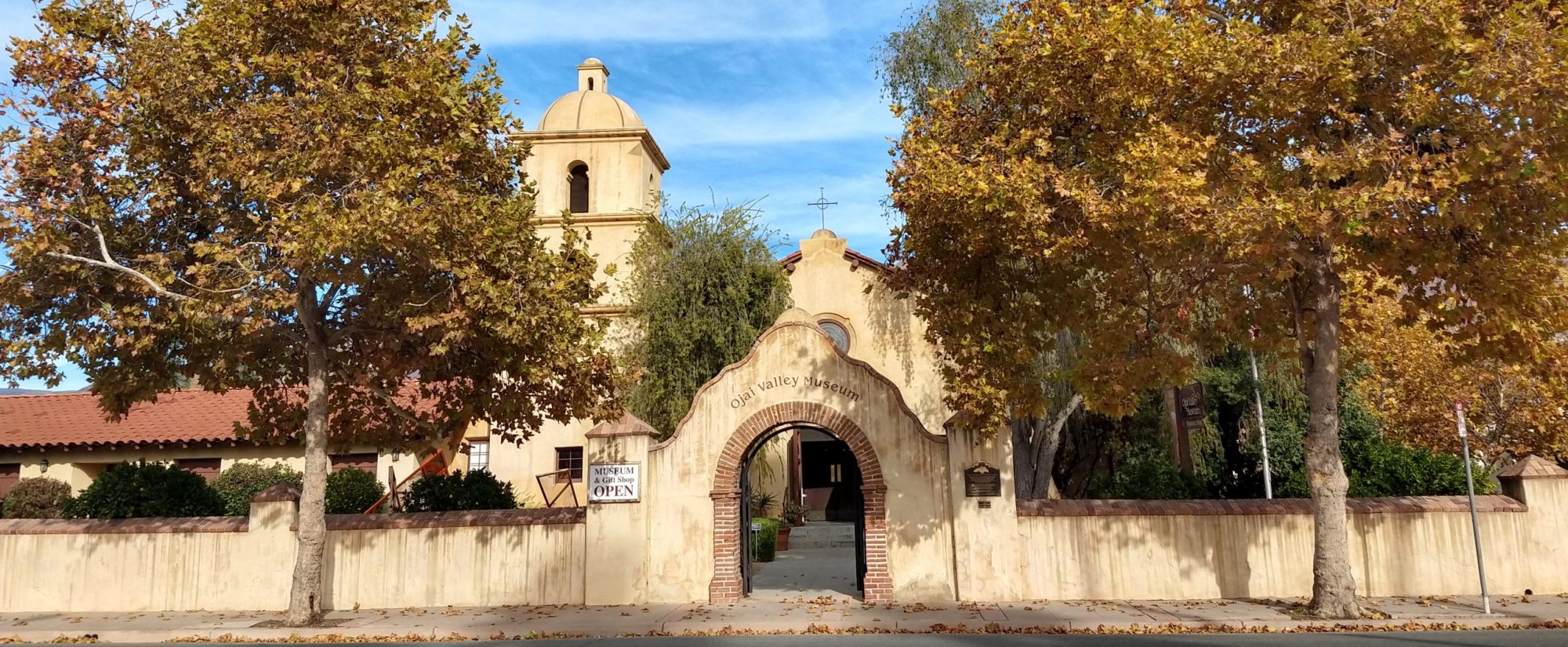
 The above is an excerpt from Ojai: A Postcard History, by Richard Hoye, Tom Moore, Craig Walker, and available at Ojai Valley Museum or at Amazon.com.