Richard Robinson by Richard Hoye
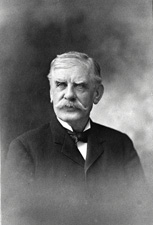
Richard Robinson was an early rancher in the valley, and he first came to the valley after retiring as a ship’s captain. The romantic story of his life at sea is accented by the fact that his wife often accompanied him on his voyages.
Richard Robinson was born in Thomaston, Maine, in 1817, and he was of Welsh extraction. He began his life at sea at age seventeen. His advancement was rapid, and he captained his first ship at age twenty-three in 1840. For the next fourteen years, he captained ships that bore names such as Mountaineer, Pyramid and Hardet. These were “Yankee Clippers” engaged in ocean-crossing commerce.
Robinson pooled his resources in 1855 with several other men to commission construction of a 200-foot long clipper ship, christened the Richard Robinson. It was the custom of captains of the clipper ships to race each other, since the winning of a race provided profitable publicity. This was the way that sea captains built their reputations, and “Virtually every passage from one port to another was a race.” Robinson won a race against the formidable Dreadnought and thereby established his ship as “one of America’s fastest ships.”
Voyages could be lengthy. One of his voyages from New York City to Bombay took eighty-eight days, and that was close to breaking the speed record for the route. Ships’ captains were inclined to take their families with them on such long trips, and such was the case with Richard Robinson. He wed Mary Wentworth in 1840, the very year he first became a ship’s captain. She was a woman fit to match him.
Mary Wentworth Robinson was the first woman to receive the degree of Doctor of Education from Harvard University. She was descended from an aristocratic English line, which included Sir Thomas Wentworth, the Earl of Stafford. She accompanied her husband on over thirty voyages. Three sons were born to the marriage: William, Richard and Charles. Two daughters died in infancy.
Robinson retired from the sea in 1872 and moved to Santa Barbara. In the following year, he purchased land in the upper Ojai Valley and began to farm. By 1875, he joined Judge Eugene Fawcett, Jr., and a wealthy eastern man, H.C. Dean, in the purchase of land from Jose Arnaz (land which now is largely covered by the northern half of Lake Casitas). They subdivided the land and started the development of ranches in the Santa Ana Valley.
Richard Robinson signed the voters registration roll for Ventura County in 1884 along with his sons Richard Owen Robinson and Charles Wentworth Robinson. All three stated that their birthplaces had been in Maine.
Robinson’s approach to farming was diversification. He planted many different varieties of trees and vegetables on his upper Ojai Valley ranch. By doing this, he introduced new agricultural products to the valley, and his farm was judged by his contemporaries as especially interesting for its variety.
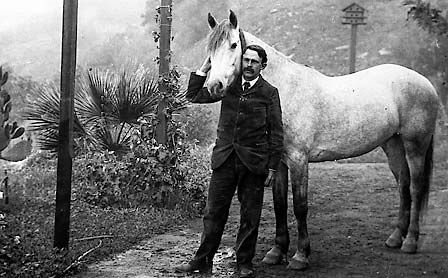
He also tried his hand at breeding race horses. He was photographed in 1896 with a race horse and sulky. In his final years, he lived in Ventura, where he died on February 6, 1896.
For an excellent account of Richard Robinson’s life, see: Marsha Kee Robinson Strong, “The Yankee Clipper Richard Robinson,” Ventura County Historical Society Quarterly 27:1, Fall 1981, pp. 11-25.