Remembering When… forefathers’ foresight led to valley parksby David Mason
“No camping was permitted west of the stream;although parties may spend the day or the evening under the live oaks, and for a small consideration may buy wood from the custodian of the park with which to cook their dinners – or suppers.”
“History of Ventura County, California” – 1926
The Road to Nordhoff
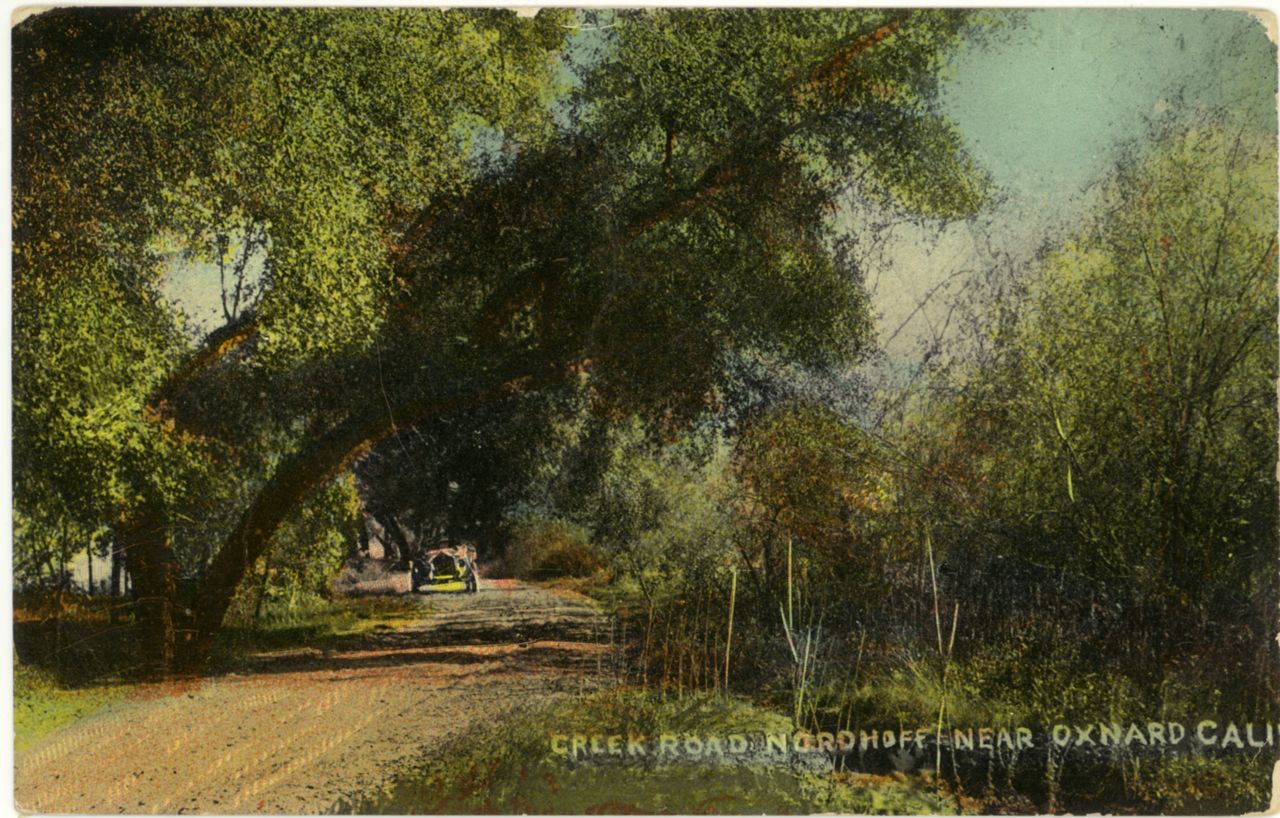
The journey from San Buenaventura north through the settlement of Stoney Flats (now Casitas Springs) to the town of Nordhoff (now Ojai) was a long and sometimes treacherous trip. The buggy trail switched back and forth across the flowing San Antonio Creek at least a dozen times on its way to the Ojai Valley. The trail was commonly referred to as Creek Road and by today’s standards, it was indeed a scenic road.
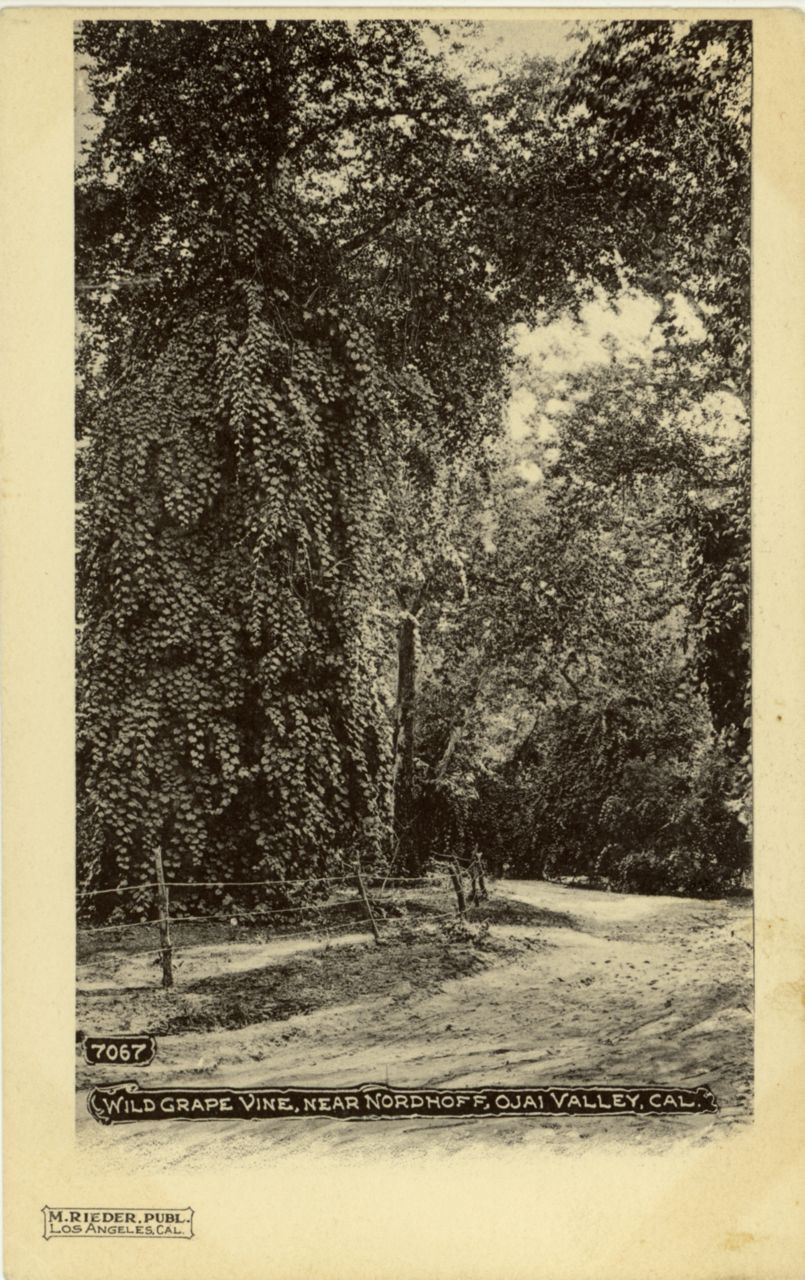
In 1883, Mary Gally, owner of the Gally Cottages, wrote in her diary, “My favorite drive that first summer was down the Creek Road for it was the one green spot in the Ojai, with the wild grapevines hanging down from the trees and the grassy banks above the running water.”
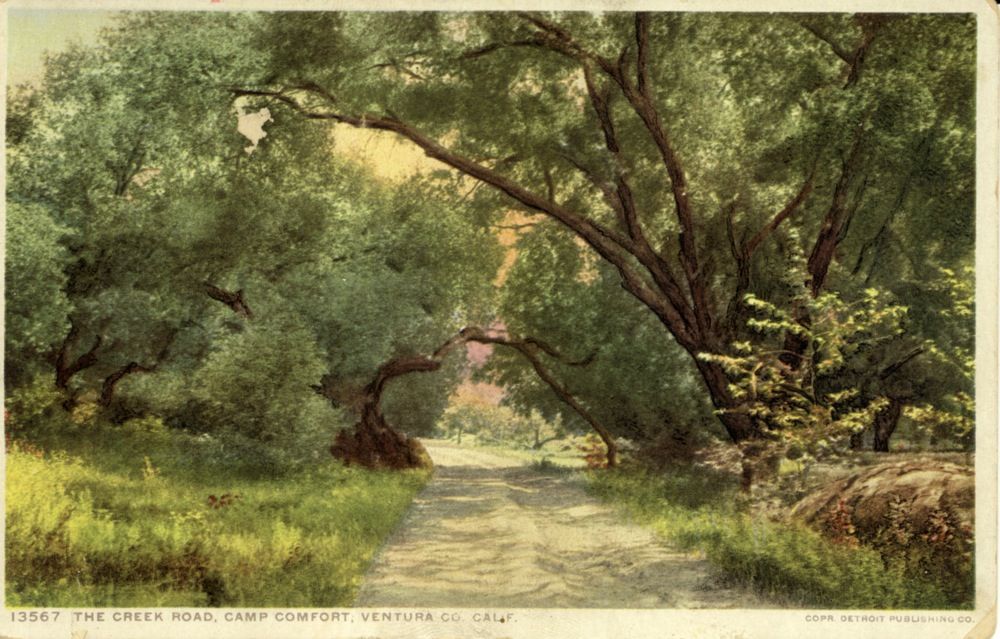
For many years, travelers had found a beautiful spot to stop, camp, rest and water their horses. It was a cool refreshing place just on the outskirts of the small town of Nordhoff, a place that was shaded by many mature oak trees and a creek that ran nearby. It was widely known as a comfort spot, and the location would become known as Camp Comfort. It was the coming of Mr. and Mrs. E.P. Foster to the town of Ventura that would save this wooded campsite for future generations to enjoy. Foster had come to Ventura in 1872 to become a rancher. Later, he would become president of the Bank of Ventura which sold to Bank of Italy (now Bank of America). In 1874, Foster married Orpha Woods, and together they had 10 children.
Camp Comfort
The Fosters loved trees and the shade they provided on their family picnics. They often rode in their
carriage, drawn by two beautiful horses, to the Camp Comfort area, long before it was a public park. The land on which Camp Comfort was located belonged to a gentleman named John Hodson who owned many acres in the area. Hodson was in the process of cutting thousands of cords of wood from his acreage and selling it and the thought of cutting down the stately oaks that shaded the comfort stop much disturbed the Fosters, so they decided to prevent it, if possible.
Meanwhile, with the nation accepting the fact that the automobile was here to stay and not just a passing fad, many new roads were being built. The first organized automobile race was being sponsored by the Vanderbilt family on the East Coast, and out here in the West, Foster was going before the County Board of Supervisors with his idea of creating a public park along the narrow dirt trail so that all the people could relax and enjoy the shade. The parcel of land consisted of 20 acres of “wild land.” The Board of Supervisors negotiated with the owner to purchase the property and succeeded. The final price was $2,500 in gold.
People enjoyed swinging on the grape vines at Camp Comfort.
The June 18, 1904, edition of the local newspaper, The Ojai, reported: “Last week the Board of Supervisors who met in the shade of the beautiful live oaks that adorn the premises, were so favorably impressed with the camp and its surroundings that they unanimously agreed to buy the property for a public park.”
Speaking on behalf of the citizens of the small town, the paper continued, “The Honorable Board of Supervisors, in this noble act, has the Ojai’s approval and appreciation, and also its lasting gratitude.” The area was officially named Camp Comfort and it was the first county park.
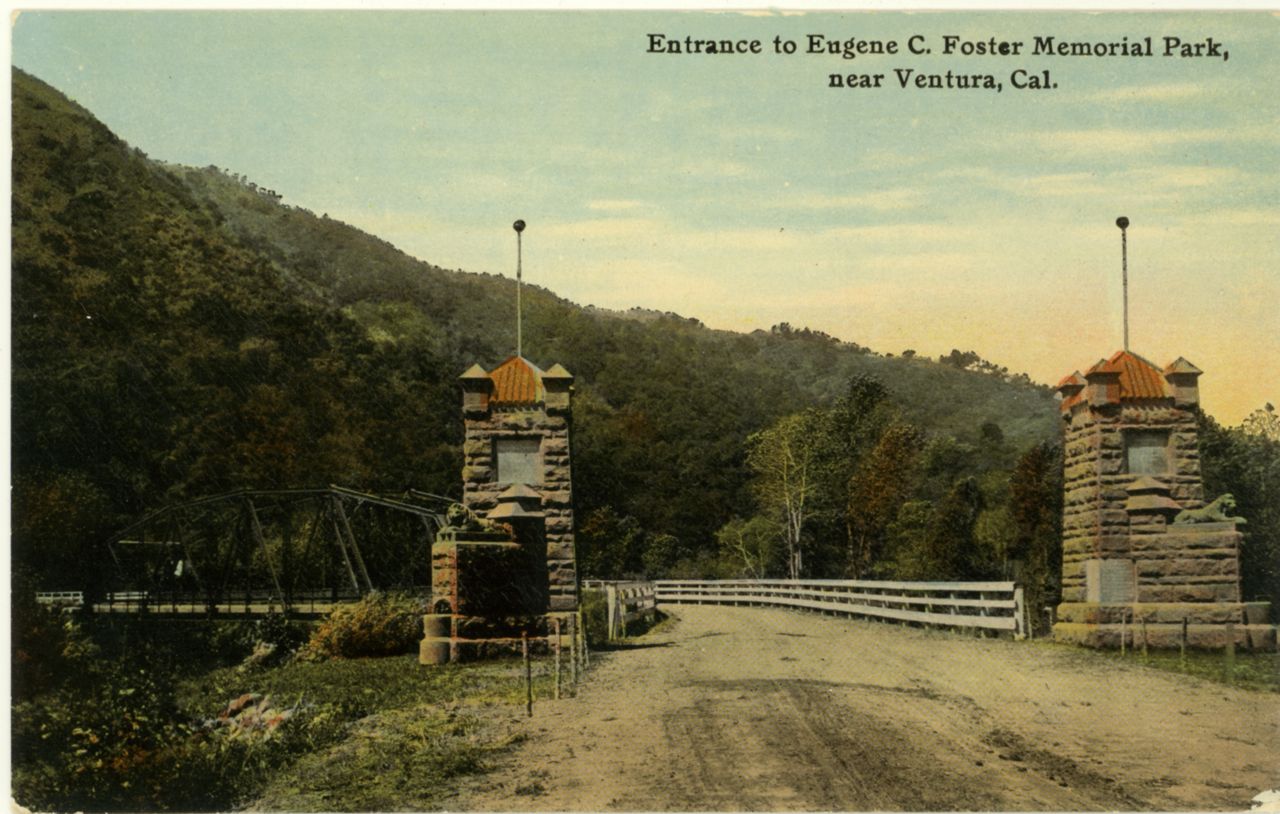
The Fosters did not satisfy their desire for parks with Camp Comfort. They purchased 65 acres from the Ayers family along the banks of the Ventura River to create another park (now at the north end of the Ojai freeway). This park was to be designated as the Eugene T. Foster Memorial Park in honor of the young son of the Fosters who had died at an early age. The Fosters purchased additional acreage from some of the surrounding property owners to increase the size of the park. The entrance was through a great stone gateway over a bridge crossing the Ventura River.
Foster Park was a popular camping ground from the start. There were barbecue pits, camping spots, swings for the children, a swimming hole in the river and, amongst the sycamores on the other side of the river, a place for campers to locate their tents and remain all summer if they desired.
Foster Park
Over the years, a small settlement developed just outside the entrance to the park and became known as the town of Foster Park. The town received an official post office in December of 1952. However, within 17 years, the whole town was obliterated by the construction of the freeway to Ojai.
The Fosters would continue their endowments to the county. The financing of the Buenaventura Hospital, later named the Foster Memorial Hospital (now Community Memorial Hospital), and the creation of the 65-acre Seaside Park lying along the ocean shore, also known today as the Ventura County Fairgrounds. The Fosters personally worked to have other public parks established in the various sections of the county. They were interested in the beautification of the parks and highways. Many of the tree-lined highways in Ventura County were started by them.
The following editorial appeared in The Ojai, December 31, 1926:
The City of Ojai stands very badly in need at the present time of some one who can solve this problem of boys on the streets at night. This band of young fellows that ranges up and down the town after dark, has become a public nuisance. They congregate outside the theater and in other places and make the place hideous with their noise. The curfew ordinance apparently has no effect. It does no good to chase them off the main streets unless they will go home, and home is apparently the one place that has no attraction. The cooperation of the parents seems to be entirely lacking. As a result, there is growing up in our midst a bunch of young hooligans. They have no respect for the rights of other people or for property. A number of minor depredations have already occurred. From this stage, the step into crime is a short one. Unless something can be done about it we are raising a crop of recruits for the State to take care of later on.
* * *
And yet, it is not fair to condemn these boys out of hand. Lacking any home life worthy of the name, they seek a field of interest and an outlet for their energies on the streets. All normal boys pass through an age when their instincts are those of a savage. At such a time they need understanding and guidance. The whole course of their future lives may be decided by the influence under which they come at this critical stage. Cannot something be done to help these boys? Is there not some way to provide them with the conditions that will give them scope for their energies along constructive and useful lines? Three things seem to be absolutely essential. First the right kind of leadership and supervision; second, a place to spend their time; and third, some sort of equipment.
The first is the hardest of all to find. The right kind of leaders for boys of this sort are young men. Men who have not lost touch with the effervescence of youthful nature, who can join in and yet retain the authority of leadership. And they should be men who can do something well enough to command the respect of the boys. Talking does little or no good. We might get a small workshop started wherein the boys might learn to make things with their hands. There is nothing quite so thrilling to a real boy as to discover and develop the skill of his hands. Games are good if they can be controlled.
The second and third requirements go together. We need some sort of a boys’ club with a certain amount of equipment for shop work and games. It would not cost a great deal.
Is it not possible for us to start some sort of boys’ club here in the Ojai? The need is great and we can hardly go on much longer ignoring the present state of affairs. Of what use our community singing and our folk dancing and our other attempts to promote a community spirit so long as we have these young people running wild about the streets? Surely it is time we elders did something to assist these young scallywags across this difficult and dangerous period of their lives.
Ojai’s Brick Firehouse — County Historical Landmark Information
Prior to 1929 the Ojai Valley fire protection was left somewhat to chance and the generosity of impromptu volunteers. Of course, the northern borders were watched over by the rangers of the Los Padres Forest. It is to one of the forest rangers who was to become Ojai’s first professional fire fighter, William Bowie, that we owe most of the information for this story.
In 1925 the growth of the area outside of Ventura city was such that the county decided to form fire districts for unincorporated areas and invited any incorporated city to join. Ojai voted to do so. Each district had one commissioner. Berkeley Brandt, one of the many easterners who came to Ojai, was the first commissioner. (Berkeley Brandt, also a noted architect, designed the firehouse.) He resided in the East End of the valley where he was a citrus grower.
In 1925 the volunteer firemen were : Fred Linder, Chief, Lawrence Shaw, Assistant Chief, Art Sacherer, Secretary, Sam Hudiburg, Clarence Lindnerm, Gene Mitchell, Herb Miller, Tommy Lopez, Guy Cruickshank, Cecil Little, Ken Ayers, Nelson Cota, George Noble, Joe Misbeek, Leon Munger, Bert Griffen and Stan Bunce.
In the forties they were: Martin Kosub, Harold Rice, Guy Stetson, Jr., Alvin Kosub, Rudy Lopez, Arla Harris, Henry Lawrence, Jim Gallio, Reg Bunce, Fred Phiffer, and George Schroff.
Volunteer firemen are still used in Ojai (1970s). Even after professional crews took over, the County continued the volunteer concept. Under the plan an individual applies as a volunteer and is required to attend classes in fire suppression. In the old days when the siren went off volunteers who were available responded from their businesses and went to the station where instructions were found on the black board. There was no compensation in the beginning for these services. About 1932 the volunteer was paid an hourly rate. This is still the basic program, but they are now contacted by walkie talkie radio.
Among the early professional firemen were: Joe Misbeek, Billy Lonsdale, Frank Keys, and Tommy Lopez.
There was also an honorary fire department. Some of the members were: Sherman Thacher, W.C. Hendrickson, Halleck Laffets, L.A. Peasley, Frank Barrington, C.V. Miller, Boyd Gabbert, F.H. Pirkins, Ernest Clark, George Sacherer, G.H. Hickey, Carl M. Yant, E.E. Kennison, William Phillips, and Cecil Little.
The first fire station was on the east bank of Stewart Wash (which now runs under Ojai Avenue just east of the Bank of America). The equipment consisted of a 1917 Model T Ford. Mounted on the car were two twenty-gallon chemical tanks. The Boyd Club occupied the present site of the Bank of America (now a collection of shops on Ojai Ave). The chief lived on the first floor of the club. He took calls for the police at night. The siren was on the roof of the City Hall across Ojai Avenue in the Arcade mounted on a steel windmill tower.
In July 1926 the volunteer fire department contracted for an American La France fire engine type 99 with a Buick motor and a one hundred gallon booster pump at a cost of $5,975. When the Ojai Fire District was organized it assumed $4,000 of the debt. The engine was delivered in December, 1928. The truck had a five hundred gallon per minute pump; a 125 gallon water tank with 500 feet of two and one half inch hose; 200 feet of one-inch hose. The down payment was raised by the volunteers and civic leaders and the fire district paid the balance. During this expansion period the charter honorary members played an active part. They were Berkeley Brandt, Hallet Lefferts, W.C. Hendrickson, Fred Barrington, C.V. Miller, Boyd Gabbert, F.H. Perkins, Ernest Clark, George Sacherer, G.H. Hickey, Carl M. Yant, E.C. McKennison, William Phillips, and Philip Pierpont.
A bell took the place of a siren and was placed in the belfry of the post office. During the day the caretaker of nearby Boyd Center took calls when the chief was out on firework of the district.
In 1936 the department was credited with helping to fight the Ventura Wharf and Warehouse Company fire. By this time the department had additional equipment in the form of a one and one half ton Dodge truck with a 300 gallon water tank and hose on the body. The pump was driven by a chain link from a power take off from the drive shaft.
On October 25, 1939, the fire department was put to the acid test. A fire started in the building housing the Ojai Publishing Company in the Arcade. The entire block was immediately endangered. Very quickly Fire Warden William Bowie was on the scene with Fire Chief Fred Linder in charge of the volunteers. Equipment from Ventura and Santa Paula was called in. In November of that year the City Council passed a resolution commending Bowie, Linder, and the volunteers for saving the downtown.
There were two platoons of volunteer firemen, each of about fifteen men. One was on call for downtown Ojai and one for the outlying areas. In the absence of radio communication one volunteer drove between the two crews during a fire alert to keep each informed. Later a portable radio system was used that could send messages but not receive them.
One of the major problems of the pioneer fire department was the numerous water companies with different size pipes, hydrants, etc. One, the American States Water Company, that serviced the City, had fire hydrants. The Libbey Water Company supplied the new subdivision, the Arbolada and the new Country Club. Senior Canyon Water Company supplied the East End. The Ojai Improvement Company piped water from Fox Canyon near Gridley Canyon to the hotel and homes on Foothill Road. Siete Robles Water Company supplied East Ojai Avenue. Meiners Oaks had their own system as did the Creek Road area. Oak View had two suppliers. None of these had fire hydrants in the early days. Even in the case of the American States Water Company the pipes would sometimes break in several places when under stress. When the Libbey Water Company was laying a new and larger main from their wells on Grand Avenue to the Arbolada, the fire department laid a connecting line which greatly improved the downtown situation and reduced fire insurance premiums. In cases where the capacity of the water lines was in question as to the amount of pumping pressure that might be exerted, the hydrants or outlets were painted different colors and the colored chart was carried on the truck indicating which ones could be used for pumping. This is still a necessity to determine the flow of the system.
As the years advanced the Fire Department took on fire prevention tasks and ordered safety measures at Nordhoff High, Monica Ros School, Ojai Valley School, and Oak View Elementary. The theater was also inspected and safety measures ordered. An arson unit was also at work which consisted mainly of the Chief.
During World War II the Ojai fire department in cooperation with Ojai Red Cross and its chairman, Dr. Tippett, taught first aid. A total of 385 citizens participated. During this period the department invested in a resuscitator, inhalator, and aspirator. The resuscitator was donated by the Ojai Valley Woman’s Club.
Harmon Vaughn, who had purchased the bakery from the Baker family, gave the department a Model A delivery truck. It was painted red with two white crosses on each side and a sort of ambulance became part of the department’s equipment. The materials for the “ambulance” were again a gift of the Ojai Valley Woman’s Club and cost $413. Citizen William Mays donated a portable generator plant at a cost of $150.
All was not serious work for the volunteer fire department. After the tennis tournament was concluded on Saturday, the firemen closed off Ojai Avenue between Signal and Montgomery and hosed the area down for a big street dance. Early Sunday morning the firemen were out to wash the powder from the pavement. The powder was used to help the waltzers glide to the tunes of the 20s and 30s. When Ojai Avenue became a state highway the practice was discontinued. But even before then the town leaders were thinking of discontinuing this old time activity because of the intrusion of “outsiders.”
Ojai’s first firehouse was located on Ojai Avenue, where Danski is now.
By 1935 the Ojai Avenue fire station was outgrowing its space. A new site was decided on South Montgomery Street, which had been, from 1894, the former location of the George Thacher Memorial Library. Part of the site was bought by a committee of valley citizens headed by Dr. Charles Butler which was destined to be the home of the Ojai Valley Art Center. The space north of that was bought by the fire district and was to be the home of the fire department until 1979.
[The architect for the new building was none other than Fire Commissioner Berkeley Brandt. According to David Mason, “when it was decided to pursue construction of a new building, Berkeley Brandt, volunteered to draw plans for a new building to replace the small one. Originally from Chicago, Brandt had attended the Harvard School, the Chicago Art Institute, and the University of Chicago. He had devoted himself particularly to the study of architecture and went to Paris, France, where he attended the L’Ecole des Beaux Arts. He made a name for himself in America by designing large important public buildings, mostly libraries and Masonic lodges, including the Ojai Masonic Lodge. His work, while to a certain extent conventional, was also marked by an originality and broadness of conception, which gave it a distinctive individuality. Consequently, Brandt’s services were in constant demand.”]
This was the time of the Great Depression, so the fire district applied for Federal funds under the Works Progress Administration (WPA). The government’s share was $6,000 and the Ventura County Fire Department was to provide the additional $4,000. The Federal government agreed to a 10% override in case of necessity. The district was to furnish the plans and a technician to supervise construction. The contractor encountered difficulties and delay began. A series of articles appeared in The Ojai by editor Frank Kilbourne. In an editorial on January 9, 1936, he wrote in part: “Oh, yes! there was something said about putting up a new fire hall in Ojai. In fact, the government loan has been secured, the deeds given, the machinery and some material put in place on the lot and nothing happens! Labor shortage, they say! That sounds good. But give us our fire hall as soon as may be–and the cut in insurance rates to follow…” Kilbourne was answered by a letter to the editor on January 16, 1939, by John A. Dron, local manager for the WPA in Ventura County. He attempted to explain the labor shortage by pointing out that another WPA project in Ojai was absorbing all the eligible and available men who were on relief. He wrote: “If The Ojai will point out where twelve carpenters may be found on relief rolls at the present time, anywhere in the County, to put on the fire house, it will perform a great service to the WPA, for there are several projects equally as worthy as this one and now standing approved, which cannot be taken up because of the lack of skilled labor. The primary purpose of the WPA Program is not “to give a fire hall as soon as may be.” The Ojai editor replied in an open letter to Mr. Dron and regretted any offense and ended his letter by saying that, “it is heartening to know that labor is scarce. And the entire valley is confident that as soon as may be, the fire hall will be built! Meantime, our sincere regrets over the unhappy brain wave which resulted so wrongly.”
On January 30, 1936, The Ojai reported that construction was started by a contractor from Santa Paula and a crew of WPA workmen from Meiners Oaks and Oak View working on the foundation. But in March,The Ojai reported again that only 30 hours of WPA labor per week was available. In the same article we read, “that the new building will be constructed from cement blocks and provide space for two engines in the large one-story section and in the two-story section side will have an office, nose room, dormitory and storage space for the fire ladders. Upstairs will be living quarters for the County Deputy Fire Warden in charge here–in this case William Bowie and family. The structure will be finished in a white coating of cement and whitewash giving an effect similar to that of the high school (now Matilija Jr. High School). The Ojai Garden Club was active in those days. The Ojai tells us that the Club received the cooperation of the county fire authorities in a move to keep the poles off the Santa Paula grade. The poles carried a private telephone line from Santa Paula to the new station.
When the eight thousand dollars from the WPA portion was exhausted for reasons not available, the government failed to appropriate the additional $3,000 and the interior of the building was threatened with incompletion. [David Mason says, “during the final stages of construction, the government asked for an accounting and inspection of the building. It was found that the construction supervisor had been lax in his duties, being away from the site much of the time and spending a lot of time gambling in Ojai and Oxnard. In fact, he lost much of the firehouse WPA money in Las Vegas. He had also allowed materials to disappear from the site and, when the inspectors arrived, the fire station that was supposed to be almost completed was no more than a shell of a building and the funds all but depleted. The government refused further help. The deputy fire warden, William Bowie, and some of the county firefighters volunteered to complete the work themselves.]
Ojai was not to be denied their new firehouse. Ventura County decided to go it alone. A carpenter was hired to build cabinets and install the sinks. The Fire Warden suddenly became the prime mover in completing the building project along with the aid of his staff. It was not until 1939 that the roof was put over the small porch in the front of the building, which became a bedroom.
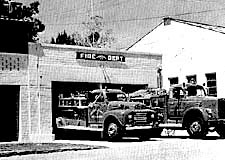
The “new” cement brick firehouse on South Montgomery St.
By September 17, 1936, the move into the new building was eminent. The Ojai of that date wrote: “When the new quarters for the Ojai branch of the Ventura County Fire Department on Montgomery Street are completed, the fire boys plan to hold an open house and dance. The public will be invited to inspect the building.
“The large garage, with overhead doors at both ends, will take care of four cars: the two fire-fighting units now housed in the old firehouse, a light pickup, and Deputy Fire Warden Bill Bowie’s personal car.
“Adjoining the garage is a large office, which will have new desks and equipment, and in the rear a dormitory for additional firemen, with modern showers. The entire upper floor above the offices will be an apartment for Mr. Bowie and his family with kitchen, bath, bedroom and living room, and with stairs in the front and rear and a passageway leading to the large  sun deck above the garage. The grounds in front will be landscaped. A driveway along the south side will lead to a a turn around in the rear, where there will be an area of lawn. A weather box is to be erected here, where an official thermometer, barometer, and other instruments will be located.
“The whole structure is built of concrete bricks, heavily reinforced with large steel-framed windows throughout, and is a distinct asset to lower Montgomery Street.”
No further articles appeared in The Ojai about the opening. However, we do read in a news release of December 17, 1936, that the City Council voted to let the Boy Scouts use the old firehouse for a meeting. Apparently the move was made to South Montgomery in late 1936 or early 1937.
Groovy History: Ojai’s Two:Dot Studio recorded the sounds of the psychedelic ’60s. Now it’s playback time. by Mark Lewis
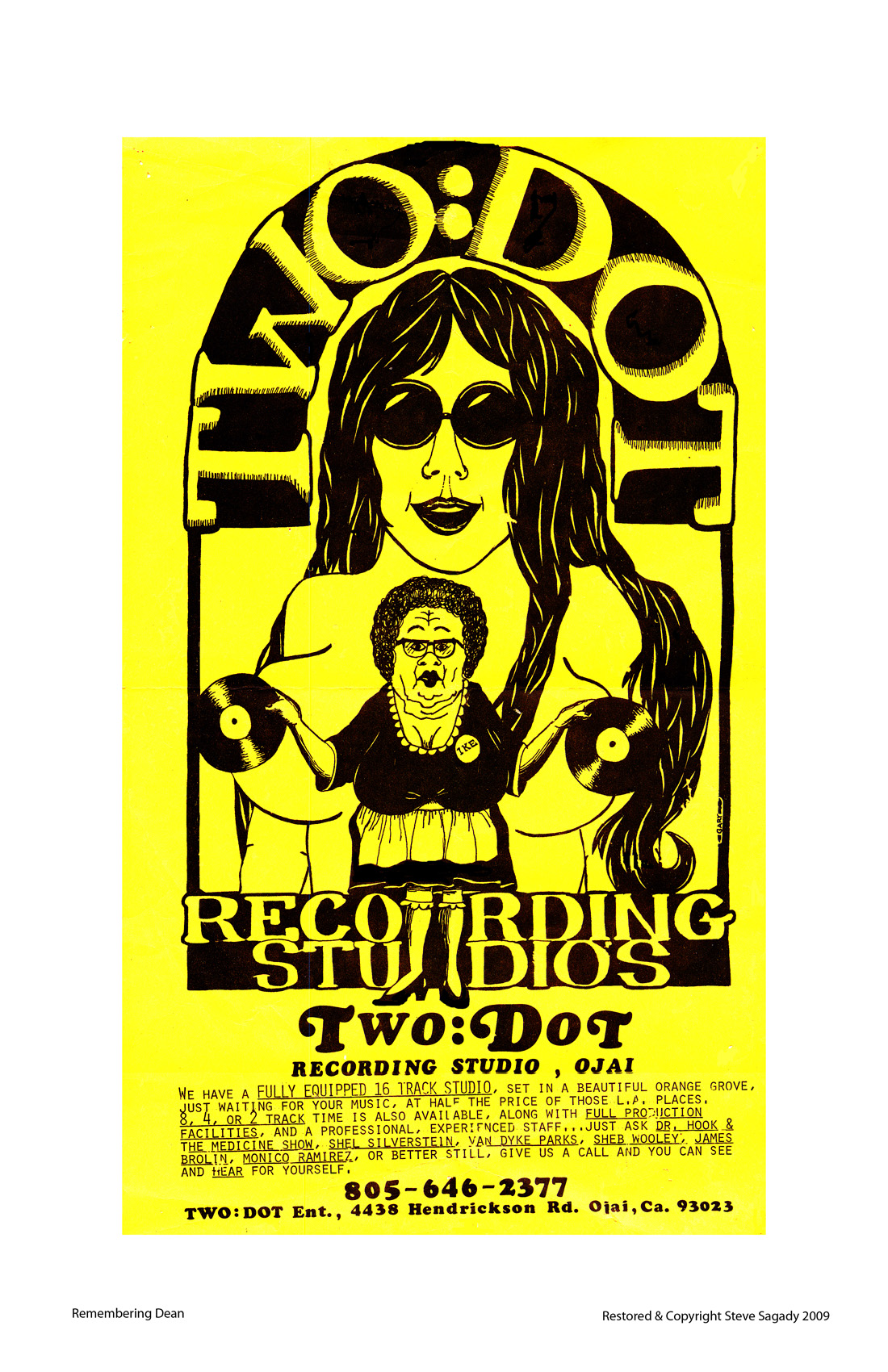
A Two:Dot poster designed by Dennis Shives.
When Dean and JoAnne Thompson built themselves a home in the East End back in 1954, they made the news with their choice of material. Rather than put up a standard suburban ranch house, they hired a contractor to mix mud and straw into large blocks, bake them in the sun and truck them to an isolated lot near the end of Hendrickson Road. There, the blocks were assembled into a handsome, Mission-style ranch house, complete with a two-car garage and a workshop for Dean to putter around in.
“We went back to the good old Chumash construction and built an adobe house,” JoAnne recalls. “Warm in the winter, cool in the summer.”
The Ojai Valley News considered this structure so unusual that they ran a story about its construction. But after that auspicious debut, the house subsided into anonymity. No one took much notice, a few years later, when Dean converted his workshop and part of the garage into a homemade recording studio. The Thompsons raised three sons in the house, then sold it in 1976 and moved to Santa Barbara. In 1983 the house passed into the possession of its current owners: Darrell Jones, an engineer, and Glenda Jones, a painter who taught at Topa Topa Elementary School. The Joneses knew nothing of the house’s history. Then one day their friend Dennis Shives brought over an old record album, Milton Kelley’s “Home Brew,” and told them it had been recorded in their garage.
“I told them that they have got some big ghosts in this place,” Shives recalls. “That this is a magic place.”
Shives these days is an artist, but in 1970 he was primarily a musician, and he had played harmonica on the Kelley album. The best players in town regularly found their way to the Thompsons’ Two:Dot Recording Studio to cut their teeth as recording artists. Alas, none of the records they made there became hits. The little studio closed its doors when the Thompsons moved to Santa Barbara, and over the years it faded into oblivion — until the advent of the Internet, where time stands still, and nothing is lost forever.
These days, a copy of “Home Brew” that’s still in decent shape will go for hundreds of dollars on eBay — and a sealed, never-played copy might fetch $3,500. And “Home Brew” is not even the most sought-after Two:Dot recording. The long-vanished studio is barely remembered in Ojai, but it’s now world famous among collectors of obscure rock albums from the ’60s and early ’70s. Cultish websites make gushing references to the “legendary” Two:Dot, that mythical place where “mega-rare” albums like “Hendrickson Road House” were created. Enthusiasts in Europe and Japan will offer big bucks for vinyl rarities recorded in that converted garage — albums hardly anyone bought when they first came out. As long as a record can plausibly be categorized as “psych” or “psych-folk” — short for “psychedelic folk rock” — people will line up to bid for it.
This is the story of Two:Dot’s heyday, and its unlikely afterlife as a holy grail for record collectors. It’s set against the background of Ojai’s extraordinarily vibrant music scene during the Two:Dot era, which largely overlapped the psychedelic ’60s era. This was a time when several big-time rock stars came to Ojai and mixed easily with little-known local players, some of who would go on to bigger and better things. Two:Dot was a vital component of that scene. There were plenty of bars and clubs in the valley where bands could play live sets, but there was only one place in town to cut a record: Dean Thompson’s funky little adobe-walled studio in the middle of an orange grove, near the end of Hendrickson Road.
SOUND AND VISION
Dean and JoAnne first met at the University of Redlands around 1950. She was a voice major; he was a physics major with a minor in math. Together, they added up to something. By 1951 they had married and settled on Drown Street in Ojai, where Dean started work that September as the science teacher at Nordhoff High School. Five years later, Dean left Nordhoff to work for a neighbor, Lee Appleman, who had started an electronics business called Topatron. By then, the Thompsons had built their adobe house on Hendrickson Road, a private road that runs east from McNell Road to the top of a hill offering splendid views of Sulphur Mountain. Their three sons, Kenneth, Bryan and David, attended the nearby Monica Ros School. Their neighbors included the movie star Anthony Quinn.
Sue Akins with her band, circa 1971. From left: Don Wilson, Sue Akins, Martin Young. (Photo courtesy Sue Randall)
The Thompsons planted 700 Valencia orange trees on their five-acre lot. (JoAnne planted the first 50 herself, by hand.) Meanwhile, Dean began to dabble in audio recording as a hobby. “He hung a microphone from the rafters in the living room and recorded me singing some Broadway tune,” JoAnne recalls. “Just for fun.”
In the late ’50s, Appleman moved Topatron to Garden Grove. Dean soon tired of the long commute. He decided to stay in Ojai and turn his recording hobby into a full-time career. For the name of his new venture, he reached back to his college days, when he and his friend Tom Oglesby had talked about starting a business someday and calling it Two:Dot, for their initials: Tom W. Oglesby and Dean O. Thompson. Years later, Dean revived the name for his Ojai recording studio. It appealed to his quirky sense of humor.
JoAnne handled the office duties, and Dean was the engineer. They did not initially set out to record rock ‘n’ roll acts. Two:Dot’s bread and butter was souvenir albums for church choirs, student chorales (including Nordhoff’s Gold ‘n’ Blue Singers) and high school musicals. (One album still in JoAnne’s collection is a Santa Barbara Youth Theatre production of “West Side Story” featuring Eduardo Villa, who currently makes his living as a tenor at New York’s Metropolitan Opera.) But in the mid ’60s, with the advent of the Beatles, the market for rock music grew exponentially. Suddenly, newly formed groups were crawling out of the woodwork, and they all dreamed of signing a record deal with a major label. These groups represented a potential bonanza for Two:Dot — and for Dean’s new friend Tom Lubin.
Lubin was a Santa Barbara City College student, a part-time radio DJ and a would-be music mogul, affiliated with a fledgling Santa Barbara label called Jet Set International. He already had produced a single by a local band called the Calliope, which had received some regional airplay and sold a few thousand copies. Now, Lubin was looking for a place to record Jet Set’s other acts, the folk singer Don Robertson and a garage-rock band called Blue Wood. But Jet Set was a shoestring operation, and studio time in L.A. was expensive. Somewhere, possibly at the radio station, Lubin heard about a little studio in Ojai with a decent 4-track tape recorder and reasonable rates.
“I think it was mid 1966,” Lubin says. “I ended up driving over Casitas Pass for the first time to see the Two:Dot studio. Over that year I’d drive that road countless times. Through farmland to Ojai to Hendrickson Road and more farmland. Hendrickson Road was one of those country roads that started out paved but quickly became dirt. Dean’s place was the end of the road. For those who belted up that road and missed Dean’s access drive, they would suddenly end up in a gully in the middle of Dean’s orange grove.”
The studio looked primitive, but it was fully functional, and the price was right. Lubin produced a Blue Wood single (“Turn Around” backed with “Happy Jack Mine”) and a Don Robertson album, “Yesterdays Rain” (sic). Neither record took off, but there were plenty of other musicians in the region who were eager to take their shot at success. Dean decided to place a bet on the rock ‘n’ roll boom.
“A few weeks later he called and said he was getting one of the new Ampex 8-track, 1-inch recorders which had just been introduced,” Lubin says. “We drove down to Audio Industries, which was the premier pro audio supplier in Hollywood. There we were on La Brea across from the old Chaplin studio that had just become A&M Studios, lifting the 8-track up into Dean’s old pickup. It took four of us, and it was seriously top-heavy.”
Dean’s new 8-track machine was more advanced than the one the Beatles had recently used in EMI’s Abbey Road studios in London while recording “Sgt. Pepper’s Lonely Hearts Club Band.”
“How proud he was to take it home to his studio in the middle of an orange field,” Lubin says. “Even the Beatles only had 4-track.”
Dean’s next move was to have Lubin record a demo album, to show what Two:Dot and its 8-track could do. Lubin recruited some musician friends from L.A., and they set to work writing songs.
It was now late July of 1967, the midway point of the Summer of Love. “Sgt. Pepper” was dominating the airwaves, and flower power was in full bloom. In downtown Ojai, hundreds of hippies spent that summer cavorting in the park, where they clashed with local rednecks, sometimes violently. But all was peaceful out on Hendrickson Road. Lubin and his friends commuted to Ojai every Friday evening and spent the weekend in the studio laying down tracks.
They called themselves Prufrock. By year’s end they had completed an impressive-sounding album that echoed all the psychedelic sounds emanating from San Francisco and Los Angeles. Then they disbanded and went their separate ways. Two:Dot never pressed any vinyl copies of the Prufrock record — it existed only on acetate. But it had served its intended purpose, by showing what an ambitious band could achieve at Two:Dot.
“The album pushed the little studio to the limit,” Lubin says. “I borrowed a harpsichord and a celeste from the UCSB Music Department. I organized a string section, found an arranger, got a brass section, a choir, found an extraordinary lead guitarist. We didn’t think it would ever get done, but of course it did. It was an impressive recording for Dean to use for demonstration.”
Installing the 8-track did not automatically vault Two:Dot into the big time. The Thompsons’ approach to marketing leaned heavily on word of mouth, so it took a while to build a regional reputation.
“We didn’t do any advertising,” JoAnne says. “We were just sort of open to whoever came. Some of them were pretty bad.”
Others were undeniably talented. There was for example Dennis Shives, who played harmonica on Ronny Bowdon’s 1968 EP “Portrait of a Gambler,” recorded on Hendrickson Road. Another Two:Dot discovery was Ojai guitar whiz Martin Young, who was only 16 in 1969 when he recorded an album called “Take One” with local singer Sally Magill. Young played most of the instruments himself.
Two:Dot was not a full-fledged label; it was more akin to a vanity press. Dean generally ordered only as many album copies as the recording artist was willing to pay for. “The majority of the people who came to us used to sell them to their friends,” JoAnne says.
Some Two:Dot clients were more ambitious — they hoped to use their albums as demos to market themselves to major labels. Many of these demo albums were recorded with local musicians serving as session players. Dean paid these musicians with free studio time, which they could devote to their own projects. For homegrown Ojai players like Martin Young and his fellow guitar virtuoso Raj Rathor, Two:Dot’s unlikely presence in their tiny little town was an enormous stroke of luck.
“We were honing our craft there,” Rathor says. “What better place than a recording studio? It’s amazing that we had one.”
“It was our introduction to the professional-musician world,” Young says. “And Dean was just a gracious guy. A gentle soul.”
HOME BREW
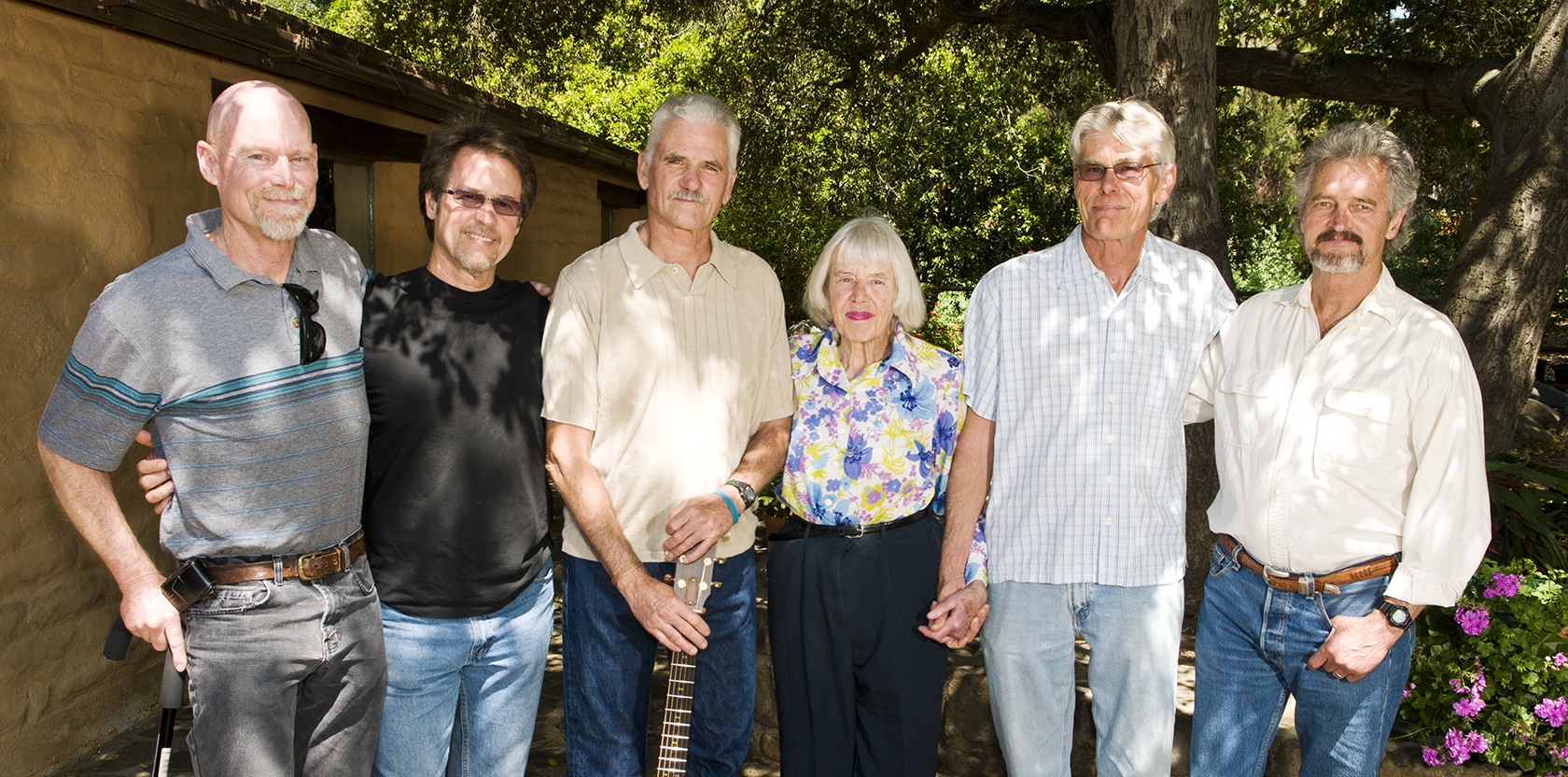
Bryan Thompson, Martin Young, Milton Kelley, JoAnne Thompson, Jeff Hanson and Alan Thornhill, on a recent visit to the old Two:Dot garage studio site on Hendrickson Road. Photo credit: Caitlin Petersen.
Dean had no shortage of session players to call upon, because Ojai by the late ’60s had developed a thriving music scene. The homegrown talent was augmented by L.A. transplants like John Orvis, who moved up here from Venice in 1969. Orvis would strap a Pignose battery-powered amplifier on his back, plug in his left-handed guitar, and wander around the Arcade, serenading passersby with tasty blues licks. Nor was Orvis the only live-music option in town.
“You could go hear live music at six or seven places on a Friday night,” Shives recalls. He played harmonica with the Ojai All-Stars, which had a regular gig at the Ojai Club, a rowdy downtown bar located where Ojai Pizza is today. “There was also the Oaks, the Cactus Club, the Sand Dollar, the bowling alley, the Firebird, the Deer Lodge and the Wheel — all had live music,” Shives says.
Libbey Bowl was another popular venue for local musicians. It was there, early in the summer of 1970, that Dean Thompson met Milton Kelley.
Kelley was a singer-songwriter who had grown up in Ojai and was now back in town after serving a tour in Vietnam. He was part of the musical line-up at the bowl that day, and Dean liked what he heard.
“Dean was there recording some live stuff,” Kelley says. “He came up and said, ‘Hey, man, I’ve got a recording studio up on the hill. You should come up and do an album.’ ”
The result of that conversation was “Milton Kelley’s Home Brew,” released on the Two:Dot label. The backing musicians included Martin Young on guitar, Poi Purl on “jangle piano,” Ronny Bowdon on “bongo-congas” and Dennis Shives on harmonica. Dean was the engineer and the genial host.
“He knew what people needed to get them going,” Shives says. “You could feel comfortable up there. And when you feel comfortable, the music sounds better.”
Kelley’s friend Dan Cole had some recording experience — he had played drums for the Raiders, an early ’60s Ojai group that had once cut a single in a Hollywood studio. Cole ended up producing Kelley’s album.
“I listened to a bunch of his songs and we picked, like, 13 of them,” Cole says.
After they had recorded them all, Dean said they needed one more song to complete the album. On the spot, Kelley and Shives came up with “Peyote Pete.”
“We did it in one take,” Cole says. “And that’s the song everybody likes.”
“We printed 400 LPs and sold every one,” Kelley says.
Meanwhile, Dean was back in the studio recording another promising singer-songwriter, 19-year-old Sue Akins. She had grown up in Ventura but left home at 17, venturing north to Haight-Ashbury, the hippie mecca in San Francisco, before returning to Ventura County. By 1968 she had landed in Ojai, where she was living in the Cottages Among the Flowers on West Aliso Street, and working as a dishwasher at the Gables.
She had written a couple of songs that had impressed her friend and neighbor Phil Wilson, with whom she played music occasionally. As it happens, Wilson also played bass with a local trio, which had arranged to cut an audition tape at Two:Dot. During that recording session, Phil told Dean Thompson about his talented friend Sue, the teen-age troubadour who might be the next Laura Nyro.
“Eventually Dean asked to meet me, so I went up to the studio with Phil,” recalls Sue Randall (as she is now known). “I was a polite young lady of few words but I remember Dean’s beaming face and that jolly beard. I didn’t feel intimidated at all.”
Dean offered to produce an album for Randall.
“I’m sure I said something like, ‘Far out, man,’ ” she says. “Suddenly I had a whole lot of songwriting to do. And I kept my day job.”
The backing musicians for these sessions included Wilson on bass, Norman Lowe on guitar and Don Mendro on piano and drums.
“At first we recorded tracks with the group, whichever group was on board,” Randall says. “Later, Dean and I would do the solo material, songs I wrote for guitar and piano, autoharp and multiple voices. This is where Dean and I came together. Dean owned the candy store and he was letting me run through it, hog-wild, tasting all the wares, letting me use whatever I wanted.
“On some tracks, I would think we must be done, but Dean would say, ‘I think one more track would make it perfect, can you think of something?’ I could come up with new stuff at the drop of a hat. He was able to see this, though I couldn’t. I’m sure he was like this with all the musicians who came to his studio. Somehow, he knew how I wanted my song to sound and he made it happen.”
The album, “Hendrickson Road House,” came out in December 1970. Randall cannot recall exactly how many copies were pressed, but she thinks it was probably 200. She formed a group called Hendrickson Road House, with Phil Wilson on bass and Martin Young on guitar, and they promoted the album at their shows. Eventually the last copy was distributed, and no more were ever pressed.
COSMIC COWBOYS
As the ’60s turned into the ’70s, country rock began to supplant psychedelic rock, as musicians exchanged their Nehru jackets for fringed buckskin vests. Yet the early ’70s still counts as part of “the Sixties” — the era rather than the decade. The “cosmic cowboy” phase of the Sixties had kicked in, with Laurel Canyon as its epicenter. The music business was still booming, especially in Hollywood, where A&R men, the gatekeepers, reigned supreme. At the other end of the industry food chain, Two:Dot continued to record anyone who could pay for a session, and a few who couldn’t.
“Dean was always generous with the personal as well as his studio time,” Tom Lubin says. “Lots of acts didn’t pay for the time, or would do so sometime later if the recordings made any money. Some did. Dean did a lot of horse trading and bartering for painting, wiring, equipment, etc. I don’t know if he accepted eggs for studio time, but he probably did if he believed in the artist.”
Daniel Protheroe, who had played bass with the Calliope, did some session work at Two:Dot from time to time. One day, he asked Dean for a full-time staff job. Dean hired him and immediately left town on vacation, leaving Protheroe in charge of recording a single called “Love is an Animal,” by a man from the Santa Ynez area who owned a menagerie. Clients like this were strictly small-time, but Two:Dot seemed poised for bigger things. Especially when several prominent television actors who lived in the valley began coming to the studio to cut demos.
One was the actor and country singer Sheb Wooley, of “Rawhide” fame, who had topped the pop charts in 1958 with his novelty hit “The Purple People Eater.” Another was James Brolin of “Marcus Welby, M.D.” Then there was Michael Parks, the star of “Then Came Bronson,” who was living on Foothill Road. Parks was also a singer, and he was scheduled to do an album for Warner Bros. He decided to record it on Hendrickson Road. It was to be produced by another Ojai resident of the time, the folk-rock pioneer Jim Hendricks. With this big-time project in view, Dean decided to splurge on another studio expansion.
“So we ordered a 16-track tape recorder, and away we went,” Protheroe says.
Unfortunately, the Parks-Hendricks project fizzled. Protheroe did record some demos with Hendricks and the legendary songwriter and producer Van Dyke Parks (with Martin Young on guitar), but those sessions never resulted in an album. Still, the new 16-track machine did enhance Two:Dot’s regional reputation.
“Dean Thompson was widely known in the Central Coast,” says former Two:Dot technician Jeff Hanson. The studio “was a little dynamo out in the back woods that really made its mark.”
As word got around about Two:Dot’s high quality and low prices, clients from distant places began to beat a path to Dean’s door. “We had an Englishman come out,” Hanson says. “John Jones, a Brit. He found us.” Jones recorded his material, paid in cash for the sessions, took his tapes and left. “We never saw him again.”
Another unknown singer who recorded at Two:Dot in those days was Eddie Mahoney, who fronted a Berkeley rock group called the Rockets. Mahoney’s Two:Dot connection was Tom Lubin, who by this point was working for CBS Records in San Francisco. Lubin had taken on the Rockets as a personal project.
“I liked them, we got along, and so I arranged to produce and engineer four songs at Two:Dot,” he says. “The band and I went to Ojai a few times. Two:Dot was bigger now and there was a lot more gear. The old studio was now the control room, and the other half of the garage was now the studio.”
Pleased with the results of these sessions, Lubin took the tapes to his colleagues at CBS. To his chagrin, they declined to sign the Rockets, and the band soon broke up. But Eddie Mahoney did not disappear into obscurity.
“Eddie took the tapes to Bill Graham, changed his name to Eddie Money, and a couple of years later was signed to CBS,” Lubin says.
As Eddie Money, the singer would score big hits like “Baby Hold On” and “Take Me Home Tonight.” But in 1972 he was just another unknown rock ‘n’ roller who trekked to the Ojai boondocks to make a demo, hoping it would be his ticket to the big time. There were many more like him. Two:Dot continued to record church choirs, student chorales and school musicals, but it was the would-be rock stars who really kept things humming at the studio during the early to mid ’70s.
“We were cranking out a lot of work in those days,” Hanson says.
“It was mostly local bands,” the former Two:Dot engineer Larold Rebhun says. “We could do an album in a day.”
SAND DOLLAR DAYS (AND NIGHTS)
One of those local bands was the Country Z Men, whose lead vocalist, Alan Thornhill, had moved to Ojai in 1973. Other Z Men included Martin Young and Jim Monahan, with George Hawkins on bass and Todd Nelson on drums. The group did session work at Two:Dot and cut some demos of their own. “We never released any of it,” Thornhill says.
The Z Men had a steady gig playing at the Sand Dollar on East Ojai Avenue. (Formerly known as Boots and Saddles, it later changed its name to the Topa Topa Club, and is now a Chinese restaurant called the Golden Moon.)
“We played there six nights a week, and that place was full every night,” Thornhill says.
The Ojai scene was still going strong, and not just at the Sand Dollar. Glenda Jones, who was living in Ventura at the time, remembers driving up Highway 33 to hear live music at the Oaks, in its pre-spa phase.
“Everybody in the county used to come up and dance at the Oaks,” she says.
People came to Ojai from beyond the county, too. Famous people. John Lennon and Yoko Ono rented a house in the East End for several weeks in June 1972. They mostly kept to themselves, but other rock stars were more sociable. The singer Chaka Khan rented the old farmhouse on Persimmon Hill, where she threw epic parties. “They would go on for days,” Glenda Jones says. “You’d find people sleeping under trees.”
Ojai in this period resembled a northern outpost of Laurel Canyon. At least one full-fledged rock star of the era became a full-time resident: Jimmy Messina, who in 1972 bought himself a ranch on Creek Road. His musical partner Kenny Loggins was a frequent Ojai visitor who for awhile maintained a pied a terre in the old motor court on Mallory Way. Loggins in particular was willing to befriend the local musicians and hang out with them. He would come to the Sand Dollar to see the Country Z Men, and sometimes join them on stage.
“He sat in with us a couple of times,” Thornhill says.
“Of course we were all awe-struck,” Young says. “We recorded a couple of demos with Kenny.”
Naturally, those demos were cut at Two:Dot, still the only recording studio in town. Loggins & Messina did not cut any tracks there as a band — they recorded at Messina’s ranch, using a remote truck they brought up from Hollywood. But the two stars did visit Two:Dot together from time to time to check their mixes on Dean’s equipment.
Another Two:Dot visitor and Sand Dollar regular was a strikingly beautiful Ojai Valley School student named Rae Dawn Chong, the future film actress (and the daughter of Tommy Chong of “Cheech and Chong” fame).
“I met Kenny and Jim on the corner in the center of town when I was 12,” Chong says. “They were cute guys, obviously older, but we started talking and they invited me to lunch and we became friends instantly. They took me up to Messina’s ranch where they were recording that day.”
Messina’s wife initially was nonplussed by Chong’s presence: “She was very cautious and angry at first, me being jailbait, but realized I had charmed them into adopting me in a platonic way, so she relaxed and made sure I was safely returned back at school.”
Chong was a big fan of the Country Z Men.
“My home economics teacher was dating Martin Young,” she says. “Her name was Vanessa Hendricks. [Jim Hendricks’s ex.] She was my pal and she took me to the Sand Dollar to see them. I went quite a bit because I spent my weekends with her.”
Chong also made the scene at Two:Dot, at least when the Z Men were in session.
“I loved the band. I think Alan Thornhill is an amazing singer. George Hawkins was my first big crush. I thankfully grew out of that but my teens were filled with awesome music made by dear friends. I felt very lucky to be so exposed to it.”
Hawkins left the Z Men in 1976 to join Loggins & Messina on their farewell tour. “His life changed overnight,” Larold Rebhun recalls, as Hawkins went on to play bass with a long list of hall-of-fame rock stars over the years.
Rebhun’s life changed too, if not quite overnight: The Two:Dot technician started working in that remote truck at Messina’s ranch, which led eventually to an illustrious career as a engineer at Cherokee Studios in Hollywood. (Rebhun later moved into TV and film work, and in 2011 he won an Emmy for sound recording.)
Ojai’s Loggins & Messina era also was pivotal for Alan Thornhill, who co-wrote a song with Kenny Loggins and Martin Young, and made connections that led to some big-time gigs, such playing guitar in Hoyt Axton’s band. Young went on to play in Clint Black’s band for many years. The Country Z Men never released a record as a group, but they went on to successful individual careers, helped along the way to some degree by connections originally made through Kenny Loggins and Jim Messina.
“It was really a big thing for us,” Thornhill says.
It was less of a big thing for Dean Thompson, since Loggins & Messina as a group never recorded anything in his studio. But in 1974, another well-known rock group did come to Hendrickson Road to cut an album. And these sessions would yield the only hit song ever recorded at Two:Dot.
TOP OF THE POPS
Dr. Hook and the Medicine Show had scored big hits in 1972 with “Sylvia’s Mother” and “The Cover of the Rolling Stone.” But their follow-up singles all flopped, and two years later they were broke.
“We recorded a lot of the ‘Bankrupt’ album in Ojai, including the hit single ‘Only 16,’ which was a cover of the old Sam Cooke song,” says the former Dr. Hook vocalist Dennis Locorriere.
“I don’t remember who found the studio or how we came to record there,” Locorriere says. “As the album title boldly states, we were broke and didn’t have a record deal, so it was probably less expensive to do the recording there than at a big, fancy studio in one of the major cities. I don’t remember much about the studio itself because we were touring and would drop in on days off to do some work on the tracks and get right back on the road.”
“Bankrupt” came out on Capitol Records in 1975, and “Only 16” topped out at No. 6 on the Billboard singles charts in January 1976, with Locorriere on lead vocal. Two:Dot finally had produced an actual hit: “Only 16” soon was certified as a gold record. But already the little studio’s days were numbered.
By this point, the trippy ’60s era finally had expired, and “the Seventies” were in full swing. Rock music was now a serious business, and there was a limit to what Dean and JoAnne Thompson could accomplish in a converted garage in a tiny town in the middle of nowhere. They decided to move to a bigger market and open a much bigger recording studio. In March 1976, they sold the house on Hendrickson Road and moved to Santa Barbara.
Alan Thornhill remembers ferrying boxes of Two:Dot equipment to Santa Barbara in his old VW van, driving over Casitas Pass during a heavy rainstorm. Dean’s new building was an old Salvation Army gymnasium with a leaky roof. As Thornhill unloaded his van there and looked around, he was not very impressed. “I remember thinking, ‘This is going to be the new studio?’ But it turned out great.”
Dean retired the Two:Dot name and dubbed the new studio Santa Barbara Sound. He built a first-class facility that attracted world-famous clients, as Thornhill discovered one evening when he dropped by and found himself keeping company with Ringo Starr. (They watched TV together while Joe Walsh mixed Ringo’s latest album on Dean’s shiny new 24-track machine.)
“Dean slowed down a bit in Santa Barbara,” Lubin says. “Once the studio was Santa Barbara Sound it was world class, but also more of a business, and I think not so much fun for Dean.”
Dennis Shives makes a similar point: The Santa Barbara operation was vastly bigger and better than Two:Dot had been, but perhaps less satisfying to run.
“At that point it was not the same,” says Shives. “It reminded me of Los Angeles.”
By 1990, Dean had sold Santa Barbara Sound and gone on to other things. He died in 1996, at the age of 70. The old Two:Dot crowd was well represented at his memorial service.
“It was one of those funerals that take forever, because everybody had something to say,” Shives says. “Great stories!”
TWO:DOT REDUX
Dean Thompson’s professional legacy endures, as reflected in the subsequent careers of his former technicians, many of who now run their own studios or audio-related businesses. “Dean was a real mentor,” Protheroe says. “He touched a lot of lives.”
But Two:Dot’s physical legacy — the actual recordings — seemed destined for the scrapheap. In fact, that’s precisely where many of them ended up. Some years after the move to Santa Barbara, Dean made a good-faith effort to locate everyone who had ever recorded anything on Hendrickson Road. The people he was able to locate were offered the master tapes of their sessions.
“The others eventually were tossed,” JoAnne says.
So that was that. Except that it wasn’t. Even before Dean died, old Two:Dot albums were popping up in unexpected places, especially in the record collections of people who were fascinated by late ’60s psychedelia. One such collector was Raymond Dumont, who lives in Buchs, an Ojai-sized town near Zurich in Switzerland.
Dumont makes a specialty of reissuing obscure late ’60s albums on vinyl through his own label, RD Records. In the early ’90s, he was particularly interested in an extremely rare and much-sought-after recording by a singer named Arthur, last name unknown. This Arthur apparently had recorded his one-sided LP at a label called Two:Dot in 1969. But no one had ever heard of Two:Dot. Eventually, Dumont’s research led him to Dean Thompson. He placed an overseas call to Santa Barbara.
“But Dean did not remember Arthur,” Dumont says.
Some time later, Dumont called again to ask more questions, only to find that Dean had died, and that JoAnne did not remember Arthur either.
With further research, Dumont eventually determined that the mysterious Arthur was a Canadian singer-songwriter named Arthur Gee, who had cut that Two:Dot record as a demo. Gee then went on to record two albums in the early 1970s for Denver-based Tumbleweeds Records. Neither one made a splash, so Gee returned to Canada, where Dumont eventually found him many years later. With Gee’s cooperation, Dumont produced a handsomely mounted vinyl reissue of the “Arthur” Two:Dot sessions, now titled “In Search Of.”
The fuss over the Arthur album rescued Two:Dot from obscurity. Soon, the collectors of late ’60s “psych-folk” records had a new holy grail to pursue: Sue Akins’s “Hendrickson Road House.”
“It’s a great record,” says Dumont, who tried in vain to find Akins so he could reissue her album too. But Akins now had a different name, Sue Randall, and she had left the music business behind many years before. She was difficult to locate, and completely unaware of the renewed interest in her old album.
“I never found her,” Dumont says.
Meanwhile, original copies of “Hendrickson Road House” were going for $1,000 or more on eBay. Collectors began bidding for anything with a Two:Dot label, on the theory that it would have a similar sound to the Arthur and Akins albums. In Ojai, an astonished Milton Kelley was informed that a pristine copy of “Home Brew” was now worth its weight in gold, and then some. (Alas, Kelley was not in a position to cash in. He has only one copy left, and it’s been played a lot.)
Three factors drove the collectors’ fascination with Two:Dot. First, scarcity. Two:Dot generally printed albums in tiny lots: 50 copies, 100 copies, perhaps 200 copies. Four decades later, how many could possibly be left?
Second, sound quality. For a tiny studio out in the boondocks, Two:Dot maintained very high technical standards. And Two:Dot of course used analog equipment, which later was rendered obsolete by the digital revolution. Many audiophiles nowadays revile the sound of digital recordings and thrill to the sound of a well-made analog album, including those cut at Two:Dot.
Third, the cultural context. If a record gives off the right vibe, redolent of the late ’60s, then it will be cherished as an endearing artifact of that tie-dyed, paisley-patterned period that began with “Sgt. Pepper.”
“The late ’60s, early ’70s psych stuff is very interesting to collectors,” Dumont says. “Especially when it was released locally.”
The problem for collectors is that most Two:Dot albums were not in fact very psychedelic. Many a psych-folk aficionado has ponied up for a rare Two:Dot title by the likes of the Guys and Dolls or Mountain Glory, only to find himself in possession of a mediocre country-rock album, or one with a Christian theme. Even more problematic is “Maybe,” a very rare Two:Dot album by the groovy-sounding Mystic Zephyrs 4. Collectors who shell out hundreds of dollars for a copy may be disappointed to learn that the Zephyrs in question were four squeaky-clean teenage siblings from Ventura, whose album is rather less trippy than advertised. Back it goes on the online auction market with a new and somewhat desperate sales pitch, such as this one (actual ad):
“Incredibly strange and rare original private press from 1974! Incompetent teen-age family band with sincere pop songs and positive vibes. The drummer is only 12! May be your only chance to grab this highly sought after and mega-rare artifact!”
Eventually, Two:Dot collectors unearthed the rarest artifact of all: The original Prufrock demo album from 1967, of which only six acetate copies were ever made. Somehow, one of these acetates resurfaced many decades later in Europe. One track — “Too Young” — appeared on a ’60s compilation disc and apparently became a cult favorite in Austria. Eventually Tom Lubin, who now lives in Australia, received the inevitable email from Raymond Dumont: “Dear Sir, are you the Tom Lubin who produced and engineered the band Prufrock in 1967?” And so, 40 years after those seminal Summer of Love sessions in Ojai, the Prufrock album — now called “Visions” — finally was released on vinyl in 2007. (It came out on CD a year later, and is available on Amazon.com.)
In 2009, Lubin had the further satisfaction of seeing the Rockets demos he had produced in Ojai in 1972 finally released as part of a Rockets CD called “Re-Entry.” (The lead singer is now billed as Eddie Money rather than Eddie Mahoney.)
Dean Thompson, of course, did not live to see these old Two:Dot recordings rediscovered and reissued. Lubin, who says he fell out of touch with Dean after moving to Australia in 1987, seems eager to share the credit with his old mentor. “I thank him for the opportunities and the support he gave me,” Lubin says. “He was a wonderful friend.”
Next it was finally the turn of “Hendrickson Road House,” the collectors’ favorite. Sue Randall was living in Oregon, still unaware of the intense interest in her old Two:Dot album. In June 2010, someone finally tracked her down and clued her in. A year later, “Hendrickson Road House” came out on CD, on the British label Wooden Hill. It contained some never-before-heard bonus tracks, most of them recorded on Hendrickson Road and preserved for decades in acetate form by the former Two:Dot technician Don de Brauwere, who remastered them and gave them to Randall for the reissue.
“I was very happy to be able to contact JoAnne Thompson to tell her that ‘Hendrickson Road House’ had come full circle,” Randall says. “I was happy to be able to say thanks to Dean for the incredible opportunity he gave me 40 years ago. I am indebted to everyone, even the jerks, who were instrumental in making this happen. I could never have guessed this outcome.”
FINAL VINYL
Hendrickson Road long ago was paved all the way to its end, so these days the uphill drive to the former Two:Dot site is a smooth one. The garage has gone back to being a garage, and is notable only for the presence of Darrell Jones’s lovingly restored 1947 Dodge sedan. Glenda has converted Dean Thompson’s former control room into an exercise room, and the only audio equipment it contains is her Bose CD-radio player.
JoAnne Thompson still lives in Santa Barbara, in a lovely home overlooking the ocean. Still very active at 83, she gives voice lessons, sometimes recording her students on a machine in her living room — a nice Two:Dot touch.
Ojai still boasts a lively music scene, along with a couple of spiffy recording studios. (The popular indie rock band Edward Sharpe and the Magnetic Zeroes spent several months in the valley in 2011-2012 cutting their hit album “Here.”) Alan Thornhill plays at the Ranch House on Friday nights, and Milton Kelley has a regular gig at the Deer Lodge. Martin Young recently moved back to Ojai after many years as a big-time professional guitarist based in Nashville, and he often joins his old friends on stage. Few of their listeners realize it, but whenever Thornhill and Young play an old Country Z Men favorite, or whenever Kelley and Young play “Hard Way to Die” from “Home Brew,” they are offering a tribute of sorts to their Two:Dot days.
Young says he might look into the possibility of releasing those old Country Z Men demo tracks, “if we can find a decent copy.” Another intriguing possibility would be the demo he cut with Dan Protheroe, Jim Hendricks and Van Dyke Parks — if he can find any copy at all. “I’d give my left arm to have that recording now,” he says wistfully.
Is there anything else from the Two:Dot vault that is waiting to be rediscovered? Jeff Hanson doubts it. Not since Dean Thompson threw out all the unclaimed master tapes when he liquidated the studio’s inventory.
“There is no vault,” Hanson says. “There’s nothing left out there.”
But how can he be sure? Who knows when another Arthur Gee might come forward, a forgotten hippie troubadour clutching the only remaining copy of an old Two:Dot demo? Or perhaps that mysterious Englishman John Jones will one day re-emerge from oblivion clutching the tapes of his Two:Dot session, now hailed by collectors as a long-lost psych-folk masterpiece.
Dean Thompson’s studio was open to all comers, without filters, at a time when a great many people sincerely believed that rock music had the power to save the world. Some of those who recorded there hoped to sign with a major label and win fame and fortune. Others just wanted to testify; to add their voices to the heavenly choir. They sang their piece, paid for their records and went away. And life went on, and rock music did not, after all, usher in the millennium, and those records ended up stashed in a box in an attic and forgotten. Some are still there.
The Two:Dot catalog — whatever is left of it — beautifully documents this process as it unfolded here in Ojai, where the millennial impulse has always been strongly felt. No wonder collectors are drawn to these records. They offer the pure, unvarnished sound of the Sixties moment, lovingly preserved on vinyl, still waiting to be heard.
Originally published in the Summer 2012 edition of the Ojai Quarterly.
ART AND ABOUT … RARA AVIS in our midst by Anca Colbert
Everyone wants to understand painting. Why don’t they try to understand the song of the birds?
–Pablo Picasso
Have you heard the song of the red-winged blackbirds in this valley?
Years ago, walking along the soggy shores of Lake Casitas, I discovered where they gathered in the reeds, perched on tall cattails. They have enchanted me ever since with their melodic whistling and modulated thrills. Blue and grey herons, white egrets, bright black crows, hawks, peregrine falcons, mourning doves, flocks of quail abound at the lake and visit the Ojai Meadows Preserve, which the Ojai Valley Land Conservancy has restored and maintains as an ecological safe haven. (The latest count states there are 174 species of birds at the Meadows!)
What about those spirited hummingbirds, those flying jewels, tiny lightning bolts, dashing up, down, sideways and even backwards, coming to a sudden stop, hovering and looking at you, suspended in thin air, apparently motionless while their wings beat on average 60 times per second? These acrobats are a daily miracle in our lives.
Since ancient times birds have inspired people and artists. Messengers of the gods, their flight or song were “signs” interpreted as either good or bad omens sent from a higher source. Had Caesar listened to the augurs about those Ides of March, he might not have walked into the Capitol that fated day in Rome. In cultures around the world, from the Greeks and the Egyptians to the Aztecs and the Zulus, these divine winged messengers were revered through art and rich myths.
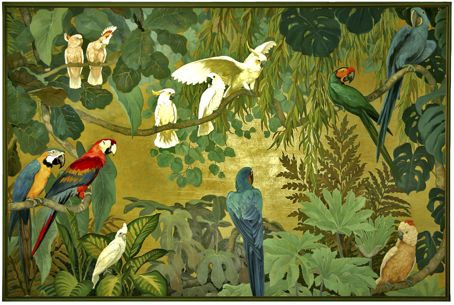
This is about two artists whose works I love, and the very different birds which inspired them. These “rare birds†are indeed treasures in our midst: two large paintings of magnificent, tropical birds by Jessie Arms Botke (on display at the Ojai Valley Museum) and two small retablos of modest, local birds by Dianne Bennett (at the Beatrice Wood Center for the Arts).
The distinctive art and accomplished careers of Cornelis and Jessica Arms Botke have long been known far beyond Ventura County, where they lived and had their studio most of their lives. Originally from Chicago, the couple moved to Santa Paula in 1929. They worked together on numerous commissions (some grace public spaces in Santa Paula and Ventura), but had different styles, which they continued to develop separately. Cornelis (1887-1954) was a refined printmaker, a skilled draftsman keen on attention to details. Jessie (1883-1971) became famous for painting exotic birds, with a predilection for white peacocks (the Botkes kept an aviary and peacocks roamed their large property in Wheeler Gorge). Her splendid skills as a designer and a colorist made her style famous: detailed renditions of elegant, rare birds set against luxuriant foliage in rich, dazzling colors with spectacular use of gold leaf backgrounds. She painted large and bold. Jessie’s works were widely exhibited and collected in Los Angeles, Chicago and New York. Her career was as brilliant as her painting.
Jessie Arms Botke, “Twelve Tropical Birds” (1954). Oil painting and gold leaf on canvas. Photo courtesy the Ojai Valley Museum.
In 1954, Frank Keenan, owner of Ojai’s Oaks Hotel, commissioned Jessie Arms Botke to paint an entire wall for the hotel barroom. Botke responded: “I have an idea for a really stunning design, cockatoos, macaws, parrots and parakeets in a mass of rich tropical leaves, the sky spots in pale gold leaf.” In the 1970s the mural was purchased by Sara Bayless and removed from the Oaks in sections. In 1993 she donated it to the Ojai Museum, where (after restoration) it is now on permanent display. The Michelin Guide would say: “Worth a detour!” I encourage you to go discover these treasures, and read about their unusual history. (David Mason, Ojai historian, wrote the curatorial notes at the museum, which provided precious information for this story.)
Botke painted large-scale compositions of regal elegance, refined decorative canvases and murals often showing groups of birds in decidedly elegant repose. Her feathered subjects keep a certain distance from her and from the viewer: a splendid, seductive detachment.
Dianne Bennett’s paintings of birds are often small to tiny in scale, and use metal signs and other rescued materials as support. Her focus is mostly on an individual subject and on more humble, common birds, but she is expressing their singular nature. These birds sit up close and intimate with the painter and the viewer. They speak to us in a direct, primitive, soulful language.
I recently visited Dianne at her studio in Meiners Oaks and asked about her connection with the birds. “When I was growing up, my father always kept bird feeders off the back porch so I have been tuned into songbirds since I was a child. When I see a bird, I experience a sense of freedom and pure joy.” “They are wildlife in our midst and witnesses to our madness. I have read that songbird numbers are decreasing due to global climate change, loss of habitat, feral cats, acid rain…. So I see birds as winged messengers reminding us to be conscious of our actions and how they affect our planet.”
Bennett’s works are currently exhibited in two local shows: “hear + now” at the Beatrice Wood Center for the Arts in Ojai (through June 29) and “one time one place” at the Museum of Ventura County in Ventura (June 9 to August 19).
Both Botke and Bennett show profound love and respect for their feathered subjects. Whether silent and motionless or singing and in full flight, the sentiment is one of reverence by the painter for her “sitters.”
As birds fly through space, they draw lines, circles, spirals; they create a visual reality in the air, just as their songs and calls make music that punctuates the silence. Space and silence. How these are defined, by their presence or their absence, is at the core of every painter’s gesture, every musician’s note, every poet’s word. Do birds have any choice in these matters? Of course not. Do artists? Most of the great ones feel driven by the inner necessity of a creative force, a mysterious spirit which flows through them and guides their hand. The old Chinese proverb got it right: “A bird does not sing because it has an answer. It sings because it has a song.”
As one leaves the Pacific Ocean to veer from the Pacific Coast Highway to Highway 33 toward Ojai, the eyes catch sight of the sunlight over the hillside on the left. Sometimes just a glimmer of light, other times a bright shimmering over the fields and orchards of the old Taylor Ranch: a first sign on the road up to Ojai that something is quite different now after that turn.
The 15 miles from the ocean waters to the mountain valley takes just twenty minutes to drive, but feels much longer. Time and distance can be measured, but the impression of entering another realm is a flexible reality.
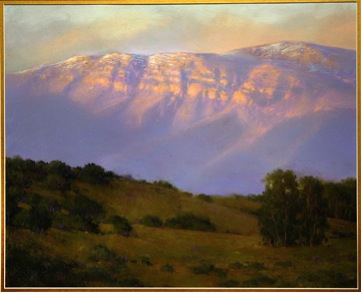
“Topa Topa Bluffs” – Pastel by Bert Collins, one of the founders of the Ojai Studio Tour (collection: Ojai Valley Museum)
The stretch of highway through La Canada Larga runs a few miles. While you can already see the Topa Topa Mountains in the distance, famous for their occasional and unforgettable “pink moment,” the wide road seems to have purpose: a feast for the eye and a time to prepare for the entrance on to the more narrow, winding mountain road leading higher up to the Ojai Valley.
“The essence of drawing is the line exploring space,” says Andy Goldsworthy, an artist who has deeply explored movement in art and nature.
Driving up to Ojai on that road feels like a visual andante. That seductive sense remains still fresh and exciting after years traveling on the same path, first as a frequent visitor from Los Angeles, later as a full-time resident of the Valley.
Seekers of art adventure take the road up to Ojai the second weekend in October. For some it’s an annual pilgrimage. Their destination: touring the open studios of the renowned Ojai Studio Artists (OSA). This year it takes place October 8-9. OSA’s website (www.ojaistudioartists.org) gives ample information about the organization, its founders and history, its 52 current members, this year’s tour, and the “Meet the Artists” reception at the Art Center. Yellow banners mark the location of the studios. Easy to spot!
Open studio tours have become a favorite event in recent years, drawing both local crowds and tourists. There appear to be at least 26 of them in Southern California alone! Visitors always get a map and guidance to the studios. The tours usually are run by the artists themselves. They open their homes/studios for visitors to see their work (both completed and in-progress) and to engage in conversation.
So there is a chance to really connect with an artist, in their real-life personal environment (gardens, dogs, chickens and all), not in the more neutral/abstract/detached space of an art gallery or cultural organization, nor with the frenetic pace and accelerated intensity of busy booths at big art fairs. Most art lovers treasure this chance at an up-close and personal glimpse into an artist’s creative heart and soul.
Artists, their family and friends work very hard to produce and prepare for this annual event and the two long days of interaction with hundreds going through their studios. Not easy for people mostly keen on working alone in a quiet space. Probably most artists relate to Georgia O’Keeffe’s famous comment: “I found I could say things with color and shapes that I couldn’t say any other way–things I had no words for.”
The OSA Tour was founded in 1984 by Marta Nelson, Gayel Childress and Bert Collins. It was called “A Day in Art Country,” a clear homage to the French Impressionists and their love of landscape painting. Every year OSA organizes an exhibit and sale at the Ojai Art Center showcasing works by all their artist members, whether or not they participate in the tour that year. How is the Ojai Studio Artists Tour different from others? In 1989, Vivika Heino and Linda Taylor joined the three original founders to initiate a new program: Revenues from the tour would fund scholarships to help local students with their continuing education in the arts. Members also agreed to participate in some way with art enrichment for their community and schools. Since 1993, OSA has given out more than $133,000 in art scholarships. In the process, these artists have changed a few lives. Art does that.
You have to leave the coastline and drive up the gentle hills to a higher place to reach this small paradise called Ojai. The light is different here. There is a sweetness in the air. That drive itself on a fairly narrow mountain road towards the village creates excitement and expectation: a sense of initiation emerges, inspiring those seeking a closeness to the artist’s life to deepen the connection to their own creative life force. The mystery of art is contagious. And that surely is a good thing.
Ojai Quarterly Magazine, Winter 2011 Issue
ART AND ABOUT…
…… of dogs and their artists. By Anca Colbert
From large shepherds to small bichons, dogs are a most visible part of life in the Ojai Valley. They seem to have a particularly important place in the physical and emotional geography of artists’ studios.
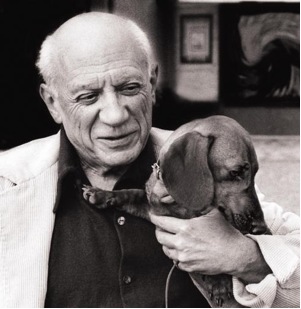
Two famous ceramic artists in the valley always had dogs around: Beatrice Wood had little Dali, then Colette, Charlie and others. Otto Heino aged with his fluffy Australian shepherd, Prince, on his heels. Donna Granata shared a touching memory about the pair:
“Otto sculpted a kiln god in the likeness of Prince and I saw it on top of the kiln and asked him if I could have it. Otto was always so generous. Whenever I would ask him for a kiln god he would fire it for me so that it would be more durable. It remains my favorite among my collection of kiln gods.”
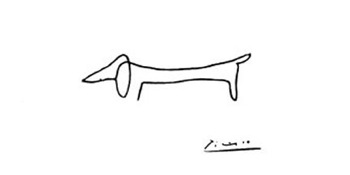
Picasso and his dachshund, Lump: Photo by David Douglas Duncan
Dogs provide protection. Literally and spiritually. Indeed they are, as Milan Kundera put it, “our link to paradise. They don’t know evil or jealousy or discontent.” Artists are isolated by the nature of their work, often self-absorbed, and sometimes affected by the stress or anxiety of not knowing where their creative flow is taking them. A dog’s rhythmic breath and physical ease, its ability to be in the here and now, can be a great comfort in the studio. Dogs are physically grounded and emotionally grounding. A cold, wet nose brings instant re-connection with reality! Dogs teach artists to be playful yet patient, spontaneous yet quiet, detached yet fully present. It is no wonder that some Ojai painters have devoted much of their creative attention to painting their cherished companions and accommodating models.
When I asked Linda Taylor why most artists prefer dogs to cats in the studio, her answer was prompt: “Dogs don’t walk on artworks!” In her case, having paw marks on her exquisitely executed prints would be a no-no. She finds that playing with her dogs (Oreo, a male Australian shepherd, and Libbey, a female Australian cattle dog) relaxes her and helps her find resolution with her art.
Linda Taylor playing ball with Libbey in her printing studio.
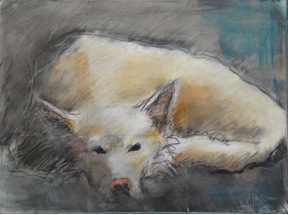
Kate Hoffman is an accomplished painter of animals, horses, dogs and cats. She prefers older dogs: “They are quieter and easier to paint.” She likes pictures of sleeping dogs; they remind her of people. One of her favorites is Andrew Wyeth’s painting (“Master Bedroom”) of a yellow lab peacefully sleeping on a bed, curled up against the pillow in a soft light.
Kate’s rendition of her samoyed-wolf mix, Tofu, echoes a similar sense of comfort and relaxation. As a painter, she is always looking to simplify, and she captures the essence of her subjects, a fine line moving at the intersection of the human and animal kingdoms.
“Missy” by Kate Hoffman
Dianne Bennett experiences the animal world with the warm, keen sensitivity manifested in her brilliant paintings and retablos of birds, turtles, coyotes etc. As she tells her stories with colorful vibrant images, clearly there is a love and reverence here for the whole world of nature, a deep and joyous connection among the full spectrum of all forms of life.
With Sophie, her white poodle, cuddled snuggly in her arms, Dianne speaks about dogs with gentle tenderness in her voice.“Sophie in my world waiting” Painting by Dianne Bennett
“A dog’s needs are very simple: they will be there, sit and wait for you,” she said. “Art making is a solitary endeavor. Sophie, like Jackson before her, is my muse and constant companion while in my studio. Her presence, watching and waiting, provides inspiration and connection that calms me and supports my creative flow.
Pablo Picasso had many dogs in his life, and apparently they went everywhere with him, although he often left women and households behind.
Maybe his most adored canine companion was a dachshund named Lump, which he had gotten from David Douglas Duncan, the photojournalist and author of seven books on Picasso, including “Picasso & Lump: A Dachshund’s Odyssey.”
Picasso’s masterful use of the simple line drawing catches the essence of his beloved Lump in “The Dog.” His sketches of Lump, like those of his toros, are among his most famous drawings. As for the photographs of him embracing Lump, tight and close to his heart, I can’t recall any other picture of Picasso where his whole body seems to surrender into such a soft smile. Dogs do have that effect on people, even on the most moody of masters.
Charles Schulz, of Snoopy fame, summed it all up: “Happiness is a warm puppy.” And we all know he was an authority on dog matters.
As for other illustrious dogs and their famous masters, one must at least mention David Hockney and his inseparable dachshunds Stanley and Boodgie; William Wegman’s photographs of his Weimaraners (Fay and her brood); Andy Warhol and his dachshunds Archie and Amos; Pierre Bonnard’s black poodles and his dachshund, Pouce; and Lucian Freud’s haunting portraits of his beloved whippets Pluto and Eli.
Dogs do not speak (or do they?), so we must want to listen intently and observe their body language to hear their voice. These furry friends are humble yet quite effective teachers to humans on matters of unconditional love, trust, wisdom, playfulness, patience and animal instinct. Â Joyful and attentive companions, they bring all that and unaccountably more to the lives of those willing to open their eyes and hearts to their soulful presence. The bond is powerful. Â In an artful portrait, it is made visible.
The World and Ojai Change Forever,from The Ojai Valley News, 1991
Soldiers parading on the golf course.
Betty Jo Bucker Strong of Ojai was attending services at the Ojai Presbyterian Church on December 7, 1941, when news broke that Pearl Harbor had been bombed:
“That Sunday’s afternoon excursion for us teenagers was immediately canceled, and we all just stood in front of the church absolutely numb,” she recalls. “Within days, we were ordered to tar-paper our windows at night, and we held regular air raid drills. My mother learned to shoot a rifle.”
Ojai on the Defensive
With the declaration of war, Ojai Mayor Fred Houk issued a proclamation creating a Civilian Defense Council to coordinate “all war and defense measures in the city and the community.” Routine blackouts and air raid drills were signaled by the bell in the post office tower, and civilian wardens with whistles patrolled the outlying neighborhoods to warn householders to douse their lights. Stores in the Arcade conducted end-of-the-day business behind draped windows, and cars were ordered to pull over and turn off their headlights.
Less than three months after the start of the war, on February 24, 1942, the Ojai Valley’s readiness was put to the test when a Japanese submarine slipped into the Santa Barbara Channel and fired 20 rounds from its 5-inch guns into the Ellwood Oil REfinery near Goleta. Although there were no casualties and little damage was done, the incident unnerved locals when told that it was the first attack of the war on the U.S. mainland. That February night, the all-clear signal for Ojai and the Central Coast didn’t come until almost dawn. The blackouts became a nightly occurrence thereafter, and it was several weeks before the standing order was rescinded and Ojaians resumed normal activities after nightfall.
Residents of Ojai, as in all American communities, threw themselves behind the war effort by raising money for the Red Cross, purchasing war bonds, rationing rubber tires, collecting scrap metal, nylon, and silk, sewing bandages and “comfort kits” for the wounded, even collecting cooking fat that was used to make munitions. “Everyone was involved in the war effort,” remembers lifetime Ojai resident Shirley Dunn Brown. She would soon leave Ventura College to work as a radio contact for the civilian fire and aircraft spotters at an observation post on the old Raymond Ranch near San Antonio School.
The Army Heads South
During February of 1942, a U.S. Army regiment of some 3,000 troops moved south along the California coast from Fort Ord, digging foxholes and patrolling several locations on the beaches until it reached Seaside Park in Ventura, where it established regimental headquarters in the winter of 1942.
Ventura resident Campbell Fahlman was a 26-year-old private from Nebraska serving with the 134th Infantry Regiment, a part of the 35th Infantry Division of the U.S. Army, that had been federalized by the Nebraska National Guard to help defend the California Coast. He remembers the temporary shelter at the fairgrounds vividly:
“We had no blankets or tents when we got there, so we slept on the stadium benches of the fairgrounds. It was cold and damp, and a lot of guys caught the flu. It was rough…”
The regiment’s 1st and 3rd battalions occupied “on line” positions on the beaches from Gaviota to Malibu, practicing “stand-to’s,” alerts, and patrols. Officers filled their intelligence journals with notations of alleged submarine sightings (which were later proven to be only sea lions) and mysterious lights reported along the blacked-out coast.
Camp “La We Ha Lis”
Meanwhile, Colonel Frank Dunkley was ordered to take the 2nd battalion inland as a reserve force. Seeking a location for the battalion’s training base, he discovered the Ojai Valley Country Club, which operated at that time as a winter resort. Ojai’s weekly newspaper then known as “The Ojai” reported that Army officers had visited the valley during the first week of May to scout locations for a “small unit” of soldiers.
“The telegrams flew back and forth from Ventura to Toledo, Ohio,” recalls Fahlman, as the Army sought permission from the Edward Drummond Libbey estate to occupy the private property. Three weeks later, a battalion of 1,000 men took over the former country club. “Everyone thought we were going to ‘O-jay,” remembers Bob Branch, a longtime Ojai resident who was then a young operations sergeant. “We were all from out of state, and we didn’t know how to pronounce the word, not even our commanding officer,” he chuckles.
A plea went out to Ojai homeowners with extra rooms or cottages to rent to make them available to the wives of soldiers who had followed their husbands to the new base. Many Ojai residents remember the influx of military visitors. David Mason’s grandmother’s house on Fox Street had a parlor that was diode into apartments for 4 army wives, and Shirley Dunn’s mother rented out rooms in their large family home in the Arbolada.
Military tents blossomed on the Country Club grounds. Enlisted men set up over 125 tents on the southwest side of the golf course, while some 20 line officers were housed in the clubhouse. Bob Branch remembers erecting the platform tents with wooden floors brought up from the Seaside Park headquarters: “It was a typical army tent camp with six enlisted guys in a tent. Each of the 4 companies first stationed there–E, F, G and H–had their own mess tent. Systems of open latrines–slit trenches–were dug into the golf course.” Wooden barracks were added a few months later.
Barracks at Camp “La We La His,” home of the 134th Infantry.
The new camp was soon dubbed “Camp La We La His,” meaning “the strong, the brave” in the language of the Nebraska Pawnee, which was the 134th regimental motto. Roads were built between the barracks and the officer’s quarters and were respectively named Dunkley Road for the battalion commander, and Miltonberger Road for the regimental commander. Second Battalion Field in front of the clubhouse was designated the official parade ground, and the long, tree-shaded entrance road tot he former country club was renamed Nebraska Road in honor of the regiment’s home state. In time, the camp constructed a dispensary, a chapel, kitchens and recreation halls.
An officer’s club was set up in the clubhouse bar, which at that time was decorated like a British pub with tartan plaids and English prints on the walls. According to Shirley Dunn, who met and dated Army Capt. Rodney Brown while he was stationed there, “it was very cozy, very British-looking, and it just dazzled all those farm boys from the Midwest who had never seen anything like it!”
Romance and Pranks
More than a few couples recited their wedding vows before base chaplain Capt. John Reents, whose little daughter often stood in as a flower girl. Wedding receptions were held on the patio of the former clubhouse. Other romances bloomed between local women and the soldiers stationed in Ojai and led to weddings held out of state when the men were transferred to distant locations. Ojaian Shirley Dunn Married Capt. Brown in 1944. Bob Branch wed Norma Nichols of Ojai the same year, and Pvt. Fahlman married Madge Kilbourne, daughter of the newspaper’s editor, in 1943.
One night a young Betty Jo Buckner joined a group of her school friends who dared each other to sneak up the the Country Club “to spy on the Army.” Armed sentries stood guard every night at the three entrances to the property: at the intersection of Country Club Road and Country Club Drive, at the service entrance further south on Country Club Drive, and at the greens keeper’s house on Highway 33 and Ojai Avenue. The young pranksters managed to stay hidden from the rifle-toting guards, but by the time they got close enough to see anything interesting, their courage had disappeared and they ran back to town. Nevertheless, the life of a soldier must have impressed her, because two years later, Betty Jo Buckner became the first local woman to enlist when she joined the U.S. Air Force as a field locator and was stationed for the duration of the war at a bombardier training base in New Mexico.
Training and Readiness
While very little information was made public about the military activities inside Camp La We La His, those who were stationed there recall many days spent in combat training exercises in preparation for the expected enemy invasion. Whenever a Japanese submarine in the Pacific was lost on American radar screens, the 134th Infantry was put on alert. “They trained with 60- and 80-mm mortars, machine guns and rifles,” remembers Bill Bowie, a long time resident of Ojai and archivist at the Ojai Valley Museum. “At one time, I was a fire marshal; and I went along with the troops when they held artillery practice out by Rancho Matilija or up in the Sespe. My job was to report any brush fires that the ammunition might ignite.”
Pauline Emerson Farrar was fresh out of Nordhoff High School in the summer of 1942 and was working at Bill Bakers Bakery.
“We’d often look out the store windows to see small squadrons of armed soldiers sneaking through town from doorway to doorway, on special training maneuvers,” she remembers. “We had to remind ourselves that they were practicing military techniques for dodging enemy fire! Of course, we never interfered, but it always gave me a start!”
Pageantry and Parades
The regiment’s commanding officer, Col. Butler B. Miltonberger, a lover of military pomp and circumstance, quickly organized an unofficial regimental band. Â Private Campbell Fahlman joined as a drummer. Some 35 musicians, playing the drums, tubas, trumpets, trombones, saxophones and cymbals, were decked out every Sunday in white spats and dress belt and sash for the colonel’s formal Guard Mounts and Parade Retreats, marching in formation on the golf course in front of the flag pole. Ojai townspeople were invited to attend the ceremonies and remember the soldiers who were still dressed in their heavy winter uniforms in the middle of the summer. “The summer sun was brutal on those boys,” says Pauline Emerson Farrar. “There were always a few who would faint in the heat.”
Others remember the pageantry that stirred unabashed patriotism in the hearts of the local spectators. Writing at the time in a letter to the local editor, pastor George Marsh of the Presbyterian church described “the superb setting which suggests something of the grandeur and beauty of the far-flung expanse of our fair America–the green stretch of the beautiful golf links rising to the rolling hills which mounted to the noble range of the Matilija, and the mountains touched with the glory of the setting sun.” An officer in the camp was quoted as claiming, “No camp in the United States has a finer setting.”
Valley Hospitality Blooms
In town, a hospitality center serving coffee and doughnuts was opened for the soldiers at Russ and Ruth Brennan’s electrical shop on Signal Street, where the Dancers Studio is located today.
Villanova School made its pool available to the Army for swimming and diving, and softball games were organized at Sarzotti Park between the soldiers and local teams. Dances were held at Nordhoff High School (then located where Matilija Jr. High School stands today).
As a coed attending Ventura College in 1942, Harriet Grout Kennedy remembers “marvelous times” getting to know the soldiers who arrived in Ojai that spring. “The bowling alley was located at 312 E. Ojai Avenue where the Village shops are today, and we organized bowling leagues to include the Army boys,” she recalls. “We went to the movies at the Ojai Playhouse, and we also used to get out to the Maggie Hunt stables which were next to St. Joseph’s Hospital and take the officers on horseback rides.”
It wasn’t long before the community volunteers running the little hospitality center out of Brennan’s Electrical Shop moved their activities to the larger Jack Boyd Club, then located next to Libbey Park at the present site of the Bank of America [now Nomad Gallery], which became Ojai’s official U.S.O. headquarters. An Army dance band, formed out of the larger regimental band, practiced at the Boyd Club and played at the frequent dances held in the club’s basement, at the high school, or at other county U.S.O. locations. Campbell Fahlman, who played in the dance band, remembers those parties with special fondness. “I used to play the drums and watch this pretty girl who danced with all my buddies,” he recalls, “so I decided I’d better figure out a way to meet her.” He did, and married her a year later.
Military Secrecy
Recognizing “the importance of maintaining close understanding and high morale between the U.S. armed forces and the civilians among whom they are stationed,” Col Miltonberger assigned a Pvt. Gorfkle and a Sgt. Lorimer to submit occasional army news items to “The Ojai” for publication.
Although the exact number of troops stationed in Ojai was never revealed, nor were the destinations of the almost constant arrivals and departures of the various companies, military promotions were routinely reported, and community leaders active with the local Red Cross and U.S.O. were invited to the camp to discuss their volunteer projects with the officers. Col. Miltonberger was a stickler for discipline and insisted on the meticulous appearance of his troops at all times. The camp’s log records his almost-daily admonition to his officers: “Any member of this unit found dead in battle will be found properly dressed.”
Popular Guests
The troops were immensely popular with their Ojai hosts.
During December of 1942, locals teamed up to furnish two recreation halls on the base–one was was remodeled from the old garage building of the country club–by contributing a piano, tables and chairs, rugs and curtains, books and games, and had them both ready for use by the holidays, complete with fresh fruit and nuts. Trees provided by the Forest Service station in Ojai were decorated with paper chains and popcorn made by Ojai school children. Ojai churches sent their choirs to sing at the base chapel.
Rumors circulated that the 134th would soon get orders to overseas duty. Some 1,000 townspeople turned out to watch would be the regiment’s last ceremonial parade on January 10, 1943. Within days, “Ojai’s beloved Army group,” as one newspaper editor wrote, was abruptly pulled out in January 1943, leaving behind them an almost deserted camp, many local friendships, and not a few sweethearts. The soldiers of the 134th 2nd Battalion were sent to hot spots in both the European and Pacific theaters of war. Some were assigned to the Aleutian Islands, while most joined the ground divisions that ultimately merged with Patton’s Third Army in France.
During the eight months the 134th 2nd Battalion had been stationed at Camp La We La His, Ojai Red Cross volunteers had mended more than 2,000 uniforms for the soldiers,sewed military piping on 1,000 of their caps, and helped find rooms and employment for Army wives. Hospitalization and baby equipment were arranged for expectant Army mothers. Valleyites collected hundreds of rags that the soldiers used to care for their equipment, and gas heaters were donated to warm the wooden barracks during the winter months.
Camp Oak is Born
By May of 1943, a convoy of new Army units from the 174th Infantry arrived in Ojai from Fort Dix, New Jersey, with hundreds of raw recruits hailing from upstate New York. The promptly renamed their new home Camp Oak. The social schedule of popular U.S.O. dances and Army band concerts were resumed, along with the collection of donated furniture for the camp facilities. Sports events were played again at Sarzotti Park between the soldiers and local teams. The base’s new Army Chaplain, Lt. Frederick E. Thalmann, performed still more weddings at the officers’ club.
Much of the daily routine in Ojai again centered around the presence of the soldiers. Joe Sarzotti, whose family farmed many acres in the Ojai Valley, had been granted exempt status from the draft because his agricultural work was considered critical to the war effort. “I was just 20 years old when the war started,” he remembers, “and we worked from one season to the next harvesting barley, oats, citrus and about 40 acres of apricots. Almost every bit of it was sold off to the government’s quartermaster corps and wound up as C-rations. I don’t know why we had to bother with the middle man, we could have trucked it all to downtown Ojai and sold it directly to the soldiers at the Ojai Valley Inn.”
Joe did participate in at least a few bartering sessions that had a more perusal touch. Â He befriended several soldiers while they were stationed in Ojai, and they struck up a typical war-time deal: he swapped his much-coveted gasoline ration coupons for their cigarette coupons. Â “I was a smoker at the time, and those city boys said they definitely wanted to spend their precious leave time out of town!”
Not all the soldiers were so eager to leave the little quiet town. Â “There were more than a few romances that bloomed during the war years,” he says. “My sister Mary met a 1st lieutenant at a U.S.O. dance at the Boyd Club, and they dated for several months until he was shipped out. That’s the way it was during the war: here today, gone tomorrow.”
Sarzotti remembers several soldiers with the 174th Infantry from New York who used to make fun of the unglamorous life in the Ojai. “They thought it was the worst hick town they had ever seen!” he laughs, “but when they left, they cried. The people in Ojai were so nice to those young men, inviting them home for dinner, organizing social for them. I guess they weren’t used to that kind of warmth and hospitality.”
Here Come the Seabees
By the end of January 1944, the 174th Infantry had pulled out of Camp Oak and was assigned duties in Oregon, Arkansas, Oklahoma and Alabama. Life in town quieted down again, until word came that the U.S. Navy had allocated $80,000 to improve the camp for the Navy’s use. Seabees from Port Hueneme spent several weeks working on the barracks and the clubhouse and even adding two swimming pools.
In May 1944, units of the Acorn Assembly and Training Detachment from Port Hueneme moved in under the command of Capt. Marshall B. Gurney and Lt. Cmdr. Lloyd R. Saber. Like the Army soldiers before them, the sailors became an important part of Valley life, even spending their liberty time helping local ranchers with the harvest during the summer and fall. Ojai firefighters could always count on extra help during an emergency from the Camp Oak Navy personnel, and the high school football games were regularly attended by the Navy doctor and a pharmacist’s mate.
In November of 1944, when a commercial airstrip was approved for Ojai’s Dry Lake in Mira Monte (locally known as Henderson Field), the Navy loaned the heavy equipment that was used to grade the landing strip.
In April of 1945, locals were thrilled to be invited to Camp Oak to watch an exhibition match played on the camp’s 9-hole course by radio and film stars Bob Hope and Bing Crosby. Proceeds raised from the $1 tickets went to the Navy Relief Welfare Fund. Cmdr. Creighton, one of the Navy’s finest golfers, paired up with Bing Crosby, while Hope’s partner was Gabe Burbank, a former professional golfer who was stationed at Camp Oak at the time.
Some 3,000 spectators, civilians and servicemen alike watched the 12-hole match that was marked with the antics of the famous comedians. At the end, the Hope and Burbank team won the contest by the margin of one hole. It was an extravaganza of stars and military brass that focused enormous media attention on the little town and its former country club.
Victory Comes
Nine days later, on May 8, 1945, VE-Day was celebrated by all Americans, and three months after that VJ-Day brought an end to five years of combat on every continent of the world.
Still, it was months before the Navy at Camp Oak made known its intentions about its continued use of the property, although fewer and fewer sailors were seen in town. Rawson B. Harmon, local resident and manager of the Libbey interests in Ojai, announced that the Libbey estate would no longer keep the property but insisted that the Navy restore the links and the buildings to their original condition. Numerous private investor groups made offers to purchase the country club on the assumption that the military would son be gone.
But it was not until late summer of 1946, 15 months after the end of the war, that the U.S. government finally auctioned off over 50 barracks buildings and quonset huts, some of which were purchased by locals. Villanova School, which was facing an unusually high enrollment for its first postwar term, bought two large barracks to use as dormitories, and others can still be spotted in the Ojai Valley today as converted residences, workshops and places of business.
From Fort to Resort
In October 1946, the Navy returned the property to the Ojai Valley Company, and one week later Rawson Harmon, representing the Ojai Valley Company, announced the sale of the Ojai Valley Country Club to Don B. Burger, Willard Keith and Associates of Beverly Hills. An article in “The Ojai” assured locals that “Mr. Burger and his associates will operated the property in accordance with standards established by the Libbey interests and have expressed a sincere desire to cooperate in every way with the Ojai community in making the country club one of the finest developments of its kind in the country.”
Work on the reconstruction of the golf course began in December 1946 under the supervision of William P. Bell of Pasadena, the original architect of the famed course, and took seven months to complete. A new swimming pool was built, and tennis courts, stables and riding trails were completely reconditioned. Inside the charming old clubhouse, the dining room, bar, and guest rooms were restored by a team of local workers, including a recently discharged Army sergeant who knew the property better than anyone.
Campbell Fahlman had returned to Ojai, the hometown of his bride Madge Kilbourne, and drove straight to the country club where he had been stationed five years before he was sent to join Patton’s Third Army in Europe. Fahlman was hired on as part of the crew that worked on every inch of the 200-acre property throughout the winter and spring months; and on June 7, 1947, the former country club, that had been briefly known as Camp La We La His and Camp Oak, was officially reopened as the Ojai Valley Inn, leaving behind forever its place in the history of World War II.
The Ojai: Pink Moment Promises,by Patricia Hartmann
Book Synopsis
The simplicity of Ojai farm girl Meggie Baxter’s life is shattered when she must choose between loyalty to her rough-hewn friend, Rusty, and the dashing Charles.
As the decades of her life unfold, she faces the elemental dangers of floods and fire as well as the colorful high-jinks radiating from Pop Soper’s Fight Camp, the steam baths at Matilija Hot Springs, a leaning post office tower, a corrupt councilman and Libbey’s plans to modernize the town.
Amid tragedy and loss, Meggie clings to the one constant in her life, the promise of God’s love. It is the ‘pink moment,’ the evening sunset casting a rosy hue like a prayer across the Topa Topa Mountains, that points her again and again to faith and courage.
Midst the idyllic beauty of the Ojai Valley and the crushing forces of change, will Meggie and her beloved Ojai stay true to their rural roots of faith and family? Will the ultimate sacrifice that spares Rusty’s life be enough? Or will the winds of destiny destroy both the people and the indomitable spirit of the Ojai?
____________________________________
The following excerpt (Chapter 11) takes place at Christmastime, 1916.
To purchase the full book, visit www.patriciahartmannbooks.com, order from Amazon.com, or purchase at the Ojai Valley Museum.
“All that Glitters” 1916
“Hey, Trooper. Easy boy…It’s OK.” Rusty spoke soothingly as he forked some hay into Trooper’s trough for his evening feed. The big chestnut gelding held back a few moments before moving forward to eat. Pa’s horse was showing telltale signs of abuse. A slight skittishness. Some scarring along the flanks. A wary look to the eye. It saddened Rusty in a way he couldn’t quite come to grips with. Everything Pa touched suffered. Trooper had been a fine, handsome horse when Pa won him off a fella in a poker game a few years back. Rusty made sure Trooper was well fed, but he couldn’t control what happened when Pa was drunk and in the saddle.
Rusty tried to reassure the horse with a gentle rub along the neck and a few soft words. “It’s okay fella…That’s a good boy.” The animal flinched slightly before blowing a stream of air out of flared nostrils and finally relaxing into Rusty’s touch. As he rubbed behind Trooper’s ears, Rusty noticed that the horse favored his right forefoot.
“Easy now, boy…Let’s have a look.” Rusty wedged his back against Trooper’s shoulder, shifting the animal’s weight off the front foot. He lifted the foreleg back and examined the hoof. The worn shoe was missing a nail. A second nail had worked loose and was protruding about a quarter inch from the bottom of the loosened shoe. Rusty grabbed a hammer and pounded the nail back in. “This is only a quick fix, Trooper. You’ll be needin’ to see Charlie Gibson at the blacksmith shop right away…if’n I can get Pa to part with the money.” If not, maybe Rusty could work it off mucking out stalls.
The days were shorter in these cooler days of December. Already the sun was starting to set. Rusty hurried to finish his chores while he still had light.
Moving to the pig shed, Rusty checked on the sows. Nine of them were nearing their farrowing time. Pa bred them too early – spring piglets had a better start in life. The sows all seemed steady on their feed. None of their teats leaked milk. Looked as if they’d hold off a few days yet. After scratching a few of the rounded backs with a stick, Rusty hefted a metal bucket he’d held back from his earlier milking of the gentle Guernsey cow. He poured a little of the rich white liquid to the pig troughs. Rusty wished he had some good corn to fill out the slops. They’d produce better with richer feed. But Pa’s only interest in corn was if it could be made into whisky.
Rusty sighed and straightened up. He headed to the wash barrel by the back door. Tonight was the big Christmas party at Thacher School. He needed to get cleaned up and dressed in his Sunday best. Rusty struggled to rouse some lather from the remnant of the cracked lye soap bar.
His thoughts turned to the night ahead. Good thing it’s within walkin’ distance. Even if’n Pa would let me ride Trooper, that wouldn’t be smart. Good way to lame a horse.
A tinge of anticipation countered the shivers from the cold water. The big Thacher Christmas hoopla. All the Nordhoff high-schoolers and the Thacher School boys were invited. Some of the older townsfolk would likely be a coming too. Meggie was sure to be there. Rusty scrubbed harder. Sure, she’s courtin’ with that Charles the III fella. All the more reason to keep an eye out fer her.
_____________________
Meggie threw a heavy flake of alfalfa into Molly’s feed trough, then held out a few chunks of carrot for the mare’s usual evening treat. Molly lifted her upper lip, revealing yellow teeth, as Meggie gently rubbed the soft pink skin of the horse’s nose. Wags bumped the back of her leg, demanding some attention too. Meggie stooped to stroke the silky black head and rub behind the dog’s ears, eliciting a rhythmic waving of his namesake tail. “OK, Wags, chores are done. And none too soon.” The sun was setting.
Meggie lingered in the barnyard, pulling her coat tighter about her, tucking her cold hands in the pockets. Yesterday’s light rain puddled the yard and the fresh smell of wet earth and damp hay filled the air. Meggie breathed in the scents and felt a quiver of excitement flood her heart. Bathed in the orange and pink hues of the sunset, Meggie had every reason to be thankful. The Topa Topas glowed pink, then purple in benediction. A few trailing rain clouds rested on the Chief’s headdress. As she turned her circle in the yard, Meggie thanked God for this day and in advance for the glorious evening ahead.
Tonight she would see Charles at the Thacher Christmas Party. This was not a box lunch or a carriage ride, but a real fairytale ball. Lights and dancing and romance. Meggie pictured herself there, clinging to the warmth of Charles’ arm. The shimmering deep blue of her formal gown matching the color of her eyes. She and Mama had spent hours stitching the dress by hand from expensive yard goods and the latest Sears Roebuck pattern.
Meggie could still see the shiny soft blue taffeta spread across Mama’s lap as she bent to make small, even stitches in the fabric. Mama’s golden hair, escaping from its tortoise shell combs, fell in soft tendrils around her face. Side by side, she and Mama had worked to fashion the iridescent fabric into a tight bodice and flowing skirt that cascaded gracefully to the floor.
The tiny seed pearls to be sewn in at the neckline and sleeves had given Meggie even more of a challenge. The pearls, carefully clipped from a castoff mourning dress Mama had found at the church rummage sale, had a very tiny center hole for threading through. It took a trip to Barrows & Son General Merchandise to find a needle thin enough to do the trick. Then Meggie had spilled the tin of pearls, watching helplessly as they bounced and skittered across the wood planks of her bedroom floor.
Chase caught her on hands and knees, searching for the tiny white beads under the bed and in the yarn of the throw rug. “So this is how Me Lady prepares for the ball…Praying are we?” He expertly dodged the pink velvet throw pillow Meggie aimed at his head. “Now…now, Meggie. You shouldn’t get testy with your carriage driver. The supply wagon just might turn back into a pumpkin.”
“And that would make you what…a rat?” From her position on the floor Meggie spied a tiny pearl near his boot. “Don’t move.”
“Why? Are you taking aim at me with your glass slipper next?” Chase grinned at her from the doorway.
Meggie rescued the pearl and stood to her full five foot one inch height to stare up into her brother’s blue eyes. She held the tiny bead in front of him. “You almost trod on a pearl of great price – you big brute.”
A smile twitched at the corners of his mouth as Chase bent to kiss the top of Meggie’s blond head. “You’re right, little lamb. I almost did.”
When Meggie tried on the finished gown and stood on a stool to see her reflection in her dresser mirror, she felt transformed into a real princess. She twirled a bit to reveal the layers of petticoat and piled her blond hair atop her head to study the effect. In the mirror she caught Pa’s reflection as he caught her admiring herself. He was smiling.
“You’re a real beauty, Meggie,” he said, leaning against the door-jam. “Reminds me of your Ma.” Pa’s eyes took on a faraway look. “When we first met, your Ma sure took my breath away. You look just like her.”
Meggie turned to face him. “Thanks, Pa. You like it?”
“Beeeautiful. Downright Baxter beautiful.” Pa stepped closer to cup her face in his hand. “It’s not just the gown, you know. The beauty that lasts comes from deep inside. You’re growing into a real beauty, Meggie. Makes a Pa right proud.”
Meggie blushed at the compliment.
______________________
Wags barked, chasing a covey of quail away from the edge of the chicken yard, bringing Meggie back to the present. The lovely gown was waiting for her. Tonight was the night. What would Charles say when he saw her in it?
Meggie tried not to think about the second part of the evening– the part that made her more nervous than excited. The part about the scholarship and Mr. Prentiss, the Cambridge/Radcliff dean, who would be waiting to meet her. What if he didn’t like her? What if her poems hadn’t impressed him? What if he thought she was too unsophisticated for Radcliff?
Quit it. Stop being so negative, Meggie scolded herself. God’s working it all out. Me and Charles. The scholarship. Getting a degree at Radcliff. Using my talents for God’s glory.” Meggie took a deep breath of the cooling air. Tonight is the start of a glorious adventure! Meggie wiped her damp hands on her skirt. She straightened her shoulders and walked toward the farmhouse and her future.
_______________________
Meggie was glad for the borrowed wool coat from Aunt Rose and the lap robe that kept her warm on the ride up Thacher Road. The three eligible Baxters-Dalton, Chase and Meggie rode on the front seat of the supply wagon as it eased into the lamplight at the front of Thacher Hall. The creaking wagon was not Cinderella’s fancy carriage, but had hauled a few pumpkins in its day. Meggie felt no need of a fairy godmother to make her dreams come true. It was a night perfect for romance.
Dalton had his eye out for his intended, Florence, who went all doe-eyed around him. Meggie knew that a whole flock of clucking females would collect in the warmth of Chase’s smile. He was a handsome and desirable bachelor, still playing the field.
Meggie’s thoughts centered on Charles and on how to best impress the respectable Mr. Prentice. In her head, she rehearsed the little greeting she’d planned for the college dean. So glad to meet you, Mr. Prentice. An honor, I’m sure.
She gave a little shake of her head. Too much reflection could spoil a girl’s special evening. Best think only of Charles, and the warm way he looked at her. Meggie intended to enjoy this rare night. A fancy ball. Christmas magic.
She smiled from pure joy as she threw off the lap robe, and stepped down from the wagon seat, taking care not to catch the hem of her gown. The rich fabric and the many petticoats beneath rustled softly as she moved. Meggie actually felt beautiful as she walked toward a night full of promise.
The entrance of Thacher Hall was warm in greeting; soft yellow light spilling out into the night from the beveled glass ovals in the massive front door. Through the large mullioned windows she could see a towering Christmas tree, beribboned pine boughs, and hundreds of flickering candles on the window ledges.
As the trio made their way up the rock steps, the door opened to the merriment of music and laughter. A pungent fragrance of pine and nutmeg-spiced eggnog tickled Meggie’s nostrils as she dared to breathe. She was really here. Meggie hung her coat on one of the hooks by the door.
“There you are…” Charles held out his hand. “Meggie…you look lovely. My farm girl transformed.”
Meggie blushed, taking his hand. “Oh, Charles. And you are…dashing.” Meggie’s gaze took in his waistcoat and tie, his neatly pressed black suit, the cut of his dark slicked-back hair. He was surely the most handsome man alive. This must be love, she thought as her throat tightened at the sight of him. Meggie took his arm to steady herself.
Her brother, Chase, pushed past the couple into the main room. “Look at this spread. Tarts, ham, pies, rolls, spiced peaches.”
“We can eat later, Meggie. Right now I want to show you off.” Charles ushered her to the dance floor where other couples already moved in time to the music. Meggie floated in Charles’ arms. This evening was a golden fairy tale, satisfying the most romantic dreams of her soul.
Meggie reined in her worried thoughts when she caught sight of Lucinda twirling past the huge candlelit Christmas tree. So what if Charles turned to stare. Who wouldn’t notice Lucinda in that bright red silk gown? It was cut daringly low at the bosom, with a long train that Lucinda held up out of the way with a braided cord looped over her dainty wrist. The young men desiring a spot on Lucinda’s dance card swarmed around her. But even the lovely Lucinda couldn’t spoil Meggie’s mood. Meggie was dancing with Charles. She closed her eyes and let the music enfold her.
She didn’t notice Rusty enter and stand in the shadow of an anteroom. She didn’t see him cross his arms in front of his best shirt as he watched her dance and spin with her beau. When the music ended and they applauded the small orchestra, she had eyes only for Charles.
Couples moved out onto the large covered porches to escape the heat of the room, taking cups of mulled cider with them. Laughter and music filled the cool night air.
The loud clatter of hoofs on the rough stone driveway rang out. Meggie looked past Charles’ shoulder as a horse and rider raced up. A rain of curses jarred the mood of the festive setting.
“Where the heck is thet no good son of mine?” Clyde Stowe spurred a lathered Trooper closer to the wall. “Rusty…get yer tail out here. Me best sow’s farrowin’ tonight. Then you sneak off to some gall durn fancy party. Get yerself home right now or there’ll be hell to pay.”
Cyclone Clyde’s words slurred. “Damn you. If’n a single piglet or me best sow dies, yer ta blame. Lazy, good fur nothing…” He cantered his lathered horse around in tighter and tighter circles at the edge of the lantern light, narrowly missing the tethered teams and wagons. Trooper limped as he struggled to obey his crazed rider. Nervous horses tied to the rail nickered and stomped their feet in agitation, shying away from the sweat-darkened chestnut gelding.
“Stupid pig-farmer.” Charles’ voice held a note of contempt.
In the shadows, Rusty moved forward. His face burned with shame. Why does Pa have to ruin everything?
He saw the shocked look on Meggie’s face–saw her turn, lock eyes with him, and look away.
Clyde jerked cruelly on the bit, pulling his horse off balance. Trooper slipped on the wet ground. “Whut the…gall durn it. Git up you lazy piece of horse flesh!” A string of profanity and the slashing sound of a whip cut through the night.
“Pa…No!” Rusty ran forward, jumping off the low wall to the drive below. He tried to grab Trooper’s reins. A slash of the whip caught him just above the eye and seared across his nose. Rusty staggered backwards, bringing a hand to his bleeding face.
“Dern bastard!” Clyde spat the words at his son and yanked on the reins, forcing his mount back on his haunches. A horseshoe dangled from Trooper’s right front hoof. It flashed for a moment in the lamplight. The horse staggered, smashing into a wagon behind him. As he tried to right himself, the gelding’s front hoof came down hard on the flopping metal shoe. The chestnut horse fell awkwardly to his knees, throwing his rider over his head. Clyde’s boot caught in a stirrup, jerking him sideways just as the gelding fell heavily on his flank, crashing into a group of wagons. The splintering sound of breaking wood, amid the screams of horses, ripped the night as the frightened teams tried to break loose and escape the turmoil.
Rusty rushed forward, putting himself in the middle of pileup. He vanished in the crush of rolling wheels, jangling double-tree hitches, and terrified horses. One arm was caught hard against a wagon bed. The crack of wood and bone rang out.
“Whoa there. Easy now.” Chase guided a wagon team away from the carnage. He, along with his brother Dalton, calmed horses and moved teams aside to free the area around the fallen Trooper.
“Pa…Pa…” A still form lay crushed under the big chestnut horse. Trooper struggled to get up on bleeding knees. Rusty ignored the pain in his right arm as he eased the horse to his feet and jerked the loose shoe off. Trooper stood-favoring one leg. The lathered horse panted heavily…trembling. In the flickering lantern light, half hidden in the shadows, dark blood poured from Trooper’s torn knees and from whip slashes on his heaving sides.
Holding the reins in his left hand, Rusty knelt beside the fallen form of his Pa. The tears that ran down Rusty’s cheeks mingled with the blood oozing from the whip cut across his eye and his nose. His Pa’s staring eyes saw nothing.
Meggie stood frozen in horror. Then she took a step forward. Charles grabbed her arm, pulling her back. “No, Meggie.”
“I have to go. Rusty needs me.” Meggie pulled free of Charles and raced down the steps to Rusty. She knelt beside him in the dirt, softly touching his shoulder.
The eyes that turned toward hers were full of misery.
“I think my arm’s broke.” Rusty’s voice was somewhere between a plea and a sob.
“It’s OK. We’ll help you.” Meggie looked up at Chase who gently tugged on Rusty’s good arm to help him to his feet.
Rusty gritted his teeth against the pain. In the wavering lamplight, Meggie saw that his right arm jutted out at an unnatural angle.
“We’ll need a sling,” said Chase, looking around for a bit of cloth.
“Here.” Meggie lifted her skirt and tore off a piece of her petticoat flounce. Chase quickly fashioned a crude sling and eased it under Rusty’s forearm. He tied the ends behind the boy’s neck. Rusty swayed a bit. His wounded eye was swelling closed.
“Lean on me.” Meggie pulled his battered head towards her shoulder. He slumped against her.
“We got our team and wagon untangled from the lot” said Chase. “Dalton and I’ll take you to the Doctor.”
“Trooper…I can’t leave him.” Rusty looked over at the injured animal. “And Pa…what will …?” Rusty couldn’t finish the sentence.
Sherman Thacher stepped out of the crowd, holding a blanket in his arms. “Don’t worry, Rusty. I’ll handle it…and later the buryin’ too.” He moved to cover the body of Clyde Stowe. “You go along now to the Doc’s. We’ll tend to Trooper at our stables. Try to save his knees. You’ve my word on it”
Rusty nodded and handed the reins into Sherman Thacher’s hand. He took one last look at the still form of his Pa. A patch of red hair matted with blood protruded from the top of the blanket. Worn, scarred work boots covered in mud jutted up past the bottom edge. The boots–like those of Billy Soule–lay stone still.
He’ll never hurt Ma or me again, thought Rusty. Never again. So what was the sharp ache in his chest? Rusty tried not to think about it.
He winced in pain as Chase and Dalton helped him up to the wagon seat, setting Molly off at a trot into the night. Rusty wiped blood from his cheek with his left hand and let his good eye fall closed. There was nothing else he wanted to see tonight.
__________________________
Meggie watched as the body of Cyclone Clyde was hefted into another wagon for his last trip into town. An empty whiskey bottle fell from his jacket pocket, shattering into sparkling shards on the hard, cold ground.
Meggie wondered how a night that began with such glittering promise could have turned so tragic.
Slowly, the crowd drifted back inside. The music began to play once more.
“Meggie?” Charles came down the walk to usher her inside. Just inside the hall, where the light was better, he stepped away from her. He stood a few feet away, a strange look on his face. “Whatever were you thinking?”
In the crowd gathering behind Charles, Meggie saw the red silk gown. Lucinda’s face held a satisfied smirk as she moved aside to let an older gentleman pass. The man, dressed in a three-piece woolen suit with silk shirt and black tie, came to stand beside Charles. Meggie noticed that his shoes were spit shined, the cuffs of his tailored pants neatly pressed.
Charles gave a nervous cough. With a look Meggie could not fathom, he stared right through her as he made the formal introduction.
“Mr. Prentice…may I present Miss Megan Elizabeth Baxter.”
Meggie started to extend her hand, but stopped midway. Her hand was smeared with blood. In the beveled glass of the entry door she caught a glimpse of her reflection. Her cheeks were streaked with dirt and tears. Her hair, having come loose from its pins and combs, hung in a few bedraggled clumps around her face. Smudges of mud stained her lovely blue taffeta gown, which had a few jagged holes at the knees. The right shoulder of her dress was marred with darkening blood. Shreds of white petticoat drooped out from underneath.
Meggie struggled to think…to breathe. What words had she practiced?
“An honor, Mr. Prentice,” she said in a barely audible voice, backing away. “If you’ll kindly excuse me…I’m afraid I’m not myself tonight.”
With flushing cheeks, Meggie grabbed her coat off the hook and fled out the door, stopping by the nearest lamppost. Charles followed at a safe distance. “Meggie…that was quite a show. Your big chance to get into Radcliff and you decide to play nursemaid to a pig farmer.”
Charles paced back and forth glaring at Meggie as if seeing her for the first time. “You have to decide what you want, Meggie. An education at a college back East or a being stuck in a backwoods place like Ojai–all your talents wasted.”
“I do want to go to college…It’s my dream. All those books, a real library…a chance to learn…” Meggie shivered in the cold and pulled her coat closer about her. “But…”
“But you just couldn’t help yourself, could you?” Charles’ brow furrowed as he squinted at her. “They take ladies at Radcliff, Meggie. They have a reputation to maintain.”
“But I…” Meggie struggled to explain herself. “I had to help.” She was becoming angry that she needed to explain.
“Oh I see…” Charles took a sarcastic tone. “You can take the girl out of the farm – but you can’t take the farm out of the girl.” Charles gestured at the muddy rutted driveway, the ragtag collection of wagons. “Look around you, Meggie. Is this what you want?”
Meggie looked up at the bright sparkle of stars strewn across the sky. The dark mass of the Topa Topas rose in front of her, surrounded by the black lacy edges of valley oaks silhouetted in the faint moonlight. Meggie’s breath frosted in the cold air as she spoke. “Ojai is my home.”
“Well, you’re welcome to it, then.” Charles smoothed back his dark hair with a well-manicured hand. “I’m so glad we had this little talk.” He gave an exaggerated bow. “Goodbye Meggie.”
Charles turned back toward the laughter and gaiety of the Christmas party, leaving Meggie alone. The woman in a low-cut red gown took his arm at the door.
Meggie drew in a deep breath. She took one last look at the glittering hall. Then she turned back toward the steep road home. My only regret, she thought as she strode into the darkness, is that I’m not wearing my sensible walking boots.
Ojai author Patricia Hartmann
Order The Ojai: Pink Moment Promises from Amazon.com, www.patriciahartmannbooks.com or purchase at the Ojai Valley Museum.