Nordhoff Cemetery: Frank Frost by Patty Fry and Dennis Mullican
Died April 14 (or 17), 1939 at the wheel of his automobile from a heart attack. Born in Missouri in 1878, Mr. Frost was a graduate of the University of Missouri. He became a teacher. He also did some mining in the west and banking in New York. Mr. Frost talked Edward Yeomans into starting Ojai Valley School and he built the first dormitory there, still known as Frost Hall. He was also instrumental in organizing the Frost-Coolidge Music Festival in 1925. Funeral Services for Mr. Frost were in San Francisco and he was buried in the Nordhoff Cemetery. Mr. Frost left five children, Morris, Emily, Frank Jr., Robert, and Anne. Mr. Frost was so well known in fine music circles that his obituary was reported in newspapers in San Francisco, Los Angeles, New York, Washington DC as well as Palo Alto and Ojai. Mr. Frost was reportedly buried in his favorite red plaid shirt and brown suit which was handwoven from Norwegian homespun yarn. One of his sons said at the time of his burial that the Nordhoff Cemetery was just the sort of place Frank Frost would have loved. And that he would have been pleased by the fact that three Scotchmen are buried near him.
The above is an excerpt from Nordhoff Cemetery, Book Two, by Patricia Fry with Dennis Mullican.
Matilija Stage Coach. The Ventura Signal reported on July 26, 1873, that a stage line had been opened between Ventura and Matilija Hot Springs. Andy Van Curen opened a line between Ventura and the valley in the summer of 1875. Various lines operated thereafter. This photograph shows a stage at the second site of Matilija Hot Springs and dates from around 1910.
The above is an excerpt from Ojai: A Postcard History, by Richard Hoye, Tom Moore, Craig Walker, and available at Ojai Valley Museum or at Amazon.com.
Bathing Girls at Wheeler’s Hot Springs. There was no reason to be morose about the ultimate destiny of the springs. Here was one way of having fun. The women have arms and legs uncovered, so the photograph must be sometime during the 1920s.
The above is an excerpt from Ojai: A Postcard History, by Richard Hoye, Tom Moore, Craig Walker, and available at Ojai Valley Museum or at Amazon.com.
Note: Howard Bald was an early Ojai resident. His reminiscences were written in the early 1970s.
About the middle of that first decade of the century [1905], an occasional automobile would appear in Ojai. Naturally there was some friction between auto drivers and horsemen. Generally, the automobile people were quite understanding and would often pull to the side of the road, shut off the motor and even lead a fractious horse past the auto.
One farmer had quite a smash-up. The motorist went to his assistance and did all possible to straighten things out, but the irate farmer was not satisfied and insisted on fighting. The motorist backed off, saying, “You don’t know me.” The farmer didn’t care who he was and kept advancing and swinging.
Finally, the motorist struck one blow and the farmer went down in a heap. That motorist was Joe Rivers, a world-famous prize fighter of that day, who was training at Wheeler’s Hot Springs. He fought several battles with Ad Wolgast, who held the crown, but just didn’t make it.
The Pierponts were among the first of that day to have an auto. Phil and Austin came bowling down Ojai Avenue looking neither right nor left. Fred Houk and I were riding up on horseback, and our horses shied off the road at their approach.
I don’t think we were much inconvenienced, but we were incensed at being “run off the road” by those “stuck up so-and sos.” We turned about and galloped into town, vowing to show them a thing or two. We were doubtless relieved when arriving to find that they had not stopped and were probably headed for Ventura. Phil, Austin and I have had some good laughs over it.
I can’t refrain from relating one more horse-auto episode, even though it occurred in the middle of the second decade [1910-1919]; and I am trying to confine myself to the first decade [1900-1909]. I bought a rather attractive colt for a few dollars, because of her questionable character. After several months of training and a little expense, she became quite a docile animal. I had an interested buyer who offered quite a substantial sum of money, considering what I paid for her.
Before the deal was closed, I was riding up the upper Ojai grade with a young lady, when an auto crowded us into the bank and rammed into my colt. As a result, she developed an everlasting fear of the chugging monsters, and of course, ruined my sale.
At the time, Earl Stanley Gardner was practicing law in Ventura (that was before he took up writing). We had been on several expeditions in the Sespe and Pine Mountain country and had become quite friendly. When he heard of the incident, which was months later, he said, “Let’s sue them.” “Them” was the Bartlett Music Company.
The trial that followed was one of the funniest events that was ever staged in Nordhoff [now Ojai]. Court was held in the rear of what is now Bill Burke’s offices [the Ojai Realty Company in the arcade], and Judge [Harrison] Wilson was on the bench. At times he was practically on the floor from laughter.
The defense had gone to a great deal of expense and time, procuring evidence and witnesses to prove that the animal was a confirmed outlaw, and I was reputed to be the best rider in the county, that at one time I was unable to ride her, and that I paid only 37 dollars for her. My witnesses were winter tourists of the Foothills Hotel and Pierpont Cottages, who all volunteered their services.
All of the defense witnesses’ testimony was really a help to me, and for the sake of brevity I will eliminate details; but Judge Wilson decided in my favor. Gardner would take no pay from me. He just had the satisfaction of beating Earl Moss, who was a young Ventura lawyer, not to be taken lightly. The Ventura newspaper (I don’t remember its name) gave the country boy [Howard Bald] quite a panning for trying to hog the road with old Dobbin [“the confirmed outlaw”].
I faintly remember the furor that went up at about the turn of the century over women riding cross saddle. My mother and aunts were among the first to change. The garb they wore was a long, voluminous, divided skirt, that reached almost to their stirrups. One prominent citizen threatened to take his wife and sister off their horses and spank them if he caught them riding “astride.” Our family had several side saddles around for years, but whatever became of them, I don’t know. They would be valuable antiques today.
“Reminiscences of Early Ojai” by Howard Bald, 1973
The First Decade of the Nordhoff Union High School An Address by Walter W. Bristol, the First Principal Presented in December 1939.
Although I had been re-elected principal of the Madera Union High School, I decided to make a change; and, with my family, went up to Berkeley and put myself at the disposal of the appointment secretary of my alma mater, the University of California. When I went into her office one morning, she asked me to see a gentleman from Ojai. I was introduced to Sherman D. Thacher. Well, the upshot of the matter was that I decided to go to Ojai, the personality of Mr. Thacher having much to do with my choice. However, I had been in the Ojai Valley many years before and remembered the beautiful environment.
We reached Ventura on the morning of July 1, 1909. The “Ojai Bullet” [a railroad engine] was busy shunting beets at Oxnard, so we stole a march on the Southern Pacific [Railroad] and came up the Creek Road in a surrey drawn by two horses, which made the hot, dusty trip in about three hours. We stayed at the Berry Villa, a small hostelry situated back from the Main Street, behind Charlie Gibson’s blacksmith shop [now the site of the post office]. Mrs. Joe Berry, who is still living in the Valley, kept a very nice place.
While I was looking over the school situation, Mrs. Bristol had a very amusing time trying to find a place to live. We finally leased a house on Blanche Street, which was being built by Mrs. Bates of Ventura. We spent the rest of the summer in Santa Barbara.
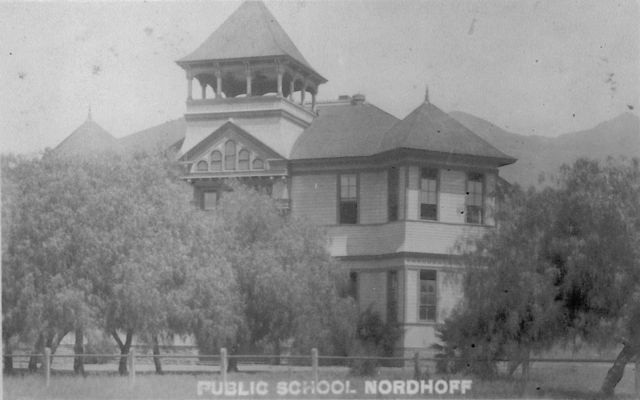
The Old Elementary School, Nordhoff High School’s First Location
The time for opening the school duly arrived. On the second Monday in September 1909 [Sept. 13, 1909], Miss Mabyn Chapman and I met the trustees and twenty-four pupils. Members of the board of trustees were: Sherman D. Thacher, Joseph Hobart, F. H. Sheldon, Dr. B. L. Saeger, and Frank Barrows. The school convened on the second floor of the old grammar school building, which has just been torn down [1937]. Principal Edgerton had the grammar school on the ground floor with about 75 pupils.
The situation was depressing. The upper floor consisted of two class rooms and two other small rooms, one of which, used for an office, was hot, and in the other in the attic a colony of bats had their hideout and regaled us every day with nauseating odors.
But all that was overlooked and in time remedied. Mr. Thacher introduced us to a group of splendid boys and girls, who almost to a man lived up to what our first impressions indicated. But, the principal evidently did not live up to the first impressions of the pupils, for I learned afterward that they thought he, because of his heavy eyebrows and stern expression, was going to be a hard taskmaster.
The appointment secretary at Berkeley had sent Miss Mabyn Chapman as assistant to the principal. Miss Chapman remained with the school for five years. She was a remarkably versatile person. She could teach almost any subject usually given in the high school those days with equal facility and made a charming hostess. She lived in a cottage next to ours, and that corner (Blanche and Oak Streets) became the social center of the high school. I speak feelingly about Miss Chapman (now Mrs. Howard Bald) because the successful launching of the high school owes much to her ability and her loyal attitude.
We had a successful, happy year in spite of our handicaps. On the evening of the day school closed, I was taken to Ventura by the [Abe] Hobsons in their car to take the train en route to China, Japan and the Philippines; and so close was my schedule of travel that, on returning, I arrived in Ojai the day before school opened in the fall of 1910.
Mrs. Ruth Forsyth of Gilroy was added to the faculty the second year. She also remained five years and was a splendid teacher. Miss Chapman and Miss Forsyth became fast friends, and I could fill a page or two recounting amusing and sometimes strenuous adventures.
The distinctive feature of the second year of the school was the introduction of an extensive course of lectures and entertainments. The principal gave a series of illustrated talks about his trip to the Orient. Principal Lee of Oxnard High School gave an illustrated lecture on the Shakespeare country. Mrs. Albert Barrows gave a talk on the Philippines, and we had a concert or two. In lighting the projector, we had to use acetylene gas; and it was a toss up as to whether it would last through the lecture. The girls that year organized a basketball team and met Santa Barbara. The boys did some track stunts, with Bob Dennison frequently coaching them. Tennis was, of course, a favorite sport.
A play of that year stands out in my mind. It was “Op O’ My Thumb,” in which Margaret Bald distinguished in the leading role. I recall that Mrs. Margaret Clark Hunt furnished horses one Saturday for the whole school. We went to Topa Topa’s summit. Through the kind offices of some of the boys, I was pulled out of the saddle when the interesting trip was over. I did not go to church the next day.
During the second year of the school, I urged, much to the evident consternation of the trustees, the necessity of having larger quarters and more equipment. Being convinced that such was the case, the trustees began the discussion of a site for the proposed new building. According to law, if all the trustees of a school unite on a site, it may be carried without a vote of the people concerned. Four of the trustees, from the first, favored a site about three-quarters of a mile west of the village [then known as Nordhoff]. One member stuck to his guns for a site east of town on what is now known as the Waite Tract.
The whole matter was warmly discussed on the street and in the press. At last, the day of the election arrived and such excitement. The west side carried the day by 40 votes. Bonds for $20,000 were voted, and in the summer of 1911 the buildings were rushed to completion on ten acres of land, half of which was given to the district by Waldo Forster.
In September 1911, the first sessions in the new but somewhat incomplete plant began. Miss Helen F. Dorrance and Miss Ida Belle Lamb were added to the faculty. John Timms was the janitor and gardener and served for many years. Under the direction of Miss Lamb (now Mrs. R. S. Dennison), the Girl’s Glee Club became a prominent and most delightful feature of the school.
The new school buildings were formally dedicated November 1, 1911. Dr. James
The “new” campus in 1910
Blaisdell of Pomona College was the speaker of the evening. In the spring of 1912, Miss Lamb presented her Girl’s Glee Club in its first concert. It was most ambitious for a small school (about 40 [pupils] now] and very successful. The stage setting won great applause by the large audience and was the work mainly of Miss Nina Soule and Mrs. [Olive] Bristol.
The first part of the program was the Glee Club. The second part was Denza’s cantata “The Garden of Flowers,” starring Carolyn Wilson. Miss Chapman had organized a Deutscher Ziken (German club), and on May 10th gave a concert and play in German. The play presented that year was “The Elopement of Ellen,” which included in the cast Howard Bald, Nina Freeman, Thornton Wilson, Abbie Cota, and Tom Gibson.
The first class (1912) to graduate was: Grace Hobson (Valedictorian), Carolyn Wilson (Salutatorian), Nina Freeman, Ethel Freeman, Edna Leslie, Abbie Cota and Levi Bray.
The annual, which we named Topa Topa made its first appearance at the close of the 1912-1913 session. Carolyn Wilson was editor and Howard Bald business manager.
At the opening of school in 1912, automobiles made their first appearance in the faculty. Miss Forsyth drove down from Gilroy in a Reo, and Miss Dorrance appeared in some kind of car. The principal did not have such a luxury until 1917.
Physical Education was started in that year [1912]. Miss Chapman and Rev. W. H. Macpherson taught the various stunts in this line and gave public exhibitions from time to time.
There were two major plays in 1912-13. “The Lady of Lyons,” a five-act play, starred Thornton Wilson and Helen Baker. The play was directed by Miss Dorrance, and the rather elaborate costumes were designed and made by Miss Chapman. It was a memorable show. Also, “A Scrap of Paper,” starring Thornton Wilson and Dorotha Clark [was performed], with a part for each member of the class. Another excellent program was presented by the Girl’s Glee Club, under Miss Ida Lamb’s direction, in the spring of 1913.
The class of 1913 was: Margaret Bald, Fred Burnell, Howard Bald, Ruby Watkins, Mertie Jackson, Mary Freeman, Elma Morris, Thornton Wilson, Dorotha Clark, Jennie Friend, Maxwell Allen, and Rose Goodman.
Howard Bald was ill on commencement night, which circumstance gave the principal a chance to commend his splendid services to the school.
Owing to the well-nigh perfect record at the University of California of Grace Hobson, professor Thomas of the University school examination staff, reported to us that the N. U. H. S. stood first in the state in scholarship among the freshmen at the close of the first semester on 1912-13. Carolyn Wilson that same year, at the San Jose Normal School, won a prize of $150 for good work in her studies and for participation in school activities.
School opened early in September, as usual, in 1913. In the fall of that year, the Alumni Association was formed, and for several years we held annual conferences. The graduates living near attended, and many who were away sent letters.
The Girl’s Glee Club gave a concert on December 12th, and Miss Agnes Lord assisted with her violin. It was Miss Lamb’s last concert, for she married R. S. Dennison soon after. Miss Dorrance continued the girl’s chorus work. The play that fall was Kendrick Bang’s “The Worsted Man,” a semi-musical comedy, starring Harry Stoker and Charlotte Treadway.
The month of February, 1914, was noted for a great storm. Rain poured down for 54 hours with scarcely a let-up. School was closed for three or more days. In June “The Private Tutor” was presented by the senior class, consisting of Tom Gibson, Clifford Watkins, Irma Busch, Julia Lescher, Elizabeth Kincher and Jack Clark.
Tom Gibson, a remarkable lad, was the Valedictorian, his subject being “The Marvels of Modern Surgery.” He was a student who knew what he wanted to do and stuck with it. Tom Gibson is now a most successful surgeon in San Francisco. The Topa Topa was edited by Tom Gibson and dedicated to the principal.
In the fall of 1914, Alexander Barnes was added to the corps of teachers. Mr. and Mrs. Barnes made their influence felt in the school and community, especially in the field of music.
The play that fall was “Her Own Way,” by Clyde Fitch, starring Helen Baker and John Dunshee. It was cleverly done. Instead of the usual concert in the spring, Mr. Barnes put on a very successful minstrel show, using fifteen boys in the circle. This entertainment was followed in May by a play called “All of a Sudden, Peggy,” which was put on by the senior class.
In the spring of 1915, the school decided to accept the invitation of the Southern California High School Chemistry Society to compete along with other Southern California high schools in a written examination relating to chemistry. We sent Helen Baker and Ruth Garland to Los Angeles to represent us. In due course, we were notified that our team had won the coveted distinction of having the highest average and winning the cup. On October 22, 1915, at a luncheon at the University Club in Los Angeles, there were assembled the Garlands, the Bakers, the Principal, and Miss Forsyth, who taught the team and who came over from Pasadena to be present. In the presence of about one hundred scientists and science teachers, our girls were presented with the cup, and a proud day it was for the school.
The commencement exercises of the class of 1915 were rather unique. On the stage there was a demonstration of classroom work in Mathematics, chemistry, and botany. A lesson in trigonometry was given by Charlotte Busch, botany by Marguerite Mallory, geometry by Evelyn Herbert, and chemistry by Fred Sheldon and Ruth Kincher. This program constituted the first part of the evening exercises. The second part conformed to the usual type of commencement proceedings, in which Helen Baker was the Valedictorian.
Topa Topa that year was dedicated to Madame Thacher with the following lines:
Aged thou art,
But old thou never wert.
Gray Time is yet thy friend; aye more,
Thou dost so make God thy life.
That old Time hast had command
To spare thy soul to abide alert.
In years we measure by the score,
Aged thou art.
Thy temp’ral powers decline.
The Spirit is ever thy star; aye more,
Thou dost so make Love thy life,
That in this transient world of strife
There glows through thee spirit so divine.
To know thee is to love, adore.
Sixty-one students registered in the fall of 1915. Miss Alice Fowler took Miss Dorrance’s place in the faculty. Miss Forsyth gave place to Miss Hope Jordan. The fall play was “The Colonel’s Maid,” starring John Dunshee and Reba Taylor.
One Saturday in February, 1916, I was sitting in the Boyd Club, when Mr. Charles M. Pratt came in. As he approached me, I arose; and we passed some complimentary remarks, when he suddenly asked me, “What can I do for you?” For some months, I had been concerned about the inadequacy of our high school to meet the modern demand for training in the practical aspects of life and had fear and trembling about deciding to broach the subject to the trustees and ask for equipment to teach domestic science and art for the girls and boys. Crafts for the boys, also. I was so full of the subject that, when Mr. Pratt asked me that fateful question, I replied promptly. “Yes, Mr. Pratt. I wish our high school had the facilities to teach domestic science and the crafts.” We discussed the matter awhile, when he ended the conversation by saying, “I will come to see you some day soon.”
The day came, and we went over the whole subject on the grounds. He said finally, “You seem to know just what you want. Tell your trustees to get the same architect who planned your school and have him plan, construct, and equip one building for the boys and one for the girls and send the bill to me.” I am sure I walked on air the rest of the day. The trustees lost no time in getting the buildings up and the equipment put in place, so that they could be in use in the fall of 1916.
The week of May 15th was high school week at the Isis Theater [the town’s motion picture theater], a part of the proceeds to be given to the school by the proprietor for athletics and the Topa Topa. Owing to the illness of the English teacher, we did not have a play in the summer of 1916.
The class of 1916 was composed of Ruth Garland, Elmer Freeman, John Dunshee, Hazel Parmenter, and Harold Neville. At the commencement exercises, Ruth Garland was the Valedictorian, and Dr. Alter W. Palmer of Oakland was the speaker of the evening.
The annual was edited by John Dunshee and dedicated to Charles M. Pratt with these words: To the man out of the East
Who bears choice gifts
To bless us and those who follow,
Gifts of gold, but also
Gifts of character and the spirit
Of plain democracy,
More enduring
We dedicate this, our annual.
The school opened in September, 1916, with great expectations. The two new buildings were ready and splendidly equipped. Seventy-two pupils were registered. We began the year with the following new teachers: Lucetta Kenneberger, Margaret Alltucker, Francis Mowry, and Kenneth Rich. Alexander Barnes held over. Miss Mowry had the domestic science and art departments and Mr. Rich the manual training.
A Spanish Club of twenty-eight was organized. In February, 1917, Miss Kellenbarger ambitiously put on Sheridan’s “The Rivals,” starring Eldred Miller and Doliver Church. Mrs. Wilda Wilson Church helped with the play and other times gave us readings and interesting talks.
The new buildings were dedicated in March [1917]. The speakers were Dr. Scherer of the California Polytechnic [Institute] in Pasadena; Mr. Pratt; Sherman D. Thacher, the president of the board of trustees; Felton Taylor, president of the student body; and the principal.
We did not compete for the chemistry cup in 1916, for the reason that chemistry was given out every other year. But in the spring of 1917, we prepared to enter the competition again, with Miss Alltucker as instructor. The team we sent to Los Angeles was composed of Cecil Crowe, Reba Taylor, and Eldred Miller.
The senior play was given on June 5th. It was staged out of doors and coached by Miss Kellenbarger, who, by the way, was an exceptional English teacher. The play was “Hiawatha.” Felton Taylor was Hiawatha, and Esther Waite was Nokomis. William Mallory made his debut as an actor in the part of the child Hiawatha.
On Saturday, June 9th, there descended upon the Ojai Valley the disastrous fire of 1917. I had been at a meeting of the County Board of Education that day and drove home about two o’clock. Esther [his eleven-year-old daughter] was with me, and we spoke about the smoke rising over the range toward the north, but did not consider it serious. John Timms and I patrolled the school grounds; but when the hot wind swept the flames along the tops of the oaks toward the school property, we were helpless. The tennis court saved the domestic science building and the main buildings, but the manual training building was burned to the ground and the expensive equipment ruined. Mr. Pratt wired to have the building rebuilt at his expense.
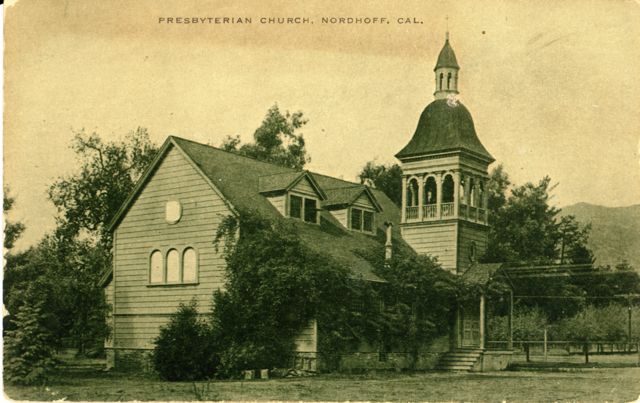
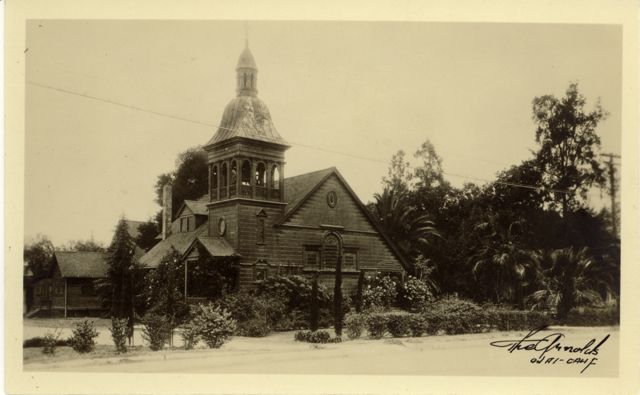
Those were sad, trying days. We had no lights in the auditorium, so simple commencement exercises were held in the old Presbyterian church. The class was Cecil Crowe, who entered high school at eleven years of age and was one of the brainiest boys I knew; Felton Taylor; Florence Schurman; Dewitt Menefee; George Jackson; Esther Waite, and Bennie Houk. Cecil Crowe was Valedictorian. DeWitt Menefee edited the Topa Topa.
The great fire destroyed our home and all there was in it, also, Mrs. Bristol’s School building and equipment. Mr. Ladd telegraphed from Portland, Oregon, that we could have his house for the summer, which we gratefully accepted. My wife and I were at the crossroads. What should we do? Seated on the east veranda one afternoon, we discussed the situation. Mrs. Bristol had made a success of her [private] school and loved it; but rebuilding would be a trial and expensive, especially if she took a few girls to board, which she importuned to do. I was inclined to take advantage of the break and try for another school.
It was the lowest point in our depression; for, turning to some unopened mail on a table nearby, I read a letter from the Southern California Chemical Society saying that our team had again won the contest in chemistry. That settled it. I couldn’t desert a school that had won an intelligence test in competition with twenty-two schools and eighty-four students. In October, 1917, the presentation took place at the University Club in Los Angeles. Reba Taylor received the cup for the school, which this time was ours to keep.
The opening of school in 1917 was quite depressing. The enrollment had decreased considerably. The shadow of the great fire was till over the community. The war spirit [World War I] was such that the boys wanted military drill, which to a limited extent was allowed them. We had in the school that fall a Jewish boy, whose family came here for the winter. He had some training in military tactics and undertook to command the boys under general direction of Mr. Rich. Miss Rosina Caldwell took Mr. Barnes place in the faculty. The reconstructed manual training building was ready for the opening of school.
There was a move to organize a Y. M. C. A. in Ojai. The school gave a play written by Kate Douglas Wiggins entitled “The Birds”. . . . It was given in the old Presbyterian church. Early in 1918, automobile sheds were constructed by the boys of the Manual Training Department. The winter play was “Green Stockings,” starring Florence Thompson and George Busch. The spring play, coached by Miss Kellenbarger, was “In Cleon’s Garden,” a Greek play. It was given out of doors. Arthur Waite and Eldred Miller had prominent parts. A turtle and parrot were in the cast. Special lighting effects were devised by the students, and tiers of raised seats were provided for the audience.
Topa Topa that year was edited by Reba Taylor and dedicated to Edward Drummond Libbey. The dedication lines follow:
A man whose practical idealism,
Whose love of the beautiful,
Whose vision of altruistic service,
Has inspired and brought to pass
A great work in the Ojai Valley –
An esthetic endowment of such wondrous value
That no man can contemplate it without
Spiritual uplift.
The class of 1918 consisted of Faith Van Curen, Eldred Miller, Reba Taylor, Ruth Parmenter, Charles Parsons, Dwight Van Fleet, Winifred Gibson and George Busch. Reba Taylor was the Valedictorian. On account of the high cost of materials, Topa Topa was not published that year.
At the opening of the school in 1918, Miss Ruth Garner of Lodi took Miss Alltucker’s place; and A. W. Muse took Mr. Rich’s work. Both of these were remarkably fine persons and teachers, and we hated to lose them. Miss Elizabeth Taff, now Mrs. Harry Dennison, took Miss Mowry’s work in the Domestic Science Department.
We had just got well-started with the work of the year, when the Spanish Flu struck the town; and the school was closed for seven weeks. The Manual Training Department put on a play in April, 1919, called “Under the Laurels,” under the direction of Mr. Muse; which, as I remember it now, was not up to our usual standard of plays.
The class of 1919 graduated on the evening of June 20, and [was] comprised [of] the following students: Elsie Gibson, Dorothy Yant, Harriet Semro, Margaret Macleod, Jessie Drown, Margaret Hunt, Melba Miller, Fern Watkins, and Arthur Waite. Dorothy Yant was the Valedictorian.
Athletics
Very early in our history, the teachers and students agreed that in athletics we would undertake only such sports as we could with credit to ourselves. Consequently, we left out track and football and concentrated on tennis, baseball, and basketball. In 1917, we were first in the county in tennis, second in baseball, and second in basketball. I shall never forget the pennant game of baseball played with Fillmore on our field in the spring of 1917. Bennie Houk, reputed to be the best pitcher in the county, pitched a fine game through eight innings; and our school was ahead. In the ninth, he let in enough runs to beat us. The excitement was too much for him, perhaps. We were good losers, nonetheless. The nostalgic effect of the game was felt in the school for some time. I remember Mrs. Drown gave the school a scoreboard, and Mr. and Mrs. W. E. Houk gave us a handsome blue and gold megaphone.
In the years 1912 and 1919, inclusive, we graduated sixty pupils. Of these, 35 went to higher schools. Eighty-two children, so far as we have been able to learn, have been born to these graduates, some of whom have also graduated from the local school.
With this report of the first decade of the Nordhoff Union High School, I bring to a close what seems to me to be romantic years.
Summer Bummerby Mark Lewis
Ojai’s Long, Strange Trip Through the Turbulent Sixties
The Age of Aquarius lingers on in Libbey Park, where Ojai’s flower children convene on Sunday afternoons to bang a drum or twirl a hula hoop. Counterculture types also can be spotted occasionally at the Pergola of a Friday evening, joining in the Peace Vigil to protest the wars in Iraq and Afghanistan. The enduring hippie presence is a long-established Ojai tradition. But there was a time when they did not seem so benign.
For many Ojai residents – those of a certain age, who grew up here – the sight of tie-dyed peaceniks cavorting under the Pergola is a scene straight out of 1967, when anyone driving through downtown was sure to spot hippies lounging on the south side of Ojai Avenue. Some will smile at that memory, but others will cringe, because the Summer of Love was no love feast in these parts. There was yelling and rock-throwing and fist-fighting, culminating in three midsummer nights of violence which old-timers still refer to as “the Ojai riots.” Then the Pergola itself was bombed, and eventually demolished.
It seems extraordinary that these events could have occurred in peaceful little Ojai, which sees itself – and rightly so — as a refuge from the ills of urban life. But 44 years ago, when the 1960s suddenly erupted into “the Sixties,” Ojai seemed on the verge of losing its cherished Shangri-La status. Baffled and bewildered by all the changes, many people focused their fury on the hippies in the park, who seemed to represent a terrifying alien invasion.
Over time, passions cooled, and Ojai’s safe-haven status was preserved – with considerable help from the hippies, as it turned out. The Pergola eventually was rebuilt, and now seems as though it has always been there. The events of 1967 faded into legend, then into obscurity. To many newcomers, Ojai seems firmly rooted in a much more distant past, with its iconic Mission Revival architecture and its century-old orange groves. But a case can be made that the Ojai of today is really a child of the Sixties. Its birth was unusually traumatic, and the quickening began on a festive day in the fall of 1966, when a certain longtime resident returned to town after many years away.
The Secret Doctrine
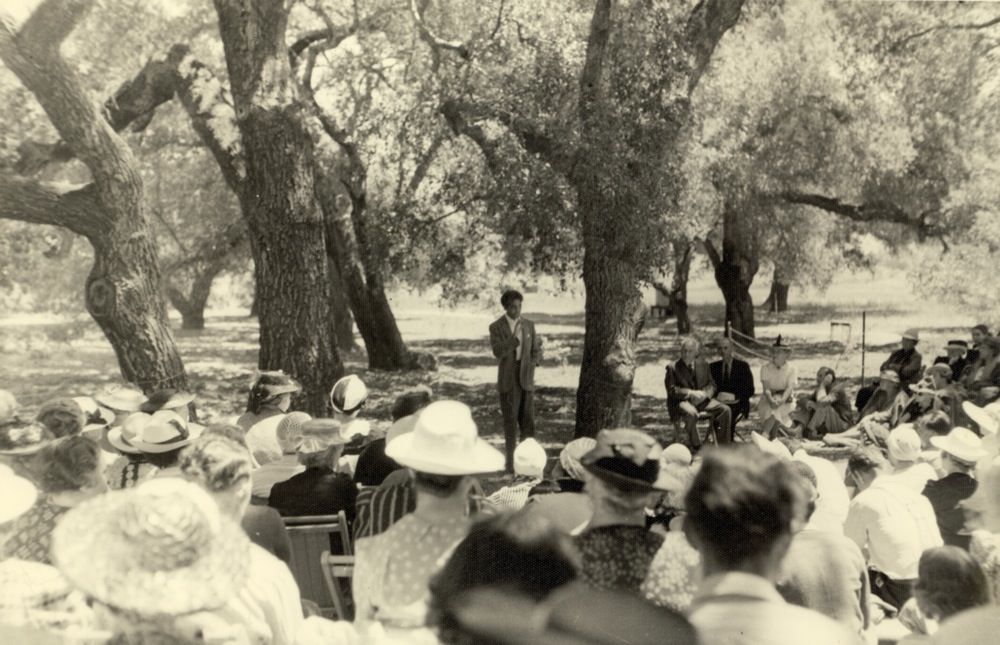
Jiddu Krishnamurti first came to Ojai in 1922 as a messiah-in-training for Annie Besant and the Theosophical Society. He eventually rejected their World Teacher role and resigned from the society, but he continued to make his home on McAndrew Road, and to give occasional public talks at the Oak Grove in Meiners Oaks. Among his East End neighbors in the late 1950s was a young girl named Susan Diets, who would grow up to be Suza Francina.
Suza Francina & Manuel Saenz
“I often saw K standing at the bridge on McAndrew, soaking up the beauty of the valley,” Francina recalls.
For Judy Evans, who grew up in the Upper Valley during the ’50s, the K connection was more fundamental. “We actually moved to Ojai because of Krishnamurti,” says Evans, who describes her parents as “vegetarians and nonconformists.”
That description could be applied to a number of people lured to Ojai by the sage’s presence, including the potter Beatrice Wood and the restaurateur Alan Hooker, who started the Ranch House. Nor was Krishnamurti the only draw. There were also the Krotona Institute of Theosophy and the Happy Valley School (now known as the Besant Hill School). Ojai was home to some notable eccentrics, such as the woman in Meiners Oaks who went barefoot and lived in a tree. Most of the valley’s bohemians were less flamboyant; they had jobs and mortgages and looked pretty much like their neighbors. But when “the Sixties” kicked into gear, they (and their teenage children) were ready to embrace it.
As for Krishnamurti, he almost missed the Sixties altogether, at least as they unfolded in Ojai. He had avoided the town since 1960, due to a strained relationship with his business manager, D. Rajagopal. But in the fall of 1966 he returned to make peace with Rajagopal, and to give a series of talks at the Oak Grove. Alas, the hoped-for reconciliation did not pan out; the sage soon departed, and did not return until well into the 1970s. But his three-week visit in 1966 would have a lasting impact.
Despite his long absence, these talks drew enormous crowds. More than 2,000 people came to the first one, on October 29, to hear Krishnamurti call for “a revolution in the psyche, in the mind itself.”
Ojai’s homegrown intelligentsia turned out in force, along with curious teenagers like Suza Francina, who was delighted to find herself in such enlightened company. Francina, the product of a strict, Pentecostal upbringing, found herself drawn to the free spirits she encountered in the Grove. The term “hippie” had only recently been coined, but it applied to many of Krishnamurti’s listeners. Even in that crowd, they stood out.
“Everything about them had a different vibe,” Francina says.
Many of them had come up from Los Angeles: Laurel Canyon cowboys and Hollywood hipsters eager to latch onto the new thing, Indian gurus being all the rage. To be sure, Krishnamurti’s links to Hollywood went back many decades, and he had been prominently associated with the late Aldous Huxley, whom the counterculture would embrace as a prophet. But K’s 1966 visit seems to have re-forged the Ojai connection for a new generation of Angelenos, especially those who had stopped getting haircuts. Ojai would soon be a regular stop on the hippie caravan route from L.A. to San Francisco.
“Maybe they would have found Ojai anyway,” Francina says, “but they found it sooner through the K talks.”
The talks, which continued through November 13, were extensively covered by the Ojai Valley News. Writer John Nimick attended every session and explicated Krishnamurti’s philosophy in long, detailed articles, which no doubt were well read in the valley’s bohemian precincts. But most OVN subscribers skipped over Nimick’s articles and turned to the sports pages, where bigger news was brewing.
Catch a Wave
November 19 was Homecoming Day at Nordhoff High School. The gym had been decorated for a big dance featuring the Decades, a highly regarded rock band from Ventura. But first the Rangers would host Bishop Diego for a game that would determine the Tri-Valley League championship. Nordhoff was a basketball powerhouse in those days, but the football team had never made it to the playoffs. An enormous crowd showed up at the field on Maricopa Highway that Saturday afternoon, hoping to see the Rangers make history.
Before the kickoff, Homecoming Queen Jill Bryan received her crown — and a kiss — from team co-captain Steve Olsen. Playing center on offense and linebacker on defense, Olsen racked up six tackles and seven assists that day. But Nordhoff still trailed by a point in the final minutes of play, and Bishop Diego was running out the clock. Then the ball popped loose, and Olsen pounced on it. Jan Colenbrander, an exchange student from Holland, kicked a 35-yard field goal, and Nordhoff held on to win the game, 16-14.
The town went temporarily insane with joy. The victors were honored with a triumphal procession through downtown Ojai, escorted by smiling police officers. Then it was on to the dance, and a celebration that would linger in many memories for years to come. Theosophists by the thousand might beat a path to Ojai to sit at Krishnamurti’s feet, but this was still at heart an All-American small town out in the boondocks, where most people cared more about football than about expanding their consciousness.
“It was a time when athletes still dominated the scene,” Olsen recalls. The retired Chaparral High School principal looks back fondly on his own high school days, when Ojai resembled the setting for George Lucas’s classic film American Graffiti.
Just as in Lucas’s film, Ojai teenagers spent their weekend nights cruising the strip, which ran along Ojai Avenue from the Shell station (where Cluff Park is today) to the Hitching Post drive-in at Bald Street. (The Hitching Post, famous for its corn burritos with Happy Jack’s special sauce, was on the site currently occupied by Sea Fresh.) Olsen and a friend once cruised the strip nonstop for 24 hours in a ’55 Chevy: “It was just something we decided to do, and did it.”
More American Graffiti parallels: Ojai’s Top-40 radio playlist was curated by Wolfman Jack, broadcasting from a pirate station south of the border. And just as in the film, Ojai teens were devoted to drag racing. Since the 1950s, successive generations had been racing their cars in the East End, beyond the jurisdiction of city police.
“We’d drag on Gorham Road,” recalls Susana Arce, Nordhoff ’60 (she was Susie Callender back then). Carne Road also was popular, and sometimes Grand Avenue. Everyone fell into one of two categories, Ford or Chevy. “I had a ’52 Ford,” Arce says. “I was a Ford person.”
Manuel Saenz was a Chevy person. More specifically, a ’57 Chevy person. He and his friends were known as “the car guys.” They were a few years older than the high-school crowd. Saenz was 22 in 1966 — old enough to buy beer, which car guys consumed in prodigious quantities.
“In the 1960s, Ojai was the party town of the county,” Saenz says. For car guys, it was heaven: “There were eight gas stations back then, and there were eight bars that were open.”
In that more innocent era, drunk drivers were treated more gently than today. If a teen-ager drank too much, the cops were apt to give him a lecture and drive him home. “It was like Mayberry,” recalls Dan Cole, Nordhoff ’64, who played drums in Ojai’s hometown rock ‘n’ roll band, the Raiders.
Or maybe it was more like Petticoat Junction, since Southern Pacific Railroad trains still chugged into town occasionally to pick up loads of fruit from the packing house on Bryant Street. When kids heard the whistle of an approaching train, they ran down to the tracks to place pennies on the rails.
“Ojai wasn’t a very active place,” says Dr. Ray Huckins, who served as mayor from 1967 to 1970. “And that was fine as far as I was concerned. Nobody got very excited.”
“It certainly was a sleepy town,” agrees former city attorney and City Council member Jack Fay. “But I wouldn’t call it a hick town.”
Indeed not. Ojai offered highbrow cultural amenities rarely available in small-town America. The Happy Valley School staged modern dance programs featuring solemn-looking young women in black leotards, striking esoteric poses derived from Martha Graham. An eccentric impresario named Wayne Glasgow took over the Ojai Theatre in 1966, changed its name to the Glasgow Playhouse, and offered a steady diet of artsy foreign films: Godard, Truffaut, Pasolini. The Art Center that fall was mounting a production of William Inge’s steamy Picnic, to be followed by a heavy dose of Eugene O’Neill. The Ojai Music Festival was planning to bring in the avant-garde composer Pierre Boulez as its next music director, and have him conduct Stockhausen’s “Zeitmasse.”
Perusing this exotic bill of fare in the Ojai Valley News, many valley residents simply scratched their heads. But there was something in the paper for every taste. Under editor-publisher Fred Volz, the OVN ran rave reviews of New Wave films like Last Year at Marienbad, but also gave plenty of ink to church socials, and to the bowling league results from Topa Lanes.
“Ojai was culturally schizophrenic at the time,” says Richard Laubly, Nordhoff ’69. “As far as I know, only long-hairs from Happy Valley School went to Godard films, amongst the teenagers, anyway. For the rest of us, it was definitely James Bond double features at the Los Robles Theatre. On the other hand, I remember various teenagers I knew showing up at Krishnamurti talks, and we would be a little surprised to see each other there.”
One person Laubly didn’t see there was Steve Olsen, who was a jock and a surfer but not a budding Theosophist. Olsen’s focus was on football — at least until the Rangers lost their playoff game. After that, he was free to resume his regular weekend beach safaris to Mondos or Rincon, where an Ojai boy could catch a wave and be sitting on top of the world.
Distant Trumpets
At least one dark cloud was visible on the horizon as 1966 drew to a close. Young men who didn’t go to college were subject to the draft, which meant they might be shipped off to Vietnam.
“The war had kicked in, and I was opposed to it, right from the very beginning,” recalls Howard Landon, who was then a Nordhoff history teacher. “And I was one of the few in town who was. A lot of people thought I was a Communist.”
Ojai’s political spectrum ran the gamut from radical leftists to the John Birch Society. But the liberals — a mostly college-educated cohort of teachers and artists and Theosophy enthusiasts — were far outnumbered by conservatives such as Dr. Huckins, who had actively supported Barry Goldwater’s presidential run in 1964 and Ronald Reagan’s California gubernatorial bid in the fall of 1966. Reagan’s victory on Nov. 8 cheered his many Ojai supporters — but some were appalled in mid-December when local anti-war activists announced plans to hold a regular Peace Vigil on Sunday afternoons in front of the Bank of America building. (This was not the current Bank of America building; it stood just east of the park, on the site currently occupied by Leslie Clark’s Nomad gallery and the Los Caporales restaurant.)
Meanwhile, there were disturbing reports in the OVN that marijuana and even LSD were making inroads in Ojai.
“Drugs were something that we had just not been aware of,” says Michael Cromer, whose family owned (and still owns) Bodee’s on the Maricopa Highway. Cromer graduated from Nordhoff in 1963, when marijuana and LSD were largely unknown in the valley. Just three years later, they suddenly seemed to be everywhere. “We thought that was something on another planet,” he says.
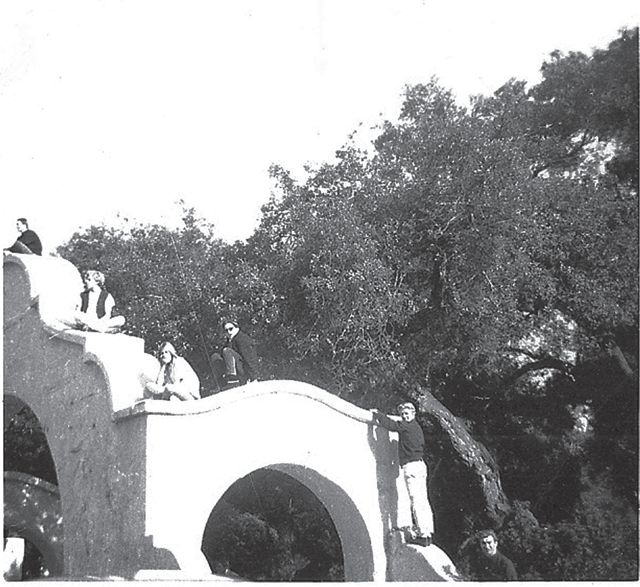
The dopers hung out in Civic Center Park (it would not be renamed Libbey Park until 1971), and they were increasingly brazen. In those days, there was no open plaza behind the Pergola, there was no big playground, and the park was more heavily wooded. The Pergola was better known as the Wall, a name derived from the three-foot-high masonry structures that filled the spaces between the pillars. When viewed from the street side, they looked like a wall that stretched along the entire length of the Pergola. For decades, Ojai teens had sat on that wall to watch the world go by. Now, this previously benign edifice was beginning to look more like an ominous fortress, which protected the shady characters in the park from police scrutiny.
Not that Ojai was opposed to walls. A lot of people would have liked to build one around the entire valley to keep it safe from outside influences. From the traditionalists’ point of view, Ojai remained a place apart, an island of beauty and sanity and tranquility in a world gone mad. They were determined to keep it that way. But it seemed to be a losing battle. All over Southern California, small towns like Ojai were submitting helplessly to the L.A. juggernaut and trading their orange groves in for housing developments. By the year 2000, the Ojai Valley’s population was projected to rise to 80,000, as more and more people fled the city to find refuge in this rustic paradise. In the process, the newcomers inevitably would transform Ojai into the very thing they were trying to escape.
While Ojai officials cast about for ways to stave off this looming disaster, many younger residents were dreaming of escaping from Ojai itself. They yearned to bust loose and see what the outside world had to offer. They were particularly curious about San Francisco, where strange and wonderful things were said to be happening. Suza Francina was in a hurry to find out for herself. Graduating from Nordhoff a semester early, she left home in December and boarded a northbound Greyhound bus. Soon she was living in a rented room on the third floor of a house in Haight-Ashbury. It was a room with a view, and she sat there at her window watching a brave new world being born.
The Summer of Love
On Jan. 14, 1967, thousands of hippies thronged San Francisco’s Golden Gate Park to celebrate the first Human Be-In. It inspired similar events in New York, Los Angeles — and Ojai, where a tribe of local hippies already had staked out Civic Center Park as their headquarters. The closest thing they had to a leader was Ben Barraza, whom the Ventura County Star-Free Press later would dub “the King of the Hippies.”
“I was one of the first ones to go up to San Francisco,” he says. “I went up to the Monterey Pop Festival too.”
At 30, Barraza was older than the average hippie. An Ojai native, he had been a football star at Nordhoff in the mid-Fifties. By 1967 he was married to Judy Evans and they had two young children. But when the counterculture blossomed, Ben grew his hair long and embraced a new role.
“He went from captain of the football team in high school to King of the Hippies,” Evans says.
Ojai’s first love-in, in March, was a peaceful event. “Barefoot youths with flowers behind their ears strummed on guitars, ate picnic lunches and proclaimed ‘love’ to all who would listen,” the OVN reported.
A few hippies from Los Angeles came up to join in the fun. “People who went said it drew a crowd of several hundred and was a peace family trip,” reported the Los Angeles Free Press, an alternative newspaper that kept close tabs on counterculture happenings.
The Ojai Valley Tennis Club was less enthusiastic about the hippie presence. In late April, during the club’s annual tennis tournament, the Los Angeles Times reported that “a group of gate-crashing hippies — not exactly the kind of people you’d expect to see in Ojai — upset the tournament committee by making too much noise during a match between USC’s Stan Smith and UCLA’s Roy Barth.”
In response, some of the hippies formed the Ojai Valley Dopers Association, or O.V.D.A., to tweak the Tennis Club officials.
“The O.V.D.A. was originally a joke on the O.V.T.C., tennis folks who gave some of us a hard time about cluttering up ‘their’ park with our loathsome longhaired hippie selves,” recalls Tony Neuron. “At one point my brother Michael and I played doubles with a couple of other O.V.D.A. members on ‘their’ courts, barefoot with old junk rackets, largely just to piss them off. They saw us as criminal lowlifes — we saw them as stuck-up snobs.”
When the tournament ended, the tennis folks left the park to the hippies. The second love-in, in May, was bigger than the first. The crowd was swelled by local high-school students such as Richard Laubly who came to check out the scene. There were also more out-of-towners, two of whom were arrested for marijuana possession.
“The love-ins were a kick — lots of hippies but also several very straight-looking undercover cops trying to blend in,” Laubly says. “But I think after the first love-in more and more people started coming into town, either just to hang out or for the following love-ins. Ojai being more or less on the route from L.A. to S.F. might have also played a part.”
The hippies were impossible to ignore. There they were lounging on the Wall, right across the street from the Arcade, which in 1967 was not yet the tourist Mecca it is today. Back then the shops catered more to local residents, who went downtown nearly every day for one reason or another.
“That’s where people congregated, that’s where they shopped, that’s where they did everything,” Vince France says.
France is an Ojai native who graduated from Villanova Prep in 1961. By 1967 he was a sergeant on the police force, which suddenly found itself dealing with a serious drug problem. And it was not confined to the hippies in the park. There was, for example, the 14-year-old boy tripping on LSD who took off his clothes in Bart’s Books one evening. “I love everybody,” he announced.
Less amusing were the youths who became seriously ill after overdosing on jimson weed, a natural hallucinogen that grows wild in the hills.
“We had five kids who damn near died,” France says. “It was crazy, it was absolutely crazy.”
Nordhoff teachers had to deal with students who would show up in class while under the influence. “We went through a real drug thing here,” Howard Landon says. “I would have kids in class who would act a little strange.”
Ojai was Mayberry no more. The straight people in town — i.e., the vast majority — looked on aghast as longhaired, unwashed vagrants in psychedelic regalia took over the park and painted “LSD” and other drug-culture slogans on the Pergola. The community demanded action, and the police complied. But in the new political context of 1967, many young people felt persecuted by any vigorous attempt to enforce the drug laws. They felt that the cops “were a little heavy-handed, and so they started to retaliate,” Steve Olsen recalls. “And because of that, there was some anarchy.”
“The Hippie set,” as the OVN called it, consisted of several overlapping groups. There were the authentic flower children, who were obeying Timothy Leary’s injunction to turn on, tune in and drop out; there were young activists who were more politically minded, and more focused on protesting the war; there were dopers, who just liked to get high; there were drug dealers, who were there for business reasons; and there were high school kids who were just there to soak up the vibe. Collectively they were the long-hairs, whereas the anti-hippie set – the car guys, the farm boys, the rednecks, the straight kids – can be labeled the short-hairs, at least for the purposes of this article.
Tension between the two groups further escalated when the O.V.D.A. began using the Pergola as a billboard.
“Ojai police, nettled by a series of provocative acts attributed to members of the Hippie set, were mulling retaliatory action Friday,” the Ojai Valley News reported on June 4. “Chief James D. Alcorn said his phone ‘has been ringing off the hook,’ with calls from citizens who are plainly disturbed by what they claim are impudent reflections on recent narcotics violations. The most recent incident was the posting of a sign near the arches fronting Civic Park, proclaiming ‘Things go better with pot.'”
There was a truce for the Fourth of July, which featured Ojai’s usual parade. It was unusually well attended that year. The theme was “Our America,” and the hippies joined in the spirit of the occasion. “I borrowed a truck,” Barraza says, “and we made a float completely out of flowers.”
But the third love-in, in mid-July, was a disaster. Undercover narcotics officers tried to bust a dealer for selling hashish, and quickly found themselves surrounded by angry young men who did not like narks. A passing short-hair saw what was going on and ran to the officers’ aid, yelling, “All right, which one of these hippies do you want me to clobber?” When the dust cleared, five people were in police custody and hundreds were bummed out.
By now, the battle lines were clearly drawn. “It became where you had the rednecks and the car guys versus the hippies,” Olsen says.
Car guys like Manuel Saenz, who had a job in a machine shop, resented the hippies for thumbing their noses at people who worked for a living. When Saenz and his friends would encounter any long-hairs, the tension was palpable. “Everybody was flipping each other off,” Saenz says.
The short-hairs often congregated in the Elbow Room, a bar in the Arcade near Rains Department Store. (Nowadays the location is occupied by the Primavera Gallery.) The Elbow Room had pool tables and a card room and a good view of the Pergola’s west arch, which constituted the hippies’ main redoubt. From their vantage point under the Arcade, the short-hairs seethed as they watched the long-hairs made teasing remarks to passersby, including women who had to pass the Pergola on their way to the Post Office.
“A lot of young fellows like myself, we just thought that they were being disrespectful,” Mike Cromer says. “It kind of got to a boiling point.”
It was summer now, so all the teenagers were out of school and hanging out downtown. Some lined up with the car guys, some with the hippies. Others just milled about, not taking sides but eager to see what would happen.
Up in San Francisco, the Summer of Love was in full swing. In other cities, fear and loathing were more predominant. All through the long, hot summer of 1967, ghettos erupted in violence. First Newark went up in the flames; then on July 23 the riots spread to Detroit, where they continued for five or six nights, and 43 people were killed. In Ojai that week, people stared at their television sets in disbelief. Could anything like that happen here? Ojai was too small to have a real inner-city ghetto, but it did have a park full of hippies, and clearly there was trouble brewing.
Looming over everything else was Vietnam. On July 23, the OVN reported the death of Army Sgt. David Allen Stephens, Nordhoff ’64, the first Ojai man to be killed in the war. Married only eight months, Stephens left behind a widow who was pregnant with a daughter who would never know her father. Ojai mourned his death, and brooded over its meaning.
Some of the short-hairs were ex-servicemen. They bitterly resented the hippies for opposing the war, and therefore dishonoring the sacrifices made by men like Allen Stephens. “They thought we were being unpatriotic,” Barraza says.
The animosity was further fueled by a whiff of class conflict. The car guys and farm boys tended toward blue-collar occupations, which left them subject to the draft. Whereas many Ojai teenagers who lined up with the hippies were the sons of college graduates and were college-bound themselves, and therefore (at the time) exempt from the draft.
The situation was combustible; it would not require much of a spark to set it off. On July 28, a short-hair got into it with a long-hair, and events began to spiral out of control.
Up Against the Wall
A hot summer evening, well lubricated in the usual way. Young men looking for trouble, and finding it. Push comes to shove, punches are thrown, the police move in to break it up, someone takes a swing at a cop and lands in jail. Just another Friday night fight in a small town with too many bars and not enough to do. But this one lit a fuse.
Mike Cromer remembers it all clearly, 44 years later. He and a friend had just returned from Santa Barbara and were cruising down Ojai Avenue past the Wall.
“Some of these hippie characters yelled at my buddy, and he was kind of an aggressive character,” Cromer says. The friend jumped out to have a little chat with the long-hairs. Cromer quickly found a place to park his car and returned to the scene to find a fistfight in progress. The cops broke it up and hauled the participants down to the police station, which back then was located at the east end of the Arcade. Other young men gathered in front of the station, in support of one side or the other. A second fight broke out, and one youth was arrested for assaulting Chief Alcorn and Sergeant Gene Meadows.
“And that was the beginning,” Cromer says.
There was no more serious violence that night, but both sides were now girding their loins for battle. The tension continued to build throughout the weekend. The downtown area overflowed with spectators, most of who were eager to see the long-hairs get their comeuppance. Saenz recalls that many older people in the crowd were urging the short-hairs on: “The adults were yelling, ‘Get the hippies! Get the hippies!'”
In Ben Barraza’s telling, it was car guy Rick Watson who finally threw down the gauntlet. On Sunday afternoon, Watson and some friends decided that enough was enough. They marched up to the Wall and told the hippies to abandon their fortress by 5 p.m., or face the consequences. The long-hairs who received this ultimatum ran to tell Barraza, who immediately began mobilizing his troops and gathering weapons.
“We had a big stash behind the Wall — pipes and clubs,” Barraza says. “We were ready.”
Somewhat to his surprise, these supposedly peaceful flower children were ready to rumble. “They were ready to put their lives on the line and fight for that Wall,” he says.
(Note: Some longtime Ojai residents might recall a young man named Marc Lewis who lined up with the long-hairs during the period in question. He is no relation to the author of this article.)
For three nights — from Sunday, July 30, through Tuesday, August 1 — Ojai teetered on the brink of civil war. The short-hairs knew most of the long-hairs; they had all grown up together, gone to school together, played football together. Now they were at each other’s throats.
“Every night something would happen downtown,” Alan Rains says. “A window would be broken or a car would be vandalized.”
Each night after dinner, Rains and Charles Barkman would go down to the Rains store and stand guard on the roof.
“The Wall was just about directly across from our front door,” Rains says. “There were lots of people across the street raising Cain.”
The two armies faced each other across Ojai Avenue, the long-hairs under the Pergola, the short-hairs under the Arcade. Rocks were thrown, and handfuls of BBs, and the occasional cherry bomb or firecracker. Grass fires were set in nearby lots. Scores of onlookers — men, women and children — stood on the sidelines or mixed with the combatants, egging them on. The tiny Ojai Police Department, vastly outnumbered, did its best to keep things under control.
“It was just unbelievable,” says Cromer, who was in the thick of it.
There was no general melee, but there were frequent fistfights and brawls. Whenever punches were thrown, the police would quickly move in to stop the fight. Sometimes they had to arrest a combatant who failed to simmer down. On Monday night, short-hair Jerry Puckett got rambunctious and ended up in the grip of four or five officers, who proceeded to frog-march him off to jail. Some long-hairs mistakenly thought that the cops were ganging up on a hippie, so Puckett’s arrest “triggered a storm of rock-throwing,” the OVN reported.
A news photo of Puckett being subdued by Ojai’s finest went out on the wire, and apparently ran in other county newspapers. Their coverage of the disturbances inspired short-hairs from Santa Paula and Ventura to drive to Ojai to get in a lick at a hippie. On each successive night, the crowds were bigger and the mood was uglier.
“It got worse and worse as it went on,” France says. “It was scary times for awhile there.”
With tensions rising to dangerous levels, the police decided they needed to take action to head off a disaster. They called in reinforcements from the Ventura County Sheriff’s Office and the California Highway Patrol. Then they waited.
By sundown on Tuesday evening, at least 500 people were milling around in the downtown area, waiting for the show to begin. Just after 9 p.m., a brawl broke out near the Post Office, and the police made their move. They barricaded Ojai Avenue at Signal and Montgomery streets and rolled down the avenue in force with their lights flashing. Wearing helmets and carrying nightsticks, they waded into the crowds and ordered everyone to disperse.
But that was not the end of it. Someone was lurking in the shadows behind the Arcade, carrying a six-pack of Molotov cocktails. He tossed one toward the back of the police station, but it exploded harmlessly on the pavement.
The bomb-thrower, apparently, was Roger Stine, a 22-year-old doper who lined up with the long-hairs. Not that Ben Barraza had approved Stine’s commando mission. Most of the hippies were peaceful people, Barraza says: They were just out to defend themselves from the rednecks. But Stine and his cohort were something else entirely.
“These kids were on the fringes,” he says. “They were violent kids with violent thoughts, and they saw their chance to do something.”
Stine concocted his cocktails in empty soda bottles, mixing alcohol and liquid soap to create a napalm effect. “I think he was going to burn down the Arcade,” France says.
He never got the chance. Rains and Barkman, patrolling the Arcade roof, spotted Stine on an exposed deck on the second floor of Tobey’s Super Market, in the building that now houses Rainbow Bridge.
“He was heading to the top of the roof to heave this cocktail,” Rains says. “He had one in his hand.”
Rains and Barkman rushed to intercept the intruder. Stine ended up in the hands of the police, who charged him with felony possession of a Molotov cocktail. (Stine could not be interviewed for this story; he died in 2000, at the age of 54.)
Police had cleared the Arcade area, but disturbances continued for several more hours on the fringes of downtown, where short-hairs and long-hairs traded punches in parking lots and on street corners. It was well after midnight before the two opposing armies finally disbanded for the night. The following morning, Fred Volz in the OVN relayed Chief Alcorn’s warning to everyone in town to stay home that night, and to enforce the curfew on their teenagers. That warning, plus the massive police presence, seems to have persuaded most people that things had gone far enough.
“And that was the end of it,” France says.
But not quite, because now the out-of-town news media descended. “200 Youths Clash in Ojai; Molotov Cocktails Found,” blared the Oxnard Press-Courier. A TV news crew from Santa Barbara set up shop on Ojai Avenue and interviewed Alcorn and Barraza. That night, Ojai residents sat in front of their TV sets and saw their own peaceful little town described as the scene of a riot. Newark, Detroit … and Ojai?
Of course, Ojai’s so-called riots were not remotely comparable to Detroit’s. No one was killed here, or even seriously injured; there was no looting, no buildings set afire, no cars overturned. There were many arrests, but only Stine faced a really serious charge.
“There were some scuffles and pushing around,” Barraza says. “There weren’t that many scuffles, actually. Nothing really happened.”
Perhaps not, but the possibility was there. “The turmoil was very chaotic and threatening,” Rains says. “It was squelched before it turned into something major.”
Pictures at a Revolution
Suza Francina was still in San Francisco while Ojai went through its days of rage. But she returned to her hometown later in August and ended up staying at Ben and Judy Barraza’s place near downtown. She was not their only guest.
“I had a little commune going in my house on Willow Street,” Barraza says.
Other hippie hot spots included the Art Center, Orchid Town, Ojala, Camp Comfort, the Happy Valley School (then located in Meiners Oaks), and much of the East End. Also popular were the dumpsters behind the Bayless Market, where hungry flower children could scavenge for food. But the Barraza house was their main headquarters.
“That was the hippie hub,” Francina says. Fortunately, she had moved on to new digs by October 29, when a county narcotics task force raided the house on Willow Street, arresting the Barrazas and eight other people.
“The narks thought that we were selling acid,” Barraza says. And in fact, as he now concedes, at least one person staying in the house was indeed selling LSD. Acid trips were central to the hippie experience in 1967, and many Ojai flower children indulged – including, on occasion, Suza Francina.
“The hope was, of course, that psychedelic drugs would change human consciousness,” she says. “LSD has been totally marginalized and misunderstood by the mainstream press. Kids should not be taking it. But even though I probably will not take any more drugs ever again this lifetime, it has given me a deep appreciation for cultures that use psychedelic substances in sacramental or religious contexts. I had a spiritual awakening on LSD that has stayed with me my whole life.”
The charges against Barraza and his housemates apparently didn’t stick, and the hippies declined to be chased out of town. They were reinforced by new arrivals, who had heard good things about this little town in the Ventura County backcountry.
“Ojai had a reputation for drawing these people,” France says.
Between the Krishnamurti talks, the love-ins and the riots, Ojai was well known in counterculture circles. Filmmaker Edgar Beatty, who was shooting a documentary about the hippie movement, included a scene shot in Ojai of a group of local flower children, including Judy Evans Barraza, discussing various cosmic matters in a sheltered glade in Dennison Park. (The word “groovy” was frequently employed.) His film, which premiered in New York in December 1967, was titled The Hippie Revolt.
Beatty was not the only filmmaker drawn to Ojai by its counterculture ambiance. One weekend in late November, Bob Rafelson and Bert Schneider checked into the Ojai Valley Inn to work on the script for Head, a surrealistic send-up of all things psychedelic. Rafelson was to direct, Schneider was to produce, and they had brought along an up-and-coming screenwriter named Jack Nicholson to collaborate with Rafelson on the script.
The choice of Ojai as the setting for their brainstorming session evidently was not a coincidence. Twelve months earlier, Nicholson had been a face in the crowd at the Oak Grove, dragged there for the K talks by his theosophically inclined wife. At the time, Nicholson’s acting career was going nowhere, so he was shifting his focus to screenwriting with an emphasis on counterculture themes. Clearly he considered Ojai a source of good material. His script for Head would recycle the sage’s pronouncements and put them in the mouth of the Swami, a guru-like character clearly inspired by Krishnamurti.
Head was supposed to make movie stars of the Monkees, who were also guests at the Inn that weekend. The three filmmakers and the four Monkees spent several days getting high and dictating their ideas into a tape recorder. The film that emerged from this process would be a resounding flop, thus proving the O.V.D.A. wrong: Things did not always go better with pot.
(Nicholson, Rafelson and Schneider, sans the Monkees, would have much better luck with their next effort: Easy Rider.)
Ojai’s cosmic reputation also lured the novelist Thomas Pynchon to town – or so one might reasonably conclude after reading his 2009 novel Inherent Vice. Pynchon is said to have lived in Manhattan Beach during the late 1960s while writing Gravity’s Rainbow. As it happens, the protagonist of Inherent Vice is an ex-hippie-turned-private-investigator named Doc Sportello, who lives in a town very much like Manhattan Beach. At one point Doc drives up to Ojai to investigate a mysterious sanitarium, and he talks his way in by name-checking Ojai’s favorite sage:
“I believe,” said Doc earnestly, “that just as chakras can be identified on the human body, so does the body of Earth have these special places, concentrations of spiritual energy, grace if you will, and that Ojai, for the presence of Mr. J. Krishnamurti alone, certainly qualifies as one of the more blessed of planetary chakras, which regrettably cannot be said for San Francisco or its immediate vicinity.”
The Inherent Vice plot also features a bank called “the Arbolada Savings and Loan,” which makes loans to “ranchers, local contractors, maybe some Rosicrucians and Theosophists now and then.” Clearly, Pynchon knew Ojai fairly well. Nor was he the only counter-culturally inclined Angeleno to undertake that 90-minute pilgrimage via the Ventura Freeway. With the hippie movement now in full flower, and the caravan route from L.A. to San Francisco heavily traveled, many long-haired strangers passed through Ojai in those days. And some decided to stick around.
Most were more likely to crash at Camp Comfort than to check into the Ojai Valley Inn. All in all, they were not the sort of tourists that Ojai was eager to welcome. But they came anyway. To many people in town, it seemed as though their peaceful community was being overrun by bizarre-looking aliens, who were infecting the local teenagers with their deeply weird ways.
Counter Revolution
Susie Arce returned to her hometown in the fall of ’67 to teach English at Nordhoff. She found a community that felt itself besieged by the forces of chaos.
“The whole world changed in the Sixties,” she says. Small towns like Ojai “were unprepared for this huge shift. Things just erupted. And nobody knew what to do. It was a shock, I guess.”
The riots had settled nothing. Hippies still hung out in the park and lounged on the Wall, which they generously shared with their fellow travelers, the anti-war protesters. Many older people in town suspected a sinister collusion between the local long-hairs and those campus radicals one read about in the newspapers. It all smacked of an anti-American conspiracy. “They really worried a lot about Communists,” Arce says.
Civic Center Park remained the focal point, and a source of deep concern. Both park and Pergola were owned by the Ojai Civic Association, which had received them as a gift from the philanthropist Edward Drummond Libbey half a century earlier, in 1917. The association trustees were unhappy about the hippies but were unable to evict them without closing the park to everyone else.
The Pergola’s west arch, near the Post Office, posed a particular problem. It was 50 years old and beginning to fall apart, like the rest of the Pergola (and the Arcade as well). The hippies (or their doper friends) seemed to delight in vandalizing it, and in scrawling provocative slogans on its sides. Then someone decided to blow a hole in it. The deed was done on December 30 at 3:30 a.m., using what the OVN described as “a handmade bomb.”
The newspaper said the bomb was made up of shotgun shells filled with black powder. But Tony Neuron drew a different conclusion.
“I actually was on the scene, right by the Post Office, the morning after the ‘explosion,’ ” recalls Neuron, who these days is a librarian in Roanoke, Va. “I ran into Major [John] Dron, who was standing by the first arch holding an empty 12-gauge shotgun shell. It did not look like it had been ‘filled with black powder.’ It was undamaged, and looked like just what you would expect to be ejected from a shotgun after firing. The terra cotta building block that the original Pergola was built of was extremely brittle, and the damage I saw was consistent with a shotgun firing into it.”
Whether the vandal used a bomb or a shotgun, the damage to the arch was relatively minor. No one was arrested, but outraged city officials blamed the hippies.
“Last night’s act is a felonious one and is a definite threat to the health and welfare of the community, and stronger action will have to be taken,” Mayor Huckins said.
Garfield Jenks, president of the Civic Association, complained that the park had been hijacked by hippies. Major Dron, an association trustee, was even more vociferous:
“This outrage is but the culmination of a long series of insensate and vicious efforts to destroy and deface the park,” Dron said. In response, the association must “enforce rigorous measures to prevent the park from being turned into a disgraceful shambles of broken furniture, scarred trees and a headquarters for dope addicts.”
The park was closed. But then it re-opened, and the hippies drifted back in. The summer of 1968 was less troublesome than the one before, but the basic conflicts remained unresolved. The cells of the old Ojai jail behind the park tell the tale: Their walls are covered with peace symbols and drug-related graffiti dating from the late 1960s.
Some of the messages are defiant – “LSD is here to stay” – but others are poignant. One night, by the light of the moon, a young prisoner named Kerry Donat O’Connor cast a spell on the two officers who had arrested him. He scrawled a notice to that effect on the wall of Cell 3. Then he added these lines:
I started at the top
Now I’m falling to the end.
Undestined to be destined
For my life will never end.
Kerry is my name
And faith my only nation;
Time and space my dwelling place
And death my destination.
And all the while, Ojai boys kept dying in Vietnam.
Howard Landon was hit especially hard by the death of his former student George Skakel, Nordhoff ’64. “George Skakel was a brilliant young man,” Landon says. Skakel, a cousin of Ethel Skakel Kennedy, also was known for his sense of humor and venturesome spirit. After graduation, he bummed around the world for a while, then enrolled at UC Santa Cruz. Then he was drafted into the Army. “He was against the war,” Landon says, but Skakel chose not to dodge the draft, “more or less to please his father.” He was killed in action in Quang Tri Province in March 1968.
Raymond Bunch had lined up next to Steve Olsen on the offensive line the day the Rangers beat Bishop Diego. After graduating in June 1967, Bunch went straight into the Marines. He was killed in action at Khe Sanh on July 5, 1968.
In Ojai, opposition to the war was gradually increasing. But most people still viewed the Peace Vigil protesters as unpatriotic or worse, and feelings ran high. “I got my mailbox blown up once,” Landon says.
Richard Laubly, another Landon student, caused a major ruckus by resigning from the Parks and Recreation Commission to start a Ventura College chapter of the anti-war Students for a Democratic Society. His SDS chapter never really got off the ground, but he caught considerable flak just for making the effort.
“When I resigned from the Parks and Recreation Commission to join SDS, it stirred up a lot of that conservative sentiment,” says Laubly, now an education trainer based in Paris. “My father, who taught at Ojai Elementary, was threatened with losing his job, for example.”
Despite all the hostility, Ojai’s anti-war protesters continued to march through the Pergola with their placards, and the long-hairs and dopers continued to line the Wall with their freak flags flying. The structure seemed to symbolize hippie defiance.
“It was decided that it would be wise to eliminate that symbol and show them who’s boss,” Steve Olsen says, relating the story as he has heard it. “So a group of local citizens decided to take it into their own hands, and placed dynamite and blew it up.”
On October 28, 1968, a little before 4 a.m., someone dropped an explosive device into the hole created by the first blast 10 months earlier. This time, the vandals did a more thorough job: The explosion fractured the Pergola’s west arch. The City Council immediately condemned it and had it partially demolished, for safety reasons. Fingers pointed to the usual suspects.
“They tried to blame it on us,” Barraza said. “We didn’t have anything to do with it.”
Indeed they did not. No one ever was arrested in connection with the blast, but Ojai is after all a small town. Before long, everyone thought they knew the main bomber’s identity. And he was no hippie.
“I heard it was Pete Rowe who did it with half a stick of dynamite, and that Gar Jenks [of the Civic Association] put him up to it,” Barraza says.
Vince France, who later served as Ojai’s police chief, says he doubts that Jenks had anything to do with it. Concerning Rowe, France chooses his words carefully. “My theory would be Pete,” he says. “But it’s only a theory.”
Mike Cromer says his lips are sealed.
“I don’t have a theory, I know exactly what happened, and I’m going to take it to the grave,” he says, with a chuckle. “I wasn’t involved, but I had close friends who were.”
Peter Rowe died in 2008 at the age of 70. Many stories are told about this colorful character, but his biggest claim to fame was his supposed role in the Pergola bombing.
“He was a cowboy-type guy, and he was very tough,” Manuel Saenz recalls.
There’s no doubt that the bombers were short-hairs who wanted to strike a blow at the hippies. But Barraza thinks there was a wider conspiracy at work. His theory — and it’s a popular one in Ojai — is that the bombers were given a green light by the powers that be, who wanted an excuse to demolish the entire Pergola. That would deprive the hippies of their fortress, and make it easier for the police to see what was going on in the park.
Another possible motive for getting rid of the Pergola was that city planners wanted to open up the park with a plaza and a fountain as part of Ojai’s ambitious downtown redevelopment effort. The Pergola was old and in the way.
Jack Fay recalls no collusion between the city establishment and whoever bombed the arch. The Pergola was falling apart due to its age, he says, and the bomb accelerated the process.
“The damage to the structure had made it a danger to the public,” he says. “So the city proposed removing it and not replacing it.”
But a vigorous new protest movement sprang up, with the aim of preserving or replacing the Pergola as part of Edward Libbey’s original vision for Ojai. For two and a half years the battle raged, while the new plaza was constructed, and the mutilated Pergola continued to deteriorate. Finally, on March 2, 1971, the Civic Association conveyed ownership of the venerable structure to the city, which quickly made its move. The bulldozers rolled during the early morning hours of March 4, when the protesters were still asleep.
“The city struck at dawn, and had the job done before anybody got wind of it,” Fay recalls with a chuckle.
After 54 years on Ojai Avenue, Edward Libbey’s Pergola was no more.
“It was like a commando thing,” France says. “People woke up and it was gone.”
But at least one unidentified hippie noticed what was happening and moved to retaliate. That same morning, he took a sledgehammer to a newly constructed brick wall near the Ojai Library, a block west of the Pergola. After doing considerable damage, he spray-painted a defiant message on the vandalized structure: “A Wall for a Wall!”
Restoration
The Pergola’s demise foreshadowed the end of an era. By 1973, the U.S. had withdrawn its forces from Vietnam, and the counterculture was on the wane. There were still hippies around, but they were increasingly difficult to distinguish from the car guys.
“The hippies won in the long run,” Saenz says, “because two years later everyone had long hair.”
So, fast-forward to 1997. Civic Center Park is now Libbey Park and downtown Ojai is a jewel, thanks to the city’s redevelopment efforts. But local history maven David Mason knows something is missing: The Pergola.
Mason’s restoration campaign had been stymied for years by several longtime City Council members. They remembered all too well the events of 1967 through 1971, when the Pergola was a perpetual battleground and an impediment to the police.
“I had to wait until the last one retired from the Council,” Mason says.
Then he went to work, with help from David Bury, Joan Kemper and others. On July 4, 1999, the brand-new Pergola was dedicated. It was a faithful replica of the original in every important respect, except one: the Wall was missing. The spaces between the pillars were left unobstructed. “The police preferred not having a wall there, so we took that out,” Mason says.
The former short-hairs, now middle-aged and longer-haired, did not object to the Pergola’s restoration. “I think it was the correct thing to do, absolutely,” says Mike Cromer, who these days presides over his sprawling Rancho Grande guest ranch in Rose Valley, while his daughter Michele Cromer-Bentivolio runs Bodee’s.
As it happens, the City Council that dedicated the new Pergola included two members of Nordhoff’s Class of 1967: ex-jock Steve Olsen and ex-hippie Suza Francina.
Rebuilding the Pergola “brought a feeling of wholeness and harmony back to that part of our downtown core,” Francina says. “I think for those of us living in Ojai in the 1960s this was a conciliatory moment that brought closure and harmony to the community.”
(Further evidence of closure: The bronze plaque bolted to the new Pergola’s west arch lists the many “community donors” that contributed to the project. Buried in the middle of this long list is a cryptic, Pynchonesque reference to “the O.V.D.A.” Apparently this was a conciliatory moment for the Ojai Valley Dopers Association, too.)
Both Francina and Olsen served terms as mayor while they were on the Council. They have not always seen eye to eye politically, but both agree that Ojai has put the trauma of ’67 behind it. Many contentious issues still divide the town, and the debate often gets heated. But it seldom gets physical.
“As time went on, everyone reconciled,” Olsen says. “I don’t see any negative. I see that we have healed from any of those issues 100 percent.”
For Susie Arce, the 44 years that have passed since the Summer of Love also measure her career at Nordhoff, where she is retiring this June as assistant principal. She too sees Ojai as a different place today.
“People have learned to work together in many ways,” Arce says. “The hostility is gone, I think.”
Vince France, now retired from the force and living in Porterville, makes a similar point. “I think everybody mellowed,” he says. “I know I have.”
Meanwhile, the hippies are back in the park, and nobody seems to mind. Of course there are far fewer than in 1967, and they’re better behaved. They no longer seem like the heralds of change; more like artifacts from a lost past. Some of the older ones may share Doc Sportello’s predicament in Inherent Vice, “caught in a low-level bummer he couldn’t find a way out of, about how the Psychedelic Sixties, this little parenthesis of light, might close after all, and all be lost, taken back into the darkness … how a certain hand might reach terribly out of the darkness and reclaim the time, easy as taking a joint from a doper and stubbing it out for good.”
Ben Barraza, now 74 and living in Phoenix with his daughter, has known some hard times since the Summer of Love. But he still looks back fondly on his reign as the King of the Hippies.
“I loved those times,” he says. “It was exciting.”
Judy Evans also lives in Phoenix but is divorced from Ben, and she is not at all nostalgic about the Sixties.
“The aftermath was that people who were hippies ended up becoming drug addicts,” she says. “There weren’t any real good outcomes that I can see. I don’t see that anything was accomplished.”
But the hippie movement did accomplish something in Ojai. It helped save the town from the creeping urbanization that seemed so unstoppable in 1967. The political coalition that stopped the freeways and stymied the developers and thwarted the mining companies has many components, but it rests at bottom upon an alliance between well-to-do retirees and green-minded activists. The latter might not be hippies per se, but they tend to draw inspiration — and some of their tactics — from the Sixties counterculture. Over the years, they have applied that activism to the essentially conservative project of keeping Ojai pretty much the way it is. And the town’s old-school conservatives, such as ex-Mayor Huckins, seem reasonably pleased with the results.
Huckins, long retired from politics and from his medical practice, now says that all that talk about riots and bombings was greatly exaggerated. “We always had a fair number of hippies,” he says. “The majority were local. They never caused any trouble. They were mostly good kids.”
Ojai of course has changed quite a bit since 1967, and not always for the better. But, remarkably, it remains a small town surrounded by ranches and orange groves, offering a serene haven to its fortunate residents — including those latter-day hippies who still cavort in the park.
“It’s a quiet little town,” Huckins says. “It was, it still is, and as far as I’m concerned it always will be.”
Krishnamurti at the Oak Grove. When Jiddu Krishnamurti first arrived in Ojai during the summer of 1922, he was already the leader of his own worldwide religious organization, the Order of the Star. During his 1922-23 visit, he spoke at the Hollywood Bowl to an audience of over 16,000 followers. In 1924 he began giving talks in Ojai at the Oak Grove (above), which continued until his death in 1986. Krishnamurti established his Ojai home at Arya Vihara (below), making Ojai one of four worldwide centers for his teachings. He held many discussions and private interviews at Arya Vihara. Among those who visited Krishnamurti here were Annie Besant, Charlie Chaplin, Aldous Huxley, Jonas Salk, John Lennon, Greta Garbo, Igor Stravinsky, D.H. Lawrence, and David Bohm.
The above is an excerpt from Ojai: A Postcard History, by Richard Hoye, Tom Moore, Craig Walker, and available at Ojai Valley Museum or at Amazon.com.
The Pierpont-Ginn House. After the death of her husband in 1905, Josephine Pierpont married the San Francisco publisher Frederick Ginn. She commissioned the famous California architect Julia Morgan to design a house for her in 1908, shown in this picture, one of Julia Morgan’s first residential works. The family’s first home then became the main house for Pierpont Cottages.
Note: This was one of Julia Morgan’s first residences. She is best known for designing Hearst Castle in San Simeon.
The above is an excerpt from Ojai: A Postcard History, by Richard Hoye, Tom Moore, Craig Walker, and available at Ojai Valley Museum or at Amazon.com.
Discord Comes to the Ojai Valleyby John Montgomery
[Note: John Montgomery was one of Ojai’s first settlers. He arrived in Ojai in 1874. He lived in the large, two-story wooden house that still stands on Matilija Street, next to Theater 150. Montgomery Street is named after him.]
From the year 1873 to 1879 we were a harmonious and model community, living in peace and good fellowship, with no offensive inequalities of fortune or education. Upper and Lower Valley, East End and West End mingled on equal footing at our picnics, May Day parties, and Christmas trees. Our population continued increasing, and the newcomers were welcomed to our festivities. Those were happy days for our children who knew no strifes but a generous emulation at school; many of them are now fathers and mothers residing in the valley, some have left to return, and a few have gone never to visit us again.
The brick schoolhouse served as Nordhoff's church until 1882.
Our little brick school house sheltered on Sundays members of all churches and creed, and many were ignorant and indifferent as to the pastor’s sect or denomination, enough that he preached good will and the golden rule to all men. The stentorian voice of our village blacksmith led the choir at service, and, admitting that he did sing out of tune a half note on either side of the scale was a trifle in those days to the neighborly ear of charity, and was compensated by the fervor of his good intentions.
For years we were content to ride in our farm and spring wagons, and our cottage organs were the pride of the parlor and had the choice location among the furniture.
But this Arcadian felicity was not to last forever, and the demon of discord was biding his time to entrap us. First, a top buggy came into the Valley and the wagon fell fifty points. Then Mrs. _____ introduced with her two accomplished daughters, a seven octave Steinway grand, and the organ trade disorganized to a collapse. Later, a reading club was got up in the village, having a clause to avoid crowding, that members must reside in Nordhoff. This was equal to slamming the door in people’s faces, and the epithets “stuck up” and “high-toned,” were hurled back in retributive ejaculations.
The fact is, people were soured. The year 1877 was a dry one, and 1875 was the disastrous “rust” year, and two bad years in succession made people “long” on expense and “short” on resources. The hotels were crowded with stylish eastern tourists who introduced new and expensive notions, sneered at our music and church service, and reproached us on our want of a decent church. The two hotels, though miles apart, glared at each other in envious rivalry. [The Nordhoff Hotel was located where the Libbey fountain is now; Oak Glen Cottages were located on the corner of Ojai Avenue and Gridley.] The guests and others at the Nordhoff Hotel raised a subscription to build a church, and the whole Valley joined in the contribution; trustees were chosen and the association incorporated, and all went harmoniously till the question of the church site came up. Then the storm burst. Nordhoff people insisted on having the church in their town, while the outsiders were equally determined to have it up their way, and complete rupture took place between Nordhoff and its opponents; and the village, strong in the justice of its course, put on its war trappings and defied the world.
The Upper Valley to a man joined the eastern seceeders. The two hotels were the
Ojai Presbyterian Church (1882) by J. Cleveland Cady
nucleus of the hostile forces. The good pastor was drawn into the vortex of dissension, and losing his equilibrium, recklessly declared for the Wild West, and was thrown overboard by the “Orientals” as a second Jonah. Then suddenly somebody discovered that the minister was not a Baptist, and another that he was not a Methodist; while some of the older members had their doubts that he ever was sound on Calvanism. But the difficulty deciding on a church site had to be overcome one way or another; and the trustees, amid the din of battle, resolved, four to one, that the proper place for the Presbyterian church was where it now stands, in the center of the community and accessible to all [where Ojai fire station is now located]. Nordhoff was furious, the more so that one of its trustees had gone back on it, voting with the majority; and this culprit has survived the crisis to indite to The
The two churches united.
Recurrent these “Annals of the ‘parish’.” But the plucky town kept its back up, and when Mr. S.S. Smith of San Francisco, generously contributed $500 toward building a chapel, Nordhoff immediately made up the difference and never rested till the last coat of paint was on the walls and a sonorous bell in the steeple [this second church was built where the Ojai Library is now located in downtown Ojai].
After this little blizzard the social atmosphere cleared up; Christian charity that for a time had not a leg to stand on, now threw away its crutches, and asserted its supremacy, softening men’s hearts and extending the right hand of fellowship. But never again will the valley enjoy the primitive simplicity of its earlier years, when it was a model community, realizing the dream of a Roussen or a Tolsten.
Note: When Mr. and Mrs. Charles Nordhoff visited the Ojai Valley in 1881, Mrs.
Ojai Historic Landmark #1 - Ojai's First Church
Nordhoff decided the community should have a proper church. She sent plans for a church along with the money to build it. It was constructed on the Soule property, where the fire station now stands. Those living in the town of Nordhoff defected and built their own Congregational Church where the Ojai Library is located. In 1900 the two congregations reunited and their churches were moved to the same lot-the parking lot in front of Jersey Mike’s. The original Presbyterian Church served as the church, and the Congregational Church was used for Sunday school classes and offices. When the current Presbyterian Church was built on Foothill Road, the old Presbyterian Church was sold to the Nazarenes and moved to the corner of Montgomery Street and Aliso Street. It is now a center for author Byron Katie and is Ojai Historic Landmark #1.]
Note: Howard Bald was an early Ojai resident. His reminiscences were written in the early 1970s.
The Ojai Valley in those days was a popular winter resort for wealthy eastern people who would come out for the winter.
Other than playing tennis and cards, about the only entertainment was horseback riding, and for the elder people, a team and surrey with a driver would trot them about the valley, up Matilija Canyon (the road ended at Wheeler’s Hot Springs) up through the Upper Ojai valley and onto Sulphur mountain, or over to Shepherds Inn via Casitas Pass and sometimes on to Santa Barbara. Shepherd’s Inn, situated on the line between Santa Barbara and Ventura County was a popular, rustic inn frequented by both Santa Barbara and Ojai tourists.
The Casitas Pass was approached only via what is now Foster Park, and the road followed along the foot of the north side of Red mountain. But the east and west passes were virtually the same as of today. One popular ride was to follow the beach from the Rincon to Ventura when the tide was low. I believe it was sometimes done with team and wagon. I did it only on saddle horse.
The livery stable was not only the site of horse trading and training, but also some lively prize fights were held there, sometimes right out on the street and sometimes in the stable. When held inside buggies would be crammed into a corner to make room for the spectators. Some of the younger fry had their first lessons in boxing there.
I well remember one time when the men had Mayor Smith and me matched together. We were fairly evenly matched and things were going smoothly until Mayor glanced over his shoulder to see how near he was to a horse’s heels in a nearby stall. At that instant I uncorked a left to Mayor’s jaw. Mayor considered that unfair tactics and retaliated with all he had. The riot was quelled by Sam (Mayor’s father) dragging him across the street to their home back of the post office.
Occasionally the village quietness was broken by a local hoodlum riding his horse down the boardwalk, and if a Chinaman happened to be within reach, wrapping the end of his cue around the pommel of his saddle and galloping to the the end of the boardwalk. (The Chinese all wore a long single braid down their back. I’ll mention them in particular later.)
One smart alec rode into Clyde Stewart’s grocery store and roped a fellow and dragged him over the counter. But that episode is getting into the second decade and I am trying to confine myself to the first decade. And besides, that smart alec (notice I don’t use the term hoodlum) was myself.
One November night the village stillness was suddenly shattered by a series of pistol shots accompanied by unearthly yells. It turned out to be only Johnny Joshlin celebrating the beginning of the fall rains. After emptying two six-shooters, he returned to Lagomarsino’s saloon and all was quiet again. Now I wonder how Johnny happed to have two six-shooters, for he was not a gunman.
The only law enforcement officer the valley had was constable Andy Van Curren. He was a familiar sight with his flowing gray beard, riding about the valley on an iron gray horse.
His home and the jail (they were separate buildings) occupied the area where the new Security Pacific Bank [Bank of America] and Loops restaurant [Cattywampus and Beacon Coffee] now stand. [See Ojai’s First Jail, by Ed Wenig]
I don’t remember there ever being anything in the jail but spare coffins, for Andy sometimes acted as undertaker. I am sure that on such occasions he substituted the gray saddle horse for a team and spring wagon. (I have recently learned, though, that Mrs. Van Curren would prepare meals, and one of the small daughters would carry them over to the inmates.)
There was story of one of the valley’s most notorious rowdies (I will not mention his name, as it might offend highly respected present day descendents). His appearances before justice of the peace McKee were becoming rather frequent, and each time the fine would be a little higher. Finally, the judge fined him $10. The fellow blinked and with characteristic oath said, “Judge, ain’t that pretty steep for a regular customer?”
Another time Constable Van Curren called at his home to make an arrest. His mother met Van Curren at the front door and parlayed with him while the intended arrestee skipped out the kitchen door, saddled and mounted a horse, and rode off to the Upper Ojai.
“Reminiscences of Early Ojai” by Howard Bald, 1973
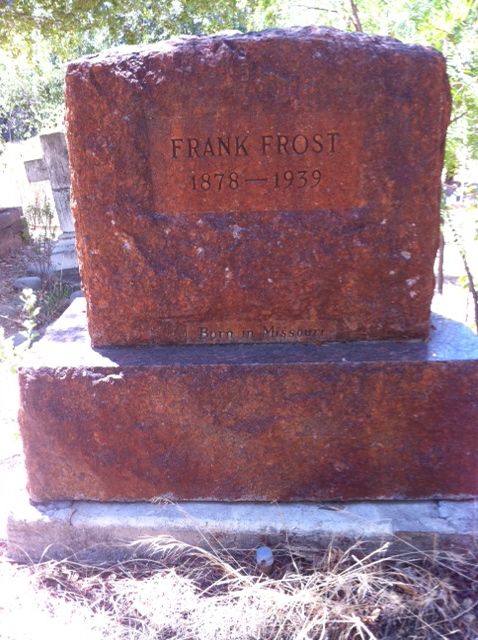 Nordhoff Cemetery: Frank Frost by Patty Fry and Dennis Mullican
 The above is an excerpt from Nordhoff Cemetery, Book Two, by Patricia Fry with Dennis Mullican.