The Second Foothills Hotel

The Second Foothills Hotel by David Mason

“A greater Ojai shall arise sphinx-like from the ashes of homes and public buildings laid waste for the fire demon.” — The Ojai, June 29, 1917

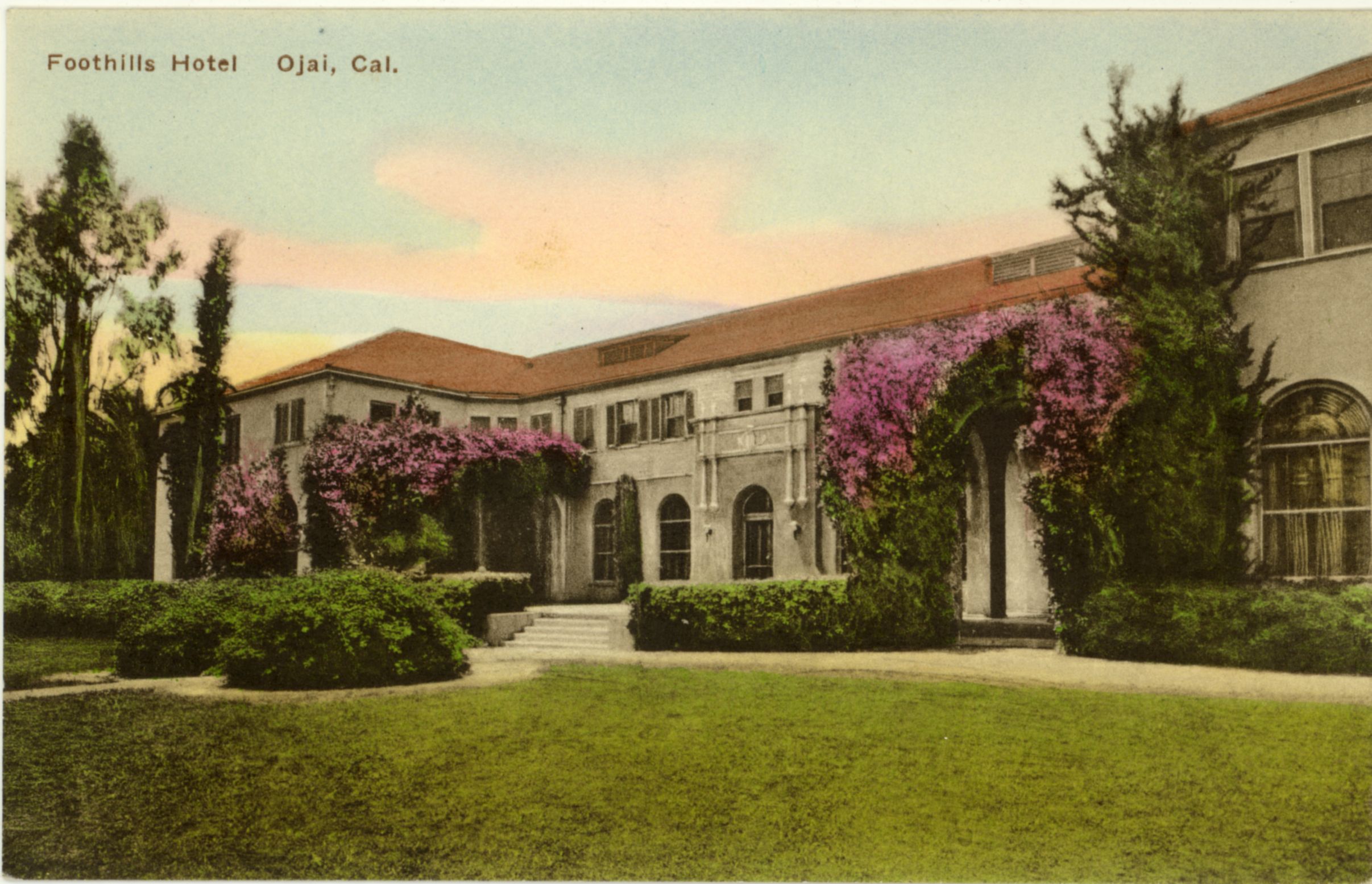
The Foothills Hotel was to be no exception to the above quote. It would, indeed, rise again even more splendidly.

The Second Foothills Hotel

The Foothills Hotel was one of a number of hotels being built to accommodate the tourist business that was booming in the state of California, primarily in the southern half. The area had great potential as a place where people could go to escape the harsh eastern winters.

The Raymond Hotel in Pasadena (1886), Hotel del Coronado in San Diego (1887), Potter Hotel in Santa Barbara (1902) and the Foothills Hotel in Ojai (1903) were the legendary grand dames of the area. They were quickly becoming the talk of the western world.

Much of the grand hotels’ popularity was traced directly to the writings of Charles Nordhoff, a famous eastern author who had written glowing accounts of Southern California.

The population of the entire state of California in 1870 was 560,000, but by 1900 it had increased to 1,485,000; and during the same period, more than three million copies of Nordhoff’s books on California had been sold.

The Foothills Hotel had charm and elegance and was so in demand that potential guests would have to write in advance, send current financial statements and wait to be notified if reservations would be coming their way or not. Many waited, but few were chosen.

The hotel built cottages on the grounds for even more guests, and during its prosperous years that would still not accommodate the many requests for reservations.

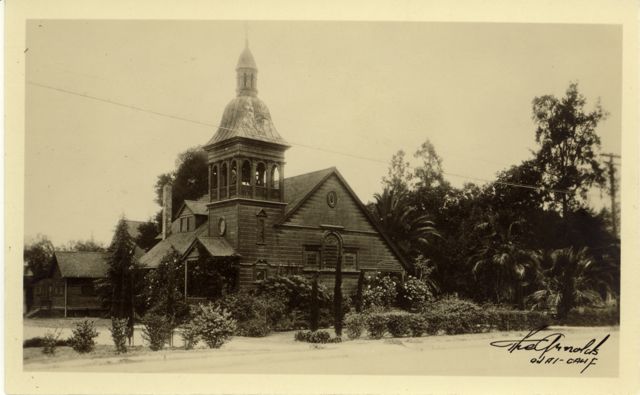
Built entirely of wood in a fire-danger area, the two-and-a-half story hotel made an impressive sight. High enough on the ridge to have a commanding view, across the manicured acres of the golf course, of the valley below, and with the majestic mountains as a backdrop, it was a place where travelers could gather to relax, play golf, or even ponder an investment in the young community.

The summer of 1917 was really not much different from most Ojai summers. It was hot, and the fire season had once again arrived, a time that most valley residents dread even to this day. And as luck would have it, a fire broke out in Matilija Canyon, because of carelessness by a camper, and quickly swept the hills and headed to the valley.

Many believed that Ojai was doomed, and the flight to safety began early in the evening.  Of the 60 or more structures lost, the Foothills Hotel was one of them.

The fire was so consuming and the high winds were blowing so relentlessly that during the day feather mattresses were flying out of the windows of the hotel and helping the spread the fire to the valley below.

That fire, like so many before and since, ended with thoughts of the people being, “We must unite and begin to rebuild.”

E.D. Libbey, Ojai’s greatest benefactor, sent a telegram conveying his sympathy for the loss and said, “From such devastation and ruin will spring renewed energy and courage.”

Within days, the architects Mead and Requa, who had earlier designed the arcade and post office tower, were preparing plans for an even greater Foothills Hotel. The town newspaper proclaimed that there would be “no unnecessary delay in the building and furnishing of the handsome hostelry to be.

From the balcony looking south.

Built on the same foundation, the new hotel was a two-story, white stucco building, a model of completeness and easily surpassed anything of its size on the coast in modern appointments and equipment. A large and commodious lobby with a huge fireplace occupied the center of the lower floor of the main building. Large, easy armchairs, sofas and settees were invitingly arranged around the room.

To the left of the fireplace was the manager’s office, so situated that a clear observation could be had of all parts of the lower floor. To the back of this was a very cozy private breakfast or luncheon room, where special and private dinners could be served.

To the east of the lobby was the ladies parlor—large, roomy and comfortable, with a magnificent view of the valley below. Adjoining this was a parlor for maids and attendants across the hall, leading in from the east entrance, were the lavatories.

In the west wing of the lower floor was the large and spacious dining room, partitioned from the lobby with a glass panel arrangement, which could be folded back, converting these two rooms into a large ballroom.

To the north of the dining room was the kitchen, with its large range, modern steam dish-washing machine, and, with all the other modern appliances, it was one of the finest kitchens on the coast. Adjoining the main kitchen was the bakery and pastry kitchen.

To the east of the kitchen was a very inviting dining room for the help, maids and chauffeurs. The upper floor was given over entirely to 18 guest apartments with their individual baths.

Four cottages were located near the hotel that consisted of two and three bedrooms and baths, living rooms and sleeping porches. Just in front of the hotel were the tennis courts and golf course.

It was open only during the winter months, and because of the remoteness and lack of some services, many visitors simply wanted to make the hotel a temporary destination for resting from the rigors of life in the big cities, and for escaping from colder climates.

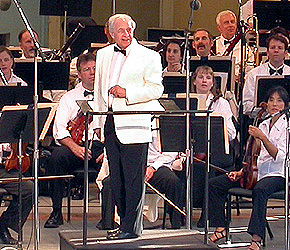
Much of Ojai’s social life centered around the hotel. Many delightful nights of entertainment were held and were open to the public in the spacious lobby. The most prominent was the first Frost-Coolidge Music Festival, which started in 1926. Many consider the event to be the inspiration for the present Ojai Music Festival.

The festival was announced to the valley through the local newspaper, The Ojai, in August of 1925 and was held in April of 1926. It was front-page news. “One of the greatest musical events that has ever taken place in America came to a close on Sunday evening with the final concert of the Ojai Musical Festival.”

It surpassed all expectations, great as they were; and the five concerts stood out as unquestionably the most wonderful thing that had ever happened in Ojai.

The Ojai newspaper continued to rave, “To have entertained at one time a group of world-famous musicians, any one of whom is able to command the attention of the music world, wherever he or she may be, to have heard during a period of three days three such famous aggregations as the London String Quartet, the San Francisco Quartet and the Little Symphony of New York under Georges Barrere, are experiences almost unknown in musical history.”

The lobby of the Foothills Hotel provided an auditorium so perfect that both audiences and artists confessed surprise.  From the rearmost seat inside and the furthermost seat outdoors, every note was clear and distinct.

More than 500 people attended each concert, the greater number from the Ojai Valley itself, and about one-third coming from outside the valley.

One of the striking things about the festival was the arrangement of the programs. Only experts, such as Mrs. Elizabeth Sprague Coolidge and Mr. Franklin Jefferson Frost, could have planned five such complete and self-contained concerts.

Each was a gem; each brought out a special phase of music; each gave scope for a particular branch of instrumentality; and each gave the audience an opportunity to hear a different artist or group of artists. It was felt that the Ojai Music Festival would become a yearly event.

The hotel would continue to attract high society until the Depression of 1929, when the hotel’s popularity began to decline. It would continue to operate, but the years had taken their toll; and the Foothills Hotel was no longer the well-polished resort it had once been. The visits of eastern and Hollywood elite had all but ceased. Countless tales exist, some true, some legendary, and some nearly forgotten—of the notables who experienced the Foothills Hotel.

By 1942, the hotel was sold to the California Preparatory School, started in Pasadena as a military academy and then moved to Ojai. The hotel and cottages were remodeled for the use of the school, that would accommodate 100 students.

The property was sold again in 1955 for the establishment of Camp Ramah and enlarged to accommodate 200 students of the Jewish faith. Camp Ramah, needing more space, purchased El Rancho Rinconada and disposed of the beautiful Foothills Hotel.

The historic Foothills Hotel became but a memory in 1976 with the help of a demolition crew, and once more an Ojai treasure was gone.

By David Mason, Foothills hotel was a legendary grand dame of the area, Ojai Valley News, June 4, 1999

The First Ojai Boom (1873)

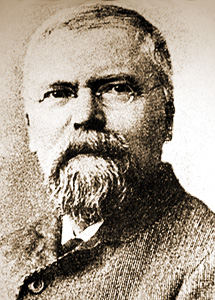
Royce Gaylord Surdam

Royce Surdam and The First Ojai Boom
by John Montgomery

[John Montgomery came to the Ojai Valley in 1874 as part of the valley’s first real estate boom. The first Ojai boom was primarily the work of Royce Surdam, a local businessman who subdivided the town and sold its first lots. John Montgomery’s house was on Matilija Street. Montgomery Street is named for him.

California has experienced many real estate bubbles over the years. John Montgomery describes the first Ojai boom (and bust) in this wonderful portrait of Royce Surdam, the founder of our town–formerly known as Nordhoff. Those of us taken in by the recent real estate bubble can take some comfort in knowing we were not the first!]


Is there a boom bacillus? Most likely there is; how otherwise can we account for the resemblance of the disease to the measles with its incipiency, its outburst and decline? It is as contagious as the smallpox, as infectious as the cholera. Once let the boom microbe enter the system and the victim is as diseased as a hospital or asylum patient, his brain undermined; he peoples trackless deserts with mighty hosts, builds castles in the air and sees gold nuggets in common boulders; then finally wakes up, too often, alas, to a long a painful convalescence and the self-interrogation of “where was I at?”

One of these epidemics struck Southern California in the year 1873, the centers of infection being San Diego and Santa Barbara for Tom Scott has promised a railroad to the former and Charles Nordhoff had published in Harper’s a series of articles on Santa Barbara which caused a stream of one-lunged pilgrims to flow into that Mecca. Los Angeles and San Buenaventura were not thought of, but the hitherto secluded Ojai Valley posed as a boom-struck celebrity and was introduced into turbulent companionship by a very singular personage. Royce G. Surdam had fallen in love at first sight with this rustic beauty, and never was an ardent lover more entranced than he over his new-found enamorata. The expressive term “rattled” may be applied to his state of mind in relation to his discovery. He purchased 1,500 acres from T.R. Bard, the tract extending

Surdam’s plat for the new town of Nordhoff (1874).

from the creek at Nordhoff west to the present Meiners property. From this tract he selected a town site, named it Nordhoff and had A.W. Blumberg start a hotel, a free transfer of twenty acres being an inducement. In the spring of 1874 this solitary building was completed; and on a windy night in April a select but limited circle inaugurated the grand opening to the strains of a Ventura band, with choice selections from the repertoire of a coyote troop in the woods outside.

Surdam was so enthusiastic over his new acquisition that he could think, talk or dream of nothing else. In place of a portrait of his charmer he had a gorgeous map of her lineaments, with all the embellishments his fancy could bestow, namely: a grand public square with fountain and diverging avenues; a town hall; academy, location for a chapel; and vast possibilities. The writer will never forget his fruitless search for these attractions on his first visit to Nordhoff, and the bewildering confusion of mind resulting from their absence.

Surdam had his headquarters at the Santa Clara Hotel in Ventura; and there the unwary stranger, whether Jew or Gentile, was entrapped and like the youth in the Ancient Mariner was held spellbound to hear the story of the beauty and virtue of the new acquisition. A cure for all the ills that afflict humanity, from relapsing fever to impecuniosity, was guaranteed to the fortunate guest or investor in the charmed groves of Nordhoff.

Don Quixote sallied forth on the highway to challenge to mortal combat any man refusing to own his Dulcinea the peeress of every lady in the land; Surdam had neither lance nor sword, but not the less emphatically did he insist that all should acknowledge the marvelous superiority of his mountain enchantress. Let no one suppose the man was insincere; he believed every word he said; he was an honest enthusiast with the boom fever in his marrow.

There are many now in the valley who would champion its cause with all the ardor of its first boomer. Is she not the ever youthful bride he imagined her to be with perennial orange wreath adorning her lovely crest? Has she not the magic balm of health he promised to all her votaries? Are not the diverging avenues, the grand square, the academy and the public fountain among the probabilities, nay the certainties of the near future? Whether he exaggerated or not, the fact remains that to Surdam the valley owes its first boom: his persistent praise called attention to its beauty, its excellence; and many who would have passed to other points in search of health or homes were induced to cast anchor in the romantic haven so warmly recommended.

So successful, indeed, were Surdam’s efforts that lands east of the town advanced in a few months two hundred percent, jumping from ten to thirty dollars an acre. Additional accommodations were soon necessary to harbor the throng of home and health seekers who came into the valley, so that McKee’s canvas tent was transformed into an attractive building, under the appropriate title of Oak Glen Cottage.

While Surdam insured success to the valley, he himself in his personal speculation failed to meet the success he anticipated and that his energy deserved. People did not want narrow town lots when broad acres were to be had so cheap. Then he refused to subdivide his outside lands and held them at a high figure, and thus others profited by his efforts while he himself reaped little or no benefit. His expenses were heavy; livery teams, surveying and advertising were sapping his means; and the purchase money had to be forthcoming. He held on so long as he was able; but thee came a day when, with a heavy heart, he parted with his idol. In December 1874 the writer acquired his outside tract of 1,300 acres; and shortly after Colonel Wiggins purchased the townsite, also the Blumberg Hotel, improving the same by adding the west wing.

For nearly 12 years the boom virus lay dormant in Surdam’s system to break out afresh in the excitement of 1887 when he undertook to float the Bardsdale property. On this occasion he displayed some of his old spirit, but it never reached the acme of his first craze.

Poor Surdam, prince of boomers, to think that all should end in an overdose of morphine and a coroner’s inquest!

The promised railroad did not materialize in San Diego, but fine buildings and substantial improvements did; and Santa Barbara owes the Arlington, the Clock Building, Odd Fellows Hall, etc. to the boom of 1873. It died hardest in Santa Barbara, but in 1876 the fever was over, and the languid patient had scarcely strength left to raise a small mortgage.

The Ojai Valley, on the contrary, held its own. Whatever start it got in the excitement it retained. It had its wet years and its dry years; barley would lodge and wheat rust. Noisy croakers would wander off Jason-like in search of a golden fleece, lose their husky voices on the trip and return speechless as to the defects and drawbacks of the valley; but the majority of the substantial residents continued nestling in contentment and somnolent in the feeling that life’s aims were attained.

Early Stories of Ojai, Part VII (Downtown Nordhoff)

Early Stories of Ojai, Part VII (Downtown Nordhoff) by Howard Bald
Written in 1972 by longtime Ojai resident Howard Bald.

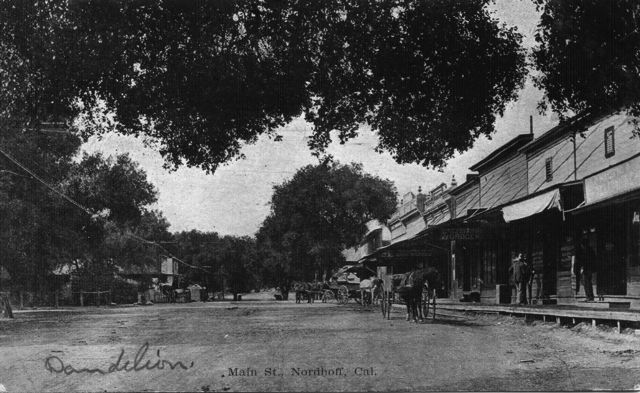
Main Street of Nordhoff

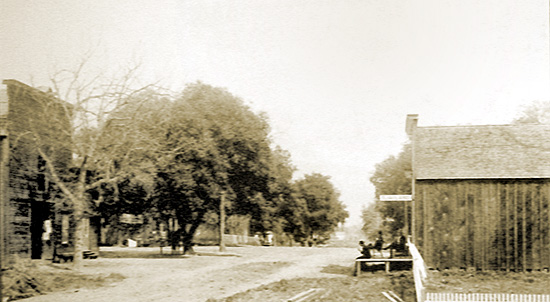
Nordhoff (now Ojai) has generally been described as a quiet, peaceful little place, and generally it was. Several oak trees strung along Main Street from Tom Clark’s livery stable [Ojai Village Pharmacy] to Schroff’s harness shop [Ojai Cleaners] furnished the only shade, for there was no arcade until 1917.

There were three gaps in the row of buildings on the north side of Main Street. One was between Lagomarsino’s saloon and Archie McDonald’s blacksmith shop at the east end of the business block [the Hub], and Barrow’s hardware store stood alone. There was an alley on both the east and west side of that building, which I think was the site of the present hardware store [Rains].

Corner of Montgomery and Main looking west.

The east alley was used by pedestrians. I think the board sidewalk prevented vehicles going through. But the sidewalk ended at the west corner of Barrow’s hardware, so that alley was quite generally used by horsemen as well as pedestrians.

West of that alley was Bray’s plumbing shop, and from there on to Signal street was the livery stable with its buggy sheds, corrals, and hay sheds. West of Signal on the site of the Oaks Hotel stood a small, whitewashed, clapboard building where Chet Cagnacci was born at the turn of the century and later, I believe, Tommie Clark.

Corner of Signal and Main, looking east.

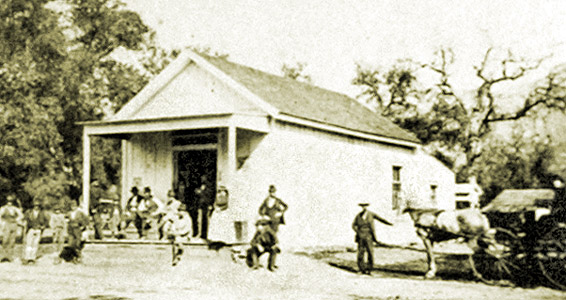
Across the street about the site of Van Dyke’s Travel Agency [Library Book Store] stood Dave Raddick’s residence, then easterly a break then the meat market [The Jester]. On the southwest corner of Signal and Main was The Ojai newspaper printing office where the theater now stands and easterly across the street, where the present post office is located, was Charley Gibson’s blacksmith shop. There was a gap between the blacksmith shop and Lauch Orton’s plumbing shop, the barber shop and post office. Through that gap could be seen the Berry Villa, which is now the Post office employee parking place.

A little distance east of the post office, briefly, stood C.B. Stevens little grocery store, then the entrance and exit to the Ojai Inn, which is now our city park. A leaky, redwood horse trough and a hitch rail extended onto the barranca. It was always shady, and teams of horses and buggies were customarily tied there while the out of town folks did their shopping.

The Ojai Inn.

I once had a Plymouth Rock hen who would bring her brood through the alley between the saloon and blacksmith shop to scratch around where the horses were tied. Sometimes she would miscalculate and be overtaken by darkness, so hen and chicks would simply fly up on a vacant spot on the hitch rail and settle down for the night. Our stable and chicken coop was just back of Dr. Hirsch’s office [Dr. Phelps], and more than once at about bedtime, I would carry them back to their own nest.

Schroff’s harness shop east of the barranca stood high enough from the ground that one could step from a saddle horse onto the porch, which was convenient for ladies riding sidesaddle to dismount and mount.

The corner of South Montgomery and Main was open and was used mainly by Thacher boys to tie their

Presbyterian Church on southeast corner of Main & Montgomery.

horses while attending services at the Presbyterian church, which then stood where [Jersey Mike’s] parking lot now is. That building is now the Nazarene Church [Byron Katie’s headquarters] on N. Montgomery and Aliso.

I could go on and on and on with details of the village of Nordhoff at the turn of the century, but I fear that would become too boring, so I will get on with some of my memories of the activities of the time.

Early Stories of Ojai, Part VI (More on the Ojai Train)

Early Ojai Stories, Part VI (More on Ojai Train) by Howard Bald
Howard Bald describes life in turn-of-the-century Ojai in these articles from 1972.

The Ojai-Ventura Train.

There were other incidents in connection with the “Ojai Flier” or”The Cannon Ball” that might be worth mentioning. One of the train crew lived with his family on Signal Street, the old two-story house now occupied by a masseur [Inn Harmony]. His daughters in the evening would hitch the old white mare to the buggy and park them near the side door. When they heard the train whistle in the distance, one or all three daughters would jump in the buggy and dash off to meet their daddy.

One evening a daughter went out, and finding no horse and buggy waiting, decided that one of the other sisters had gone alone and thought nothing of it. When father checked out from his “run”, he found the horse and buggy in the customary place. After looking around and finding no daughters, he drove home alone. Later it was revealed that the old white mare was seen jogging down Signal, up Main Street to Fox, and down to the depot on her own.

A few years later my young sister decided to make Peggy, our two year old colt, acquainted with the train. Margaret was riding bareback with only a hackamore. Peggy took a pretty dim view of the hissing monster, putting on quite a scene, and at one time was in the middle of someone’s buggy. But through it all, Margaret stayed astride her.

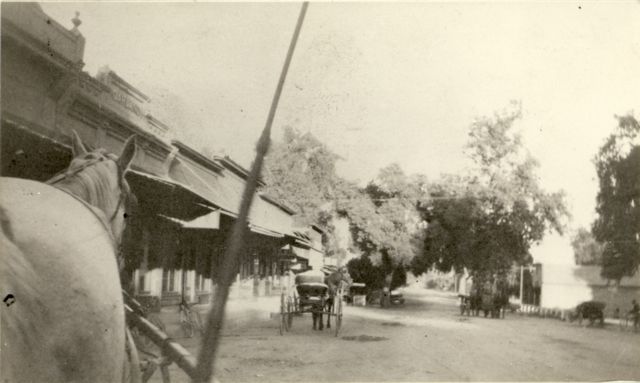
A horse and buggy in downtown Nordhoff.

One time I was sent from the livery stable with a horse and buggy to meet a domestic of the Edward Thachers on Topa Topa Ranch coming in on the train. It was winter and, of course, dark when the train came in. We soon had the old gal and her belongings loaded and were off up Ojai Avenue. By the time we turned off onto Reeves Road (it wasn’t much more than a narrow, winding, rocky trail then and I don’t believe it had a name) the poor old Scandinavian was having some misgivings as to the reliability of her escort. She couldn’t understand why I didn’t drive faster.

I did my best to reassure her, pointing out that the road was rocky and narrow. When we turned up McAndrew road and the horse travelled even slower, she was really convinced that I was lost. There was nothing, though, that she could do, for it was pitch dark and I don’t suppose she even ha a pair of reins in her hands. It probably wasn’t eight o’clock when we drove into Topa Topa yard, and Mr. and Mrs. Thacher appeared with coal oil lanterns. But that lady, I guess, considered it a harrowing experience.

It was wintertime when once my mother, my sister and I were going someplace by train. As we groped our way on foot from Signal to Fox Street in the dim dawn, we heard the locomotive give some sharp whistles, but we sauntered along until we discovered the train was at the Fox Street crossing. Mr. Spence, the engineer, knew we were no aboard and was waiting there for us.

Another time most of Nordhoff went to Santa Barbara to a circus. We arrived via train in Ventura at 7 a.m. and had quite a wait there for another train, but were in Santa Barbara in time for the parade, saw the afternoon performance, then took a southbound train back to Ventura, arriving in time to catch the Ojai Flier home. I am not sure but what it had to wait for us in Ventura.

Mr. Spence, the engineer, was a kindly old gentleman, and once he took me with him on the locomotive, a cod burner, to Los Angeles and back, a two-day trip with 24 hours of travel. It was one of the events of my young life (I was probably 10 then), but alas it was somewhat marred by my introduction to indoor plumbing. I had never seen or heard of anything of the kind, and the whole thing was too embarrassing for words. No one knew how I suffered. Mr. Spence doubtless thought me a very unresponsive and unappreciative youngster. It was my first experience with electric lights, too. In the center of each room a cord hung from the fixture in the ceiling.

Well, so much for railroading. We will next dwell on the village of Nordhoff.

Early Stories of Ojai, Part V (The Ojai Train)

Waiting for the train to arrive.

Early Stories of Ojai, Part V (The Ojai Train) by Howard Bald
Howard Bald recounted life at turn-of-the-century Ojai in these articles from 1972.

Much has been written over the years about leading citizens of the Ojai Valley and their contributions to the community. What I propose to do is to try and present a picture of the everyday citizen, something of what life was like at the turn of the century and the decade that followed, of some of the industry and activities that have long been forgotten.

Unfortunately, there are not many left to help me on points that have become dim in my memory. I trust, though, that there will be no more inaccuracies in my statements than there have been in statements made by people who are better qualified to be historians than I am.

For instance, at the dedication of the new post office a few years ago it was stated that the new building stands on the same spot the post office stood at the turn of the century. Another person in her memoirs stated that Ojai (Nordhoff) never had a saloon. Also the Ojai newspaper wrote an account of Mr. Gridley murdering a Basque sheepherder in the Sespe. All of which I know to be absolutely inaccurate. But more on those subjects later.

Now it is not my purpose to start right in criticizing others, but to show how easy it is to make misstatements. I will doubtless make my share of them.

Arriving in the village of Nordhoff (Ojai was Nordhoff until the time of the first World War) in the spring of 1900, I was a scrawny, squint-eyed eight yar old with a supposedly short time to live because of TB. The long severe winters of northern Washington and Idaho kept me wrapped up in bed a good part of the year, so a mild climate with plenty of freedom was recommended by the doctors.

Well, I took full advantage of the freedom and in that way gained a wider knowledge of what was going on than the average boy of that time.

One of the things that stands out in my memory was the Nordhoff train. It was not until I had grown up that I realized that the train had arrived only two years before my arrival in the Ojai Valley.

Two trains plied between Los Angeles and Nordhoff. As the train left Nordhoff at 6 am, its sister train left Los Angeles. They crossed at Moorpark, where the crews had their lunches, then continued on to their respective destinations. So each train took 12 hours to make the one way journey.

On long summer evenings one popular source of entertainment for certain men, boys and dogs was to sit on the board sidewalk, where the arcade is now, and at the sound of the train whistle down near Grants Station [where Rotary Park is now], all would take off on a trot for the [Nordhoff] Depot.

Near Schroff’s Harness Shop (where the Ojai Cleaners now is) we cut down Montgomery Street and below the lumber yard, now Wachters, we went across to Fox Street.

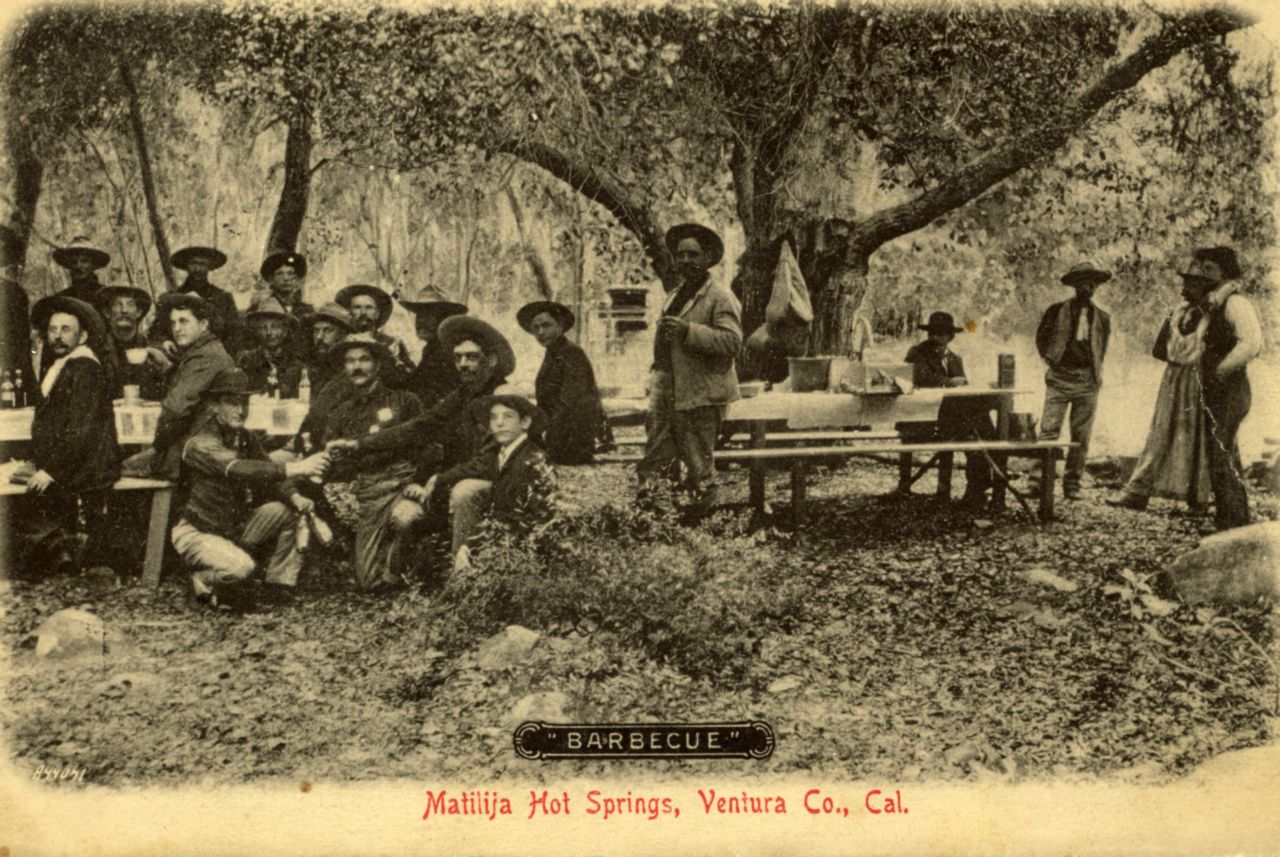
At the same time the Matilija Hot Spring’s big lumbering overland stage, driven by either John Oretega, Bill Olivas (father of the Billy Olivas who is currently making headlines at Matilija Hot Springs) or Bob Clark would wheel in a cloud of dust, followed by Wheeler Blumberg with his four white horses hitched to a four-seated buckboard. Nordhoff’s taxi, which comprised a team of horses attached to a buckboard, would be there along with an assortment of country folk with a horse and buggy to meet incoming friends or family.

The Matilija Stage

As the train crossed S. Ventura, S. Montgomery and Fox streets huffing and puffing, with steam jetting from both sides and the bell clanging, there was general pandemonium, for many of the country horses were terrified of such a monster and resorted to lunging, bucking and rearing. Not infrequently would be heard snap of a buggy shaft or a wagon tongue amid the barking of dogs and shouting of women and children on the ground greeting incoming family.

When the Matilija and Wheeler Hot Springs guests were all loaded there would be a popping of four horse whips, as the stages departed through town on a dead run. In later years I have wondered just when the horses settled down to a jog trot, for certainly they couldn’t endure such breakneck speed for long.

The Taxi

Finally as broken harness and buggy shafts were mended and the more terrified horses were led out across the bridge and all the passengers had departed, the boys and dogs would straggle off to their respective homes and the men back to their visiting along the boardwalk or to Dave Raddick’s pool room. I don’t believe the patron’s of John Lagomarsinoa’s card house were ever diverted from their evenings carousel by the arrival of a train.

Postcard: Hanging Rock — A Trysting Place.

Hanging Rock by E.M. Sheridan

I’d like to go to hanging rock today,
Just as I did in that far other day,
To sit and dream in the deep canyon’s shade
Beneath the towering crags rising rugged above
The tumbling waters of the river,
In wondrous Matilija.

Twas very long ago, in flaming youth,
We two sat side by side beneath
The great moss-covered stone
A trysting place sought out in those old days
By the swift river waters where trout sprang
Glinting in the sunlight
In Matilija.

With devil’s slide across the way,
And dotting the declivities
The snow-white Spanish daggers reared their heads
Boldly in the upper reaches of the sun
On the canyon steeps,
And bird song filled the air, and calling quail
And murmuring dove were in Matilija.

It’s well-remembered by the young of then,
That old hanging rock,
By those of now who are with us
Those of now with grandchildren
Toddling about their knees, and whose mirrors
Bring a sigh as a memory travels back.
And where are the lovers of yesteryear,
Lovers of olden Matilija.

NOTE: Hanging Rock was covered by Lake Matilija when Matilija Dam was built in the 1940s. Where do young couples go to tryst now that Hanging Rock is gone?


Early Stories of Ojai, Part IV (Nordhoff Rangers)

Early Stories of Ojai, Part IV (Nordhoff Rangers) by Howard Bald

Note: Howard Bald was an early Ojai resident. His reminiscences were written in the early 1970s.

In 1898 the Santa Barbara National Forest (now Los Padres) was created with headquarters in Nordhoff. Willis M. Slosson was sent out from the east as supervisor. The boundaries extended from Castaic up into San Luis Obispo County and north into Kern County.

Men were recruited from all parts of the back country, and they were largely homesteaders, cowboys, miners, and such. Their pay was $60 per month. They had to own at least two horses and maintain them. Generally the ranger (they were all rangers then) had to provide his own quarters. There were no fringe benefits.

With Nordhoff the national forest headquarters, and since the only means of getting around was via saddle and pack horses, there was a great deal of forestry activity in the valley, that is, mountain men coming and going. A more rugged, hardy, self-sufficient, picturesque group of men would be hard to imagine. Though as a whole they were rather short on formal education, they accomplished a prodigious amount in the way of trail building, and maintaining, investigating mines and homesteads, issuing grazing permits and performing fire suppression.

They were also deputy and game commissioners.

Of course thee were no telephones at first, no lookout stations, no airplanes or helicopters, or radios, and but few trails. Sometimes a ranger would ride a day or more to get to a fire. The nearest ranger to a fire might recruit a few men—homesteaders, cattlemen or miners, and with just a few simple tools attack the fire.

One wonders now how they accomplished so much with so few men and little equipment, when one hears of the hundreds of men, bombers, fire engines and other sophisticated equipment that is employed to suppress the same fires today and at a cost of hundreds of thousands of dollars.

Among some of the more colorful men of that period was Jacinto Reyes, who to this day is a legend among people in the back country, not only for his fire fighting but also for his horsemanship, endurance, rescue work, and ability to settle sometimes violent disputes among homesteaders, cattlemen, or miners. Then there were his brother Geraldo Reyes, Frank Ortega (father of ex-Ventura postmaster Melito Ortega) and Fred de la Riva. They were what we called in that day “California Spanish.” They were great horsemen and very capable.

My father, George Bald, became one of them in 1903 and until the mid-twenties was chief ranger of this area. Trever Isenberg, Jerome Larmer, Bob Clark, Bob Miller, Bill Herbert, the Leiber brothers, Tom Dunsmore, Gene Johnson were among others of that day I remember. They were what one might call, at that time, “real Westerners.”

There is, to me, an amusing story that might give an idea of how that breed of men could impress the uninitiated easterner. In later years it was recounted to me many times.

Sarah McMullen was a nurse who came to take care of Loring Farnum, a semi-invalid who bought our Rinconada Ranch (J.D. Reyes and I gave it that name), later the Orchid Ranch, which is now owned by Camp Ramah. She always began the story with: “The worst fright I ever had was being confronted at Mr. Farnum’s front door by three of the awfullest looking men I ever laid eyes on!” Then there would be a detailed description of the three. “Two were huge, very dark complexioned men with high cheek bones and dark, piercing eyes. The third man was short with a sandy complexion and legs like a pair of ice tongs.” The refrain would be: “And that was your father!”

They wore broad-brimmed, low-crowned hats and red bandanas, and, of course, were unshaven. They curtly asked to see Mr. Farnum. I was trembling so,” said Sarah, “I could hardly speak when I went back to Mr. Farnum’s room and said there are three of the most terrible men I ever saw who said they want to see you. Mr. Farnum said, ‘Well, show them in!'”

As I pictured the scene, Jacinto and Geraldo Reyes and my dad were returning from a week camping in the mountains. They were tired, dusty and, of course, thirsty, and they knew that Mr. Farnum was always generous with the drinks.

“Reminiscences of Early Ojai” by Howard Bald, 1973

Early Stories of Ojai, Part III (Chinese in Ojai)

Early Stories of Ojai, Part III (Chinese in Ojai) by Howard Bald

Note: Howard Bald was an early Ojai resident. His reminiscences were written in the early 1970s.

Many Chinese as well as Italians were employed in wood cutting operations in the valley around the first of the century. Some Chinese lingered on as domestics or in other capacities for a decade or so.

My grandmother had one who baked delicious bread. The loaves were always a beautiful deep brown. But the Chinese and my grandmother suddenly parted company when it was discovered that he would fill his mouth with water and squirt it over the loaves during the baking.

There was always a Chinese vegetable wagon pulled by two horses, or sometimes one horse, that came around once a week. (There were never fresh vegetables in the grocery story that I remember.) A carrot or a turnip to each of us youngsters was always a treat, but the Chinese vendor didn’t always have them.

At this period no one can tell me where the vegetables were grown, probably near Ventura. A special treat that we youngsters looked forward to about Christmas time was Chinese nuts, or litchi nuts. They were delicious.

And there was the Chinese laundry that at one time was operated by Wah Lee. It was located east on Ojai Avenue just west of the bridge, and on the north side of the property on Mrs. Gally’s property, mother of Howard Gally. Wah Lee went about with a covered wagon drawn by one horse. His business survived on into the second decade. In fact, during prohibition times, he probably made more money bootlegging than doing laundry. I faintly remember a little stir that was caused by Mrs. Gally refusing to put him out when the local officers were unable to catch him.

Chinese were said to have built the first stone walls in east Ojai valley. It seems to me that the walls looked as old at the turn of the century as they look now. Those walls don’t include the ones on east Ojai Avenue, east Grand, north Carne and the one on the Twin Peaks Ranch. I have been told that these Chinese received 50 cents a day.

There was not too much law enforcement in that day, and the poor Chinese sometimes had a pretty rough time of it. I have heard my mother tell of her brother Tom roping (lassoing) one as he plodded along the dusty road. Tom was riding a colt and couldn’t manage the rope and the colt at the same time, with the result the Chinaman climbed up the rope and took it away from him. Tom dismounted, my mother (Katie) held the colt, while Tom tussled with the man and retrieved the rope.

Later the fellow returned with a shotgun, but Tom had ridden off to the Upper Ojai, while Katie’s mother hid her in a clothes closet and locked all of the doors. That house was the two story, yellow building south and east of the Ojai lumber company yard, a mile and a half east of Ojai.

Well, that fellow had the last laugh. Some time later the boys who had taken his laundry were swimming in the creek beyond what was Clausen’s dairy on the Pirie ranch. This same laundryman slipped up and stole all of their clothes. Needless to say, they were not returned nicely laundered.

There were many other incidents of that nature, some funny, some not so funny, dependent largely on one’s point of view. But just one more Chinese anecdote: A group of rowdies one dark night surrounded the wash house and began firing guns into the air. The occupant of the house opened the door and returned the fire. In the rowdies haste to clear out, one was almost decapitated on a clothes line.

“Reminiscences of Early Ojai” by Howard Bald, 1973

My Chumash Ancestral Legacy

My Chumash Ancestral Legacy by Julie Tumamait-Stenslie

Julie Tumamait

As a Chumash descendant, it is my belief, and that of many other Chumash people, that we have always been on this land. Anthropologists (scholars who study the remains of past societies) do not know for sure when the ancestors of the Chumash arrived in this area. Theories claim that they may have arrived somewhere between 12,000 and 27,000 years ago.

Recent studies on human remains that have been in the possession of the Santa Barbara Museum of Natural History have been dated 13,000 years ago. These bones belong to one person, a woman who lived on Santa Rosa Island, one of the islands belonging to the group of islands known as the Channel Islands off the coast of Southern California. This places her as the oldest recorded human being on the North American Continent.

Scholars theorize that the people migrated across a land bridge called the Bering

Typical Chumash Village

Strait, a strip of land from Siberia to Alaska. In the Chumash oral tradition, we have creation stories where the people of the upper world, Mishupashup, created man from a table made of marble and then, after it was decided what kind of hands man should have, he was placed in this world, Itiashup.

The decision on the kind of hands for man came about when Snilemun (Sky Coyote) argued with Sun that man should have hands like his; then it was decided. As Snilemun was ready to put his paw down, a lizard ran around behind Snilemun and put down his hand, and with that action, we have hands with fingers instead of paws.

Another more modern creation story came out of Santa Barbara around the 1930s “the Rainbow Bridge Story” in which Mother Earth, or Hutash, planted seeds in the ground on the island of Limu, which means “In the Sea” (Santa Cruz Island), and up sprouted these people, strong and handsome. She gave them many gifts, items for them to survive on. When the island became too heavily populated, Hutash called them to the highest point of the island and told them that she was going to make a bridge out of a rainbow and that they were to cross over to a new land. This bridge connected this this land that spreads out for hundreds of miles in all directions. As the story goes, Hutash gave a warning stating that if the people looked down off the bridge, they would fall off and drown in the sea. Some of the people did look down, and as they fell Hutash heard the cries for help, so, out of pity, she turned them into dolphins.

So, with these stories in place, we Chumash people believe in these origins. My heritage comes from my father, Vincent Tumamait, and my mother, Lucy Castro Tumamait, whose parents come from Guajuanto, Mexico. They settled in Camarillo. My mother and father married in 1942 at the Mission Santa Barbara and made their home in Ventura. Family stories, baptism records and interviews with anthropologist have helped our family trace our lineage throughout Chumash territory.

Our family descends directly from Santa Cruz Island. In 1811, Juan de Jesus Tumamait was baptized in the San Buenaventura Mission, which was established in 1782. He was raised by his grandparents, who were two people among hundreds to be removed from the island to become part of the labor force that built the mission in Ventura. As an adult, Juan de Jesus became a captain for that area, helping maintain order and peace between the native people and the missionaries. He also played a violin in the mission orchestra.

As an adult, he took back his native name of Tumamait, which through research we have found to mean “orphan”. He tried to set an example for the other people to tell them that they should not let go of their culture so quickly, but assimilation was rapidly descending upon the people. As a result, our family is the only one who has a Chumash name as a surname. Juan de Jesus was our great-grandfather.

Vincent Tumamait. Photo by Juan Carlo.

My father Vincent moved us into the Ojai area in 1952. I grew up in the river bottom of Meiners Oaks, off the north end of Rice Road. As a child, I loved this area, being near the river and the mountains. Later, I would learn that our family descended from the people who lived in the village there. Juan de Jesus’ mother, Maria Ricarda (her native name was Alulalmegue, which means “one who drags their feet”), was born here at the village called Matâ’ilha, or as we know it today, Matilija, which means “division”. She was born about 1786. The village proper was situated where the present-day historical Lopez Adobe is; in 1830 it was a fort. In 1925, it was sold to Louise McCaleb.

It was in the 1830s that soldiers witnessed the Chumash people, hunting and gathering along the river, making temporary camps and performing ceremonies. Recently, workers were pulling rocks out of a stream bed just up from the former village of Matâlha to use for building a rock wall. One of the workers picked up a rock about the size of a frying pan, and when he turned it over, he saw some painting on it. It turned out to be a ceremonial stone with painted Chumash symbols on it. There has been only one other such stone found and we cannot explain them. This stone was donated to the Santa Barbara Museum of Natural History.

Throughout Chumash territory there are select places where cave paintings can be seen. We do not know all there is to know about them, but we do know that these caves are sacred and that visitation is not encouraged. This ceremonial stone was found near a spring, which is consistent with the painted caves. The closest cave that we know of in our area is in a place called Mutah Flats, named after William Mutah, a homesteader who lived in the area of Pine Mountain. This cave is a beautiful example of the intricate designs that the Chumash used to express their visions.

One reason that we will never fully understand these symbols is because the person or persons painting these symbols were sometimes under the influence of a hallucinatory drug, a special potion made up of the Datura plant. When drunk, the person went into a coma-like state. Upon awakening, the person would then tell the medicine man, or the “alaqlapsh”, his or her dreams. It is at this point that we lose the knowledge as to who actually painted the symbols.

When we take a look at Ojai and its power spots, we have to first acknowledge the great Topa Topas. The name comes form the Chumash word “sitop topo,” which means “much cane.” This type of cane was used for arrows and for small tubes about 2 inches long used to hold tobacco and then the person would pierce it through the ear lobe.

The village of “Awhay,” which is where the name Ojai comes from, was situated in the upper valley and, from ethnographic reports, it was said that crystals were gathered from the Topa Topas. Our oral traditions tell us about men who would dress in bear skins and travel from the villages of Sisar (eyelash) Sespe (kneecap) down the grade to villages in the lower valley all the way to the village of Matilija.

Little is known about the life of the Chumash in the Ojai Valley during the pioneer days. Some of the Chumash became cowboys and ranch hands; others picked the fruit from the orchards. Like my grandparents, they would belong to a family who put them to work on their ranch. Then, when they were finished, they would be “lent” out to another ranch.

Very little archaeology has been done in the downtown Ojai area. We all know about the Soule Park Golf Course site; it has no village name, only a number. It is only by looking at the collections at the Ojai Valley Museum that we can get an idea of what was in people’s back yards.

When Caltrans was doing trenching along Ojai Avenue near the El Camino Motel [Chantico Inn] and dirt was being loaded on dump trucks, the person monitoring this dig asked to look in the back of the truck. While sifting around with a shovel, a sandstone bowl was found. This bowl would have been used for pounding acorns into flour.

My brother and I do monitoring of construction sites, and it is in talking with different men who we are working with that we get a lot of after-the-fact news about village sites that were destroyed, or cemeteries that were plowed through. We heard how Lake Casitas and the Ojai Valley Inn were both built on former village sites. This was at a time when there were no laws in effect to prevent it. Communication with native people wasn’t done then and sensitivities weren’t as strong as they are today.

During the Ojai Valley Inn’s new construction, they hired a monitor. When we experience any drought years, people call me to say how artifacts are washing out of the banks at Lake Casitas, but my only concern is that no human remains are being exposed there.

A village by the name of Kashomshomoy (kind of animal) was located at the Ojai Honor Farm site (now HELP of Ojai West).

When I was a child, we spent a lot of time at Matilija Hot Springs and Wheeler Hot Springs, both have the healing waters that made Ojai famous.

The Matilija Hot Springs were discovered in 1873 by J.W. Wilcox, and were purchased by R.M. Brown in 1895. It was sold again in 1877 to a Mr. Gardner who opened it to the public. It remained open for several decades, but in 1988 it was closed to the public. It is now owned by a couple who allows groups to come in, though it is still closed to the public.

In my mind, this should always remain a healing place. I always feared the Matilija area for reasons I couldn’t explain to anyone. Through my learning process, I can now explain those feelings. This is a very powerful medicine place, and I feel that people should only enter this place at certain times with great respect.

We grew up hearing about Chief Matilija and his group of warriors who tried to fight off the ever-present armies. In the myth, the story goes on to tell of Chief Matilija’s daughter, Amatil, who was very much in love with the handsome warrior, Cocopah. Tragically, he was killed in the final battle. Amatil’s love was so deep and so pure that she she laid upon her lover and there she died. What remained of that love was a beautiful flower with pure white petals symbolizing their love and a yellow center to represent the everlasting brilliance of their love.. We know this flower as the Matilija Poppy.

Even though Chief Matilija was a fictional character, his curse still lives on. Many people have asked me about this. I don’t know when it began, but it focuses on the Wheeler Hot Springs several miles up the road from Matilija Hot Springs. The curse states that anyone who uses this land for ill gains shall perish. In our oral stories, we have a special one called “Gain Is All” that talks about the results of too much profit.

“A man once played on his four-holed flute: ci winu hayaya, winu winu hayaya, gain or profit, will always exist. He was a very close observer, and he began to study the world. He found conflicts that went so far as people killing one another, and the cause of it all was gain. He stopped playing this flute, put it to his ear, and listened to the world. And he heard that all was gain. Then he played the tune again and listed again, etc. And this is all—the hole in the flute is the pathway to thought. After figuring it all out, the man concluded that profit is the voice of all. All the time, it is a single voice-like humming of the air. Gain is the touchstone of the human heart. This story was published in 1975 by Thomas C. Blackburn in his book December’s Child: A Book of Chumash Oral Narratives.

Wheeler Blumberg built a bathhouse at Wheeler’s Hot Springs in 1888. He died in 1906, leaving the place to his daughter and son-in-law Webb Wilcox. It was sold many times and had a number of disasters befall on it. In 1917, five people died in a fire, and a flood in 1935 nearly destroyed it. A mobster was hiding out in one of the cabins when it blew up, killing him. One of the owners in the 1960s committed suicide. The flood of 1969 again put Wheeler’s out of commission for several years.

In 1985, as I was visiting the spa, I had just started my shower after a wonderful massage and hot tub, when I heard the sound of a fire engine. I looked out the window and the fire truck was pulling up in the parking lot. You never saw anyone get dressed so quickly! As we ran out of the building and out onto the road, we could see the fire coming down toward us.

At the time my now ex-husband was playing in a band at The Wheel bar across the street on Sunday afternoons. Well, this was a Monday when the fire started so all of the band’s equipment was still in the bar. We found some people who were visiting and had them fill their cars with all the instruments to take them down the hill to our house. The hot tub buildings did catch fire, but were not destroyed.

The worst tragedy was the death of owner Frank and Evelyn Landucci’s son John in 1987. He and a friend were killed when an oak tree fell on them. It had been hollowed out by the 1985 fire.

Wheeler’s is now closed due to a number of financial problems. The latest news that I have heard was that someone wants to turn it into an Indian casino and I’ve been asked if I would be interested in joining up and being a part of it. “No, thank you!” Some people just don’t get it. Wheeler’s has so much power that we will never be able to capture its full potential; we have seen the full potential of its wrath.

This place as to remain what it had been for thousands of years, a healing place of humble origins, a place where friends and families can go and be healed. Great respect should be given when thinking of developing the land. When disturbing ancient sites, in some cases, there is retribution.

As we come back down the hill along the Ventura River, we come to everyone’s favorite gathering spot. As we talked about earlier, the shell beads that the Chumash made can be found everywhere in this valley, especially after it rains. These beads were made only on Santa Cruz Island, so when found on the mainland, one can say that they were a trade item. The Chumash people would bury the shell beads with the dead. So, when people tell me about the collection of pretty beads they have and where they found them, I have to ask them how their luck and health have been lately. I tell these people that the best thing to do is to go back to the spot and bury what they found, say a prayer, and ask for forgiveness. People who have not heeded the warning often fallen ill and died or they kill themselves.

Some may find this superstition, but, you see, we do not have much proof. Somehow man has learned that it is not OK to dig into modern cemeteries, so they don’t. We don’t know what effect that would have on a person. On the other hand, it seems to many that it is OK to go looking for the pretty beads and other things that are considered ceremonial and funeral-related.

There are other places we must mention which can occur anywhere; they are prayer spots. We can be walking down a trail and all of a sudden spot a carved stone item. This is an atishwin, a supernatural dream helper obtained by a vision quest and used as a charm. The person who made this fetish is long gone, but, for all we know, his or her power still remains. So, when you find these items, place them back in the ground and say a prayer.

One of the reasons I love living here in Ojai is the people and their concern about the land. People here are always ready to put down their hard-earned money to purchase land to be preserved as open space. For me and my descendants, it will be wonderful legacy to be able to learn and know about the ancestral villages and be able to look out over an open meadow instead of a mall.

From The Ojai Valley at the Millennium, 2000

Oak View Fire Station 23

History Fire Station 23, Oak View by Ventura County Fire Department

Oak View’s first fire station was established in 1938, when the County Fire Protection District delivered a flat bed Chevy truck, with a 300-gallon water tank and a 500 gallon-per-minute pump driven by a Chrysler auxiliary engine, to the Oak View Road station. A small amount of hose was also carried on the truck.

In 1946, Engineer Wayne Troxell was put in charge of the Oak View station and its volunteer group.

The title, Engineer, was later changed to Captain and the titles of the four Captains in charge of the four districts in the county were changed to Battalion Chief. The Engineer’s title was not used again until 1962.

At that time working hours were reduced from four 24-hour days on and 48-hours off to a schedule of two 24-hour days, one eight-hour day on, and 48-hours off. The new engineer position covered the station Captain’s two days off and worked with the Captain only eight hours of his three days on.

Troxell, his wife, and children lived in a small trailer parked behind the station. In 1948 a new two-stall fire station with living quarters for Wayne and his family was built at 15 Kunkle Street in Oak View. In 1952, Troxell resigned and built a number of buildings and homes in the county, including Station 20 and Station 35.

Glen Tremain, the second man hired for Oak View, lived at the station with his wife in an eight-by-ten room, cooking meals on a small two-burner stovetop.

Glen served the district for a number of years until he retired as Captain of the Ojai fire station.

The Oak View fire station has the distinction of owning the first resuscitator unit in service in the fire district. Donated by the local Lions Club, it marked the beginning of other service clubs donating resuscitators to their local fire stations.

In 2000 the station was demolished for today’s Station 23 on the same site. The crew operated out of a trailer across Kunkle Street, in a vacant lot, until the new station was finished.