The following article was first seen in the Thursday, May 24, 1962 edition of the “OJAI VALLEY NEWS” on the “OPINION PAGE” (Page A-2). It is reprinted here with their permission. It was an “EDITORIAL”, and the author is unknown.
Our problem: growth
A recent population analysis issued by the Ventura county planning staff revealed that the “Ojai planning area,” comprising Ojai, Meiners Oaks and Oak View, was growing slightly faster in the period April 1, 1961 – April 1, 1962, than the county average and about twice the rate of growth of the State of California.
Figures showed the county rate of growth as just over seven percent. This compares with an average of six percent the previous year. This is in line with recently-released statistics which told that Ventura had become the second-fastest growing county in the Los Angeles complex, second only to Orange. Its jump of over one percent in a year presages an increase year by year.
In the Ojai planning area the trend was slightly higher than the county average. We inched upwards to an eight-plus population increase this year. With plenty of land and water available, no slackening in this trend is in sight. No impenetrable barricades will be stretched across Highway 399 on the Arnaz grad or across other access, the Upper Ojai. Employees of the industries moving into the Tri-Cities, Oxnard, Thousand Oaks area will drive here some Sunday afternoon, fall in love with the valley and buy a home. Father will join the roughly 50 percent of the present commuters who live here and work elsewhere.
Another pertinent statistic came to light in the county survey. The highest rate of growth in the county was in the Simi planning area — a remarkable 27 percent increase. Second was Camarillo with 15 percent. Ojai was third at eight-plus.
A look at a county map at this point is revealing. Growth, which has been coming in the past from commuters who work in the Ventura area, will soon make a pincer movement into the valley via the Upper Ojai. Planners count on the development of the large ranches of the Casitas lake perimeter, but the Upper Ojai and even East Ojai’s proximity to the 27 percent increase of the planning area is even more startling. This is where growth is spilling over from the San Fernando valley coming this way along a Santa Susana-Simi-Moorpark — Santa Paula line.
Incidentally, great efforts are being made in Santa Paula to obtain industries. And, down the road a few miles in the Tri-Cities of El Rio, Montalvo and Saticoy, vast acreages are zoned industrial. Recently a 133 acre piece was sold to heavy industry.
Far from Ojai? Not really. From the Tri-Cities it is just as close to Ojai via Santa Paula as it is through Ventura. The same goes for Fillmore, which is due for San Fernando growth.
So here is our problem: proximity to growth. And, to a certain extent the cause of our present problems, for the valley has been growing steadily for a number of years. But the rate is accelerating — probably never to runaway proportions — but nevertheless as consistent as the rising sun. The population should inexorably double in ten years.
So, the future is already upon us. What to do about it?
The obvious answer: plan. The not-so-obvious answer: make decisions.
And, we mean make decisions now. Every decision deferred now means time that cannot be retrieved . . . . more pressure on the day when action is overdue, when action will be forced under pressure, perhaps under controversy, and always under haste, and extra expense.
Honestly now, wouldn’t our valley be a better place to live — a better planned community, if governmental bodies had been ready for growth, such as subdivisions, then years ago.
Only fast, massive, intelligent action on Ojai’s master plan, and by the county on the unincorporated sections of the valley (which are exceptionally vulnerable) can save the valley from a fate it does not want — or deserve.
Cash rings register
The following article was first seen in the Thursday, February 8, 1962 edition of “THE OJAI VALLEY NEWS” on the front page. It is reprinted here with their permission.
TINKLE, TINKLE
Cash rings register
by
HANK PEARSON
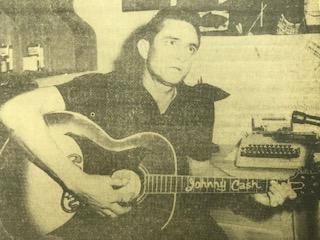
On May 10 next several hundred people will be crowding into New York’s famed Carnegie hall to listen to a tall, dark haired handsome young man from Ojai valley as he sings many of his songs that have led to his being called America’s Number One country singer.
That man will be Johnny Cash, a man less than ten years ago was totally unknown in the world of music, but who today has become recognizes as one of the country’s leading mail vocalists in the field of folk songs and religious hymns, as well as a top-notch composer.
Johnny Cash has lived for the year in a beautiful home located on a hillside overlooking the Ojai valley, above Casitas Springs. With him are his attractive wife, Vivian, and the couple’s four daughters, Rosanne, 6, Kathleen, 5, Cindy, 3 and Baby Tara, five months.
Johnny’s appearance at Carnegie Hall is a tribute to the 29-year-old singer’s excellent rendition over the past several years of songs that are typically American – songs that have their roots deep in the soil of the country’s past.
Most of the people in America today are well aware of Johnny’s musical performances. He composed and introduced such songs as “I Walk the Line”, which sold well over two million records; “Folsom Prison Blues”, which did almost as well; “Ballad of a Teen-Age Queen”, and a host of others. His religious albums have been instant hits. He has made many personal tours, both in this country and abroad. He has made many guest appearances on television and twice has been name America’s number one country singer. The list goes on and on.
In spite of such successes, however, Johnny Cash is not by any stretch of the imagination overly concerned with his own importance. He is a devoted family man, loves to hunt and fish; and beneath his quiet and composed mien one senses a deep reverence.
Johnny grew up on his parent’s 20-acre cotton farm in a rather remote area near Pine Bluff, Ark. (His parents now operate a trailer court near Casitas Springs.) It was not an easy life and Johnny can still recall vividly the days he spent behind a mule plowing the fields and the endless hours he spent picking cotton. With four boys and three girls in the family, and the pall of a depression over the land, there was never anything but three meals a day – and often that consisted only of beans and bread.
But it was during those days that Johnny started to sing – mainly to himself – and to make up songs as he did his chores. It was there, too, that he became thoroughly acquainted with folk songs – songs that had drifted down through the years from one person to another, without benefit of the published word.
Johnny’s break came in 1955 and for two reasons: first, of course, he had a natural talent that wished to express itself, and second, because he was about the worst salesman in the country.
Johnny had been married then just a short time – following a four-year hitch in the Air Force – and had taken a job as a salesman in San Antonio, Tex. His job was one of those door-to-door varieties and no matter how many doors he pounded on, no one seemed a bit interested in buying. He had to do something or face the dismal prospect of not having anything to eat for either himself or Vivian.
Armed with a song of his own composition entitled “Hey Porter”, he headed for Memphis, Tenn., and a newly formed recording company by the name of Sun Record company. He didn’t get much past the front door. But he didn’t give up. Several months later he came back and this time luckily, the owner, a gentleman by the name of Sam Phillips, was having a coffee break.
After considerable pleading on the part of Johnny, Sam condescended to listen to the song. He like it, later put it on wax, and Johnny had his start. Sun Records, by the way, had a pretty good start then with another lad – by the name of Elvis Presley.
For years now Johnny has had three musicians with him: a guitarist, a bass player and a drummer. They all have one thing in common with Johnny – none of them can read a note of music.
Not being able to read music has not hindered Johnny because things work out satisfactorily these days in reverse anyhow. Johnny can think up a melody and the lyrics that go with it while, for instance, puttering around his Ojai valley home. He then puts it down on tape in a small music room he has and the proper notes are put down on paper afterward.
When I visited Johnny this week he had just thought up a melody and most of the words for a song entitled “Lost on the Desert.” It was a sad but beautiful ballad – typical of the old folk songs that were sung over campfires years ago or on the front porch of a farm house in the still of a summer evening.
He is also working on a song concerning a disastrous flood; this one from memory of an event which occurred on that small cotton farm when he was a boy. Like he says, these songs just sort of “come to him.”
He will have the big opportunity on May 10 to show people just what he means.
CITY’S NEW REC DIRECTOR TAKES OVER HIS DUTIES
The following article first appeared on the front page of “THE OJAI VALLEY NEWS” on Thursday, February 23, 1961. It is reprinted here with their permission. The author is unknown.
CITY’S NEW REC DIRECTOR TAKES OVER HIS DUTIES
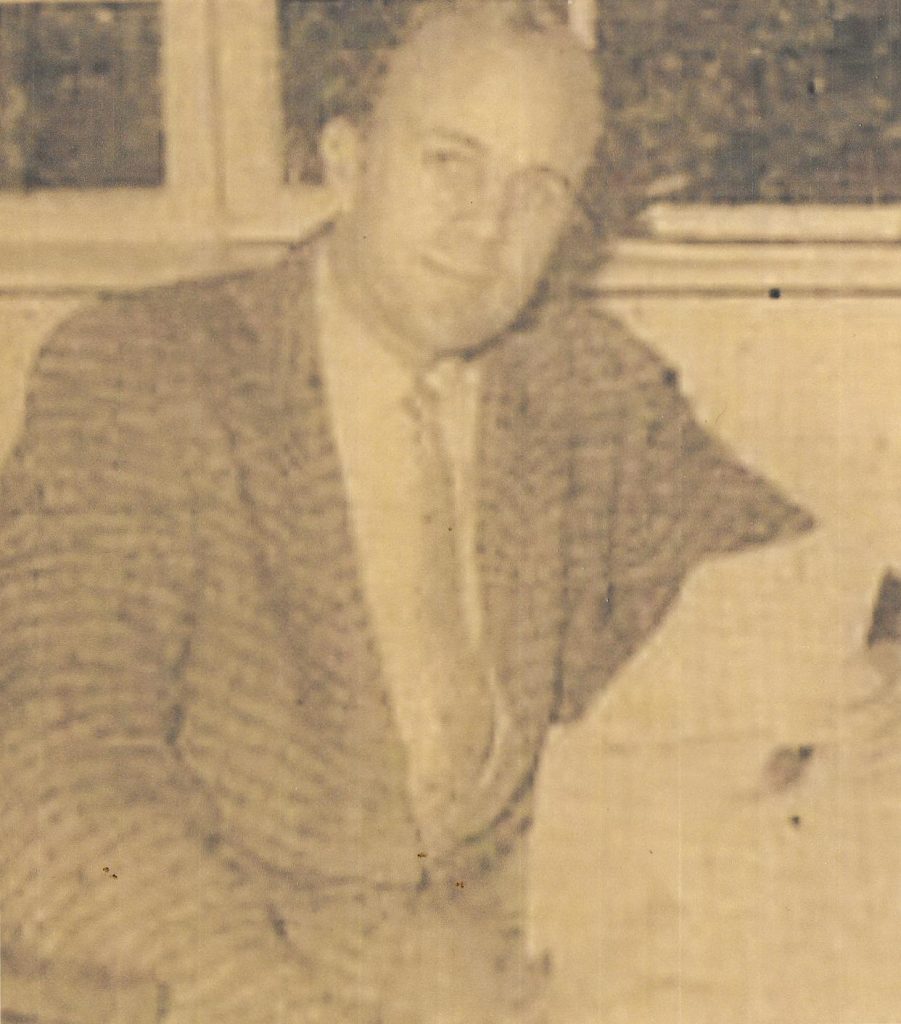
John Martin, Ojai’s new recreational director, is faced with the budget for the year plus many schedules of events.
Martin arrived in Ojai Monday from his home in Oceanside. He and his wife Carol, and their two year old daughter, Nancy, are living at 207 S. Fulton st.
The new director went to Ventura schools including Ventura junior college. He spent four years in the Navy following which he received his degree in recreation at San Jose State college.
In the throes of getting his feet wet in his new job he ran across Hoot Bennett whom he had known during his term of service, with the Navy. He also ran across an old friend, Bob Noren. He has high hopes of planning programs that will interest not only the youth of Ojai but also the adults.
MAJOR JOHN DRON WINS ROUND WITH PILLARS
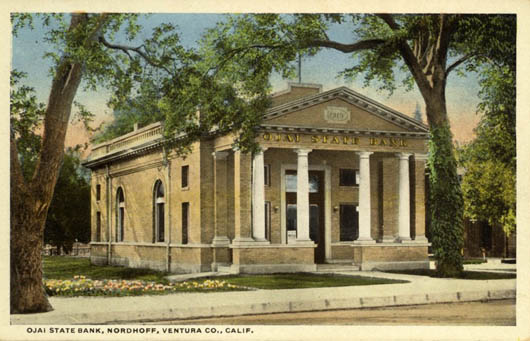
The following article was first printed on the front page of the Thursday, June 16, 1960 edition of “THE OJAI PRESS”. “THE OJAI PRESS” became part of the “OJAI VALLEY NEWS”. It is reprinted here with their permission. The author is unknown. The color photo of the “OJAI STATE BANK” was added to this article by the “Ojai Valley Museum”.
MAJOR JOHN DRON WINS ROUND WITH PILLARS
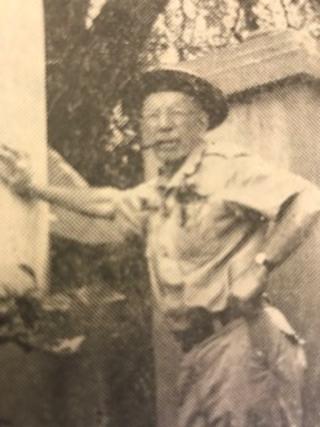
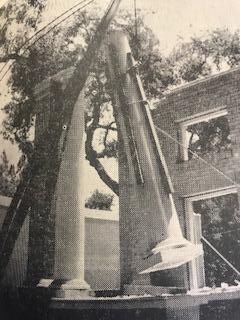
The Paul Bunyan of the Ojai has done it again! This time Major John Dron has been involved with a day long tussel with the one ton pillars which have long graced the front of the former Bank of America building in downtown Ojai.
Not letting board meetings, limbs of trees, or electrical wires stand in his way Major Dron personally hired the Chuck Major construction company in his “project save the pillars,” and overcame all obstacles, personally seeing the pillars safely stored by the garden gate before retiring to begin a scale drawing, showing the way his “Classic Doric” pillars, will grace the historic “Basic Baroque” Nordhoff Memorial fountain when he undertakes to move it block by block back to its original resting place, about, 30 feet inside the park.
His plan, subject to the approval of the Libbey estate Civic association board, headed by Charles T. Butler, includes the re-activating of the fountain, with water to spew from the lion’s mouth over the existing basin and into a pool of ferns, the pillars, to be covered by wisteria will form a pergola around the fountain. He hopes to persuade the Ojai Valley Garden club to continue to care for planters in the watering trough, or street side of the fountain.
Though he has underwritten the start of the project with his own funds, he hopes Ojai Valley residents will raise the required fund through subscriptions when the board approves the project. He reminds that donations to the historic seven acre park in the heart of Ojai, are “tax deductible.”
He called the moving of the one ton pillars “nothing” compared with the project moving the fountain yet to come. “The blocks will have to come out one by one, and be numbered, in order to put back together properly.”
Twelve Records Set At Matilija Meet
The following article was first printed in the Thursday, August 25, 1960 edition of “THE OJAI PRESS” on Page 7. “THE OJAI PRESS” became the “OJAI VALLEY NEWS.” It is reprinted here with their permission. The author is unknown.
Twelve Records Set At Matilija Meet
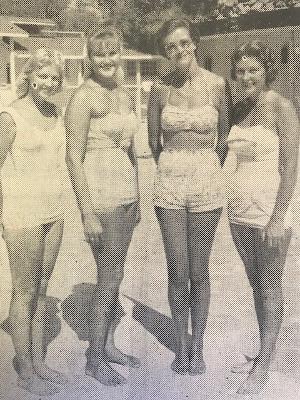
Twelve swimming records at the Matilija pool were broken during the third annual Ojai Valley swimming meet, Saturday at 11 a.m.
“A high level of excitement and enthusiasm were important in the times achieved,” according to Ojai’s director of parks and recreation Jerry Minford.
Matilija’s pool is seven feet longer than regulation, Minford explained, and the times are a little slower than they would be in a regulation pool, he added.
Typical of the records broken were the backstroke competition: girls, 10 years and under, Beverly Tyoison, 27.02; boys, 10 years and under, Craig Brown, 24.05; girls, 11 and 12 years, Roni Brown, 49.08; girls, 15 and 16 years, Sue Capune, 44.01. In the butterfly, 12 and under girls, Roni Brown, 20.02; boys 13 and 14 years, Billy Hayes, 48.04.
In the freestyle Robby Brown won the six year and under boys competition with a time of 8.01; girls, seven and eight years, Krissie Brown, 22.0; girls, 11 and 12 years, Susan Wendohl, 37.05; girls, 15 and 16, Sue Capune, 36.05.
Craig Brown took the top time in the ten year and under boys breast stroke with a time of 55.03; boys, 13 and 14, Billy Hayes; girls, 15 and 16 years, Sue Capune.
In the individual races, the swimmers were placed as follows: In the butterfly, girls 12 and under, first, Roni Brown, second, Mary Mahon, third, Mary Mahon. In the boys’ 13 and 14 year butterfly competition: first, Billy Hayes, second, Paul Booker. Boys, 15 and 16 years, first Don McIntosh, second, Bob Waggoner, third, Jack Morrison.
In the breaststroke: Girls, 10 years and under: first, Elizabeth Yunger, second, Krissie Brown, third, Carol Mahonm. Boys, 10 and under: first, Craig Brown, second, Steve Olson. Girls, 11 and 12 years: first, Mary Mahon, second, Barbara Yunger, third, Susan Lopez. Boys, 11 and 12 years: first, Kevin Yunger, second, Bobby Christianson. Girls, 13 and 14 years: first, Jan Farnsworth, second, Monica Michalski, third Monica Michalski. Boys, 13 and 14 years: first, Billy Hayes, second, Paul Booker. Girls, 15 and 16: first, Sue Capune, second, Bunny Brunette. Boys, 15 and 16: first, Tom Helm, second, Don McIntosh, third, Jack Morrison.
In the freestyle: Girls, six and under: first, Victoria Rogers, second, DeDe Wilson, third, JoAnn Ledford. Boys, six and under: first, Robbie Brown, second, Lanny Morrill, third, Johnathon Morrill. Girls, seven and eight years: first, Krissie Brown, second, Elizabeth Yunger, third, Susan Chess. Boys, seven and eight years: first, James Gamble, second, Henry Mahon, third, Jeff Norcott. Girls, nine and 10: first, Carol Mahon, second, Susan Bower, third, Anne Chess. Boys, nine and 10: first, Lance Farnsworth, second, Craig Brown, third, Jimmy Nelson. Girls, 11 and 12: first, Susan Wendohl, second, Roni Brown, third, Mary Mahon. Boys, 11 and 12: first, Bobby Christianson, second, Kevin Yunger, third, Charles Miller. Girls, 13 and 14: Monica Michalski, second, Michele Michalski, third, Jan Farnsworth. Boys, 13 and 14: first, Billy Hayes, second, Jimmy Christianson, third, Paul Booker. Girls, 15 and 16: first, Sue Capune, second, Bunny Brunette, third, Eileen Jacobs. Boys, 15 and 16: first, Kirk Spicer, second, Jack Morrison, third, Don McIntosh.
In the backstroke: Girls, 10 and under: first, Beverly Tyoison, second, Krissie Brown, third, Susan Bower. Boys, 10 and under: first, Craig Brown, second, Steven Olson, third, Lance Farnsworth. Girls, 11 and 12: first, Ronnie Brown, second, Mary Mahon, third, Barbara Yunger. Girls, 15 and 16: first, Sue Capune, second, Janice Noren, third, Eileen Jacobs. Boys, 13 and 14: first, Billy Hayes, second, Paul Booker, third, Thomas Mahon. Boys, 15 and 16: first, Jack Morrison, second, Don McIntosh, third, Kirk Spencer.
Maynard brings back memories
The following article first appeared in the Wednesday, January 9, 1985 edition of the “Ojai Valley News” on Page A-10. It is reprinted here with their permission.
ABOUT FOLKS IN OAK VIEW
Maynard brings back memories
by
Nancy Breese
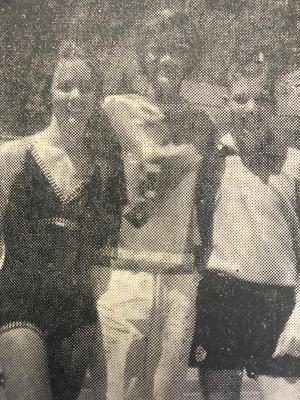
It will be a great get-together for a great cause Saturday, Jan. 19, at the Nordhoff High gym when popular jazz musician Maynard Ferguson is presented in concert, to help raise funds for the valley’s annual summertime gala — the Fourth of July celebration. Oak Viewians have always been very much a part of the day-long festivities. The Oak View Women’s Club, individual horseback riding groups, 4-H Clubs, Little League, Civic Council, and the Oak View Lions Club have, through the years, been caught up in the spirit of the day, and many local youngster and adult has added a page to his memory book from parade-day experiences. Marge Hatton was kind in providing the following “trips down Memory Lane.”
“Barbara Smith particularly recalls the year of the Bicentenial, 1976, when she was chairman of the prize-winning Oak View Women’s Club float “100 years of Womanhood.” Well over 1,000 tissue-paper flowers of red, white, and blue adorned the float. So you can imagine the chagrin of this energetic group including, among others, Lovell Willis (then president and now living in Visalia), Anne Gutierrez (still an exceptionally active member and officer) and Judy Dickens (now of Ojai) when the fog came rolling in late the night of July 3. The dyed paper in the flowers began to weep — and so did the participants. Smith, always ingenious when it comes to “saving the day” under pressure, remembered the giant parachute her family used for camping, located it, and covered the mammoth flower-covered canopy for the night. Needless to say, all turned out beautifully.
“THIS WAS by no means a first parade experience for Smith. In the mid-60s, her husband Mike enlisted her help in using his entire baseball team, on which her son, Mike, Jr. (Butch), was a player, and setting up a baseball diamond on their float, with a game in full swing. In 1970, daughter Wilma, now grown and still a valley resident, walked the Indian pony “Judo,” ridden by owner, daughter of Jim and Loretta Wagoner, who was 11 years old at the time. The girls not only walked the parade route, but also walked to and from their homes on Valley View — approximately eight miles each way!
“Oak Viewan Kathy Moore and Topa Topa 4-H Club leader Kathy Caywood really had their hands full getting kids and animals (including a tiny bottle-fed lamb of Merilee Sherman’s) organized at the parade grounds last year.
“With a giant wedding cake as a central point, a miniature “bride and groom” had a slight difference of opinion. No problem for four-year-old Brandi Azevedo, daughter of Rick and Linda Azevedo, who has been center-stage often as a frequent beauty contestant and winner. But five-year-old “groom” Brian Haley, son of Roger and Chris Haley, decided that darn “thing” was just too far up in the sky for him. Leaders and parade assistants, including Shari Skinner and Linda Warner, finally convinced him all would be well. It was, until the float started to move and Tamara Caywood, trying to retrieve an American flag that was taking off for the “wild blue yonder,” nearly tumbled off the tractor herself.
“The Old-Time Fiddlers’ Association, with cut-up Larry Shellnut, was a popular entry in the mid-70s with their fiddling and outhouse antics. Another popular group was the 3/4 Midget Racers with Rick Taylor and several other drivers from the California Motor Association. Local Shriner Milt Taylor and his wife Marge, who have a miniature antique car, have been in more parades than they can remember and could fill a book with happy anecdotes.
“THE PARADE grounds on Country Club Drive are a hub-bub of activity for hours before the parade. Two yeas ago, three-year-old Danny Jones, son of Randy and Jenice Jones, wore himself out (not really, Danny never wears himself out) running back and forth, trying to decide whether to ride with his mom on the Oaks fitness float (where there was lots of action), or on the Century 21 Little House float filled with youngsters three to eight years old. After being boosted innumerable times off the ground onto the Century 21 float, he decided that’s where he would stay. He did — until the parade was underway, and he THEN realized he should’ve located the outhouse when he was on the ground. 6’3″ Century 21 broker Bruce Hibberd came to the rescue and air-lifted Danny off and back on again.
“LAST YEAR the Jones’ rode together on an entry from their own Flexation Fitness Center. They are just one of the Oak View families who consider Ojai Valley’s Independence Day celebrations “the greatest.” They whole-heartedly support the Maynard Ferguson benefit concert — for two reasons, not the least of which is that they are avid fans of Ferguson.
“Tickets for the concert are available at the Fitness Center, 655 Monte Via St., and at the Century 21 offices in Oak View and Ojai. It’s an entertainment bargain at $6.50 per person. Newspaper editor Earl Reeves once stated, “A boom and a sparkling burst in the night sky may not make a whole lot of fiscal sense, but it does wonders for one’s morale and sense of tradition.”
“Oak View and the Ojai Valley’s morale is good, their sense of tradition intact. Indications are that locals will turn out in force to hear Maynard Ferguson an Jan. 19. It’s certainly an easy, enjoyable way to suppost a worthwhile cause.”
Thank you, Marge. I really appreciate your contribution! Have any news you’d like to share? Please call me at 649-9416.
Mixed emotions on what needs fixing at Nordhoff
The following article first appeared in the Sunday, February 19, 1978 edition of the “Ojai Valley News” on Page 4. It is reprinted here with their permission.
On Campus
Mixed emotions on what needs fixing at Nordhoff
by
Laurice Davis
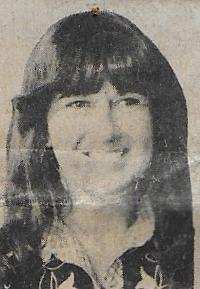
Recently the Ojai Unified School Board approved a rehabilitation of the Nordhoff swimming pool. This project will take more than a year to complete and will cost approximately $36,000. The pool was under-engineered when built, according to district business manager Ken Nielson, and the work to be done will bring the pool up to proper standards.
There seem to be many things that need improvement at the high school — the swimming pool is just the beginning of a long list. Whether or not the swimming pool project should top the list is a question that should include the input of the students who spend the most time at the school.
We questioned a number of students on whether they thought the money was well spent on the pool or whether they thought there were greater needs. Most agreed the pool was a much-needed project, but they also expressed hope the improvements will not stop there.
Do you think the $36,000 to rehabilitate the swimming pool will be well spent? If not, where would you spend the funds?
Mia Emhardt — “I’m happy to see that something is finally being done about the pool. The condition of the pool has been deteriorating rapidly and I think it is very wise to have it repaired. The pool is of great potential to the NHS curriculum.”
Jim Clement — “It’s an improvement that money is being spent, but I think it is for the wrong purpose. The parking lots need a lot of work and some classrooms, also.”
Cindy Jennings — “I think it is good that they are trying to rehabilitate at least part of the school. But the problem is, we need a lot more money to fix up the rest of it.”
Micah Martin — “I think spending the money on the pool is a good idea. There are other things that need improvement. They aren’t as important as the pool. It is one of the good things at NHS and I think they should try to keep it in good condition.”
Lionel Guiterrez — “I feel money should be used to improve the educational materials we don’t have.”
Donna Allsberry — “I think that it is a lot of money to spend to improve the pool area, but most money is granted to the major sports and I am glad that they are trying to improve the minor sports. The improvements don’t just benefit the kids going out for water polo, etc., because a lot of kids take swimming as their P.E. class.”
Jack Klassen — “It sounds like a good project to improve the pool, but it seems like a lot of money. That much money will go a long way to just improve a pool. Money should be spent to plant the dirt part on the bleachers. I would hate to see them wash away.”
Jeff McConnell — “I think they should get money to fix the parking lot. The gravel is ruining everyone’s paint job. The rest of the money left should be used to fix the pool.”
Mike Murray — “I think it is a great idea. I am a swimmer, and not all the times I swim is the heater working. Instead of using the school district’s money they should use their money for other things the school needs to have the people who really use the pool and want it fixed donate money and have fund raisers.”
Chris Clark — “I think it is a reasonable way to spend $36,000. The school needs lots of improvements. Who is to set the priorities on what needs the improvements? If you ask a swimmer he’ll say the pool, a runner, he’ll say the track. You have to start somewhere.”
Tammi Warner — “For $36,000 you could practically build a brand new pool!!”
Supervisors forecast county problems as water, growth, health and homeless
The following article first appeared in the WEDNESDAY, JANUARY 9, 1985 edition of the “OJAI VALLEY NEWS” on Page A-1. It is reprinted here with their permission.
Supervisors forecast county problems as water, growth, health and homeless
by
Star Smith
As is the wont of many in the first day of each new year, county supervisors Tuesday looked back on the accomplishments of the past, then peered into their crystal balls, trying to foretell the issues of the future.
THE CONSENSUS: growth, water, health care, and the homeless will be the major issues for the county in the next year or two.
The occasion for the government soul-searching was the swearing in of reelected supervisors Maggie Erickson, representing Ojai Valley, Camarillo, and Santa Paula/Fillmore; John Flynn, Oxnard and Port Hueneme; and Susan Lacey, Ventura.
All three won decisively their reelection bids in June, Erickson taking 64 percent of the District 3 vote; Lacey, nearly 80 percent in District 1; and Flynn, running unopposed in District 5. Tuesday’s ceremony before a packed house in the Government Center boardroom was primarily an upbeat occasion.
Newly chosen chair of the board, Ed Jones of Thousand Oaks, reflected on the years since 1978, when he had last been chair. In that year, Proposition 13 was approved by California voters, and it threw local governments into a belt-tightening turmoil.
But, Jones said Tuesday, Ventura County adapted to the public mandate, and has come through the toughest times, emerging into “a period of cautious optimism, or prudence.”
IN THE SIX years since Prop. 13, inflation has totaled about 70 percent, Jones said, but Ventura County has kept a tight rein on spending. In 1978, the county spent $406 per county resident; this year, that figure is $407 per capita, a miniscule increase, Jones said.
The county has also been conservative in the growth of its staff; while the ranks of county employees have grown, the percentage of county employees to county residents is actually down, he said.
But, Jones warned, local voters evidently are not completely satisfied. While Proposition 36, billed as the measure which would close Prop. 13 loopholes, was defeated statewide in November, it passed in Ventura, a sign Jones said, that the county must continue to “put our own house in order.”
One of the housekeeping chores the board will face in the coming years is planning and controlling growth, predicted Supervisor Erickson. The county will continue to grow, she said, forcing local government into a delicate balancing act. One the one hand, “industry will be coming in, homes will need to be built” to support industry, she said.
On the other hand, the county must “look at the environment,” she continued. “We must balance (the two sides)…so our children and grandchildren can enjoy” the benefits of both.
“We are blessed with natural resources: a beautiful coastline…the Los Padres mountains…oil…agricultural lands…How we use that trust is an issue the board will continue to face.”
The future looks rosier than the past, but it has not been cleaned of stumbling blocks, warned Supervisor Flynn, who reeled off a long list of issues the county will confront.
WATER WILL continue to be a burning issue for the county and the rest of Southern California, he said, but the northern half of the state will not be willing to share in a solution to the problem until the southern half takes some responsibility for its water usage and management. For Ventura County, that means continuing an aggressive conservation program and abating seawater intrusion into the Oxnard Plain aquifer, Flynn said.
The plight of the homeless “is becoming increasingly acute,” Flynn said, and it will be a county responsibility to solve or at least ease the problem locally.
The health care philosophy of the county may have to be re-thought, he said, adding that the county should think seriously about continuing to provide health care for the poor, but “move away from competition with private hospitals” for patients with means to pay.
The county also will have to wrestle with waning authority amid growing responsibility, Flynn said, as state and federal governments mandate more local programs but don’t always give control to local governments. For example, he said, solid waste disposal is a county responsibility, but the cities have the power to override county decisions on the issue.
Mashburn leaving Youth Employment Service
This article first appeared in the Wednesday, June 7, 1989 edition of the “Ojai Valley News” on Page A-3. It is reprinted here with their permission. The author is unknown.
Mashburn leaving Youth Employment Service
Arlou Mashburn, co-director of the Ojai Valley Youth Employment Service, is leaving the agency because of funding problems.
The problem came to a head earlier this week when it was learned the service’s funding request to the United Way for $18,000 would not be honored.
Instead, United Way decided to give the agency $9,500, the same as last year.
The employment service’s board of directors on Monday voted to accept Mashburn’s resignation as a cost-cutting measure. The resignation follows recommendations made by United Way.
Mashburn said her resignation is effective June 16 unless an unexpected funding source is found.
Mashburn has been with the service since the 1970s and was a longtime director.
She said one of her biggest fears is that the Ojai Valley residents may not be aware of the importance of the program to the community.
Mashburn said that not only do many young people need the money they earn on jobs provided through the agency, they need the work ethic and self esteem jobs provide.
Mashburn said she has no immediate plans for the future.
Her husband retired two years ago, but she would like to continue some form of work on a part time basis.
“I don’t think I can do for myself without doing for others,” she said.
Tim Sidoti, the other co-director of Youth Employment Service, will remain on the job.
The service makes some 1,400 job placements a year for the youth of the Ojai Valley. There is no charge to employers or job seekers for the service.
Sidoti said United Way’s low grant was unexpected.
Sidoti, who was hired in January to increase funding and recruit more young people and businesses, said he felt that the employment service has made several changes to comply with previous requests made by United Way, including the generation of funds and solicitation of help from individuals and local service organizations.
“We didn’t really expect the whole $18,000, but I really expected more than last year. I expected $12,000, or at least $10,000.”
According to Sidoti, since he took over, the agency has added five new board members, who either belong to local service organizations or are prominent business people. It has received funds from the Optimists Club and the Rotary Club and it is currently negotiating for funds from the city as well as the Lions Club. It also sent out 1,600 appeals to various businesses and private employers requesting donations.
In addition, the employment service also increased the hours it is open and has conducted a training workshop for youth on how to find work.
At Monday’s emergency meeting, the service’s board had four options — to operate with a full-time director but with no other paid staff, to have a part-time director and part-time job placement clerk, to have a part-time director with a part-time job placement clerk as needed or to close the agency’s doors.
Prior to the meeting, Sidoti had said any of the first three options would diminish the quality of service.
“Being the size of agency that we are, you have to have the personnel to put out a quality product,” he said. “I hate to use that term product, but when you are giving out that kind of expertise, it takes time and money. You just can’t do it half way. I just don’t feel it can be done half way.”
Women-of-the-Year give time, energy to help community
The following article was first printed in the WEDNESDAY, JANUARY 9, 1985 edition of the “OJAI VALLEY NEWS” on Page A-1. It is reprinted here with their permission.
Women-of-the-Year give time, energy to help community
by
Brenda Loree
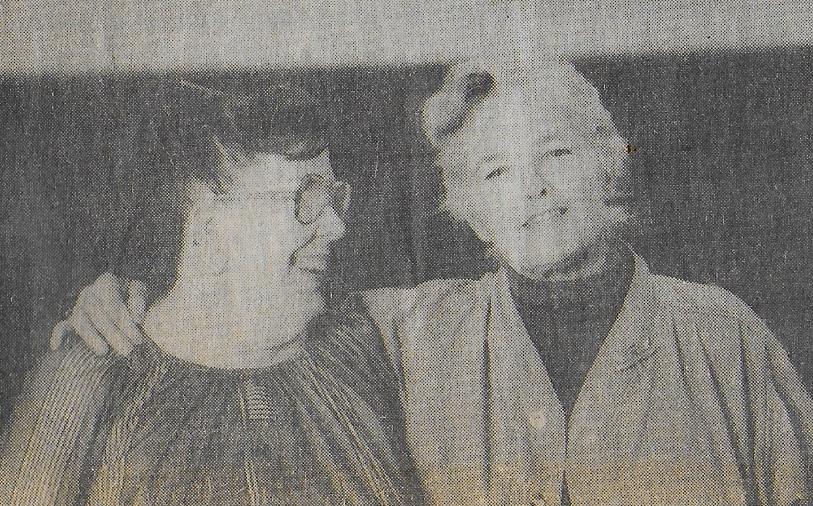
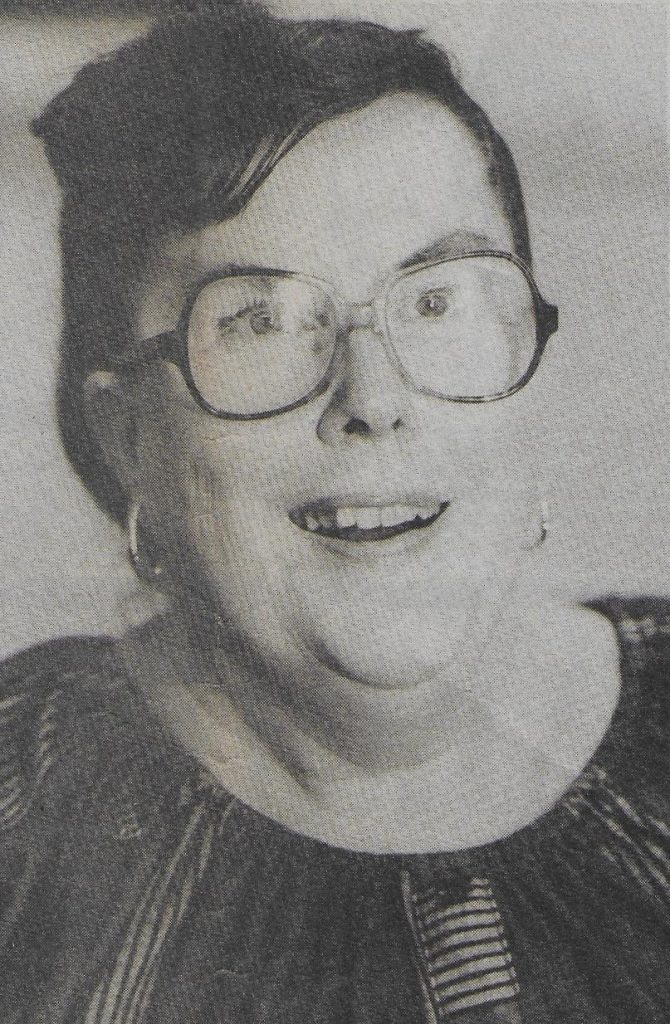
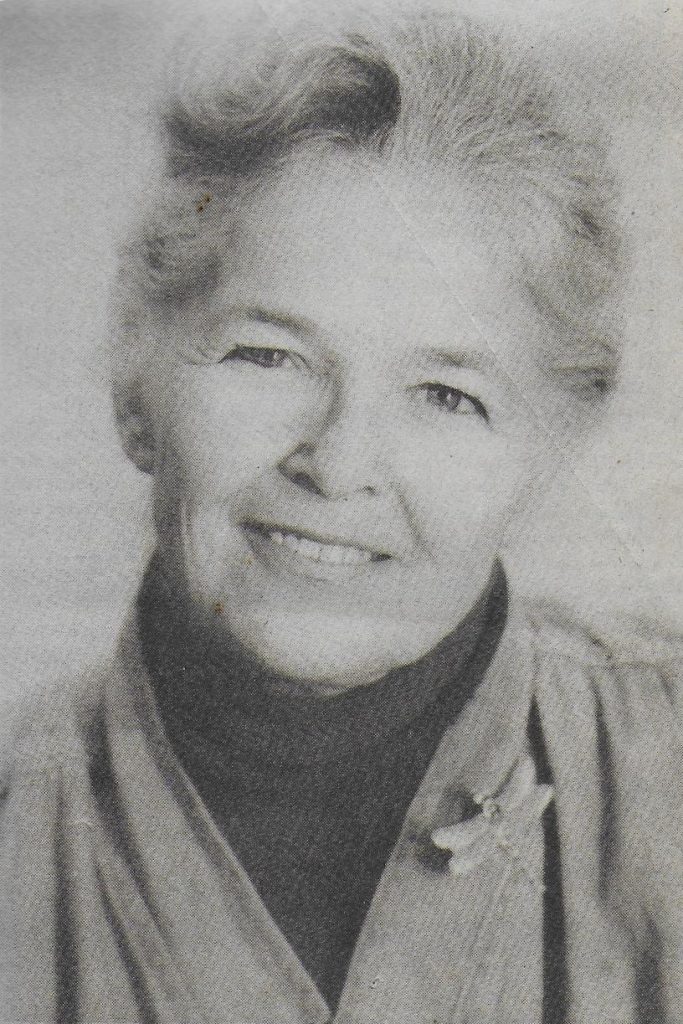
When the OVN news staff chose Arlou Mashburn and Carmen Robertson as its 1985 Women-of-the-year, it was without the knowledge that the two of them not only knew each other, but have been great friends for 24 years, and that, their lives have dovetailed and coincided many, many times since they met in 1961.
“When I moved to Ojai in 1961, Arlou lived across the street,” said Robertson. “The day after we moved in, the doorbell rang and there was this beautiful glossy head of hair with a coffeepot. It was her. It was my welcome to Ojai.”
AND WHEN THEY showed up for a picture-taking session together on Monday, throwing their arms over each other’s shoulders, assuming a buck and wing position and announcing themselves as “The Pit Sisters,” we weren’t sure but what they had misunderstood and thought they’d won the Ted Mack Amateur Hour.
Such high spirits are but symptomatic of high energy these two human dynamos possess. Rare is the person in Ojai Valley who hasn’t been cheered by, but more to the point, helped by, one or both of these women.
Neither stands on much ceremony. Neither holds formal office nor chairs important commissions. What they both have is heart, “miles and miles and miles of heart. “They are both such lobbyists for the Ojai Valley and its people that if they took their act to Washington, D.C., they’d be banned for undue influence.
Officially, Mashburn is the executive director of the Ojai Valley’s Youth Employment Service (YES). Officially, Robertson is the Ojai Valley representative of the Ventura County Arts Advisory Council.
IT’S WHAT THEY DO unofficially that singles them out. The two of them combined have probably driven their and everyone else’s kids in Ojai Valley enough miles on field trips to go around the world twice. They’ve both been unofficial sympathetic ears to enough teenagers (and their parents) in the valley to qualify for master’s degrees in family counseling.
Mashburn
One of Mashburn’s bosses, Ginny Barrett, member of the YES board of directors, said it best about Arlou: “She’s done so much more than what she’s paid to do, put in so many more hours, that she’s still our best volunteer.”
“When you see Arlou coming, you know you’re going to have a good time,” said the Ojai Valley native, can’t remember a time when she wasn’t working with youngsters on a volunteer basis. “Arlou and I were PTA nursery school volunteers, elementary school on up.”
Being mother of six and working almost exclusively with children on her job only makes her want to do more with youngsters.
“There aren’t enough people who like kids,” she said as she sat in her cubbyhole YES office on the grounds of Chaparral High School. “Hiam Ginott, my idol said you should give your child a way out. Don’t come down on them all the time. We’d never talk to adults the way we talk to our kids.
“I wish there was an outreach program here for the kids, something like Interface,” she mused between calls; calls from people wanting to hire someone and calls from kids wanting to be hired.
AFTER AN hour and a half of trying to squeeze an interview in between calls and visits from youngsters, it became obvious that Mashburn is her own “outreach program.” She serves as a personal counselor as much as a placement director on the job. Her manner is so disarming, so non-threatening, that monosyllabic teenagers walk in and find themselves pouring their hearts out to her.
“See how I love this job,” she beamed after effecting a particularly difficult job placement by phone, one in which everyone was happy. “Isn’t this great?”
“What I most hope to do here is maintain the reputation of Evy Foyil. She was here before me and it’s easy for me because of her example,” she said.
Mashburn will also be honored later this year when she leads the annual Independence Day parade down Ojai Avenue on the 4th of July as its Grand Marshall. Barely five feet tall, Mashburn will probably have to sit in a booster chair so her fans can see her in the back seat of the convertible. She won’t mind, because from her standpoint, it will mean she’ll have a better view of all of her friends.
Robertson
“She works for the good of the artists in this community,” said Carmen Robertson’s longtime friend Diane Volz. “She serves them; she brings the public to them. That’s her joy.”
ANYONE acquainted with Robertson has been buttonholed at one time or another to at- [missing words] there. She worked with the Presbyterian Church youth group and others.
In recent years she has worked as an aide at all levels of the Ojai school system, particularly with the special ed children. “I’m best as helping kids feel good about themselves,” she says. “If you say anything, say I stand for the dignity of children.”
Asked about her supreme accomplishment she said, “I was cleanup hitter for the Topa Topa Elementary School baseball team.”
ROBERTSON HAS very nearly lead two lives in one. Born and raised in Los Angeles, she became a child actress literally at the age of six months. For the next 26 years she worked for the likes of W.C. Fields, Bonita Granville, Jane Withers and appeared in “Our Gang” comedies. As she grew up she worked with Clark Gable, was a stand-in for Lana Turner and swam for two years in Esther Williams movies. “I spent two years under water. I also dived for Ginger Rogers. I was a good swimmer.”
Once she and her friend Diane Volz worked in the movie “Ziegfield Follies” together; they only realized it years later when they met in Ojai. Robertson was in the water and Volz was on the stage in a lavish “smoke-flame water ballet number.”
Then Robertson met and married yacht skipper Jack Robertson; they started a family and moved to Ventura County. The family grew to include Nick, Drew, Cullen, Winslow and Sydney, now all grown and all distinguished scholars in one way or another.
The day she started her family, she retired from the movie industry; the nurturing of her (and other people’s) children became her career. She and Jack resisted temptations to leave because “we wanted our family to have the Ojai way of life.”
“I came home when I came to Ojai. This is a mystical valley. I have a mystical streak and I feel better here than anyplace else.”