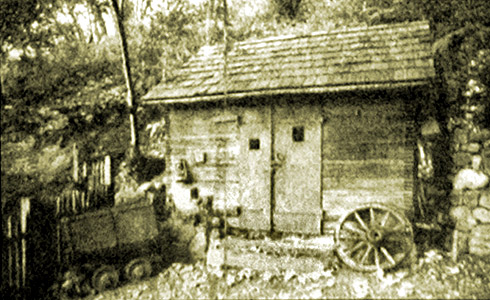
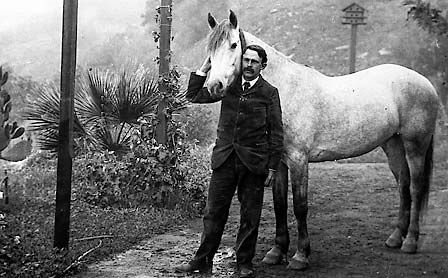
For those who needed to be incarcerated for some time, Andy Van Curen, long time constable in the Ojai Valley, provided lodging in a very small, home-made jail he had built himself on his own property. According to Edna Van Curen Miner, his daughter, the jail was built of 4 inch boards, one inch thick that were laid flat, one on top of the other, and then nailed through with iron spikes an inch apart. Says she: “It was a veritable fortress from which none could escape.”
There were two adjoining cells with an iron door for each, one cell capacity was 4, the other 7. A six inch square hole in each door provided a convenient opening for air and for providing a space for passing in small dishes of food. The jail was situated first close to Ojai Avenue, in front of what is now Loops Restaurant [now Carrow’s Restaurant]. Then it was moved under a tree back of the rear parking lot of the Security Pacific Bank building [now, Bank of America].
Andy Van Curen was Nordhoff’s constable for many years. In his later life, there was a movement among some of the citizens of Ojai to elect a younger and more active man to replace him as constable. Commenting on this situation in her memoirs of the period, Helen Baker Reynolds writes: “Andy was hurt and incensed. He let it be known that if he were replaced no one else could use his jail. The movement for replacement promptly collapsed.”
Years after its use was ended, the little jail was twice offered to the City with the suggestion that it be placed in the Civic Park, but the city was not interested.
Clara Koch who had become in possession of the Van Curen property gave the jail to Audrey Ovington of Santa Barbara, who engaged William J. Brakey, the famed “moving man” from Ventura to move it. Mr Brakey took it on a flatbed truck over the Casitas Pass, and deposited it at Cold Spring Tavern. There it stands today and may be seen by anyone interested.
Ed Wenig, Ojai’s home-made jail was escape-proof, Ojai Valley News, Nov. 19, 1969.
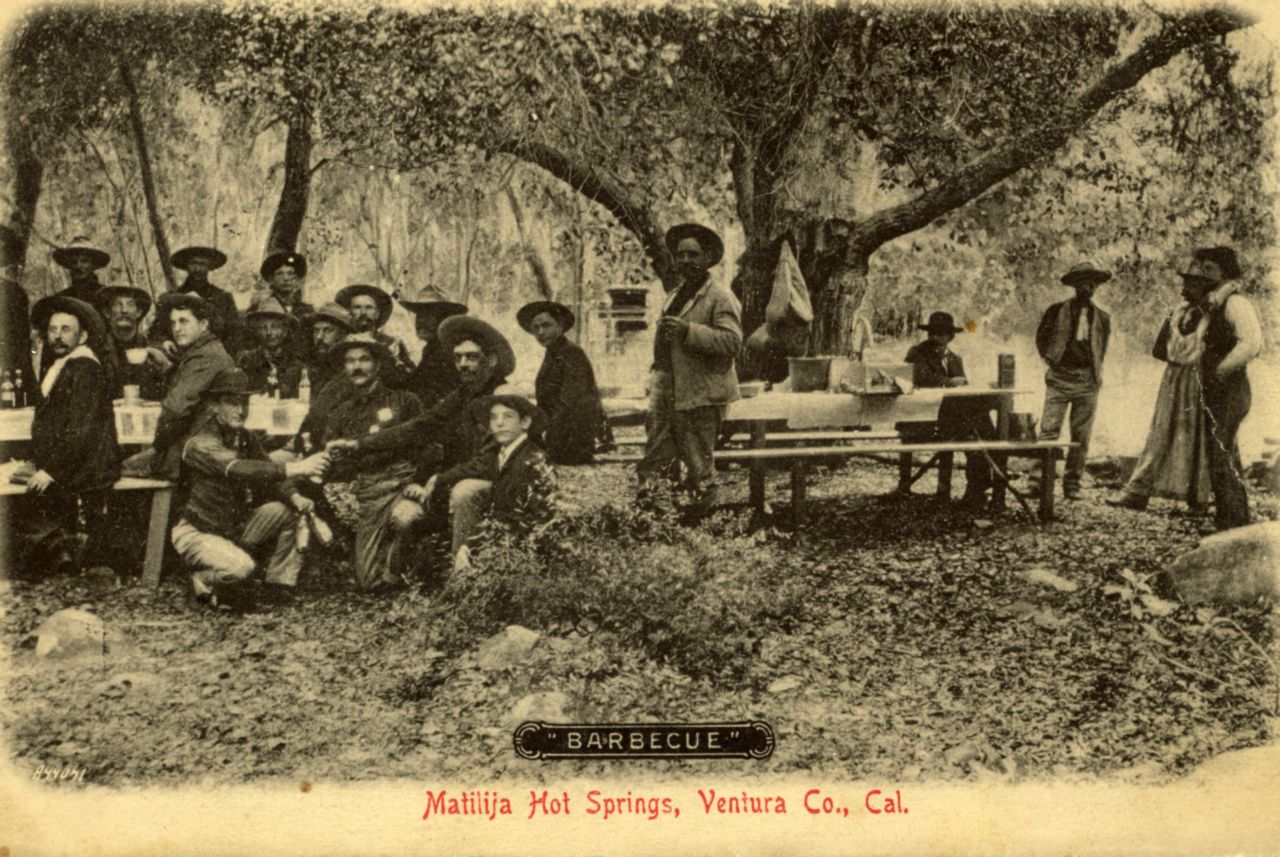
This is the annual gathering of the U.S. Forest Rangers, Santa Barbara Forest Reserve, at Matilija Hot Springs. Most of the rangers had districts in remote areas. Supervisor Willis M. Slosson held these gatherings once/year so that they could get together and exchange ideas.
Charles Nordhoff Visits the Ojai Valleyby Richard Hoye
The City of Ojai was first established as a village in 1874 and given the name Nordhoff. The village retained this name for 43 years, until it was changed to Ojai in 1917. Its original name was derived from the author, editor and journalist Charles Nordhoff, who lived from 1830 to 1901.
His name is still retained in the name of the high school, Nordhoff High School, and the name of the highest point on the ridge which forms the northern wall of the Ojai Valley, Nordhoff Peak. There is also a fountain at the center of the city which commemorates his daughter, Evelyn Hunter Nordhoff.
Charles Nordhoff is frequently confused with his grandson Charles Bernard Nordhoff, co-author of Mutiny on the Bounty; but they are of different generations. Charles Nordhoff was a well-established author in his own right. He wrote about a dozen books. His first books were about his early life as a seaman, and his Man-of-War Life (1855) was used at Annapolis as a standard reference for naval cadets. His most famous book was California for Health, Pleasure and Residence, published in June 1872. He was a deeply religious man, and one of his books was titled, God and the Future Life (1883). His Politics for Young Americans (1875) was used in public schools as a civics text.
Charles Nordhoff was a “correspondent” in Washington, D.C., for the New York Herald newspaper from 1874 until his retirement in 1890. The New York Herald was the foremost newspaper in the nation, comparable to the New York Times today. This was at a time when there was no Internet, no television and no radio. Newspapers were the principal method of mass communication. As a “correspondent” (we might say reporter/commentator) at the nation’s capital for the nation’s foremost newspaper, he was at the top of his profession and was well-known nationwide.
The following statement was included in an obituary written just after his death, which occurred in San Francisco on July 14, 1901:
“The town of Nordhoff was named for Charles Nordhoff, in appreciation of the good words spoken of the Ojai Valley as a health resort, both as a writer and in personal talks with friends.”
This is the common understanding as to how the village came to be named for the author, and it is an explanation that has been repeated many times over. Nonetheless, it is incorrect.
“Persons seeking to learn what Charles Nordhoff wrote about the Ojai Valley pick up his California for Health, Pleasure and Residence from a local library and search the book intensively only to discover that there is nothing in the work about the valley! This leads to perplexity and confusion! The book was published in 1872, and the village was named Nordhoff in 1874. . . . but, he had not written about it.”
The key to understanding what actually occurred rests in the fact that there was a subsequent edition of the work, published in 1882. The title page of the second edition stated that it was a “New Edition, Thoroughly Revised.” It is in the 1882 edition that information about the Ojai Valley is to be found. Unfortunately, it is also an edition that is less commonly shelved in public libraries.
Charles Nordhoff wrote about the Ojai Valley eight years after the village was given his name. So, it wasn’t his writing about the Valley that led to the use of his name. The suggestion for naming the village is attributed to Catherine Blumberg, wife of the man who constructed the first hotel in the center of the hamlet. She thought the use of Nordhoff’s name would be a good idea (better than the Topa Topa first considered). Nordhoff’s famous book about California had been published a couple of years earlier, and tourists were carrying it about as a reliable guide to the state.
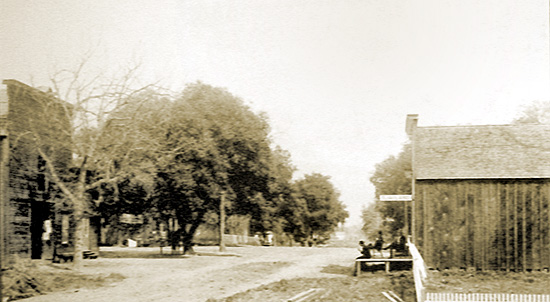
Main Street, Nordhoff, California in 1890
A two-volume biography of Thomas Bard was written by the author W.H. Hutchinson (Oil, Land and Politics: The California Career of Thomas Robert Bard) and published in 1965. Bard was the Valley’s first real estate agent; and he later became a member of the U.S. Senate, representing the State of California. Hutchinson included the following statement in his book:
“Without visiting the Ojai, he [Charles Nordhoff] penned some glowing prose about its salubrious climate and other advantages, and it is believed that he gleaned his material from Bard and Roys Surdam. His other periodical press articles and a book about his travels first gave national publicity to the southern coast and especially to Santa Barbara.”
If complete information had been available to Hutchinson, he would have reached a different conclusion.
Charles Nordhoff first visited the Ojai Valley for a quick, weekend turnaround on October 22-23, 1881. Here is part of a report from a Santa Barbara newspaper:
NORDHOFF AT NORDHOFF
The Ventura “Signal” says: Â “For the first time, on last Saturday, in company with D.W. Thompson and wife of Col. Hollister, of Santa Barbara. Charles Nordhoff, the celebrated newspaper correspondent, and the man to whom more than anyone else Southern California owes the greater portion of her population, visited Nordhoff and the Ojai Valley. Of course, he went into ecstacies over the beautiful valley.”
— Santa Barbara, The Daily Press, Oct. 31, 1881, p. 2:1.
Charles Nordhoff doesn’t seem to have been a man who would have been lost to “ecstacies”, even though the Valley does have this effect upon some. The visit was a momentous event. Here was William Hollister, owner of the Arlington Hotel in Santa Barbara, and Dixie Thompson, manager of the hotel, escorting Charles Nordhoff on his first visit to the valley. Hollister was a man of considerable wealth, after whom the town of Hollister was named in northern California. So, both Hollister and Nordhoff had towns named after them.
“Dixie Thompson was owner of a Ventura ranch which in time would be described as the largest lima-bean ranch in the world. His name is found today in Thompson Boulevard in Ventura. The news account omits the fact that Mrs. Charles Nordhoff was also a member of the party.”
We see, then, that Charles Nordhoff first visited the Ojai Valley in October 1881. The second edition of his book on California, and the edition with information about the Ojai Valley, was published in 1882. He saw the valley before he wrote about it, and Hutchinson was wrong in this particular.
Charles Nordhoff’s interest in the valley was friendly and supportive. He visited again in 1889 and 1894. He was a member of the building committee for his community church in Alpine, New Jersey; and when a decision was made to construct that church in stone rather than wood, the architectural design for the wooden church was sent to the Ojai Valley and used for the design and construction of the Valley’s Presbyterian church (which still stands). He (a Methodist) donated money for construction of the Presbyterian church and provided books for its “Sabbath School” (we would say Sunday School).
Charles Nordhoff also established an enduring friendship with Sherman Thacher, founder of the Thacher School in the Ojai Valley. Thacher hosted a reception in the Valley for Nordhoff in 1894. There is a record that Thacher later visited Nordhoff at Coronado, California, where Nordhoff had retired. Thacher was also among the last persons outside the immediate family who visited with Nordhoff in San Francisco shortly before Nordhoff’s death.
Meiners Oaks, a community where nearly every home is under a Live Oak tree, takes its name from John Meiners, who owned the large area for many years.
John Meiners, native of Germany, had come to the United States about 1848 and had established a successful brewery business in Milwaukee. He acquired his Ojai ranch in the seventies, sight unseen, as a result of an unpaid debt. When he heard that his friend, Edward D. Holton, a Milwaukee banker, was going to California for a brief trip, Meiners asked him to see the property he had acquired. Mr. Holton’s evaluation was, “It is the most beautiful valley I have ever seen.”
Upon investigating his new property, John Meiners found that he owned what was perhaps the largest oak grove on level land in Southern California, much of it so dense that the ground was in continuous shade. Furthermore, to his surprise, Meiners discovered that the climate of the valley was good for his asthma.
For a long time, the oak grove was fenced and provided a pasture for a large herd of hogs. All traffic from Ojai to Matilija went on a private road through the Meiners property, using a gate which was supposed to be kept closed. So many people went through the gate without closing it that in 1893, the manager of the ranch, P.W. Soper, locked the gate. With the Meiners road closed, the only way of getting the mail to Matilija by stagecoach was a roundabout one by Rice Road.
A news item in “The Ojai” related that, as Rice Road has been flooded, “the mail was sent up to Matilija last night on horseback, the rider going across the back hill country . . .” However, Mr. Soper later gave several keys to A.W. Blumberg, operator of Matilija Hot Springs, with the stipulation that they were to be used only by mail carriers and scheduled stage coach drivers.
In 1896, the big barn on the Meiners ranch, located approximately where the Ranch House Restaurant is now, caught fire one evening about midnight. No fire-fighting equipment was available. Twenty horses, many tons of hay, harness, and farm implements were completely destroyed. “The Ojai” of February 15, 1896 reported . . . “Mr. Meiners built a large temporary barn on Monday, and the work of the great ranch goes on energetically.”
The Milwaukee brewer lived on his ranch intermittently from the 1880s until his death in the valley in 1898. His original big house still stands on the hill above the Ranch House Restaurant and is now used by the Happy Valley School.
John Meiners organized his ever-increasing acreage into a very productive ranch. Several hundred acres to the north of the oak grove were planted in oranges, lemons, prunes, apricots and apples. P.W. Soper, father of the late “Pop” Soper, was general manager of the Meiners Ranch and lessee of 90 acres of Texas red oats, 90 acres of wheat and 200 acres of barley. A visitor who toured the ranch with Mr. Meiners in 1897 wrote, “At the Meiners Ranch we saw stalks of oats that measured 7 feet 7 inches.”
To visualize the vast area, the ranch can be described as bounded on the south by the hills of the Happy Valley School, on the west by Rice Road, on the north by the foothills near Cozy Dell Canyon and on the east by a line running through the junction of Highway 33 and El Roblar Street, north and south.
The forebears of several of the present-day residents of the Ojai Valley came here as a result of John Meiners’ interest in his ranch. The granddaughters of Edward D. Holton, who made the original favorable report concerning the ranch of Mr. Meiners and the Ojai Valley, are Misses Alice and Helen Robertson of the east valley, and his granddaughter, Mrs. Anson Thacher. Otto Busch came to the ranch as manager in 1907, and his son George Busch, now retired, was one of Ojai’s postmasters.
“He got Meiners O. for unpaid debt,” Ojai Valley News, Dec. 3, 1969
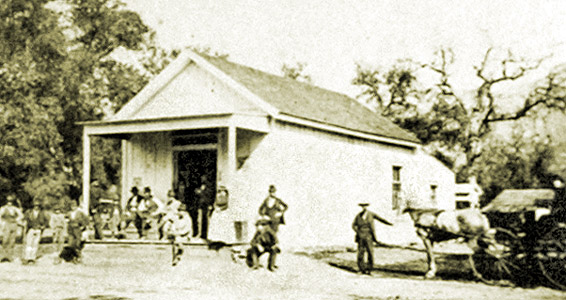
The first general store in Ojai Valley was opened by Mr. and Mrs. L.R. Herbert in 1874 on the north side of Ojai Avenue across from the present Civic Center Park [now, Libbey Park]. Ojai pioneers recall it as a small one-story building with one room that carried everything the early settlers needed.
Hattie Waite Cota, in an article on Ojai Valley’s first store, described the amazing variety of goods it displayed. She said: “The shelves were divided into sections in which goods were placed, each item in its respective department. There was a drug, a dry goods, a boot and shoe counter, and near the entrance a small glass showcase that contained, among other things, several varieties of candy, such as peppermint, horehound, gum drops, stick candy and licorice strips, very strong and very black.”
A cherished memory of Mrs. Cota: “Some time later a millinery section was added, stocked only with children’s hats. My choice was a broad-brimmed, plain-black straw [hat] with band and streamers of corn-colored ribbon.”
Mrs. Thad Timms read a paper before the Pioneer section of the Ojai Valley Woman’s Club in 1938 and is here quoted: “Prior to the year 1874, all incoming and outgoing mail was carried by some one of the residents of the valley who happened to be riding or driving to Ventura to the post office. On March 11, 1874, the Postmaster General in Washington, D.C. appointed LaFayette R. Herbert as the first postmaster of Nordhoff [now Ojai]—an office was established.”
The Nordhoff store, as with most general stores, had a little section in the front for the distribution of mail. This addition, of course, drew many into the store who, in winter especially, lingered around the wood-burning stove in the middle of the room. Here the cracker-barrel philosophers settled the problems of the world, lent their ears for local news and gossip.
Early settlers remember the blending aroma of cheese, coffee, spices, sausages and new leather. Of course, nothing was packaged, and the storekeeper measured the amount wanted from barrels, sacks and other volume containers.
Farmers, with their wagons hauling hams, chickens in small coops or with legs tied, cases or boxes of eggs, tied their horses to hitching racks or trees and proceeded to trade their produce for coal oil, flour, sugar, harness and other needs.
Barter between the farmer and the storekeeper was the general rule. This put an extra load on the Nordhoff storekeeper, who had to take all the farm produce to Ventura and bring back goods for sale. With dusty roads in summer and deep mud in winter, this was quite a burden for heavy-laden wagons.
Through the years the little store was sold to A.A. Garland and son. Later, Thomas Gilbert bought it. Finding that he needed help in the store, he sent for his bride-to-be from Michigan and announced publicly that he was going to be married. He invited all the residents of the valley to the wedding, which was held on the hotel grounds [at the front of what is now Libbey Park] with music furnished by the Ventura band. Some years later, the Thomas Gilbert family moved to Santa Barbara.
A Mr. Brown and his wife then took over the store for a brief period, but Frank P. Barrows bought it and changed it to a hardware store. Finally, Mr. G.H. Hickey and two brothers bought it and rebuilt it. The Rains Department Store, now operating on the same site, is a successor to Hickey Brothers and is operated by Alan Rains, grandson of Mr. G.H. Hickey.
“Everything sold in Ojai’s first store,”Ojai Valley News, Nov. 5, 1969
Richard Robinson was an early rancher in the valley, and he first came to the valley after retiring as a ship’s captain. The romantic story of his life at sea is accented by the fact that his wife often accompanied him on his voyages.
Richard Robinson was born in Thomaston, Maine, in 1817, and he was of Welsh extraction. He began his life at sea at age seventeen. His advancement was rapid, and he captained his first ship at age twenty-three in 1840. For the next fourteen years, he captained ships that bore names such as Mountaineer, Pyramid and Hardet. These were “Yankee Clippers” engaged in ocean-crossing commerce.
Robinson pooled his resources in 1855 with several other men to commission construction of a 200-foot long clipper ship, christened the Richard Robinson. It was the custom of captains of the clipper ships to race each other, since the winning of a race provided profitable publicity. This was the way that sea captains built their reputations, and “Virtually every passage from one port to another was a race.” Robinson won a race against the formidable Dreadnought and thereby established his ship as “one of America’s fastest ships.”
Voyages could be lengthy. One of his voyages from New York City to Bombay took eighty-eight days, and that was close to breaking the speed record for the route. Ships’ captains were inclined to take their families with them on such long trips, and such was the case with Richard Robinson. He wed Mary Wentworth in 1840, the very year he first became a ship’s captain. She was a woman fit to match him.
Mary Wentworth Robinson was the first woman to receive the degree of Doctor of Education from Harvard University. She was descended from an aristocratic English line, which included Sir Thomas Wentworth, the Earl of Stafford. She accompanied her husband on over thirty voyages. Three sons were born to the marriage: William, Richard and Charles. Two daughters died in infancy.
Robinson retired from the sea in 1872 and moved to Santa Barbara. In the following year, he purchased land in the upper Ojai Valley and began to farm. By 1875, he joined Judge Eugene Fawcett, Jr., and a wealthy eastern man, H.C. Dean, in the purchase of land from Jose Arnaz (land which now is largely covered by the northern half of Lake Casitas). They subdivided the land and started the development of ranches in the Santa Ana Valley.
Richard Robinson signed the voters registration roll for Ventura County in 1884 along with his sons Richard Owen Robinson and Charles Wentworth Robinson. All three stated that their birthplaces had been in Maine.
Robinson’s approach to farming was diversification. He planted many different varieties of trees and vegetables on his upper Ojai Valley ranch. By doing this, he introduced new agricultural products to the valley, and his farm was judged by his contemporaries as especially interesting for its variety.
He also tried his hand at breeding race horses. He was photographed in 1896 with a race horse and sulky. In his final years, he lived in Ventura, where he died on February 6, 1896.
For an excellent account of Richard Robinson’s life, see: Marsha Kee Robinson Strong, “The Yankee Clipper Richard Robinson,” Ventura County Historical Society Quarterly 27:1, Fall 1981, pp. 11-25.
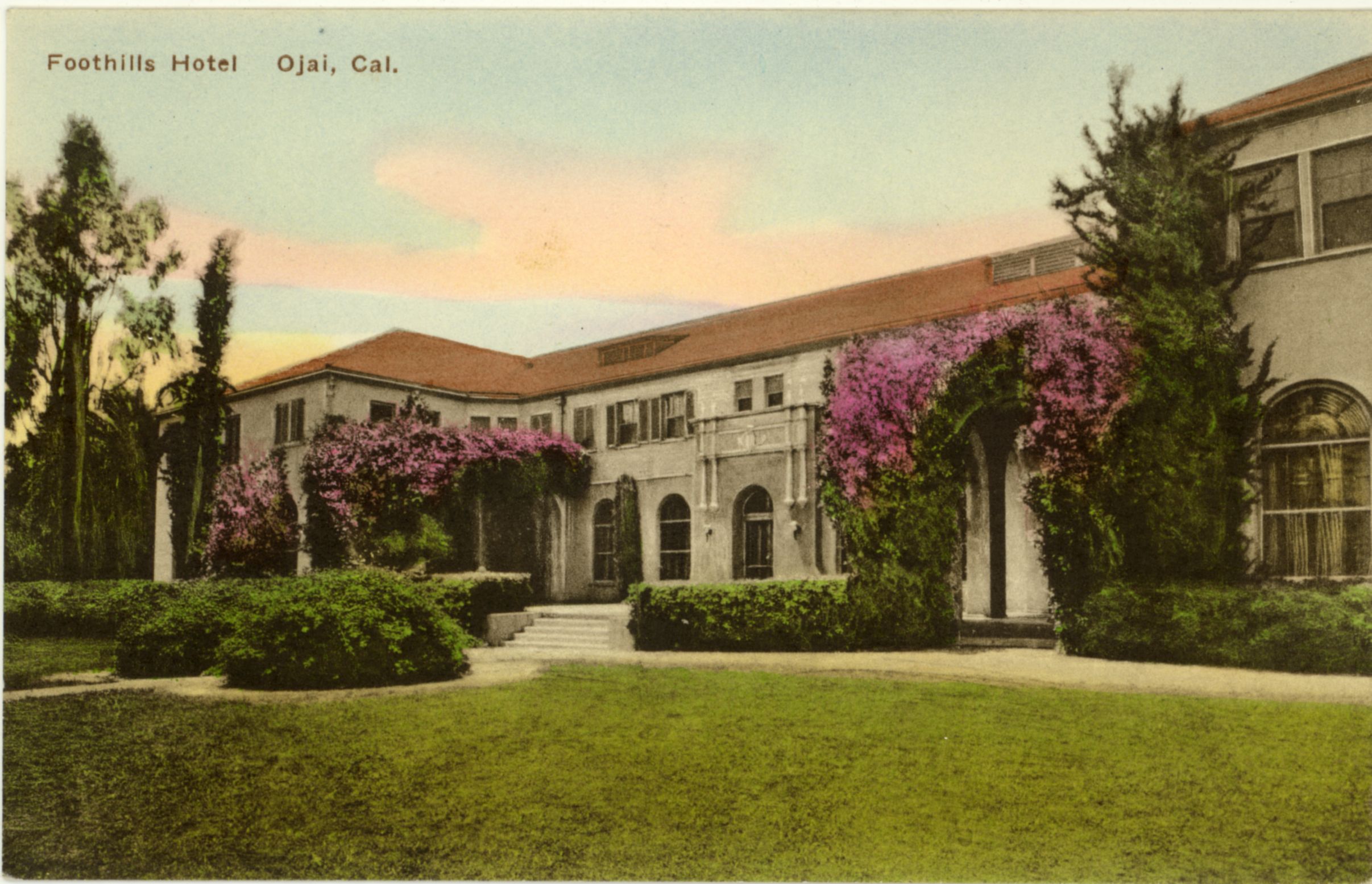
The Frost-Coolidge Music Festival. Although the Foothills Hotel catered to wealthy Easterners, Ojai residents often benefitted from the cultural and social events held there. A good example was the Frost-Coolidge Music Festival of 1926. Elizabeth Sprague Coolidge, who had a winter home in Ojai, was one of America’s foremost promoters of chamber music. She teamed up in 1926 with another Ojai resident, Frank Frost, to create a three-day chamber music festival at the Foothills Hotel. Two-thirds of the audience was Ojai residents. When the festival concluded, The Ojai proclaimed, “One of the greatest musical events that has ever taken place in America came to a close on Sunday evening with the final concert of the Ojai Musical Festival.” Many consider the Frost-Coolidge Music Festival to be the forerunner of the current Ojai Music Festival.
The above is an excerpt from Ojai: A Postcard History, by Richard Hoye, Tom Moore, Craig Walker, and available at Ojai Valley Museum or at Amazon.com.
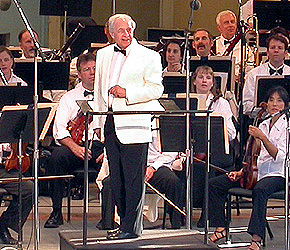
“Baton Not Tuned To Train’s Wail” Ojai Valley News, June 3, 1989 By Bob Bryan
Pierre Boulez (C) 2003 Daly Road Graphics
The year was 1967, and the Ventura-Ojai orange train—locomotive, one freight car and a caboose—was coming ’round the bend making less than 90 miles an hour when its whistle broke into a deep-throated blast. It was a familiar sound, even appreciated by some as it floated up the Ojai Valley. There, Maestro Pierre Boulez, standing on the podium with baton raised, prepared to give the downbeat that would begin that year’s Ojai Festival.
The opening number was listed as the Schoenberg String Quartet No. 2, arranged for string orchestra; its harmonics, according to the program notes, would be “unconventional, even irrational.” Nobody had said anything about a whistle.
When train whistle and raised baton coincided for the third time, Maestro Boulez walked off stage with just a touch of Gallic impatience. He was replaced, after a hurried conference backstage, by Ted Lillefelt, that year’s festival president.
An apology was offered and a question posed to the assembled music lovers: Would it not be better if the opening number of the Ojai Festival 1967 were delayed until such time as the orange train could continue on to Ojai’s packinghouse, as it was required to do daily? There it would reverse itself and come through town again, passing once more to the rear of the Festivals Bowl.
The first-night audience clapped its approval.
About 10 minutes later the orange train passed through once again, hooting jubilantly as if wishing well to the proceedings. There was an answering applause from the audience, and then everybody settled down to give Schoenberg his turn.
Open-air concerts in Ojai’s Festival Bowl have included the gentle ostinato of resident crickets and birds, a feature that Oliver Messiaen, a composer who has written music in honor of birds, found to his liking during his tenure as resident composer of the Ojai Festival.
The birds still sing, but some things that once were are no longer. There will be no freight train whistle this weekend in Ojai for Maestro Boulez or, for that matter, any future conductor of the festival. The orange train doesn’t run here anymore.
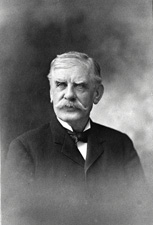
Sharp & Savvy: Thomas R. Bard (1841 – 1915) by David Mason
Thomas Bard
Mr. Bard arrived in Southern California in 1865. He was sent to this area as a representative of Thomas Scott, acting Assistant Secretary of War under President Lincoln and he was also president of the Pennsylvania Railroad. Mr. Scott’s responsibilities in the east made it impossible for him to oversee his land holdings in the west. Thomas Bard was sent to the area to manage the 350,000 acres that Mr. Scott owned.
While taking care of Mr. Scott’s property in the Ojai Valley, Mr. Bard quickly became a pioneer in the development of oil fields. He was living in a charming Swiss chalet that Mr. Scott had built for him near Sulphur Mountain, one-quarter mile from the Arnaz adobe.
Mr. Bard was also here to drill for oil, which he did with very little success. When he did find oil, it was not of a good grade, so it was decided that any fortune would have to be made in the sale of land.
It then became the responsibility of Mr. Bard to subdivide the Ojai Valley for Mr. Scott. The land was sold in small parcels and large ranches.
In 1868 Thomas Bard was elected supervisor for the county of Santa Barbara and was instrumental in forming the county of Ventura in 1873, which had originally been part of Santa Barbara County.
Mr. Bard had a varied political career that influenced much of the development of the west, including agriculture, ranching and railroading. In 1872, he partnered with Royce G. Surdam to purchase 1,400 sheep to graze on his land in the Ojai Valley.
In 1900, the Republicans backed him for U.S. Senator. In those days, senators were selected, not by the people, but by the state Legislature. Mr. Bard was selected and served a six year term. There had never been a senator from Ventura County and the excitement caused the county to celebrate with bands, cannons booming and church bells ringing.
Thomas Bard was a remarkable man, quiet and direct, his influence reached far and wide, even to the construction of the Panama Canal. His faith in what he was doing set an outstanding example for all of Ventura County. Mr. Bard died in his final home: “Berylwood” in the town of Port Hueneme, which he had founded.
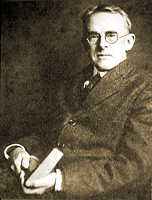
Sharp & Savvy: Sherman Day Thacher (1861 – 1931) by David Mason
Sherman D. Thacher
It was in 1888 that Sherman Thacher took up a homestead claim of 160 acres in the Ojai Valley. At first he thought he might teach as a side line which would furnish him some means of livelihood.
The idea of a school was gradually developed and the first pupil came to the “Casa de Piedra” ranch in 1889, and while being educated by Mr. Thacher, he was given the opportunity to develop a wholesome outdoor life.
Mr. Thacher’s original plan was not to remain in the valley, but to stay only temporarily, then journey on to destinations unknown. As fate would have it, the beauty and charm of the valley grew on him. He soon noticed that the outdoor life agreed with him and he saw success ahead which spurred him on.
His teaching began with the one pupil from the east and eventually, more came. Sundays, holidays and off school hours were devoted to improving his property. He even built a house with his brother’s help.
His brother, William, was also involved in civic activities and was responsible for founding the famous tennis tournaments held annually in Ojai.
With the addition of more pupils the ranch soon developed into a full time school. More suitable buildings were added year after year.
Mr. Thacher was certainly well qualified to run a school, he had graduated from the Yale University in 1883, in 1884 entered the law department of Yale University, graduating in 1886. He practiced law in Kansas City, Missouri, and in 1887 came to the town of Nordhoff in the Ojai Valley.
In 1896, he married Eliza Seely Blake, a native of San Francisco who was a graduate of the University of California in 1895. They would become the parents of six children.
Mr. Thacher served as headmaster of the school until his retirement in June, 1931. He had been associated with the scholarly and cultured life from his early childhood.
He was a kind and generous man and a valley leader. Along with his school he had been; president of the board of trustees of Nordhoff High School from 1908 until 1922, trustee of the San Antonio school district from 1898 until 1912. He was a member of the Ojai Valley Men’s League from 1910 until 1920, director of the Ojai Civic Association, and a member of the Ojai Valley Presbyterian Church since 1887. Mr. Thacher worked closely with his friend Edward D. Libbey, to change the entire face of the downtown of Ojai.
He was the paternal great-grandson of Roger Sherman who was born in 1721 and best recognized as one of the founding fathers who helped draft and sign the Declaration of Independence and laid the foundation for our current-day Treasury Department.
Many men prominent in business and the professions, not only in California but
Sherman Thacher
throughout the world, acknowledge their debt to the Thacher School for a wholesome education that has been an opening to the resources of a broad and fundamental life.
Before his death in 1931, his devotion to the valley that he loved was without thought of personal gain, he created a school of high scholastic standing, a lasting monument so recognized by educators of renown to be one of the finest schools to ever serve the students that arrive yearly from all parts of the world.