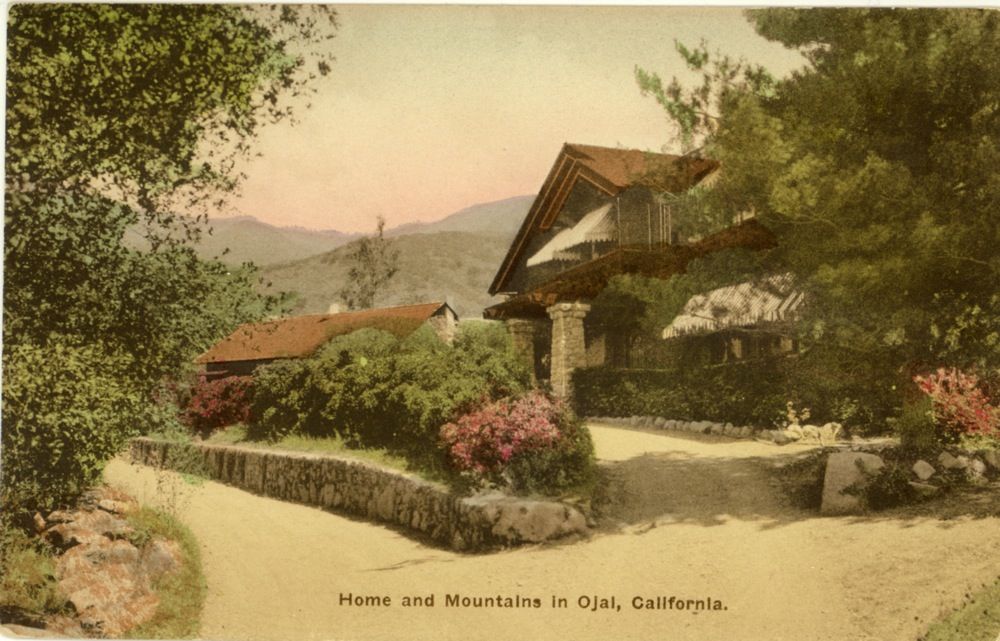
Krishnamurti at the Oak Grove. When Jiddu Krishnamurti first arrived in Ojai during the summer of 1922, he was already the leader of his own worldwide religious organization, the Order of the Star. During his 1922-23 visit, he spoke at the Hollywood Bowl to an audience of over 16,000 followers. In 1924 he began giving talks in Ojai at the Oak Grove (above), which continued until his death in 1986. Krishnamurti established his Ojai home at Arya Vihara (below), making Ojai one of four worldwide centers for his teachings. He held many discussions and private interviews at Arya Vihara. Among those who visited Krishnamurti here were Annie Besant, Charlie Chaplin, Aldous Huxley, Jonas Salk, John Lennon, Greta Garbo, Igor Stravinsky, D.H. Lawrence, and David Bohm.
The above is an excerpt from Ojai: A Postcard History, by Richard Hoye, Tom Moore, Craig Walker, and available at Ojai Valley Museum or at Amazon.com.
The Pierpont-Ginn House. After the death of her husband in 1905, Josephine Pierpont married the San Francisco publisher Frederick Ginn. She commissioned the famous California architect Julia Morgan to design a house for her in 1908, shown in this picture, one of Julia Morgan’s first residential works. The family’s first home then became the main house for Pierpont Cottages.
Note: This was one of Julia Morgan’s first residences. She is best known for designing Hearst Castle in San Simeon.
The above is an excerpt from Ojai: A Postcard History, by Richard Hoye, Tom Moore, Craig Walker, and available at Ojai Valley Museum or at Amazon.com.
Discord Comes to the Ojai Valleyby John Montgomery
[Note: John Montgomery was one of Ojai’s first settlers. He arrived in Ojai in 1874. He lived in the large, two-story wooden house that still stands on Matilija Street, next to Theater 150. Montgomery Street is named after him.]
From the year 1873 to 1879 we were a harmonious and model community, living in peace and good fellowship, with no offensive inequalities of fortune or education. Upper and Lower Valley, East End and West End mingled on equal footing at our picnics, May Day parties, and Christmas trees. Our population continued increasing, and the newcomers were welcomed to our festivities. Those were happy days for our children who knew no strifes but a generous emulation at school; many of them are now fathers and mothers residing in the valley, some have left to return, and a few have gone never to visit us again.
The brick schoolhouse served as Nordhoff's church until 1882.
Our little brick school house sheltered on Sundays members of all churches and creed, and many were ignorant and indifferent as to the pastor’s sect or denomination, enough that he preached good will and the golden rule to all men. The stentorian voice of our village blacksmith led the choir at service, and, admitting that he did sing out of tune a half note on either side of the scale was a trifle in those days to the neighborly ear of charity, and was compensated by the fervor of his good intentions.
For years we were content to ride in our farm and spring wagons, and our cottage organs were the pride of the parlor and had the choice location among the furniture.
But this Arcadian felicity was not to last forever, and the demon of discord was biding his time to entrap us. First, a top buggy came into the Valley and the wagon fell fifty points. Then Mrs. _____ introduced with her two accomplished daughters, a seven octave Steinway grand, and the organ trade disorganized to a collapse. Later, a reading club was got up in the village, having a clause to avoid crowding, that members must reside in Nordhoff. This was equal to slamming the door in people’s faces, and the epithets “stuck up” and “high-toned,” were hurled back in retributive ejaculations.
The fact is, people were soured. The year 1877 was a dry one, and 1875 was the disastrous “rust” year, and two bad years in succession made people “long” on expense and “short” on resources. The hotels were crowded with stylish eastern tourists who introduced new and expensive notions, sneered at our music and church service, and reproached us on our want of a decent church. The two hotels, though miles apart, glared at each other in envious rivalry. [The Nordhoff Hotel was located where the Libbey fountain is now; Oak Glen Cottages were located on the corner of Ojai Avenue and Gridley.] The guests and others at the Nordhoff Hotel raised a subscription to build a church, and the whole Valley joined in the contribution; trustees were chosen and the association incorporated, and all went harmoniously till the question of the church site came up. Then the storm burst. Nordhoff people insisted on having the church in their town, while the outsiders were equally determined to have it up their way, and complete rupture took place between Nordhoff and its opponents; and the village, strong in the justice of its course, put on its war trappings and defied the world.
The Upper Valley to a man joined the eastern seceeders. The two hotels were the
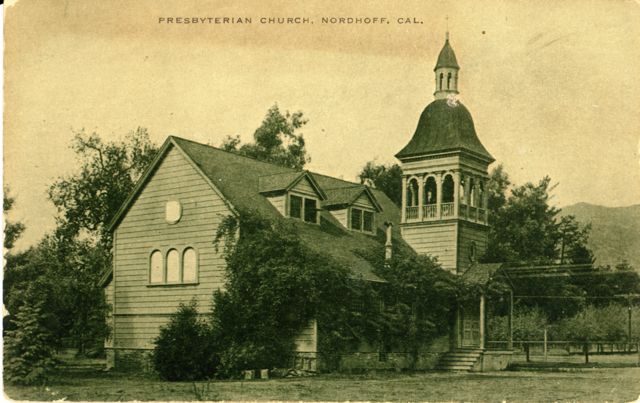
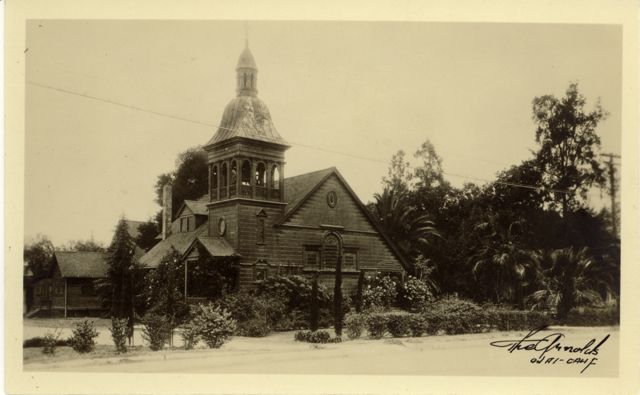
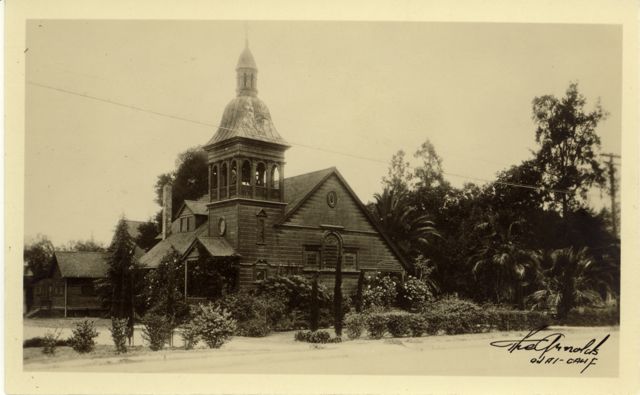
Ojai Presbyterian Church (1882) by J. Cleveland Cady
nucleus of the hostile forces. The good pastor was drawn into the vortex of dissension, and losing his equilibrium, recklessly declared for the Wild West, and was thrown overboard by the “Orientals” as a second Jonah. Then suddenly somebody discovered that the minister was not a Baptist, and another that he was not a Methodist; while some of the older members had their doubts that he ever was sound on Calvanism. But the difficulty deciding on a church site had to be overcome one way or another; and the trustees, amid the din of battle, resolved, four to one, that the proper place for the Presbyterian church was where it now stands, in the center of the community and accessible to all [where Ojai fire station is now located]. Nordhoff was furious, the more so that one of its trustees had gone back on it, voting with the majority; and this culprit has survived the crisis to indite to The
The two churches united.
Recurrent these “Annals of the ‘parish’.” But the plucky town kept its back up, and when Mr. S.S. Smith of San Francisco, generously contributed $500 toward building a chapel, Nordhoff immediately made up the difference and never rested till the last coat of paint was on the walls and a sonorous bell in the steeple [this second church was built where the Ojai Library is now located in downtown Ojai].
After this little blizzard the social atmosphere cleared up; Christian charity that for a time had not a leg to stand on, now threw away its crutches, and asserted its supremacy, softening men’s hearts and extending the right hand of fellowship. But never again will the valley enjoy the primitive simplicity of its earlier years, when it was a model community, realizing the dream of a Roussen or a Tolsten.
Note: When Mr. and Mrs. Charles Nordhoff visited the Ojai Valley in 1881, Mrs.
Ojai Historic Landmark #1 - Ojai's First Church
Nordhoff decided the community should have a proper church. She sent plans for a church along with the money to build it. It was constructed on the Soule property, where the fire station now stands. Those living in the town of Nordhoff defected and built their own Congregational Church where the Ojai Library is located. In 1900 the two congregations reunited and their churches were moved to the same lot-the parking lot in front of Jersey Mike’s. The original Presbyterian Church served as the church, and the Congregational Church was used for Sunday school classes and offices. When the current Presbyterian Church was built on Foothill Road, the old Presbyterian Church was sold to the Nazarenes and moved to the corner of Montgomery Street and Aliso Street. It is now a center for author Byron Katie and is Ojai Historic Landmark #1.]
Note: Howard Bald was an early Ojai resident. His reminiscences were written in the early 1970s.
The Ojai Valley in those days was a popular winter resort for wealthy eastern people who would come out for the winter.
Other than playing tennis and cards, about the only entertainment was horseback riding, and for the elder people, a team and surrey with a driver would trot them about the valley, up Matilija Canyon (the road ended at Wheeler’s Hot Springs) up through the Upper Ojai valley and onto Sulphur mountain, or over to Shepherds Inn via Casitas Pass and sometimes on to Santa Barbara. Shepherd’s Inn, situated on the line between Santa Barbara and Ventura County was a popular, rustic inn frequented by both Santa Barbara and Ojai tourists.
The Casitas Pass was approached only via what is now Foster Park, and the road followed along the foot of the north side of Red mountain. But the east and west passes were virtually the same as of today. One popular ride was to follow the beach from the Rincon to Ventura when the tide was low. I believe it was sometimes done with team and wagon. I did it only on saddle horse.
The livery stable was not only the site of horse trading and training, but also some lively prize fights were held there, sometimes right out on the street and sometimes in the stable. When held inside buggies would be crammed into a corner to make room for the spectators. Some of the younger fry had their first lessons in boxing there.
I well remember one time when the men had Mayor Smith and me matched together. We were fairly evenly matched and things were going smoothly until Mayor glanced over his shoulder to see how near he was to a horse’s heels in a nearby stall. At that instant I uncorked a left to Mayor’s jaw. Mayor considered that unfair tactics and retaliated with all he had. The riot was quelled by Sam (Mayor’s father) dragging him across the street to their home back of the post office.
Occasionally the village quietness was broken by a local hoodlum riding his horse down the boardwalk, and if a Chinaman happened to be within reach, wrapping the end of his cue around the pommel of his saddle and galloping to the the end of the boardwalk. (The Chinese all wore a long single braid down their back. I’ll mention them in particular later.)
One smart alec rode into Clyde Stewart’s grocery store and roped a fellow and dragged him over the counter. But that episode is getting into the second decade and I am trying to confine myself to the first decade. And besides, that smart alec (notice I don’t use the term hoodlum) was myself.
One November night the village stillness was suddenly shattered by a series of pistol shots accompanied by unearthly yells. It turned out to be only Johnny Joshlin celebrating the beginning of the fall rains. After emptying two six-shooters, he returned to Lagomarsino’s saloon and all was quiet again. Now I wonder how Johnny happed to have two six-shooters, for he was not a gunman.
The only law enforcement officer the valley had was constable Andy Van Curren. He was a familiar sight with his flowing gray beard, riding about the valley on an iron gray horse.
His home and the jail (they were separate buildings) occupied the area where the new Security Pacific Bank [Bank of America] and Loops restaurant [Cattywampus and Beacon Coffee] now stand. [See Ojai’s First Jail, by Ed Wenig]
I don’t remember there ever being anything in the jail but spare coffins, for Andy sometimes acted as undertaker. I am sure that on such occasions he substituted the gray saddle horse for a team and spring wagon. (I have recently learned, though, that Mrs. Van Curren would prepare meals, and one of the small daughters would carry them over to the inmates.)
There was story of one of the valley’s most notorious rowdies (I will not mention his name, as it might offend highly respected present day descendents). His appearances before justice of the peace McKee were becoming rather frequent, and each time the fine would be a little higher. Finally, the judge fined him $10. The fellow blinked and with characteristic oath said, “Judge, ain’t that pretty steep for a regular customer?”
Another time Constable Van Curren called at his home to make an arrest. His mother met Van Curren at the front door and parlayed with him while the intended arrestee skipped out the kitchen door, saddled and mounted a horse, and rode off to the Upper Ojai.
“Reminiscences of Early Ojai” by Howard Bald, 1973
Note: Howard Bald was an early Ojai resident. These reminiscences were probably written in the 1960s.
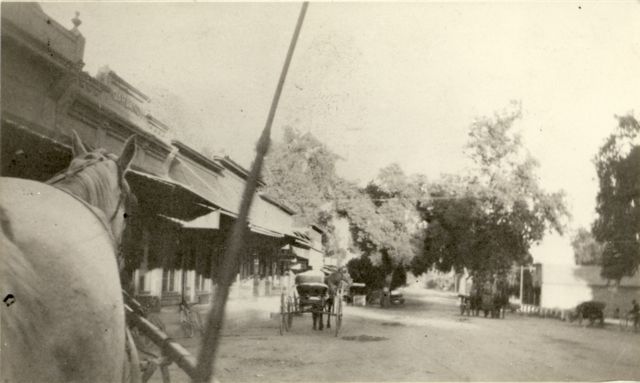
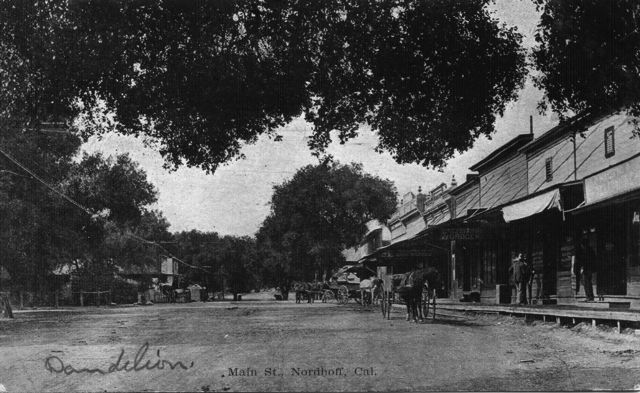
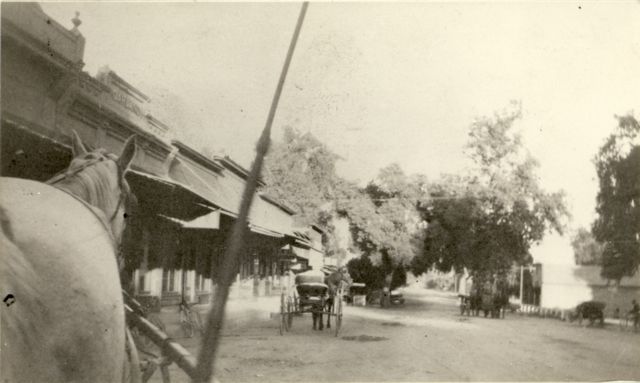
Nordhoff (now Ojai) has generally been described as a quiet, peaceful little place, and generally it was. Several oak trees strung along Main street from Tom Clark’s livery stable to Schroff’s harness shop furnished the only shade, for there was no Arcade until 1918-19 [1917].
There were three gaps in the row of buildings on the north side of Main Street. One was between Lagomarsino’s saloon and Archie McDonald’s blacksmith shop at the east end of the business block, about the location of the Edison office and Barrow’s hardware store [Rains Department Store] stood alone. There was an alley on both the east and west side of that building, which I think was the site of the present hardware store.
The east alley was used by pedestrians. I think the board sidewalk prevented vehicles going through. But the sidewalk ended at the west corner of Barrow’s hardware, so that alley was quite generally used by horsemen as well as pedestrians.
West of that alley was Bray’s plumbing shop, and from there on to Signal street was the livery stable with its buggy sheds, corrals and hay sheds. West of Signal on the site of the Oaks Hotel [The Oaks at Ojai] stood a small, whitewashed, clapboard house where chet Cagnacci was born at the turn of the century and later, I believe, Tommie Clark.
Across the street about the site of Van Dyke’s Travel Agency [Friends of Library book store] stood Dave Raddick’s residence, then easterly a break, then the meat market. On the southwest corner of Signal and Main was The Ojai newspaper printing office where the theatre now stands and easterly across the street, where the present post office is located, was Charley Gibson’s blacksmith shop. There was quite a gap between the blacksmith shop and Lauch Orton’s plumbing shop, the barber shop and post office. Through that gap could be seen the Berry Villa, which is now the post office employee’s parking place.
A little distance east of the post office, briefly, stood C.B. Stevens little grocery store, then the entrance and exit to the Ojai Inn which is now our city park. A leaky, redwood horse trough and a hitch rail extended onto the barranca. It was always shady, and teams of horses and buggies were customarily tied there while the out of town folk did their shopping.
I once had a Plymouth Rock hen who would bring her brood through the alley between the saloon and blacksmith shop to scratch around where the horses were tied. Sometimes she would miscalculate and be overtaken by darkness, so hen and chicks would simply fly up on a vacant spot on the hitch rail and settle down for the night. Our stable and chicken coop was just back of Dr. Hirsch’s office [next to Lavender Inn] and more than once at about bedtime, I would carry them back to their own roost.
Schroff’s harness shop east of the barranca stood high enough from the ground that one could step from a saddle horse onto the porch, which was convenient for ladies riding sidesaddle to dismount and mount.
The corner of South Montgomery and Main [now Ojai Chevron Station] was open and was used mainly by Thacher boys to tie their horses while attending services at the Presbyterian church, which stood where the Chevrolet parking lot now is [parking for Jersey Mike’s]. That building now is the Nazarene Church [Byron Katie Center] on N. Montgomery and Aliso.
I could go on and on and on with details of the village of Nordhoff at the turn of the century, but I fear that would become too boring, so I will get on with some of my memories of the activities of the time. (To be continued in future installments.)
“Over the hill to the poor-house
I’m trudgin’ my weary way-
I, a woman of seventy, and only
A trifle gray…
Many a step I’ve taken a-toilin’
To and fro
But this is a sort of journey
I never thought to go.”
Thus ran a popular sentimental poem written by Will Carleton in the late 1880s. Except for the vote of our supervisor in 1895, such a journey might have been taken by indigent aged to the Ojai Valley.
“The Ojai” publicized a proposal on June 12, 1895, in an editorial bearing the headline: “A County Poor Farm for Ojai Valley”. “When the supervisors were in Ojai a few days ago viewing the roads, they also inspected the Roth ranch of 120 acres near Nordhoff, offered to them for the purpose of a county poor farm, and they were so favorably impressed with the advantages of the place, they ordered their intention to buy the farm.”
This touched off a series of editorials in various papers in the county concerning the advantages of such an establishment.
An article in the Ventura Free Press explained, “The change of the laws by which the support of indigent poor is borne solely by the county in which such indigents may reside is, no doubt, equitable and just, but it makes all the more necessary the careful consideration of the question as to how this may best be provided for in the most economical manner. By the purchase of a farm and caring for them they will become as nearly self-supporting as their condition will permit…Scarcely a county can be found in the Eastern States that is not provided with a poor farm. Nearly all of them are not only self-supporting, but a source of revenue.”
Immediately the supervisors were besieged by competing offers from parts of the county to sell them land for a poor farm.
The editor of “The Ojai” threw all his support to the proposed farm on the Roth property. He wrote, “The 120 acres are all good land, with plenty of wood and water…San Antonio Creek runs through the ranch…There are also on the place four springs, the water of which, coupled with a good climate, is said to be an infallible cure for asthma.”
In another issue he pointed out, “One strong argument why the Roth place is the most desirable for the poor farm is that it is within walking distance of all churches in the valley. Poor people desire and should have church privileges.”
In yet another issue he remarked, “The fact should be borne in mind the people who would be admitted to the poor farm are nearly always feeble and unable to do much of any labor in a climate that is not the mildest. The climate of the Ojai Valley can’t be beat in the world for its salubrity.”
The County Board of Supervisors went to San Francisco to study the poor farm maintained there. Upon their return, K.P. Grant, supervisor from Ojai, reported that, by means of the farm, San Francisco was able to care for the poor at an expense of only $3 per month each, which Ventura County was paying $5 per week.
The supervisors met on July 31, 1895, to make a final decision on the purchase of the Roth property. They were confronted with a written protest signed by many large landowners of the county, including such names as Adolfo Camarillo and Thomas R. Bard. In the final vote, K.P. Grant of Ojai and Supervisor Hartman voted in favor of the purchase of the Roth property, but the three other supervisors voted again it. Thus Ojai lost the county poor farm by one vote, and the entire issue of establishing a poor farm anywhere in the county was dropped.
It is interesting that, throughout the whole spirited discussion of the issue in the newspapers of Ventura County, the citizens of the Ojai Valley remained strangely silent. No letters pro or con appeared in the local paper, nor was there any evidence of discussion in public meetings. One wonders what the attitude of the citizens of the Ojai Valley was toward the proposal to establish a county poor farm in their midst.
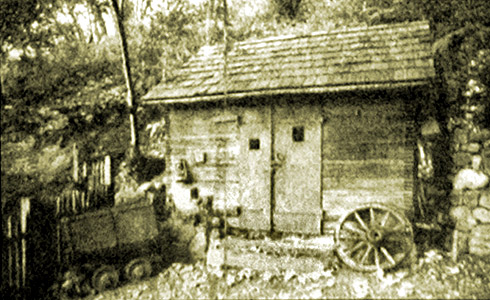
For those who needed to be incarcerated for some time, Andy Van Curen, long time constable in the Ojai Valley, provided lodging in a very small, home-made jail he had built himself on his own property. According to Edna Van Curen Miner, his daughter, the jail was built of 4 inch boards, one inch thick that were laid flat, one on top of the other, and then nailed through with iron spikes an inch apart. Says she: “It was a veritable fortress from which none could escape.”
There were two adjoining cells with an iron door for each, one cell capacity was 4, the other 7. A six inch square hole in each door provided a convenient opening for air and for providing a space for passing in small dishes of food. The jail was situated first close to Ojai Avenue, in front of what is now Loops Restaurant [now Carrow’s Restaurant]. Then it was moved under a tree back of the rear parking lot of the Security Pacific Bank building [now, Bank of America].
Andy Van Curen was Nordhoff’s constable for many years. In his later life, there was a movement among some of the citizens of Ojai to elect a younger and more active man to replace him as constable. Commenting on this situation in her memoirs of the period, Helen Baker Reynolds writes: “Andy was hurt and incensed. He let it be known that if he were replaced no one else could use his jail. The movement for replacement promptly collapsed.”
Years after its use was ended, the little jail was twice offered to the City with the suggestion that it be placed in the Civic Park, but the city was not interested.
Clara Koch who had become in possession of the Van Curen property gave the jail to Audrey Ovington of Santa Barbara, who engaged William J. Brakey, the famed “moving man” from Ventura to move it. Mr Brakey took it on a flatbed truck over the Casitas Pass, and deposited it at Cold Spring Tavern. There it stands today and may be seen by anyone interested.
Ed Wenig, Ojai’s home-made jail was escape-proof, Ojai Valley News, Nov. 19, 1969.
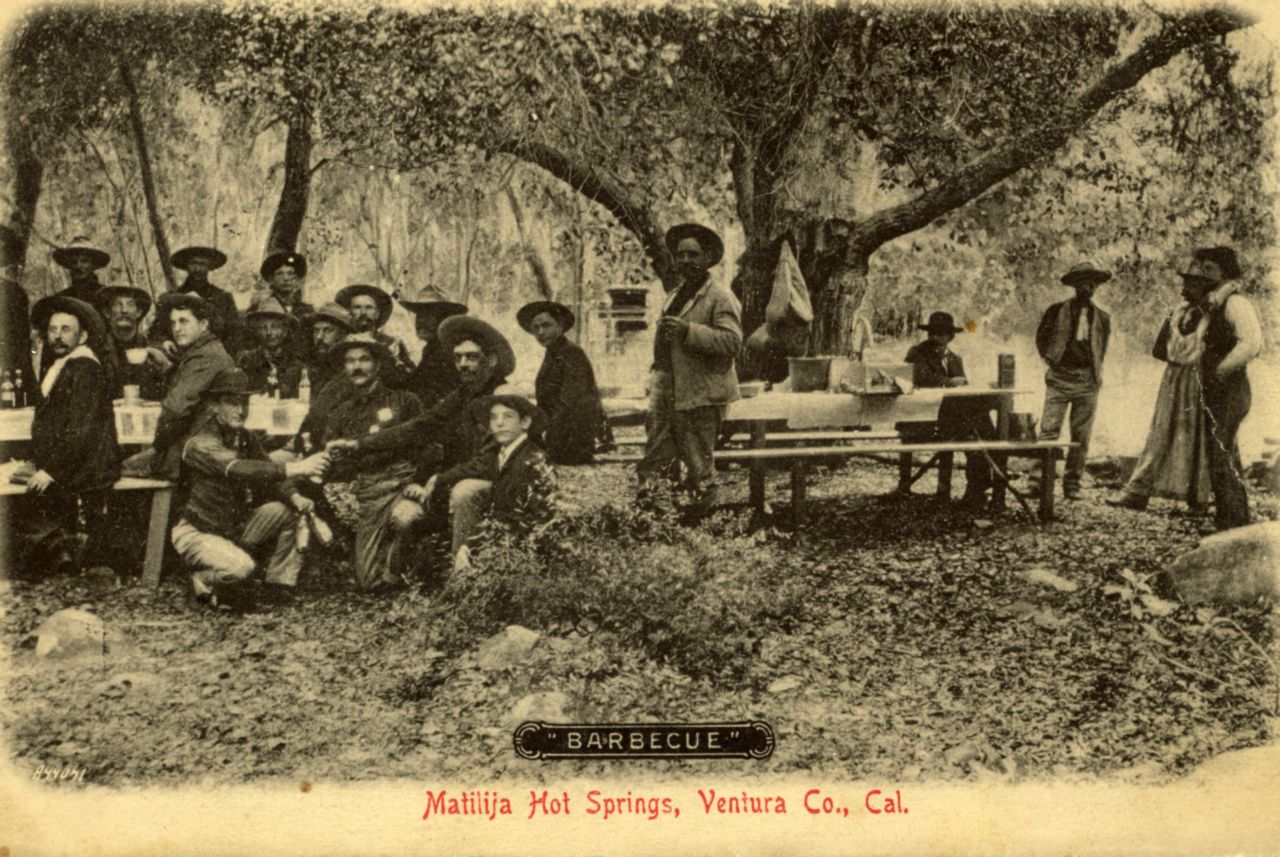
This is the annual gathering of the U.S. Forest Rangers, Santa Barbara Forest Reserve, at Matilija Hot Springs. Most of the rangers had districts in remote areas. Supervisor Willis M. Slosson held these gatherings once/year so that they could get together and exchange ideas.
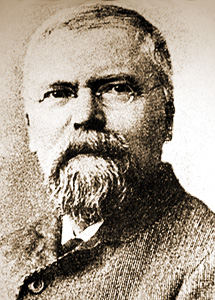
Charles Nordhoff Visits the Ojai Valleyby Richard Hoye
The City of Ojai was first established as a village in 1874 and given the name Nordhoff. The village retained this name for 43 years, until it was changed to Ojai in 1917. Its original name was derived from the author, editor and journalist Charles Nordhoff, who lived from 1830 to 1901.
His name is still retained in the name of the high school, Nordhoff High School, and the name of the highest point on the ridge which forms the northern wall of the Ojai Valley, Nordhoff Peak. There is also a fountain at the center of the city which commemorates his daughter, Evelyn Hunter Nordhoff.
Charles Nordhoff is frequently confused with his grandson Charles Bernard Nordhoff, co-author of Mutiny on the Bounty; but they are of different generations. Charles Nordhoff was a well-established author in his own right. He wrote about a dozen books. His first books were about his early life as a seaman, and his Man-of-War Life (1855) was used at Annapolis as a standard reference for naval cadets. His most famous book was California for Health, Pleasure and Residence, published in June 1872. He was a deeply religious man, and one of his books was titled, God and the Future Life (1883). His Politics for Young Americans (1875) was used in public schools as a civics text.
Charles Nordhoff was a “correspondent” in Washington, D.C., for the New York Herald newspaper from 1874 until his retirement in 1890. The New York Herald was the foremost newspaper in the nation, comparable to the New York Times today. This was at a time when there was no Internet, no television and no radio. Newspapers were the principal method of mass communication. As a “correspondent” (we might say reporter/commentator) at the nation’s capital for the nation’s foremost newspaper, he was at the top of his profession and was well-known nationwide.
The following statement was included in an obituary written just after his death, which occurred in San Francisco on July 14, 1901:
“The town of Nordhoff was named for Charles Nordhoff, in appreciation of the good words spoken of the Ojai Valley as a health resort, both as a writer and in personal talks with friends.”
This is the common understanding as to how the village came to be named for the author, and it is an explanation that has been repeated many times over. Nonetheless, it is incorrect.
“Persons seeking to learn what Charles Nordhoff wrote about the Ojai Valley pick up his California for Health, Pleasure and Residence from a local library and search the book intensively only to discover that there is nothing in the work about the valley! This leads to perplexity and confusion! The book was published in 1872, and the village was named Nordhoff in 1874. . . . but, he had not written about it.”
The key to understanding what actually occurred rests in the fact that there was a subsequent edition of the work, published in 1882. The title page of the second edition stated that it was a “New Edition, Thoroughly Revised.” It is in the 1882 edition that information about the Ojai Valley is to be found. Unfortunately, it is also an edition that is less commonly shelved in public libraries.
Charles Nordhoff wrote about the Ojai Valley eight years after the village was given his name. So, it wasn’t his writing about the Valley that led to the use of his name. The suggestion for naming the village is attributed to Catherine Blumberg, wife of the man who constructed the first hotel in the center of the hamlet. She thought the use of Nordhoff’s name would be a good idea (better than the Topa Topa first considered). Nordhoff’s famous book about California had been published a couple of years earlier, and tourists were carrying it about as a reliable guide to the state.
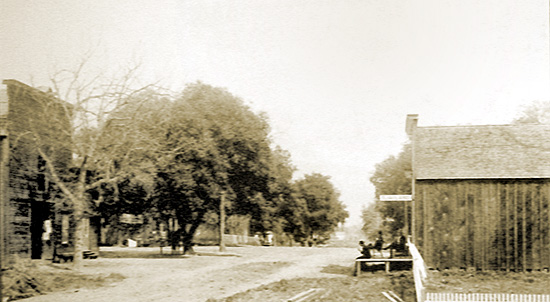
Main Street, Nordhoff, California in 1890
A two-volume biography of Thomas Bard was written by the author W.H. Hutchinson (Oil, Land and Politics: The California Career of Thomas Robert Bard) and published in 1965. Bard was the Valley’s first real estate agent; and he later became a member of the U.S. Senate, representing the State of California. Hutchinson included the following statement in his book:
“Without visiting the Ojai, he [Charles Nordhoff] penned some glowing prose about its salubrious climate and other advantages, and it is believed that he gleaned his material from Bard and Roys Surdam. His other periodical press articles and a book about his travels first gave national publicity to the southern coast and especially to Santa Barbara.”
If complete information had been available to Hutchinson, he would have reached a different conclusion.
Charles Nordhoff first visited the Ojai Valley for a quick, weekend turnaround on October 22-23, 1881. Here is part of a report from a Santa Barbara newspaper:
NORDHOFF AT NORDHOFF
The Ventura “Signal” says: Â “For the first time, on last Saturday, in company with D.W. Thompson and wife of Col. Hollister, of Santa Barbara. Charles Nordhoff, the celebrated newspaper correspondent, and the man to whom more than anyone else Southern California owes the greater portion of her population, visited Nordhoff and the Ojai Valley. Of course, he went into ecstacies over the beautiful valley.”
— Santa Barbara, The Daily Press, Oct. 31, 1881, p. 2:1.
Charles Nordhoff doesn’t seem to have been a man who would have been lost to “ecstacies”, even though the Valley does have this effect upon some. The visit was a momentous event. Here was William Hollister, owner of the Arlington Hotel in Santa Barbara, and Dixie Thompson, manager of the hotel, escorting Charles Nordhoff on his first visit to the valley. Hollister was a man of considerable wealth, after whom the town of Hollister was named in northern California. So, both Hollister and Nordhoff had towns named after them.
“Dixie Thompson was owner of a Ventura ranch which in time would be described as the largest lima-bean ranch in the world. His name is found today in Thompson Boulevard in Ventura. The news account omits the fact that Mrs. Charles Nordhoff was also a member of the party.”
We see, then, that Charles Nordhoff first visited the Ojai Valley in October 1881. The second edition of his book on California, and the edition with information about the Ojai Valley, was published in 1882. He saw the valley before he wrote about it, and Hutchinson was wrong in this particular.
Charles Nordhoff’s interest in the valley was friendly and supportive. He visited again in 1889 and 1894. He was a member of the building committee for his community church in Alpine, New Jersey; and when a decision was made to construct that church in stone rather than wood, the architectural design for the wooden church was sent to the Ojai Valley and used for the design and construction of the Valley’s Presbyterian church (which still stands). He (a Methodist) donated money for construction of the Presbyterian church and provided books for its “Sabbath School” (we would say Sunday School).
Charles Nordhoff also established an enduring friendship with Sherman Thacher, founder of the Thacher School in the Ojai Valley. Thacher hosted a reception in the Valley for Nordhoff in 1894. There is a record that Thacher later visited Nordhoff at Coronado, California, where Nordhoff had retired. Thacher was also among the last persons outside the immediate family who visited with Nordhoff in San Francisco shortly before Nordhoff’s death.
Meiners Oaks, a community where nearly every home is under a Live Oak tree, takes its name from John Meiners, who owned the large area for many years.
John Meiners, native of Germany, had come to the United States about 1848 and had established a successful brewery business in Milwaukee. He acquired his Ojai ranch in the seventies, sight unseen, as a result of an unpaid debt. When he heard that his friend, Edward D. Holton, a Milwaukee banker, was going to California for a brief trip, Meiners asked him to see the property he had acquired. Mr. Holton’s evaluation was, “It is the most beautiful valley I have ever seen.”
Upon investigating his new property, John Meiners found that he owned what was perhaps the largest oak grove on level land in Southern California, much of it so dense that the ground was in continuous shade. Furthermore, to his surprise, Meiners discovered that the climate of the valley was good for his asthma.
For a long time, the oak grove was fenced and provided a pasture for a large herd of hogs. All traffic from Ojai to Matilija went on a private road through the Meiners property, using a gate which was supposed to be kept closed. So many people went through the gate without closing it that in 1893, the manager of the ranch, P.W. Soper, locked the gate. With the Meiners road closed, the only way of getting the mail to Matilija by stagecoach was a roundabout one by Rice Road.
A news item in “The Ojai” related that, as Rice Road has been flooded, “the mail was sent up to Matilija last night on horseback, the rider going across the back hill country . . .” However, Mr. Soper later gave several keys to A.W. Blumberg, operator of Matilija Hot Springs, with the stipulation that they were to be used only by mail carriers and scheduled stage coach drivers.
In 1896, the big barn on the Meiners ranch, located approximately where the Ranch House Restaurant is now, caught fire one evening about midnight. No fire-fighting equipment was available. Twenty horses, many tons of hay, harness, and farm implements were completely destroyed. “The Ojai” of February 15, 1896 reported . . . “Mr. Meiners built a large temporary barn on Monday, and the work of the great ranch goes on energetically.”
The Milwaukee brewer lived on his ranch intermittently from the 1880s until his death in the valley in 1898. His original big house still stands on the hill above the Ranch House Restaurant and is now used by the Happy Valley School.
John Meiners organized his ever-increasing acreage into a very productive ranch. Several hundred acres to the north of the oak grove were planted in oranges, lemons, prunes, apricots and apples. P.W. Soper, father of the late “Pop” Soper, was general manager of the Meiners Ranch and lessee of 90 acres of Texas red oats, 90 acres of wheat and 200 acres of barley. A visitor who toured the ranch with Mr. Meiners in 1897 wrote, “At the Meiners Ranch we saw stalks of oats that measured 7 feet 7 inches.”
To visualize the vast area, the ranch can be described as bounded on the south by the hills of the Happy Valley School, on the west by Rice Road, on the north by the foothills near Cozy Dell Canyon and on the east by a line running through the junction of Highway 33 and El Roblar Street, north and south.
The forebears of several of the present-day residents of the Ojai Valley came here as a result of John Meiners’ interest in his ranch. The granddaughters of Edward D. Holton, who made the original favorable report concerning the ranch of Mr. Meiners and the Ojai Valley, are Misses Alice and Helen Robertson of the east valley, and his granddaughter, Mrs. Anson Thacher. Otto Busch came to the ranch as manager in 1907, and his son George Busch, now retired, was one of Ojai’s postmasters.
“He got Meiners O. for unpaid debt,” Ojai Valley News, Dec. 3, 1969
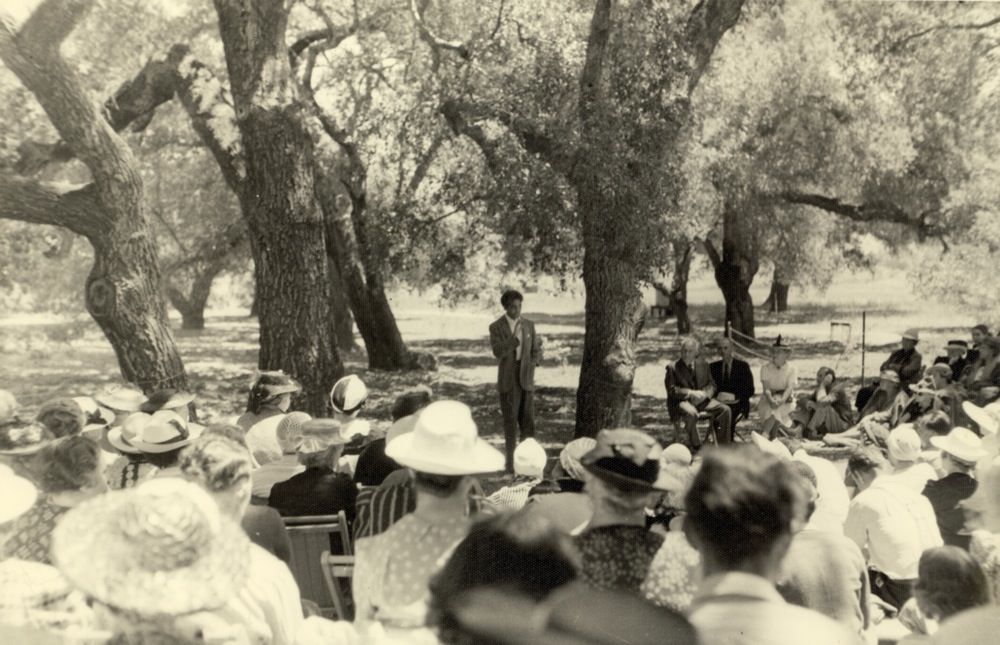 Krishnamurti at the Oak Grove. When Jiddu Krishnamurti first arrived in Ojai during the summer of 1922, he was already the leader of his own worldwide religious organization, the Order of the Star. During his 1922-23 visit, he spoke at the Hollywood Bowl to an audience of over 16,000 followers. In 1924 he began giving talks in Ojai at the Oak Grove (above), which continued until his death in 1986. Krishnamurti established his Ojai home at Arya Vihara (below), making Ojai one of four worldwide centers for his teachings. He held many discussions and private interviews at Arya Vihara. Among those who visited Krishnamurti here were Annie Besant, Charlie Chaplin, Aldous Huxley, Jonas Salk, John Lennon, Greta Garbo, Igor Stravinsky, D.H. Lawrence, and David Bohm.
 The above is an excerpt from Ojai: A Postcard History, by Richard Hoye, Tom Moore, Craig Walker, and available at Ojai Valley Museum or at Amazon.com.