Reminiscences of Early Ojai (No. 8)

The following article was written by Howard Bald and appeared in the May 16, 1973 edition of the Ojai Valley News. It is reprinted here with their permission. Bald used the same title for his many articles. This article has “(No. 8)” added by the Ojai Valley Museum.  All photos have been added by the Ojai Valley Museum.

Reminiscences of Early Ojai (No. 8)
by
Howard Bald

Gypsum mining at about the turn of the century was a minor industry and lasted but a short time. There are still craters visible on the Happy Valley school property from that operation in the Upper Ojai, near the new girls’ dormitory.

Little was said about the shipping of asphaltum in wooden barrels, and I imagine it was a rather sticky deal.

The gold strike along the foothills of the northeast side of the Ojai Valley caused quite a bit of excitement with the staking of claims and some tunneling. I never heard of any millionaires resulting from it though.

From the middle Sespe (that is, from the Sespe Cold Springs, now Hartman’s place) there were numerous homesteaders. How they expected to make a living is still a mystery to me, and many moved out without proving up on their claims. Among those who did stay were the Lathrops (Herb and father), the Harrows, the Pattons (Clarence and father), White, Willet and Cottrel.
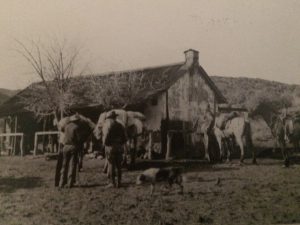
Patton’s cabin in the Sespe.

To a small boy they were not as picturesque as the cattlemen from the Upper Sespe, but judging by the farming and mining equipment and tools that were in evidence when I went out there in later years, they must have been a pretty resourceful and self sufficient lot of men, to say nothing of being industrious.

There was Mr. Willett (grandfather of Jack Willett, who once operated The Barn on south Montgomery street). He also transported over the rugged mountains a complete line of farming implements.

So far as I remember, he used only burros. This elderly man would be seen coming out of Senior Canyon, walking and leading a string of burros, followed by a shepherd dog. There was a hitch rail where the parking lot now is back of Rains dry goods store, where he tied the burros while doing his shopping. After packing his supplies on the burros, he would disappear into Senior Canyon.

I later learned that he took three days making the round trip from his Sespe Hot Springs, camping two nights in Senior Canyon, one coming and one going. There were few well defined trails in that area, and mostly he followed the ridges. That wasn’t so difficult as it sounds, for up until that area becoming a national forest, the terrain was systematically burned off by the sheep and cattle men.

Harrows farmed the Rose Valley (where the Seabees were) as well as their home place, where they built substantial log cabins and barns. A farm wagon, plows, harrows, mowing machine and rake were all transported over the mountain from Nordhoff on very inadequate trails.

Perhaps the most resourceful of them all was Herb Lathrop, for not only did he pack and, I suspect drag, in all the farm equipment, that went ranching, but he maintained and operated a tourist resort that was equipped with conveniences that were considered quite modern in that day. It was a favorite spot for hunters and fishermen.
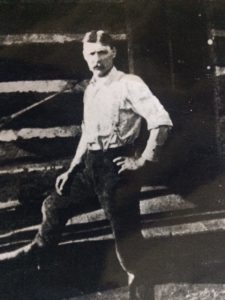
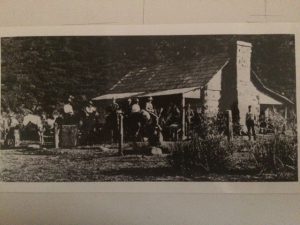
Herb Lathrop at his cabin in the Sespe.
Lathrop’s Cabin in the Sespe (Circa 1901 – 1902).

It was said that no huntsman needed to return to L.A. without a deer. I know from my own later experience that his cooking was tops.
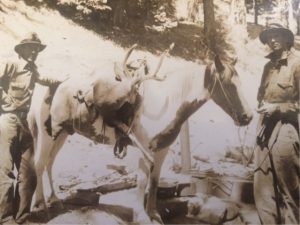
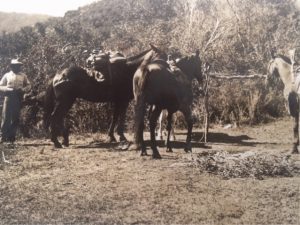
These two successful hunters were part of the Ojai Valley’s “Mercer Boys” deer hunting party back in the Sespe. Circa 1900.
Horses carried the loads for the “Mercer Boys” deer hunt in the Sespe in about 1900. Note the rifles on the horses.


Each fall Herb would ride into Nordhoff leading a string of pack horses, each one laden with three boxes of beautiful red apples that I believe he traded to the grocerymen for supplies. In November of 1916 he was shot to death by a guest who mistook him for a wildcat.

When a small boy, I listened to fantastic stories of Jeff Howard (after whom Howard Creek in the Sespe was named) and his murder of the Basque sheepman. There was feuding between the cattle and sheep men and killings, but the Jeff Howard episode was one of the most colorful.
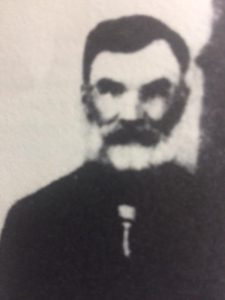
Jeff Howard

A few years ago a great grandson came here trying to find the location of Jeff’s homestead. And so far as I know, I am the only one left who could furnish that information. But in the archives of the Ventura library were found newspaper accounts of Jeff’s exploits, his arrests and several jail breaks and escapes.

The last item said: “Goodbye, Jeff. We hope we never see you again. We have to build a new jail.”

I believe a book is being written about his colorful life. He died in Arizona in 1910.
Two Military-Plane Crash Newspaper Articles

Two Military-Plane Crash Newspaper Articles

This first article was on the front page of the Friday, February 2, 1945 edition of “THE OJAI”. “THE OJAI” is now the “OJAI VALLEY NEWS”. It is reprinted here with their permission. The author is unknown.

Army Flyer Jumps To Safety as P-38 Crashes in Orchard

The first airplane crash in the history of the Ojai Valley occurred late Friday afternoon when a P-38 from the Oxnard flight strip flew into the hillside orchard of the Brandts’ Hermitage ranch, and exploded, while Lt. John R. Giberson Jr., of Sacramento, parachuted into an orange tree on the Raymonds’ Ladera ranch. Flying over the Valley with two other P-38’s, Lt. Giberson’s plane got into difficulty at 17,000 when one of his motors caught fire. After unsuccessfully trying to put out the blaze, the 23-year-old flyer got out into the country past the village and jumped. As the plane roared over her house to crash into the hillside and explode in a great ball of flame and smoke, Mrs. Frank E. Kilbourne Jr. promptly telephoned Deputy Fire Warden William Bowie reporting the location of the flaming wreck and the apparent drift of the parachuting pilot. Fire equipment and the ambulance was dispatched rapidly to extinguish the burning fragments of the shattered airplane and to aid the pilot. Although encountering difficulty at first in managing his ‘chute in the breeze around the foothills, Lt. Giberson emerged from the tree in which his ‘chute shrouds had become entangled with only minor injuries — bruises and scratches.

None of the buildings on the Brandt ranch were damaged by the exploding plane as it came down in the orchard several hundred yards east of them.

————————————————————————————————————————————-

This second article was on the front page of the Friday, June 8, 1945 edition of “THE OJAI”. “THE OJAI” is now the “OJAI VALLEY NEWS”. It is reprinted here with their permission. The author is unknown.

Army Plane Down Near Nordhoff Peak

An army air force pilot died in a P-51 (Mustang) crash in a canyon ¼ mile north of Nordhoff Peak yesterday noon. Flying with a companion plane the ship fell to the canyon floor and was reported crashed by the second pilot. Army officials from down south came up and began the search.

The ranger lookout station at Nordhoff Peak saw smoke rising from the canyon and reported fire. It wasn’t possible to see whether there was any sign of life around the burning ship but when the army relief party had come and cut a path through the dense brush, the aviator was found to have been killed. His name was not announced pending notification of next of kin.

Sailors from Camp Oak were taken in to the area last evening to cold trail the fire.

Thad Timms who assisted in cutting a trail for the stretcher bearers, talked to a brother officer of the dead flier, and learned that he was the same pilot who parachuted to safety on the Raymond ranch late in January as his P-38 cracked up and exploded against a hillside on the Brandt ranch, his second accident not having the fortunate ending that the first one had.

Fireworks caused Ranch Fire

The following article first appeared in the December 29, 1999 edition of the Ojai Valley News. It is reprinted here with their permission.

Fireworks caused Ranch Fire

by
Lenny Roberts

County fire investigators have determined that the cause of last week’s brushfire that destroyed one home on Sisar Road and denuded 4,371 acres of land was two young men setting off illegal fireworks.

There is growing speculation within the community that the pair may have been attempting to blow up a mailbox.

“Reckless use of fireworks is what we’re looking at, but there could certainly be other penal code charges,” said Sandi Wells, chief public information officer for the County’s Fire Protection District.

Wells said that the type of fireworks that were ignited “were not the safe and sane type that you buy in Fillmore,” but rather imports that fly through the air like a bottle rocket.

Authorities from the Fire Department, California Division of Forestry, the U.S. Forest Service and the Sheriff’s Department are expected to complete their investigations by the end of the week, and their conclusions will then be presented to the district attorney’s office. The reports will contain the results of physical evidence and interviews.

“It’s then up to the D.A. to decide if there is enough to substantiate the filing of criminal charges,” Wells said.

In that event, the two suspects could be arrested as early as next week.

“The Fire District would more than likely go for cost recovery of the suppression efforts and that does not include what a judge may impose as restitution,” Wells added.

The gusty and swirling winds that returned to the Ojai area earlier this week did not create additional problems for firefighters who reported Sunday that the Ranch Fire — 64 percent of which burned wildland acreage in the Los Padres National Forest — had been fully contained.

The fast-moving fire began Wednesday night near Koenigstein Road, and was fueled by unseasonably dry conditions and fierce easterly winds estimated to gust at more than 70 mph. Within hours, it was skirting the East End of the city, threatening homes, private schools, and forcing the evacuation of more than 40 homeowners.

By daybreak Thursday, nearly 1,500 county and mutual aid firefighters from Central and Southern California successfully protected homes and property along Thacher, Reeves and McAndrew roads, although a trailer was reportedly burned on Reeves Road.

Other reported losses include thousands of dollars in outdoor equipment and numerous small structures at The Ojai Foundation.

Four firefighters reportedly received minor injuries, the most serious of which required the helicopter rescue of an unidentified 18-year-old Department of Corrections handcrew member who was transported to the Ventura County Medical Center with a possible broken ankle.

The big break came in fighting the fire just before sunrise Thursday when on-shore winds helped push the flames back into the wilderness canyons of the Los Padres National Forest, away from populated areas.

But even as late as Monday afternoon, there were reports of smoldering brush behind a residence in the 4900 block of Reeves Road.

According to information provided by the U.S. Forest Service, approximately 935 firefighters will continue working around the clock to mop up the remaining hot spots within the fire’s perimeter. Officials anticipate the fire will be out late Thursday.

Ventura County Fire Chief Bob Roper, an Ojai Resident, attributed responsible weed abatement and the clearing of brush on Sisar Road and other areas as the reason more structures were not lost.

“The Sisar Road vegetation management of two years ago was a big save,” Roper said, adding that the county’s official fire season, which normally ends Nov. 15, won’t end until 2 inches of rain has fallen. Gigi Coyle of The Ojai Foundation, said although Happy Valley School and Ojai Foundation property were hit hard by the flames, about a dozen staff and neighbors worked to secure the main structures once the firestorm had past.

“Without their timely help, these critical structures would likely have been lost as fires were still burning out of control in the hills surrounding the foundation,” Coyle said.

“Thanks to the demands of our local fire department, many years of clearing around our structures also contributed to our safety. As one fire chief said, ‘It’s a miracle what happened here; the fire’s pattern, how often it came right up to structures and then stopped or went around.’

“We are so grateful for the personal commitment of these firefighters and ground crews during the holiday season.”

As firefighters worked through Christmas Day setting backfires that burned approximately 500 acres in a successful effort to contain the fire, many area residents misinterpreted that the large visible flames and resulting smoke meant the fire’s return to populated areas.

But fire officials said that the operation that included the use of both helicopter and ground-firing devices “ran like clockwork.”

Fire officials estimate the cost of fighting the fire at nearly $5 million, and noted that firefighters have constructed more than 20 miles of fire lines. All remaining statewide agencies that helped fight the fire left Monday, with the county and Forest Service sharing command. Also on Monday, the County Board of Supervisors held a special meeting to declare the burned land a disaster area, making the fire victims eligible to receive disaster relief funds.

The Forest Service is assembling a Burned Area Rehabilitation Team out of the Ojai Ranger Station to survey the affected area inside the National Forest and determine what steps need to be taken to minimize post-fire impact.

The team will pay particular attention to the potential for downstream flooding and subsequent effects to private property.

One of those who made Ojai, Ojai, passes away

The following article first appeared in the April 11, 1973 edition of the Ojai Valley News. It is reprinted here with their permission.  The photo of Major Dron was added to this article by the Ojai Valley Museum.  

One of those who made Ojai, Ojai, passes away

(Editor’s note: Major John Anderson Dron of Ojai died April 5. The following memorial was written by his longtime friend, D. Ric Johnson.)

Another part of the old Ojai of 15 plus years ago and much larger bit of my life is gone. Major John Dron has left us.

Ours was an almost instant rapport, but that was pretty average for him. He made friends easily and enemies not so easily. He had many of the former and proportionately few of the latter. You couldn’t be neutral about him, though I’ve never known a person who was more tolerant in everything except for public chicanery and avarice. Crooked politicians, corporate greed, and Babbits were his avowed, unremitting, unrelenting and implacable enemies.

The county Board of Supervisors adjourned early Tuesday
in memory of the
late John Dron, Sr.

He was classic Scot with their passion for learning; an abstract thinker with a great pendulum swing from effervescence to melancholy. When being a dour Scot “sipped his sorrer wi a long spoon,” as he was wont to say.

He opened the door to, or sent me down, many roads whose names end in “ology” — archaeology, anthropology, geology — whetting my already active curiosity in ancient engineering techniques and avenues of the literary arts never before considered. How many times have I arrived at his door with face and spirits dragging 20 feet behind to leave later willing to try again the struggle out of my personal morass.

We adventured together on short jaunts up the mountains in that jeep that was to John as was the yellow horse to D’Artagnan. Long trips — as the one when we misjudged the weather, and his ancient down sleeping bag burst in the night and mine was inadequate. The long dreary hours of the night tolled away by his sepulchral, plaintive voice querying “and what is the hour now?”

Never was I happier to see a dawn, and we did as mad a dance as his years and my infirmities would permit, ’til the sun and our little fire thawed us to merriment over our just-passed misery.

The delightful evenings spent in front of the inevitable fireplace, the night raw outside, and John reeling off vastnesses of poetry or reading philosophy, Plutarch, Henry Adams, his own letters to the great personages and their replies.

His pixie look when contemplating the deflation of some over-blown ego. The pipe with one side of the bowl burned away that took at least a box of matches per filling and the finger burned black from tamping it. His depressions, when his voice would trail off into nothingness to be followed with sighs and great groans of Scottish spiritual torment, he brought to us for surcease and went away having received it, as I did so often with him.

He gave to me that which my own father could not. A camaraderie that asked nothing but gave, expected and received all. Oh, how exasperating he could be!

Anecdotes? Our whole 15 year association was one long, loving anecdote.

The valley is less warm and less home now.

****************************************************************************************************************************************

Major Dron was born in Ayr, Scotland, September 13, 1893, coming to Big Oak Flat, California in 1900 and spending his boyhood there. He attended Berkeley High School and classes at the University of California, Berkeley.

During World War I he served as a machine gun officer. In World War II he was a Captain and Major in the Corps of Engineers. During the 1920’s he became a civil engineer, working with the Nevada and California division of highways.

A resident of Ojai since 1929, he pursued a career as engineer and surveyor, serving as ex-officio engineer of the city of Ojai for many years. In 1938 he was WPA administrator for the county of Ventura.

Well known for his many and varied interests, he was active throughout his lifetime in civic affairs, serving as trustee to the Ojai Community Art Center and Ojai Civic Association. He was an expert on architecture of the Parthenon, and was often consulted for his intimate and detailed knowledge of the backcountry of the county. He will be remembered by many as the man who kept the Edison Company from putting giant electric poles across the valley mountains.

“The Major” is survived by his three children: John A. Dron, Jr., Mrs. Robert (Dorothy) Rail, and Boyd S. Dron, all of Ojai; a sister, Miss Gladys Dron of Berkeley; and six grandchildren.

Memorial services will be held Sunday, April 15 at 2 p.m. at the Ojai Community Art Center on S. Montgomery St. The family has requested that donations in memory be sent to the Art Center.

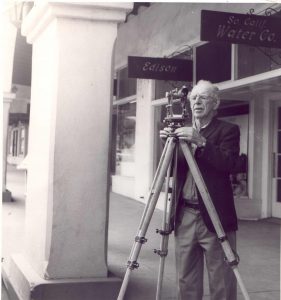
Major Dron in the Arcade

Fire control subject of controversy

The following article first appeared on Page B-4 in the Ojai Valley News on Sunday, September 23, 1979 under the “Pro & Con” section. It is reprinted here with their permission.  The photo of Cary Sterling was added to this article by the Ojai Valley Museum.  

Fire control subject of controversy
by
Cary Sterling

Cary Sterling

+our environment+

No characteristic of southern California’s brushlands causes more heartache than fire. The Ojai area has dubious honor in this regard. The largest fire in the history of California began in Matilija Canyon in 1932, spreading to 219,254 acres.

Strangely enough, it is the attempt to prevent fires which result in the extremely destructive and dangerous brushfires which inevitably occur. The policy for many years has been to control fires until, ultimately and all too logically, an uncontrollable fire is produced.

All the old-timers I have spoken with agree on one thing. This area needs more frequent fires. At first, I thought they were out of their minds. This is a rough concept for a member of the Smokey the Bear generation.

Research, as usual, supports the old-timers. The reason that chaparral is so fire-prone is, quite simply, that it loves to burn. It has been designed, by God or natural evolution if you will, to burn every eight to twenty-five years. Every year between fires, more fuel is accumulating.

A 30 YEAR OLD brushfield is not natural and when it finally goes up, adverse weather conditions can turn it into a holocaust. At this point, even the most modern of fire-fighting techniques become inadequate. It is then that we helplessly witness the spread of brush fires to areas of human occupation.

The difficult problem of bringing wild area fire management policies in line with natural ecology is explored by Professor Miron L. Heinselman, of the University of Minnesota and the U.S. Department of Agriculture, in an article entitled “Fire in Wilderness Ecosystems.” Professor Heinselman’s article appears in a text on wilderness management used by the U.S. Forest Service.

“Fire-dependent plant communities burn more readily than nonfire-dependent communities because natural selection has favored the development of flammable foliage. [Chaparral] is such a “community.” Such plants and communities actually depend on periodic fire for survival.”

While fires may be tragic for individual animals caught in the conflagration, they increase the size of later animal populations by creating more areas for grazing and browsing. Fire does this in the following ways: 1) It triggers the release of seeds. 2) It stimulates flowering and fruiting of many plants. 3) It alters seedbeds when dense litter is replaced with bare soil, ash and thin humus. 4) It stimulates vegetative reproduction of many species when the overstory is killed. 5) It reduces competition for moisture, heat, nutrients and light. 6) It reduces diseases caused by insects and plant parasites such as mistletoe.

THE ABOVE IS MOST true for the lighter fires which occurred more frequently in natural cycles. Such fires are less likely to destroy large trees. “The giant sequoia forests of the Sierra usually experienced light or moderate surface fires at short intervals (four to fifteen years) that kept down invading shrubs, true firs and incense cedar. They scarred but seldom killed the giant sequoias.” The major cause of such natural fires is believed to be lightening.

Heinselman lists five alternatives in fire management for wild areas, reviewing the pros and cons of each.

Fire Exclusion. “A fire-exclusion policy requires the immediate suppression of all fires, regardless of cause, location, or expected damage. At the very least it is often defensible as a holding action until a rational judgement concerning the best alternative can be made.

“One problem resulting from a policy of fire exclusion is a buildup of fuels. This has created very difficult control problems in the chaparral zones of California. Fire was one of nature’s ways of reducing fuels. Perhaps, in following a policy of exclusion, we are only setting the state for a major conflagration which not only could be dangerous to human life and property, but disruptive to the very ecosystems we are purportedly protecting.”

No Fire-Control Program. “Some fire protection people might believe that fire ecologists advocate complete cessation of fire control, but actually no informed and responsible person would be so callous. This option must be rejected outright.”

Management of Lightening-Caused Fires. “The approach is simply one of avoiding direct manipulation as much as safely possible by allowing nature to select the time, place, vegetation and fuels for fires through lightening ignitions.”

Prescribed Fire. “The goal is the restoration of the natural fire regime through the substitution of deliberate ignitions. The basic reason for this option is the belief that fires can often be managed safely if the time and place of ignition are selected in advance.”

Mechanical Manipulation of Vegetation and Fuels. “This policy rejects fire as an unacceptable or unsafe agent of change, and substitutes mechanical manipulations – e.g., harvest of the forest, soil disturbance, planting for the periodic, natural perturbations caused by fire.” The professor cites this approach as more appropriate for semi-wild or agricultural areas than for places where true wilderness values are the highest priority.

Heinselman’s final recommendation for true wilderness is “to restore fire to its natural role in the ecosystem to the maximum extent consistent with safety of persons, property, and other resources.” Safety is then the great problem.

“In recent years most fire fatalities have been sustained by firefighters. Furthermore, the responsibility for keeping fires away from homes, villages, roads, powerlines, structures, and commercial forests outside the wilderness is absolute.”

Many brushfields are now of such advanced age that the need for controlled burning presents a nightmare for the fire personnel. Meanwhile, for occupied areas, there is only one viable policy: the most immediate possible suppression of fires.

Jack Dron Tells How Crew Stayed In Face of Fire to Save His Home

This article first appeared in the September 17, 1948 edition of THE “OJAI” on page 9. It is reprinted here with the permission of the “Ojai Valley News”. The author is unknown.

Jack Dron Tells How Crew Stayed In Face of Fire to Save His Home

While examples of heroism in the Ojai fire are numerous and have not been brought to light, one story related to “The Ojai” this week by Maj. Jack Dron is typical of a number of cases where men saved homes through sheer, unwavering courage. Maj. Dron’s account of how his Gridley canyon home was saved is as follows:

“We were sitting around the house about 7 pm waiting for the fire. We had four orchard spray rigs from Santa Paula, two pumps, and two auxiliaries. We had four men from the San Bernardino forest service—Ranger Horace D. Jones, Joseph Austin, Harry Trotter, and Clifford Damon. Then there were Ned Taylor and F. B. Boys from the Los Angeles district, and five fellows from Santa Paula, O. W. Moten, Buck Messenger, C. J. Boyle, Otis R. Parker, and Sherman Kelley, myself and my son, John A. Dron Jr.

“All these men deserve all the credit that can be given them. Along toward evening, Emery Brandt and Ken Williams had been doing some work with a bulldozer nearby. We’d been trying to get more ‘dozers that afternoon without success. Emery came in about dusk and cleared a 60-foot swath through and olive grove on the hill above my house.

“We watched the fire burning slowly down the mountain, expecting it about midnight. We planned to backfire, but about 7:15 pm we noticed numerous spot fires below the fire line, indicating a shift of wind. In 15 minutes these had consolidated into a solid front of flame downhill. It was still about a half a mile above us. We were all prepared. The house had been battened down and sheet metal furnished by Joe Misbeek had been placed over the windows. Every available carpet, pad, and canvas was saturated and laid on the roof. Then about 8 pm we noticed a spot fire on the ridge below us, then one to the right and left of us. Then I ordered by daughter Dorothy and my youngest son Boyd to take a station wagon loaded with our possessions and get out in a hurry. The fires spread so rapidly that in the 10 minutes it took them to finally leave it had advanced almost to Gridley road. A slight panic then occurred. Two auxiliary pumpers pulled out and raced downhill. But the rest of the men stayed. About 8:15 the fire had reached the dense brush around the house and was coming fast. Ranger Jones, lacking any facilities for back-firing, took his crew and set counter fire on the edge of the break above us. Inhalation of smoke and the heat nearly prostrated him. He was vomiting but recovered and got the fire started. Meanwhile, the two remaining pumpers and crew were in action with fog nozzles spraying the surrounding trees and shrubbery. My son and I, using the domestic water supply, were on the roof wetting down the building. The heat finally became so intolerable we were driven off the roof. Only by inhaling fresh air close to the ground could we continue breathing.

“Things began to happen very fast. The dwelling to the rear of the house began smoking as the fire flanking us on the east raced down the canyon. The heat was so intense that we could only face it by wrapping wet towels around our heads and taking turns spraying each other with water to prevent our clothes from catching fire.

“We saw two foxes race across our front lawn and several deer. By that time the flanking fire had encircled the house and was closing in below us. Then the main fire struck the back fire. For five minutes we were surrounded on all sides by towering flames and were in a literal vortex. The pump men concentrated on trees and the outbuilding in front which was smoking, while my son concentrated water on the roof. Just at the crisis, which came about 8:45, our domestic water gave out, discharging black mud. In a few minutes a valve in the main line blew up with a loud report, discharging steam.

“We had provided an auxiliary supply in buckets, tubs and tanks amounting to 150 gallons, and from then on the pumpers directed streams on the house while my son and I put out spot fires and debris with buckets. In 10 minutes the crisis was past and the main front of the fire had advanced downhill hundreds of feet below. Still, a hot wind of 20 or 30 miles per hour was driving a continual cascade of burning embers and sparks against the house. Fortunately the walls were of stone and the windows were protected by the sheet metal coverings.

“In 20 minutes there was nothing left of the surrounding area but innumerable burning dumps and accumulations of leaves. By this time the crew was thoroughly exhausted, but continued to apply water to outbreaks on the outbuildings, which still were in the danger area.

“By 9:30 practically all danger was past and the men were able to take a wel-earned rest on pillows and mattresses in the yard. They stood by until early morning, when it was certain that all danger was past.”

NEW RULES FOR KINDERGARTEN ANNOUNCED

The following article was on page 2 of the JULY 16, 1948 edition of THE “OJAI.” It is reprinted here with the permission of the Ojai Valley News. The author is unknown.

NEW RULES FOR KINDERGARTEN ANNOUNCED

Enrollment in the kindergarten classes of the Nordhoff Union Elementary School district will be subject to regulations set up by the school board—regulations made necessary by the lack of sufficient kindergarten space, the coming school year, it was announced today.

With two sessions in the Oak View kindergarten and two at Nordhoff, there were not sufficient accommodations last September and there will be more on a waiting list this coming year, since the new kindergarten at Meiners Oaks will not be completed before February of 1949.

However, there is a solution which should work for the possible benefit of the children in their school work, members of the school board agree.

It is generally accepted that the school entrance age in California is too low, most states setting a higher age. By the sixth grade the average age is a year greater in proportion, showing that the average child either starts in later or has not been promoted at the end of one of the school years. The state convention of elementary school principals last April went on record as favoring a five-year entrance age to kindergarten.

Therefore, all children five years of age or older on September 1, 1948, will be admitted to a Nordhoff kindergarten; those from four years and six months to five years, as of September 1, will be placed on a waiting list and after the first day of school those whose ages are greatest will be notified that they may enter, the number allowed to enter depending upon class space still available.

Registration for kindergarteners or other pupils new to the district will be handled in the school office in Ojai beginning August 2. A birth certificate or other official evidence of correct birthdate must be shown to gain enrollment in either kindergarten or first grade. The school office will be open Mondays through Fridays from 9 am to 12 noon and 1 to 4 pm beginning with August 2. In general, the school office will be closed during the month of July.

For the convenience of Oak View children, registration there will be conducted on or about September 1 at that school; an announcement will be given later, after Mrs. Ethel Eitens, principal, has returned from her summer school work. Casitas Springs children will enroll the first day of school, September 13.

VALLEY HOMES OUT OF DANGER

The following article was on page 1 of the Friday, September 17, 1948 edition of “THE OJAI”. It is reprinted here with the permission of the “OJAI VALLEY NEWS”. The author is unknown.

Outlying Mountain Areas Still Smoldering, But —
VALLEY HOMES OUT OF DANGER

BULLETIN — District Ranger E. M. Lyds of the U. S. Forest Service said late yesterday that all danger to the Ojai Valley is now reasonably past. The fire was still smoldering in Horn canyon and northwest of Wheeler Springs but he reported that cleanup crews are busy stamping out smoldering embers in mountain areas and the “prospects are good.” He would not say that the fire was under control. “We don’t consider them under control until they’re out,” he said.

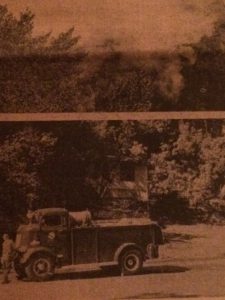
HOW IT STARTED — Bottom photo shows a pumper arriving at Wheeler Springs shortly after the alarm was sounded. At far right arrow points to a surge of flame shooting out of the tin shed which housed the hot water heater. Within minutes the fire had turned the tinder-dry mountainside into an inferno. (Top photo.)

Ojai’s worst fire since the 1917 holocaust that wiped out most of the business district appeared Thursday to be well under control after a grim, desperate struggle that lasted nearly five days.

Heartfelt thanks on the part of every Valley resident went to those unsung heroes—Seabees, Navy men, oil field workers, and local men and boys—who unflinchingly stood up to the raging brush fires and averted what might have been an unparalleled disaster in the history of Ojai.

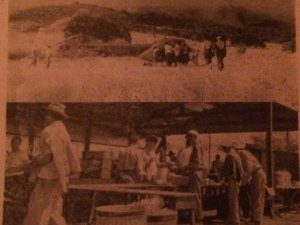
SEABEE HEADQUARTERS — To accommodate the more than 500 Seabees from Hueneme the county road department’s maintenance yard on Maricopa highway was converted into a soup kitchen. Below, a few of the boys fight off fatigue with some food. Above, one of the helicopters drops down in the adjoining field to give fire fighters instructions.

The fire encompassed an area of more than 30,000 acres, according to estimates of the U. S. forestry service.

As far as could be determined by Police Chief C. W. Robinson and Mayor J. Fred Linder, 13 houses were destroyed within the city limits, or 17 altogether in the entire fire area.

Mr. and Mrs. John (Nellie) McDonald lost all their belongings except what was in their car when their home was destroyed Monday night. Mr. and Mrs. William Sanderson, at the top of North Signal street, have nothing left of their home but a stark brick chimney. Mr. Sanderson had just returned home from a county hospital a week and a half ago following surgery. They are now staying with the Clarence Linder family. Mrs. Frank S. Beamon and her sister, Miss Mabel Isenberg, of North Signal street, lost their home, garage, and an automobile. They are now with Mrs. Beamon’s son at 139 Wall street, Ventura.

Mrs. Adelaide Northam lost two houses on Pauline street near the Caldwell home. George Caldwell lost a guest house and a small house used by the gardener. The William Lucking place lost some outbuildings and the gatehouse in Arbolada. On Mrs. William Mayes’ property a small office building was burned. Paul Pittman and a gardener, Mr. Burns, were burned out of their cottages at Cal-Prep school. The piano studio of Eugene Hassall and Adrian Wynnobel was also destroyed.

Bob Bates arrived Monday from Carpinteria to help Dr. and Mrs. C. T. Butler take away some of their things from their home on Foothill road, the former Humason house. However, the house remained intact. Mr. and Mrs. Joe Taylor of North Signal street lost a garage as the fire skipped around, taking one spot and not the next. Col. George Ragan, Miss Elizabeth Clark, John Graham, the Henry Prairies, Capt. Willard Francis home, were among those whose homes miraculously escaped the path of the fire. On Foothill road many homes emerged with scorched yards but no other damage. Skill of the firefighters was credited with having saved the homes threatened. “The technique of modern fire fighting is the only thing that saved the entire Valley from going,” said one old-timer who recalled the 1917 forest fire and methods used then.

Mrs. Arthur Rudolph, who now lives in Lompoc, lost a house and a guest house located on North Signal street. Mrs. Catherine Craig, former postmaster of Ojai, lost her home and belongings. An interesting sidelight on this was that a Los Angeles paper used a picture of the burning house and captioned it “Postmaster’s house burns.” Shortly afterward, Mrs. Matie McCormick, present postmaster, told “The Ojai” that she has received a number of calls from friends and relatives saying they had seen pictures of her burning home.

Three small cottages belonging to Mrs. Harry Workman were burned. These were occupied by a Miss Patterson, a Mr. Mulvane, a Mr. Arnold, and Mrs. Annie O’Neill, the Red Cross said. Local Red Cross officials also reported loss of homes belonging to Lily Millard, Eugene Moore, a Mrs. Collins, teacher at San Antonio school; and loss of tent occupied by a Mr. Heath. First names of these persons were not immediately available.

A home belonging to Mrs. Helen Simonds, daughter of Mrs. Berkley Brandt, was destroyed; but miraculously, her mother’s home was saved. Also, the home of Mr. and Mrs. Walter Hassall in the Gridley canyon area, was wiped out by the flames.

One of the first homes to go was that of Wes Tulleys in the Wheeler canyon Sunday night.

Tuesday afternoon was a tense one for the Thacher road area residents. The fire, fanned by a stiff wind, spread out in a two-mile-wide swath and swept rapidly down through the foothills, threatening the C. G. Raymond home.  At this point were stationed several pieces of fire-fighting equipment; exactly what they were was not discernible. But it was easy to see huge streams of water being sprayed on the house and surrounding trees. Farther east hordes of Seabees and bulldozers could be seen cutting huge swaths near the fire line. One ‘dozer operator lunged his powerful machine straight at a large clump of brush that had blazed up and pushed it back into the fire line.

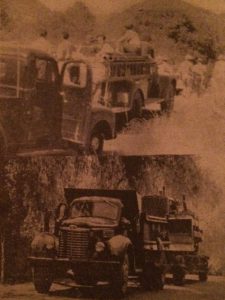
GETTING READY — Top photo: Ojai firemen and townsmen wait out the tense moments before fire rampaged through the Gridley canyon. Bottom photo: A giant ‘cat on its way up Foothill road to cut a firebreak. The breaks would ordinarily have stopped the fire, firemen said, but the wind whipped flames and embers straight for town.

Meanwhile, residents near the Thacher road, including Bill and Louise Lonsdale, Marion Applequist, and others, had evacuated their homes and moved their belongings out.

About 7 pm Tuesday, however, a large crew consisting of two bulldozers, several truckloads of youths employed by the county, and a pumper believed to have come from Los Angeles, had battled the blaze to a standstill and built several backfires which effectively stopped the fire from coming any farther toward the settlement of houses near Thacher road.

BEFORE THE CRISIS — This picture, taken from the bottom of Foothill road at Ojai avenue, shows location of the fire at 1:30 pm Monday. Five hours later the flames had come down the last ridge and were threatening the town until a shift of wind turned the tide for the fire-fighters.

True friends trust each other enough to share

This article first appeared in the April 27, 1988 edition of the Ojai Valley News. It is reprinted here with their permission.

True friends trust each other enough to share
by
David Mason
Silver Pen
Special to the News

Friends have always been an important part of my life; you can’t have too many. You share everything, when you are down, they are there, when you are up, they forget that you were ever down. Who do you call at 3 in the morning when you are having a bad night? Your friend, of course. Who else would come running across town at that time of night? Your friend, of course.

A friend is one who might not agree with a decision you have made, but will back you to the end for having made it. They may tell you what they would have decided, but then that only gives you another option to consider. The trust of a friend is without question, you trust them with your car, keys to your house and they even let you borrow their wife.

A friend will set up all night pasting flower petals on a headdress that they may feel is the stupidest thing they have ever done, but they won’t complain, they might question you doing it again next year, but they won’t complain. They may even buy you a telephone message machine, even when they know you hate machines, and then don’t bother calling to leave a message.

A friend is someone who invites you on a trip with them, and then makes sure you have a good time, even if they aren’t then able to do the things they wanted to do. A friend will also work hard for you, in business and in pleasure no matter how bad they feel. A friend will hug you in front of all his Rotary buddies and not worry about what they think.

A friend will even order tickets to a play you are in, a month before opening night and when you are terrible, they don’t mention it. They send you a card in the mail for no reason, just for fun. A friend is always interested in what you have to say. A friend doesn’t ask your feelings on the roundabout, they know you’ll tell your opinion when you have one.

A friend is one that wont’ let you quit their organization even if you feel you’re not doing a good job for them, they love you just the same. A friend flies you to Lake Havasu, just to talk. Friends are also forgiving, they have to be, none of us are perfect, we all make mistakes and use poor judgement at times, but you don’t worry about your friends, the do forgive.

A friend will help you decorate all night for Christmas and stand back while you take all the credit for the joy it gives to so many. A friend is a sharing partner, you share everything no matter how personal it may be, they understand. A friend is one who wants you to gain weight, so they take you out to dinner and fatten you up, even though you like being skinny. They don’t jump you for not doing something you promised, they wait until you’re ready to do it, knowing you will get it done, someday.

A friend will have coffee with you each morning and wish you a good day when they leave. A friend will not be concerned if you choose to sit with someone else at a luncheon, they know that next time, you’ll sit with them. A true friend is a mother and father that loves you so much they will do anything for you, not questioning why you don’t know how to run the washing machine, but instead pick up your laundry and do it for you.

David Mason is the owner of the Village Florist in the Arcade, an Ojai native and the 1986 Ojai Valley Citizen of the Year.