January 1969 Rainfall and Resulting Damage

Fifty years ago, the Ojai Valley, as well as, all of Ventura County, was drenched by records amount of rain that resulted in the loss of life and millions of dollars of damage to public and private property.  The following two articles first appeared in the Wednesday, January 29, 1969 edition of the “Ojai Valley News” on Page A1. They are reprinted here with the permission of the “Ojai Valley News”. The author of the first article is unknown.  Photos have been added by the Ojai Valley Museum.  Some of the photos were taken in January and others in February of 1969.    

The rainfall — this
is how it happened

On January 17 only 6 inches of rain had pattered on the valley. It looked like a dry year.

On January 29 over 30 inches had fallen from two Pacific storms.

The first storm started in earnest a week before last Saturday. When it ended in a drizzle six days later, over 12 inches of rain had fallen. However the valley was still in pretty good shape and Lake Casitas was storing 150,000 acre feet water for future use. Barrancas, creeks and rivers were running with a heavy winter flow.

Then it happened. Within the next 24 hours seven inches landed on the valley – double and triple that in the mountain areas – from a tropical storm.

Saturday morning, barrancas burst, creeks overflowed, and the river went wild, causing the biggest disaster in the history of the valley.
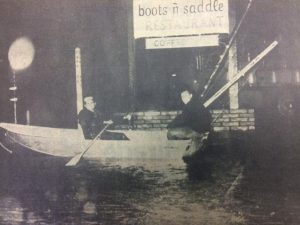
“GIVE ME MY BOOTS N’ SADDLE” was “Give me my boat n’ paddle” for Elmer Myatt of Kim Engineering and Lothar Herrman, who decided to have a little outing during the big rain Sunday night. Our photographer caught them preparing to wade to the restaurant for a coffee break. The white spots in the photo are rain drops on the camera lens. The water was nearly two feet deep for a couple of blocks along Ojai Avenue. (From Wed., Jan. 22, 1969 edition of “The Ojai Valley News and Oaks Gazette”; Page A-4)

Here’s the day-by-day rainfall:

OJAI:                                                                             1969
January 17 ………………………………………………………………… 6.05
Januray 18 ………………………………………………………………… 6.54
January 19 …………………………………………………………………10.47
January 20 …………………………………………………………………14.05
January 21 …………………………………………………………………18.61
January 22 …………………………………………………………………19.12
January 23 …………………………………………………………………19.22
January 24 …………………………………………………………………21.64
January 25 …………………………………………………………………28.64
January 26 …………………………………………………………………29.94
January 27 …………………………………………………………………29.94
January 28 …………………………………………………………………30.23
January 29 …………………………………………………………………30.23
OAK VIEW                                                                     1969
January 17 ………………………………………………………………….. 5.97
January 18 …………………………………………………………………..
January 19 ………………………………………………………………….. 8.87
January 20 …………………………………………………………………..16.48
January 21 …………………………………………………………………..20.07
January 22 …………………………………………………………………..20.65
January 23 …………………………………………………………………..20.65
January 24 …………………………………………………………………..22.16
January 25 …………………………………………………………………..29.46
January 26 …………………………………………………………………..30.89
January 27 …………………………………………………………………..31.28
January 28 …………………………………………………………………..31.30
January 29 …………………………………………………………………..31.59
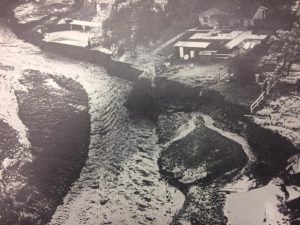
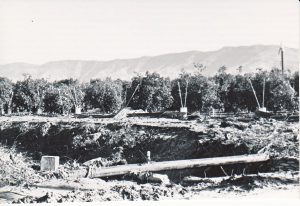
Two swimming pools were washed away from homes along San Antonio Creek near Ojai. (Dan Poush photo from “THE GREAT FLOOD VENTURA COUNTY January 1969 February”)
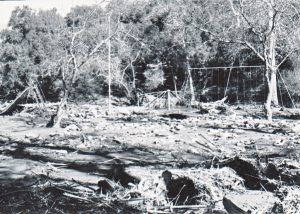
The San Antonio Creek jumped its banks, then ran through Camp Comfort.
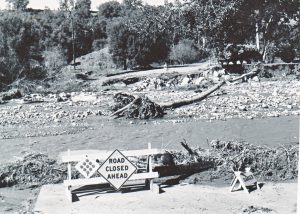
Flooding damage at the junction of Hermosa Rd. & Creek Rd. The Ojai Valley Inn golf course is at the right of the photo.
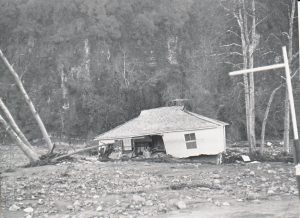
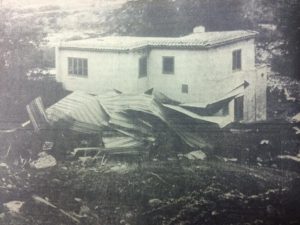
Private residence that was located along Creek Road. The flooding San Antonio Creek demolished it.
Railroad bridge toppled at Casitas Springs by 1969 flooding.

———————————————————————————————————————————————————————-

City faces crisis;
$400,000 repairs
by
Fran Renoe

“Ojai is, of course, a disaster area, and I have proclaimed it as such.” Mayor A. R. Huckins opened the Ojai City Council meeting Monday night with that statement, and the council immediately began discussion of the city’s damages.

Pipe gone

“At this time we have raw sewage dumping into San Antonio Creek. We need to replace 430 feet of sewer line,” City Manager Jack Blalock said, “This is our immediate problem. Then, there’s 500 feel along Creek rd. that is completely gone and at least a mile near Rancho Arnaz, and maybe more. Sewer lines in Meiners Oaks and Oak View are also washed out.

“This 430 feet requires 18-inch pipe, which is terribly expensive. It’s a matter of public safety, and has to be done immediately. We have a representative, John McWherter at a meeting of public works officials in Ventura tonight to find out what we have to do to be eligible for disaster funds and aid in this problem. We feel sure that Ojai will be given high priority in funds and aid,” Blalock said.

Councilman William Burr and Maarten Voogd formed a sub-committee relating to sewer problems and according to Burr, at least 6,000 feet of line is estimated to be lost, in addition to line that has yet to be measured, still covered by water or debris that the committee cannot get to and estimate damage. At this time, however, cost estimates run as high as $400,000. Blalock said that the needed 18-inch pipe runs at least $20 a foot.

Huckins reported that Blalock had ordered part of the sewer system plugged in order to keep out rocks and dirt. Even so, at least one section of sewer line is known to be plugged with debris, and Huckins commented “when that happens, sometimes it is cheaper to just lay another pipe.”

Blalock also needed approval of the council to clear the plugged lines. He said “there is a good possibility that our crew and equipment cannot do the job. We may need to call in a contractor to use jetting action tools. The first manhole just before the 430-foot break is completely filled with mud and we don’t have that kind of equipment.”

“I understand the city is also in the market for a new police car,” commented councilman Loebl.

“Yes, we were almost in the market for a new policeman,” commented Huckins. They were referring to the narrow escape achieved by Gene Meadows when his patrol car was inundated by flood waters just east of San Antonio Creek after the bridge went out.

After some discussion led by Councilman Monroe Hirsch concerning competitive bidding for a new patrol car — he wanted to know if dealers outside of Ojai were invited to bid on new cars — the council approved purchase of a patrol car. Competitive bidding between local Ford and Chevrolet dealers is conducted, with Blalock explaining that in one instance an outside bidder was only $1.75 lower than a local dealer, and that when servicing and repair work had to be done, it was cheaper to buy from a local dealer as the patrol cars could be worked on locally, instead of the police department having to drive the cars to dealers outside the valley.

Canada st.

“Other immediate damage includes street repair, especially Canada st.,” commented Mayor Huckins. “We thought at first the water was coming from the Stewart Canyon storm drain. Now it appears that it is an entirely new stream.”
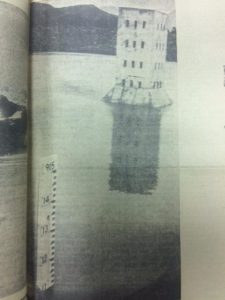
AFTER THE FIRST RAINSTORM Stewart Canyon basin, built by the federal government as flood control above Canada st,, had reached a peak of 15 feet and here has receded to 11 feet. Water metering tower is well above water level. (from Sun., Feb. 2, 1969 edtion of “The Ojai Valley News and Oaks Gazette”;Page B-3)

“Parts of Canada are caving in,” Blalock said. “We may lose all of the street as far as Eucalyptus unless we can divert the stream.”
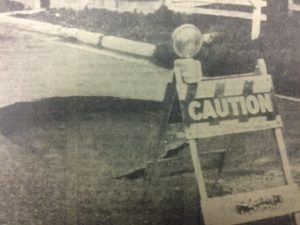
CANADA STREET in Ojai is gradually sinking in places as a result of an underground river which is threatening the walls of the Stewart Canyon concrete tunnel underneath the roadbed. The city recently has believed to have found the source of the water and is bypassing it into the tunnel underneath the street. Only time will tell — and the next big rain — if that is the solution. (from Jan. 15, 1969 edition of “The Ojai Valley News and Oaks Gazette”; Page B-3)

Councilman Burr announced that he and Voogd would be meeting Thursday night with County Public Works staff to see what could be done and what was supposed to be done. Huckins commented that a special meeting of the city council would be called if necessary to expedite authorization for any street work that needed to be done.

“There is a strong possibility we will be able to get disaster funds,” Huckins said. “We certainly can’t float a bond issue at this time and as a public body we can’t borrow from the bank. Therefore, we’ll just have to find out how to get money, then worry about how to pay it back as this is an emergency.”

Councilman Hirsch emphasized that he thought it most important that the city work with the County public health authorities to consult and approve Ojai’s actions before fixing the pipe. He felt this was important in order “not to incur liabilities where the sewage goes out at the downstream area.”

John McWherter, of the Ventura sanitary engineering firm of McCandless-McWherter & Co., arrived to make his report to the council of what had happened at the Monday night meeting in Ventura with State and County public works officials and disaster authorities.

“A Mr. King of the State Emergency Assistance Office in Sacramento met with at least 50 representatives of various city and county staffs to tell us what could be done to correct the flood damage and how to apply for assistance,” McWherter said.

Next meeting

“I brought the council a sample resolution which is to be filled out and presented to the Tri-County meeting of state and federal disaster people at the Federal building at 9 a.m. Saturday.  If Ojai is interested in obtaining assistance we should have this resolution passed upon tonight so it can be presented at that meeting.”

McWherter said he felt that the Ojai sewer system would get top priority, and suggested that a second resolution be passed if any financial aid was to be requested for street damage and repair.

Huckins immediately stated that he was in favor of the resolution to seek sewer aid, but not in favor of asking for street repair aid. “We should not ask for outside aid unless we just can’t handle it ourselves,” Huckins stated.

Burr recommended that a complete report on street damage be compiled including time spent, equipment used, photographic proof, because he felt that such a report would strengthen the cities request if made at a later date. Hirsch and Loebl voted against tabling the street resolution. The council was, however, unanimous in it agreement to collect material to be presented at a later date for financial aid for street repair work.

McWherter stated that as many as 39 state and federal agencies were standing by to provide assistance to those cities and civic agencies needing help.

Federal funds

Hirsch maintained that “it is unfair to have Ojai taxpayers paying into a fund which is used by other cities and not taking advantage of the availability of such funds when offered. I fail to see the value of essentially penalizing a small community such as ours,” Hirsch said.

“We did sustain a disaster and it is going to cost money. I don’t think we would be taking any advantage of financial funds.”

“There’s no question that federal help is needed in the sewer clean-up,” Councilman Voogd said. “But at the same time we have to be very careful to only ask for money when we really need it and after an evaluation of the situation.  If some of these situations are not as crucial as they look then we must judge the degree of crisis. That is on what we should act.”

Other business conducted by the council consisted of approval of minutes from the planning Commission and Architectural Board of Review; approval of resolutions authorizing the preparation of plans and specifications of the Del Norte sewer extension which will service Jim Wyndle’s Richfield Service Station, the Ojai Valley News and the State Equipment Yard near the Y shopping center, plus a resolution to establish an underground utility district — this involves multiple use of a trench by Cable TV, the Edison Company and possibly Pacific Telephone.

The council also approved two ordinances, one adopting a uniform building code and another a uniform plumbing code.
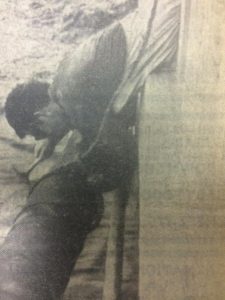
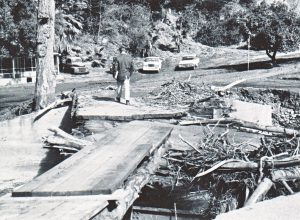
FIXING THE GAS LINE on the Grand Avenue bridge, partially washed out, was this repairman from Southern Counties Gas Tuesday. He was held by the legs by another repairman. Utility company workmen worked round the clock after the storm to restore services in most areas. (Wil Marcus photo); Wed., Jan. 29, 1969 edition of “The Ojai Valley News and Oaks Gazette” (Page B-7).
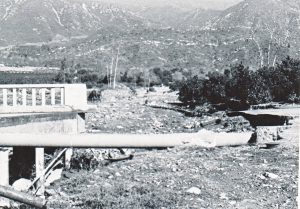
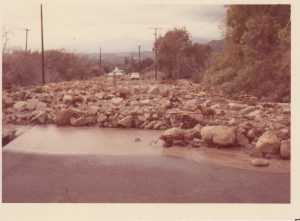
Looking west on Grand Avenue in January 1969.
Grand Avenue bridge damaged by flooding in 1969.
Gridley Road was damaged by the flooding.
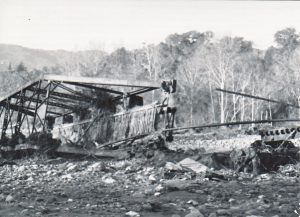
ALL THAT REMAINS of Friend’s Packing House up on the Maricopa Highway is resting in the yard of Realtor Jack Gilbert’s home across the highway. Gilbert’s house was also totaled. The packing house was dismembered and washed down across the highway. (From Sun,, Feb. 2, 1969 edition of “The Ojai Valley News and Oaks Gazette”; Page A-6)
Flood damage to the Maricopa Highway across the Ventura River from the Ojala Resort. The bridge leads over the river to Matilija Hot Springs.
Flooding damaged Wheeler Springs which is located along Highway 33 (AKA: Maricopa Highway).

Pony Express Day will be held at Lake Casitas

The following article first appeared in the August 27, 1999 edition of the Ojai Valley News. It is reprinted here with their permission.  All photos were added by the Ojai Valley Museum.  Those photos are of items that the Oak View Civic Council possess and which Barbara Kennedy and Leanna Kennedy graciously arranged for the museum to photograph.     

Pony Express Day will be held at Lake Casitas
by
Lenny Roberts
OVN staff reporter

Oak View’s Pony Express Day, the annual event staged to supplement operating costs for the community’s civic center, has found a permanent home at Lake Casitas.

Pony Express Day reflects the long-gone days when Oak View staged similar events in honor of the unincorporated community, which was a stop on California’s Pony Express route.

In 1995, members of the Oak View Civic Council created Pony Express Day while searching for alternative sources of income to support the recreational and other programs it offers.

After three years of moderate success at the Oak View Community Center, organizers moved the event to the lake in 1998 in an effort to lure more people from Ojai and beyond, according to honorary mayor Barbara Kennedy.

Flyer promoting 1998’s “Pony Express Day”.

“Having it at the lake is a big advantage,” Kennedy said. “We’re expecting 200 to 300 entries for the car show alone and have already received calls from people in Los Angeles who want to enter.

“The Ojai Valley Chamber of Commerce is involved and hopefully we’ll get a lot of the Ojai people there.”

Last-minute entries for the 12-category car show, at $25 each, will be accepted until showtime. Trophies will be presented for first and second place, best of show and for the mayor’s favorite entry.

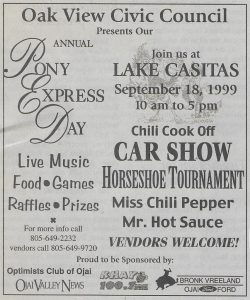
Newspaper ad promoting 1999’s “Pony Express Day”. Local artist Colleen McDougal did the illustration.

“That’s what they tell me — I just pick the one I like,” Kennedy said.

The Ojai Band, which recently concluded its 1999 Wednesday night summer concert series at the Libbey Park bandstand, is scheduled to perform, as are the crowd-pleasing Frontier Gunfighters who stage a series of comical mock shoot-outs against a western-style backdrop.

Also returning is emcee Rick Henderson, the Miss Chili Pepper and Mr. Hot Sauce competitions, the Bronk Vreeland Ojai Ford-sponsored International Chili Society chili cookoff, the Old Time Fiddlers, the Ojai Valley News-sponsored horseshoe tournament, KHAY Radio personalities with live periodic broadcasts and other entertainment yet to be determined.

Notice the sponsors of the 1999 “Pony Express Day”.

For kids of all ages, sno-cones will be provided by the Oak View Lions.

Pony rides and game booths featuring carnival-style competitions will be evident throughout the day, as will Sheriff Department exhibits, including Ojai’s K-9 unit and representatives from the Police Activities League (PAL) and the Ojai Valley’s DARE program.

Kennedy said the availability of booth space is running out for commercial and non-profit vendors. However, there are still some available at $25 for non-profit and $50 for commercial vendors.

There is no charge to attend Pony Express Day, but parking at Lake Casitas is $5 per car.

For additional information or entry forms for any of the events, call Kennedy at 649-2232 or Oak View Civic Council president Leanna Kennedy at 649-9720.

This booklet contained the listing of event sponsors, Schedule of Events, advertisements, and Special Thanks.


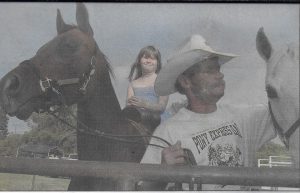
This photo was on Page A-1 in the Wednesday, Sept. 12, 2001 edition of the Ojai Valley News. Photo by Chris Wilson. The caption read, “MISTY GLENN sits atop Election at Oak View Civic Council’s Pony Express Day corral Saturday afternoon. Terry Kennedy, in cowboy hat, led riders around the corral on Election and Cassie, at right, both owned by Rhonda West of Oak View. This event has been going on for more than 50 years.” Notice the T-shirt Kennedy is wearing.

Reminiscences of Early Ojai (No. 10)

The following article first appeared in the January 3, 1973 edition of the Ojai Valley News. It is reprinted here with their permission. The article was written by Howard Bald. Bald used the same title for all of his articles.  So, the Ojai Valley Museum has added “No. 10” to the title.  All photos have been added by the Ojai Valley Museum.  

Reminiscences of Early Ojai (No. 10)
by
Howard Bald

It was always quite an occasion for mother, sister and me to drive to Ventura with the horse and buggy. The present highway did not exist then. The 15 mile drive down the Creek road with the numerous creek crossings took from one and a half to two hours, and the return trip from two to two and a half hours.

On the beach west of the Ventura pier we unhitched Charley and tied him to the rear of the buggy with a nose bag of rolled barley while we spread a blanket on the sand and ate our lunch.

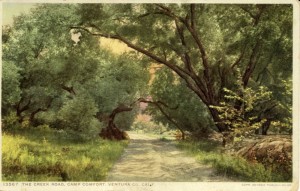
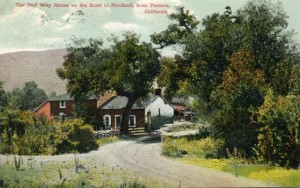
The present direct route to Ventura didn’t go through until about 1917, so all travel was via the Creek road. From Nordhoff to Camp Comfort the road was much the same as it is today. But just below Camp Comfort it crossed the creek, then a mile or more beyond it recrossed the creek, finally emerging into the present highway at Arnaz, between the famous old Arnaz adobe and the present cider stand.

Camp Comfort on Creek Road.
Arnaz Adobe

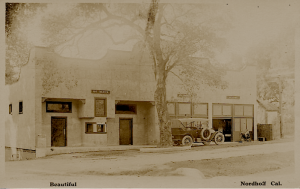
The mail was carried by four horse stage, as was also express and other special items. Of course there was no refrigeration in those days, and ice was brought up by stage. It was said that on a hot day the stage could be trailed all the way from Ventura by the mark left on the dusty road by the melting ice. I think it was about 1907 that Mr. Houk (Fred Houk’s father) put in an ice plant.

“Isis Theater” on the left, probably the market and butcher shop in the center, and Walter E. Houk’s “Ice Plant” on the right.

There would be times in the winter when the stage would be held up for days because of high water. I think it was the winter of 1905-06 that the mail was held up for three weeks. It was that winter that Herb Lamb was the stage driver (Margaret Reimer’s father had the mail franchise then), and on one trip Lamb had his wife and infant among the passengers when the stage turned over in a creek crossing. The infant was swept away and never found.

There were other drownings in the streams in those days. One time (I believe it was 1914) a group of men over in Santa Ana (among them John Selby and Gird Percy) rode on horseback to the Matilija river canyon below Arnaz. One of the group ventured in, was swept away and never found.

I don’t remember what year it was that Bob Clark was living on the far side of the river and was stormed in when a baby was due. He had one saddle horse, “Dick,” that he would take a chance on. Dick got him across the river at what is now Casitas Springs. (We called it Stoney Flat in those days.) He took a team of horses and wagons from there, drove to Ventura and returned with Dr. Homer, as there was no telephone communication in those days. Old Dick carried the two back across the river. I believe Dr. Homer stayed three days before the baby was delivered. Dr. Homer is now retired to the Ojai.

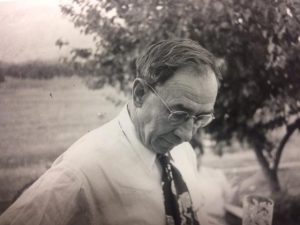
Photo of Dr. Homer taken on August 11, 1951

Tom Clark had quite a reputation in those days for crossing roaring streams when no one else would venture in. There was one famous occasion about 1888 when he took a young lady and her trousseau over Sulphur Mountain with saddle and pack horses to Ventura, where she took a steamer to San Francisco. The young lady was Bessie Thacher, the aunt of Anson and Elizabeth Thacher.

Tom Clark

The valley had its highway tragedies in those days too, only they didn’t involve automobiles, but horses. Captain Gillette (who lived where Dr. Rupp’s office now is) was killed someplace near the present Country Club. Judge Hines went over a precipice near Topa Topa ranch with a team and buggy. Mrs. William McGuire, of the Upper Ojai, was thrown from a horse and killed on Ojai avenue. Chino Lopez, to keep warm, placed a coal lantern under the buggy robe (he was blind), the buggy went off the grade in Matilija Canyon and he burned to death.

A Thacher student boy in 1904 was thrown from his horse and dragged to death. A Gibson boy, whose family were Upper Ojai ranchers, was crushed by a falling horse. Then some time later the father, Mr. Gibson, was thrown from his buggy in a runaway and killed.

Reminiscences of Early Ojai (No. 9)

The following article was written by Howard Bald and appeared in the May 30, 1973 edition of the Ojai Valley News. It is reprinted here with their permission. Bald used the same titled for his many articles. So, this article has “(No. 9)” added by the Ojai Valley Museum.

Reminiscences of Early Ojai (No. 9)
by
Howard Bald

A much later resident of the Sespe was a moronic homesteader named Jake Hartman, after whom the Hartman place was named. (I believe it is now used by the Forest Service as a guard station.)

Jake’s fame stemmed mostly from entertaining Sespe campers with tales of the men he had killed or was about to kill.

Earle Stanley Gardner, who was a Ventura attorney of that period, was greatly amused with Jake’s boasting and encouraged him to spin more yarns by suggesting that he kill someone, as things were slack in the law business.

Jake would wag his head, saying if the goldarn rangers and game wardens didn’t stop snooping around, he would have a job. Gardner would return to camp and tell me everything Jake had said, knowing that I was the only ranger or game warden in that areas, and that outwardly Jake and I were good friends.

An impressionable, overgrown, teenage boy and his mother had come to live with Jake, and it soon became the boy’s ambition to be a badman like his friend.

An elderly, rheumatic man camped most of that summer at the Sespe Hot Springs to soak in the hot mineral water. His camp was some six miles from the Hartman’s. A feud developed over the alleged theft of a gun, and Jake and the boy threatened to kill him if he didn’t leave the Sespe. I did what I could to cool off the two factions, my only fear being that they would beat him up.

At the end of the fire season, November 1917, I moved out of the Sespe and in two weeks was on my way to the forests of France. Shortly after that the boy shot and killed the old fellow. Although Jake was not present at the murder, the dimwitted kid certainly had plenty of encouragement from him.

The trial was held in Ventura, and I was told that Gardner put up a hard fight in his defense. But of course Gardner lost, and Billy was given a 10-year prison sentence. Mercifully he died before this term expired.

I don’t believe that Gardner got a penny for his services. And I was grateful that I was thousands of miles away, for I would have been a very poor witness for the defense and lawyer.

A few years ago I visited the old man’s grave site in a side canyon of the Sespe. There was not a name or date on the wooden cross, and I am not too sure now what his name was. But somehow “Corocoran” sticks in my mind. Since he came from the San Joaquin valley, it could have been that Corcoran was his home town.

Reminiscences of Early Ojai (No. 8)

The following article was written by Howard Bald and appeared in the May 16, 1973 edition of the Ojai Valley News. It is reprinted here with their permission. Bald used the same title for his many articles. This article has “(No. 8)” added by the Ojai Valley Museum.  All photos have been added by the Ojai Valley Museum.

Reminiscences of Early Ojai (No. 8)
by
Howard Bald

Gypsum mining at about the turn of the century was a minor industry and lasted but a short time. There are still craters visible on the Happy Valley school property from that operation in the Upper Ojai, near the new girls’ dormitory.

Little was said about the shipping of asphaltum in wooden barrels, and I imagine it was a rather sticky deal.

The gold strike along the foothills of the northeast side of the Ojai Valley caused quite a bit of excitement with the staking of claims and some tunneling. I never heard of any millionaires resulting from it though.

From the middle Sespe (that is, from the Sespe Cold Springs, now Hartman’s place) there were numerous homesteaders. How they expected to make a living is still a mystery to me, and many moved out without proving up on their claims. Among those who did stay were the Lathrops (Herb and father), the Harrows, the Pattons (Clarence and father), White, Willet and Cottrel.

Patton’s cabin in the Sespe.

To a small boy they were not as picturesque as the cattlemen from the Upper Sespe, but judging by the farming and mining equipment and tools that were in evidence when I went out there in later years, they must have been a pretty resourceful and self sufficient lot of men, to say nothing of being industrious.

There was Mr. Willett (grandfather of Jack Willett, who once operated The Barn on south Montgomery street). He also transported over the rugged mountains a complete line of farming implements.

So far as I remember, he used only burros. This elderly man would be seen coming out of Senior Canyon, walking and leading a string of burros, followed by a shepherd dog. There was a hitch rail where the parking lot now is back of Rains dry goods store, where he tied the burros while doing his shopping. After packing his supplies on the burros, he would disappear into Senior Canyon.

I later learned that he took three days making the round trip from his Sespe Hot Springs, camping two nights in Senior Canyon, one coming and one going. There were few well defined trails in that area, and mostly he followed the ridges. That wasn’t so difficult as it sounds, for up until that area becoming a national forest, the terrain was systematically burned off by the sheep and cattle men.

Harrows farmed the Rose Valley (where the Seabees were) as well as their home place, where they built substantial log cabins and barns. A farm wagon, plows, harrows, mowing machine and rake were all transported over the mountain from Nordhoff on very inadequate trails.

Perhaps the most resourceful of them all was Herb Lathrop, for not only did he pack and, I suspect drag, in all the farm equipment, that went ranching, but he maintained and operated a tourist resort that was equipped with conveniences that were considered quite modern in that day. It was a favorite spot for hunters and fishermen.

Herb Lathrop at his cabin in the Sespe.
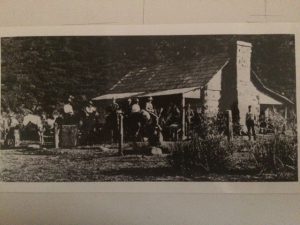
Lathrop’s Cabin in the Sespe (Circa 1901 – 1902).

It was said that no huntsman needed to return to L.A. without a deer. I know from my own later experience that his cooking was tops.

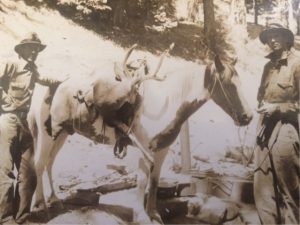
These two successful hunters were part of the Ojai Valley’s “Mercer Boys” deer hunting party back in the Sespe. Circa 1900.
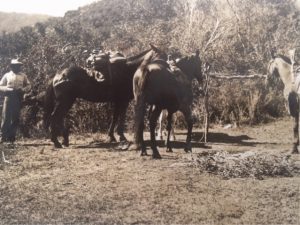
Horses carried the loads for the “Mercer Boys” deer hunt in the Sespe in about 1900. Note the rifles on the horses.


Each fall Herb would ride into Nordhoff leading a string of pack horses, each one laden with three boxes of beautiful red apples that I believe he traded to the grocerymen for supplies. In November of 1916 he was shot to death by a guest who mistook him for a wildcat.

When a small boy, I listened to fantastic stories of Jeff Howard (after whom Howard Creek in the Sespe was named) and his murder of the Basque sheepman. There was feuding between the cattle and sheep men and killings, but the Jeff Howard episode was one of the most colorful.

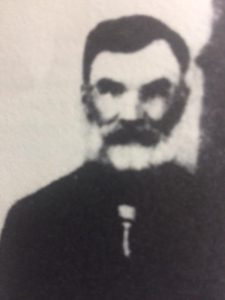
Jeff Howard

A few years ago a great grandson came here trying to find the location of Jeff’s homestead. And so far as I know, I am the only one left who could furnish that information. But in the archives of the Ventura library were found newspaper accounts of Jeff’s exploits, his arrests and several jail breaks and escapes.

The last item said: “Goodbye, Jeff. We hope we never see you again. We have to build a new jail.”

I believe a book is being written about his colorful life. He died in Arizona in 1910.

Two Military-Plane Crash Newspaper Articles

Two Military-Plane Crash Newspaper Articles

This first article was on the front page of the Friday, February 2, 1945 edition of “THE OJAI”. “THE OJAI” is now the “OJAI VALLEY NEWS”. It is reprinted here with their permission. The author is unknown.

Army Flyer Jumps To Safety as P-38 Crashes in Orchard

The first airplane crash in the history of the Ojai Valley occurred late Friday afternoon when a P-38 from the Oxnard flight strip flew into the hillside orchard of the Brandts’ Hermitage ranch, and exploded, while Lt. John R. Giberson Jr., of Sacramento, parachuted into an orange tree on the Raymonds’ Ladera ranch. Flying over the Valley with two other P-38’s, Lt. Giberson’s plane got into difficulty at 17,000 when one of his motors caught fire. After unsuccessfully trying to put out the blaze, the 23-year-old flyer got out into the country past the village and jumped. As the plane roared over her house to crash into the hillside and explode in a great ball of flame and smoke, Mrs. Frank E. Kilbourne Jr. promptly telephoned Deputy Fire Warden William Bowie reporting the location of the flaming wreck and the apparent drift of the parachuting pilot. Fire equipment and the ambulance was dispatched rapidly to extinguish the burning fragments of the shattered airplane and to aid the pilot. Although encountering difficulty at first in managing his ‘chute in the breeze around the foothills, Lt. Giberson emerged from the tree in which his ‘chute shrouds had become entangled with only minor injuries — bruises and scratches.

None of the buildings on the Brandt ranch were damaged by the exploding plane as it came down in the orchard several hundred yards east of them.

————————————————————————————————————————————-

This second article was on the front page of the Friday, June 8, 1945 edition of “THE OJAI”. “THE OJAI” is now the “OJAI VALLEY NEWS”. It is reprinted here with their permission. The author is unknown.

Army Plane Down Near Nordhoff Peak

An army air force pilot died in a P-51 (Mustang) crash in a canyon ¼ mile north of Nordhoff Peak yesterday noon. Flying with a companion plane the ship fell to the canyon floor and was reported crashed by the second pilot. Army officials from down south came up and began the search.

The ranger lookout station at Nordhoff Peak saw smoke rising from the canyon and reported fire. It wasn’t possible to see whether there was any sign of life around the burning ship but when the army relief party had come and cut a path through the dense brush, the aviator was found to have been killed. His name was not announced pending notification of next of kin.

Sailors from Camp Oak were taken in to the area last evening to cold trail the fire.

Thad Timms who assisted in cutting a trail for the stretcher bearers, talked to a brother officer of the dead flier, and learned that he was the same pilot who parachuted to safety on the Raymond ranch late in January as his P-38 cracked up and exploded against a hillside on the Brandt ranch, his second accident not having the fortunate ending that the first one had.

Fireworks caused Ranch Fire

The following article first appeared in the December 29, 1999 edition of the Ojai Valley News. It is reprinted here with their permission.

Fireworks caused Ranch Fire

by
Lenny Roberts

County fire investigators have determined that the cause of last week’s brushfire that destroyed one home on Sisar Road and denuded 4,371 acres of land was two young men setting off illegal fireworks.

There is growing speculation within the community that the pair may have been attempting to blow up a mailbox.

“Reckless use of fireworks is what we’re looking at, but there could certainly be other penal code charges,” said Sandi Wells, chief public information officer for the County’s Fire Protection District.

Wells said that the type of fireworks that were ignited “were not the safe and sane type that you buy in Fillmore,” but rather imports that fly through the air like a bottle rocket.

Authorities from the Fire Department, California Division of Forestry, the U.S. Forest Service and the Sheriff’s Department are expected to complete their investigations by the end of the week, and their conclusions will then be presented to the district attorney’s office. The reports will contain the results of physical evidence and interviews.

“It’s then up to the D.A. to decide if there is enough to substantiate the filing of criminal charges,” Wells said.

In that event, the two suspects could be arrested as early as next week.

“The Fire District would more than likely go for cost recovery of the suppression efforts and that does not include what a judge may impose as restitution,” Wells added.

The gusty and swirling winds that returned to the Ojai area earlier this week did not create additional problems for firefighters who reported Sunday that the Ranch Fire — 64 percent of which burned wildland acreage in the Los Padres National Forest — had been fully contained.

The fast-moving fire began Wednesday night near Koenigstein Road, and was fueled by unseasonably dry conditions and fierce easterly winds estimated to gust at more than 70 mph. Within hours, it was skirting the East End of the city, threatening homes, private schools, and forcing the evacuation of more than 40 homeowners.

By daybreak Thursday, nearly 1,500 county and mutual aid firefighters from Central and Southern California successfully protected homes and property along Thacher, Reeves and McAndrew roads, although a trailer was reportedly burned on Reeves Road.

Other reported losses include thousands of dollars in outdoor equipment and numerous small structures at The Ojai Foundation.

Four firefighters reportedly received minor injuries, the most serious of which required the helicopter rescue of an unidentified 18-year-old Department of Corrections handcrew member who was transported to the Ventura County Medical Center with a possible broken ankle.

The big break came in fighting the fire just before sunrise Thursday when on-shore winds helped push the flames back into the wilderness canyons of the Los Padres National Forest, away from populated areas.

But even as late as Monday afternoon, there were reports of smoldering brush behind a residence in the 4900 block of Reeves Road.

According to information provided by the U.S. Forest Service, approximately 935 firefighters will continue working around the clock to mop up the remaining hot spots within the fire’s perimeter. Officials anticipate the fire will be out late Thursday.

Ventura County Fire Chief Bob Roper, an Ojai Resident, attributed responsible weed abatement and the clearing of brush on Sisar Road and other areas as the reason more structures were not lost.

“The Sisar Road vegetation management of two years ago was a big save,” Roper said, adding that the county’s official fire season, which normally ends Nov. 15, won’t end until 2 inches of rain has fallen. Gigi Coyle of The Ojai Foundation, said although Happy Valley School and Ojai Foundation property were hit hard by the flames, about a dozen staff and neighbors worked to secure the main structures once the firestorm had past.

“Without their timely help, these critical structures would likely have been lost as fires were still burning out of control in the hills surrounding the foundation,” Coyle said.

“Thanks to the demands of our local fire department, many years of clearing around our structures also contributed to our safety. As one fire chief said, ‘It’s a miracle what happened here; the fire’s pattern, how often it came right up to structures and then stopped or went around.’

“We are so grateful for the personal commitment of these firefighters and ground crews during the holiday season.”

As firefighters worked through Christmas Day setting backfires that burned approximately 500 acres in a successful effort to contain the fire, many area residents misinterpreted that the large visible flames and resulting smoke meant the fire’s return to populated areas.

But fire officials said that the operation that included the use of both helicopter and ground-firing devices “ran like clockwork.”

Fire officials estimate the cost of fighting the fire at nearly $5 million, and noted that firefighters have constructed more than 20 miles of fire lines. All remaining statewide agencies that helped fight the fire left Monday, with the county and Forest Service sharing command. Also on Monday, the County Board of Supervisors held a special meeting to declare the burned land a disaster area, making the fire victims eligible to receive disaster relief funds.

The Forest Service is assembling a Burned Area Rehabilitation Team out of the Ojai Ranger Station to survey the affected area inside the National Forest and determine what steps need to be taken to minimize post-fire impact.

The team will pay particular attention to the potential for downstream flooding and subsequent effects to private property.

One of those who made Ojai, Ojai, passes away

The following article first appeared in the April 11, 1973 edition of the Ojai Valley News. It is reprinted here with their permission.  The photo of Major Dron was added to this article by the Ojai Valley Museum.  

One of those who made Ojai, Ojai, passes away

(Editor’s note: Major John Anderson Dron of Ojai died April 5. The following memorial was written by his longtime friend, D. Ric Johnson.)

Another part of the old Ojai of 15 plus years ago and much larger bit of my life is gone. Major John Dron has left us.

Ours was an almost instant rapport, but that was pretty average for him. He made friends easily and enemies not so easily. He had many of the former and proportionately few of the latter. You couldn’t be neutral about him, though I’ve never known a person who was more tolerant in everything except for public chicanery and avarice. Crooked politicians, corporate greed, and Babbits were his avowed, unremitting, unrelenting and implacable enemies.

The county Board of Supervisors adjourned early Tuesday
in memory of the
late John Dron, Sr.

He was classic Scot with their passion for learning; an abstract thinker with a great pendulum swing from effervescence to melancholy. When being a dour Scot “sipped his sorrer wi a long spoon,” as he was wont to say.

He opened the door to, or sent me down, many roads whose names end in “ology” — archaeology, anthropology, geology — whetting my already active curiosity in ancient engineering techniques and avenues of the literary arts never before considered. How many times have I arrived at his door with face and spirits dragging 20 feet behind to leave later willing to try again the struggle out of my personal morass.

We adventured together on short jaunts up the mountains in that jeep that was to John as was the yellow horse to D’Artagnan. Long trips — as the one when we misjudged the weather, and his ancient down sleeping bag burst in the night and mine was inadequate. The long dreary hours of the night tolled away by his sepulchral, plaintive voice querying “and what is the hour now?”

Never was I happier to see a dawn, and we did as mad a dance as his years and my infirmities would permit, ’til the sun and our little fire thawed us to merriment over our just-passed misery.

The delightful evenings spent in front of the inevitable fireplace, the night raw outside, and John reeling off vastnesses of poetry or reading philosophy, Plutarch, Henry Adams, his own letters to the great personages and their replies.

His pixie look when contemplating the deflation of some over-blown ego. The pipe with one side of the bowl burned away that took at least a box of matches per filling and the finger burned black from tamping it. His depressions, when his voice would trail off into nothingness to be followed with sighs and great groans of Scottish spiritual torment, he brought to us for surcease and went away having received it, as I did so often with him.

He gave to me that which my own father could not. A camaraderie that asked nothing but gave, expected and received all. Oh, how exasperating he could be!

Anecdotes? Our whole 15 year association was one long, loving anecdote.

The valley is less warm and less home now.

****************************************************************************************************************************************

Major Dron was born in Ayr, Scotland, September 13, 1893, coming to Big Oak Flat, California in 1900 and spending his boyhood there. He attended Berkeley High School and classes at the University of California, Berkeley.

During World War I he served as a machine gun officer. In World War II he was a Captain and Major in the Corps of Engineers. During the 1920’s he became a civil engineer, working with the Nevada and California division of highways.

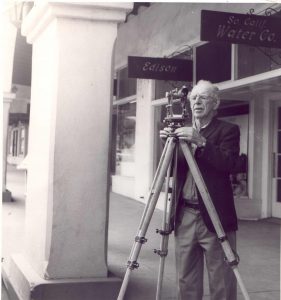
A resident of Ojai since 1929, he pursued a career as engineer and surveyor, serving as ex-officio engineer of the city of Ojai for many years. In 1938 he was WPA administrator for the county of Ventura.

Well known for his many and varied interests, he was active throughout his lifetime in civic affairs, serving as trustee to the Ojai Community Art Center and Ojai Civic Association. He was an expert on architecture of the Parthenon, and was often consulted for his intimate and detailed knowledge of the backcountry of the county. He will be remembered by many as the man who kept the Edison Company from putting giant electric poles across the valley mountains.

“The Major” is survived by his three children: John A. Dron, Jr., Mrs. Robert (Dorothy) Rail, and Boyd S. Dron, all of Ojai; a sister, Miss Gladys Dron of Berkeley; and six grandchildren.

Memorial services will be held Sunday, April 15 at 2 p.m. at the Ojai Community Art Center on S. Montgomery St. The family has requested that donations in memory be sent to the Art Center.

Major Dron in the Arcade

Fire control subject of controversy

The following article first appeared on Page B-4 in the Ojai Valley News on Sunday, September 23, 1979 under the “Pro & Con” section. It is reprinted here with their permission.  The photo of Cary Sterling was added to this article by the Ojai Valley Museum.  

Fire control subject of controversy
by
Cary Sterling

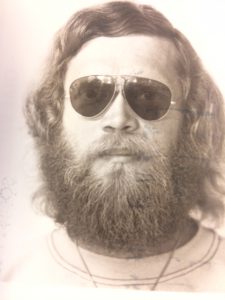
Cary Sterling

+our environment+

No characteristic of southern California’s brushlands causes more heartache than fire. The Ojai area has dubious honor in this regard. The largest fire in the history of California began in Matilija Canyon in 1932, spreading to 219,254 acres.

Strangely enough, it is the attempt to prevent fires which result in the extremely destructive and dangerous brushfires which inevitably occur. The policy for many years has been to control fires until, ultimately and all too logically, an uncontrollable fire is produced.

All the old-timers I have spoken with agree on one thing. This area needs more frequent fires. At first, I thought they were out of their minds. This is a rough concept for a member of the Smokey the Bear generation.

Research, as usual, supports the old-timers. The reason that chaparral is so fire-prone is, quite simply, that it loves to burn. It has been designed, by God or natural evolution if you will, to burn every eight to twenty-five years. Every year between fires, more fuel is accumulating.

A 30 YEAR OLD brushfield is not natural and when it finally goes up, adverse weather conditions can turn it into a holocaust. At this point, even the most modern of fire-fighting techniques become inadequate. It is then that we helplessly witness the spread of brush fires to areas of human occupation.

The difficult problem of bringing wild area fire management policies in line with natural ecology is explored by Professor Miron L. Heinselman, of the University of Minnesota and the U.S. Department of Agriculture, in an article entitled “Fire in Wilderness Ecosystems.” Professor Heinselman’s article appears in a text on wilderness management used by the U.S. Forest Service.

“Fire-dependent plant communities burn more readily than nonfire-dependent communities because natural selection has favored the development of flammable foliage. [Chaparral] is such a “community.” Such plants and communities actually depend on periodic fire for survival.”

While fires may be tragic for individual animals caught in the conflagration, they increase the size of later animal populations by creating more areas for grazing and browsing. Fire does this in the following ways: 1) It triggers the release of seeds. 2) It stimulates flowering and fruiting of many plants. 3) It alters seedbeds when dense litter is replaced with bare soil, ash and thin humus. 4) It stimulates vegetative reproduction of many species when the overstory is killed. 5) It reduces competition for moisture, heat, nutrients and light. 6) It reduces diseases caused by insects and plant parasites such as mistletoe.

THE ABOVE IS MOST true for the lighter fires which occurred more frequently in natural cycles. Such fires are less likely to destroy large trees. “The giant sequoia forests of the Sierra usually experienced light or moderate surface fires at short intervals (four to fifteen years) that kept down invading shrubs, true firs and incense cedar. They scarred but seldom killed the giant sequoias.” The major cause of such natural fires is believed to be lightening.

Heinselman lists five alternatives in fire management for wild areas, reviewing the pros and cons of each.

Fire Exclusion. “A fire-exclusion policy requires the immediate suppression of all fires, regardless of cause, location, or expected damage. At the very least it is often defensible as a holding action until a rational judgement concerning the best alternative can be made.

“One problem resulting from a policy of fire exclusion is a buildup of fuels. This has created very difficult control problems in the chaparral zones of California. Fire was one of nature’s ways of reducing fuels. Perhaps, in following a policy of exclusion, we are only setting the state for a major conflagration which not only could be dangerous to human life and property, but disruptive to the very ecosystems we are purportedly protecting.”

No Fire-Control Program. “Some fire protection people might believe that fire ecologists advocate complete cessation of fire control, but actually no informed and responsible person would be so callous. This option must be rejected outright.”

Management of Lightening-Caused Fires. “The approach is simply one of avoiding direct manipulation as much as safely possible by allowing nature to select the time, place, vegetation and fuels for fires through lightening ignitions.”

Prescribed Fire. “The goal is the restoration of the natural fire regime through the substitution of deliberate ignitions. The basic reason for this option is the belief that fires can often be managed safely if the time and place of ignition are selected in advance.”

Mechanical Manipulation of Vegetation and Fuels. “This policy rejects fire as an unacceptable or unsafe agent of change, and substitutes mechanical manipulations – e.g., harvest of the forest, soil disturbance, planting for the periodic, natural perturbations caused by fire.” The professor cites this approach as more appropriate for semi-wild or agricultural areas than for places where true wilderness values are the highest priority.

Heinselman’s final recommendation for true wilderness is “to restore fire to its natural role in the ecosystem to the maximum extent consistent with safety of persons, property, and other resources.” Safety is then the great problem.

“In recent years most fire fatalities have been sustained by firefighters. Furthermore, the responsibility for keeping fires away from homes, villages, roads, powerlines, structures, and commercial forests outside the wilderness is absolute.”

Many brushfields are now of such advanced age that the need for controlled burning presents a nightmare for the fire personnel. Meanwhile, for occupied areas, there is only one viable policy: the most immediate possible suppression of fires.