Optimists honor 25 Nordhoff students

The following article first appeared in the Sunday, November 12, 1967 edition of the “Ojai Valley News” on the front page. It is reprinted here with their permission. The author is unknown.

Optimists honor 25 Nordhoff students

The Ojai Valley Optimist Club’s “Youth Appreciation Week” will be held Monday through Sunday, Nov. 13-19. Highlight of the week is “Youth in Community Day,” when 25 students from Nordhoff High school participate in the work day of 25 local businessmen.

Students and sponsors are scheduled for a 7 a.m. breakfast Thursday at the Oaks Restaurant, according to Optimist President Bob Music.

The Optimist Club will present two outstanding community service awards: one to Roger Armstrong, an Eagle Scout who was instrumental in collecting needed items for fire-fighters during the recent Santa Paula fire; the other to Elizabeth Jones, a senior at Nordhoff high school who has contributed 190 hours of work as a volunteer of the Junior Red Cross. The awards are among the highest given by the Optimist club.

Rev. Theodore R. Little of the Ojai Presbyterian Church will give the invocation at the Nov. 16 breakfast, after greetings from President Music. The master of ceremonies will either be Dale Holt or Rev. Little.

Dr. Pat Rooney will give the keynote talk, followed by the community service awards presentation and introduction of students and their sponsors. Participation certificates will also be given at this time. Chairman of the event Bob Smith will give the closing words of thanks.

After the breakfast, the students will pair off with their sponsors and work with them at their professions until 2:30 p.m. that day.

Sponsors and students participating in “Youth in Community Day” are: Ojai mayor and David Keitges; city administrator and Byron Barnes; chief of police and Pat Harwell; recreation director and Karen Bunch; Oak View fire station, Allen Ormsby; Meiners Oaks fire station, Rod Davis; U.S. Forest Service, Terry Hanrahan; Ventura River Municipal Water District, Frank Carlson; U.S. Post Office, Beverly Fox; Presidio Savings, Jeni McKinney; Channel Islands Bank, Karen DeSautelle; Soule Park, Greg Stafford; Ojai Hospital, Nancy Branch; Price Realty, Ron Brandolino; Ojai Valley News, Kathy Magill and Merideth Morrison; Neilson and Co., Jim Flanagan; Rexall Pharmacy, Danny McKinney; Safeway, Jim Blymer; Roberts Shoes, Annette Hanson; Oaks Hotel, Carolyn Cloar; Rains Dept. Store, Marie Goudy, and county supervisor, John Hubbard.
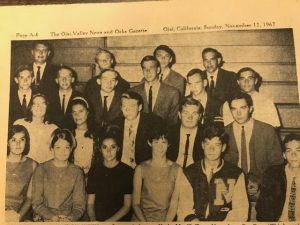
YOUTH APPRECIATION WEEK — Some of the students participating in the Ojai Valley Optimists Club’s “Youth in Community Day” to be held Thursday are: (first row, from left) Karen Bunch, Jenni McKinney, Beverly Fox, Annette Hansen, Dan McKinney, Frank Carlson. (Second row ) Nancy Branch, Kathy Magill, Terry Hanrahan, Jim Cox. (Third row) Dave Keitges, Pat Harwell, Jim Flanagan, John Hubbard, Greg Stafford, Ron Brandolino. (Back row) Dale Holt of the Optimist Club, Jim Blymyer, Byron Barnes, and instructor Paul Labute. (News photo)

The 35-member local Optimist club put the final touches on “Youth Appreciation Week” during their Thursday breakfast meeting at the Boots and Saddle restaurant. President Music said that the County Board of Supervisors has issued a proclamation for the national youth week, and that the Ojai City Council will also issue a proclamation when the councilmen meet Monday in City Hall.
Our only protection is thru long range planning

The following article first appeared in the Wednesday, December 6, 1967 edition of “The Ojai Valley News and Oaks Gazette” on Page D-6. That newspaper is now the “Ojai Valley News”. The article is reprinted here with their permission.

EDITORIAL by Fred Volz

Our only protection is thru long range planning

Twenty years ago after World War II only the most far-sighted cities in California envisioned what would happen to them.

First, they took to heart the population predictions of the experts, predictions which estimated 30,000 people a day would migrate to California in the ’60’s.

Second, these imaginative communities began to make long range plans for doubled, tripled populations. Many enacted the first master plans so new developers would be forced to adhere to more than nebulous “guidelines”, or to the wishes of a current planning commission. Now, these areas have become the model communities of California, where property values are high because they are the preferred places to live. It was all done through long range planning.

Other communities couldn’t see the need for long range planning and dealt only with problems when they were pressed by developers. San Diego, for example, is still squabbling over whether it should enact a master plan. We hardly see whether it would make any difference; San Diego has been raped by uninhibited development and only massive, expensive urban renewal can salvage what’s left.

It was so easy for communities just to coast along 20 years ago (just like Ojai is now). There seemed to be enough room for everybody. Land was cheap, autos one to the family, and the vistas of the Great West beckoned to all. If a man wanted to put a gas station across from the post office, why not — the lot was obviously “commercial” and just sitting there.

Twenty years later we can see the end — there is just so much land. The frontier is gone. This is easy to see in the Ojai Valley, bounded by high mountains on three sides and the ocean on the other. Unless long range plans are made now to protect the semi-rural environment of the valley, the citrus groves and ranches will be overwhelmed and the valley will become another San Fernando.

Even in Ojai, at a time in our history when the most unperceptive resident should know better, there’s a persistent notion that a man who owns property has the “right” to develop his land any way he chooses. Not only that, but he has the “right” to do so without the government interfering, or any planning commission telling him the rules of the game.

This hangover from the Frontier came into the open recently in, of all places, the county planning commission when it was considering a golf course development which curiously had a trailer park at its entrance. The county planning staff wanted extra time to draw up long range plans for the Lake Casitas watershed, surely one of the most beautiful, unspoiled areas left in Southern California. The majority of the commission became impatient with the staff. “Why these people want to put in trailers immediately,” was the commission consensus. (We’ll bet that the developers don’t turn a shovelful of dirt in five years. They just wanted the zoning.)

Think of the valley. Think of the millions of dollars in beautiful homes, ranches, citrus groves. Think of the thousands of modest homes that represent the largest single investment of their owners.

We believe these people have rights — and joined together they represent the rights of the community. They have the right to expect from their government some guarantee of protection.

Protection of what? Why, protection of the semi-rural beauty of the Ojai Valley — the very reason people wanted to live here and invest here. Make another vast tract out of the valley and you’ve destroyed the prime value of our community.

That’s why long range planning — right now — is essential. Without it, the population explosion will destroy our environment, just as it did in countless cities who didn’t plan ahead.

We the people who live here have “rights” and it is perfectly in order for us to ask local government bodies for protection of our environment.

There is no other guarantee of protection than long range planning.

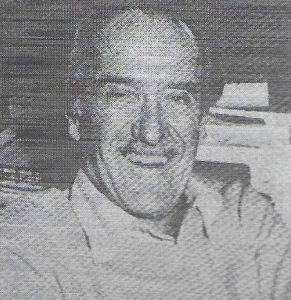
Fred Volz — Publisher and editor of the Ojai Valley News from 1962 to 1987. (Courtesy of Ojai Valley News)

Less talk about hippies; more talk about change

The following article first appeared in the Wednesday, November 1, 1967 edition of “The Ojai Valley News and Oaks Gazette” on Page D-6. That newspaper is now the “Ojai Valley News”. The article is reprinted here with their permission. PLEASE NOTE: Nick Robertson wrote the article when he was only a Senior in high school.  The photo of Robertson was added by the “Ojai Valley Museum”.  

Less talk about hippies; more talk about change
by Nick Robertson
Happy Valley Senior

A “church in change” is a phrase which might draw a strong reaction from both those who think it is perfected and those who think it incapable of facing change. But to a majority of people, it is probably one of the greatest blessings to come from the institutionalized church for a long time.

There are many, myself included, that think that a religious and moral institution should lead the way for social reform, not fight it. There are, of course, arguments which slow the more impatient of us down to a walk: namely, that the church should consider social change carefully before either opposing or supporting it.

What an institution cannot afford to do is avoid facing social changes, and with this in mind, the United Presbyterian Church of So. Calif. sponsored a conference on Theonetics (a catchy, expressive and convenient if undenfinable word) with the subject “Under 21 in California.”

Aside from the word, which sounds much more active than theology, the subject is particularly attractive to someone under 21 in California. It was, as a matter of fact, even more attractive when I found I could be subsidized by the conference if I went as a “conversation starter”: one of the few times I have ever heard the axiom that children should be seen and not heard put to better disuse.

The idea of having a host of youths at the conference was necessary, not only because of the topic, but because over half of the speakers were well over 21 anyway (it was decided that 21 really meant nothing and it was youth that was being discussed). The formal parts of the meeting tended to be discussing youths rather than discussing with them.

As I have an admitted bias to being discussed rather than heard from, I think that I will speak primarily about being heard from.

Hippy topic

The hippies, whoever they may be at the moment, were the predominant topic of discussion for the first two days.  It seemed to me that most of the people attending were unduly hung up on long hair and acid, and the program scheduled two speakers on the hippies.  The first was the editor of a Los Angeles underground newspaper, “The Oracle”, and in keeping with the spirit of the times, he was well over 40.  The second speaker did not show up for some reason, and by the second day it struck me as good luck that the emphasis (we youths had discussed threatening a walk-out unless emphasis was taken from the hippies) was shifted.

The first evening featured three young speakers under the heading of “Youth in Action”. They were all participants in some sort of social welfare program (Inner City, VISTA, and a function of the Presbyterian church called Caravaning). The church establishment came under a certain amount of fire from all of them, as the church is bound to. The message: do something!

I think that as far as I was concerned the most impressive speaker of the entire affair was introduced as “The Minority Youth.” He was Johnny Scott, a product of Budd Schulberg’s writer’s studio in Watts, and one of the most eloquent voices to come out of the ghetto (some of his poems appeared in both the L.A. Times and Time Magazine). Scott, a student at Stanford, spoke stirringly about the plight of the black man in a lily-white America. Being predisposed to such talks, anyway, for I feel that most of us WASPS (White-Anglo-Saxon-Protestants) have created a lot of our own problems, and having the guilty conscience of the typical white liberal, I don’t think anyone left the conference not duly impressed and saddened by the demand, not plea, for understanding of a black youth.

More discussion

The entire set-up of such an event makes it possible for all in attendance to either take or leave the insights presented as well as enrich them by informal conversations.  It is only fair to admit that I approached the hall with somewhat the attitude of an extremely angry (and extremely) young man, and I think that hard-headed , angry revolutionists pale after a brief exposure.  Were it mine, I would keep more time unstructured:  I felt that the talks provided a tremendous stimulus, but a stimulus that could have been matured better by more freewheeling discussion.  Our table talks were probably as important to all involved as any other single part of the conference, though I could have relaxed a little more at them.

One decided hang-up most young people attended with was the idea of communicating for result. We are an impatient breed. While we speak of the necessity of communication rather incessantly, there is, so to speak, method to our madness. Most went not with the idea of learning so much as to prod, to force a confrontation on the church, speed up a committee or two, and get what many young people in the church feel is a necessary involvement out of their congregation.

While adolescents are almost by definition a state of change, the church has often been a leader in social reaction, and it seems that there is now a tremendous impatience within the younger membership of the church that now demands action and acceptance of change.

But when one can obtain enough objectivity, it is seen to be a creative, worthwhile, and effective means of dealing with a problem (assuming that a younger generation is a problem). Perhaps we can attribute the tremendous concern for the younger generation to the long-haired, barefoot element. We beat the “seen but not heard” axiom by looking fully as obnoxious as we sound.

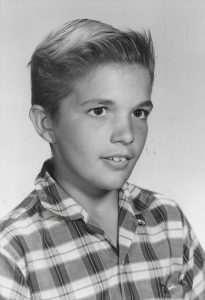
Ojai resident Nick Robertson when he was around 14 years old.

Marijuana more than a drug; it’s a symbol

The following article fist appeared in the Wednesday, May 31, 1967 edition of “The Ojai Valley News and Oaks Gazette” on Page D-6. That newspaper is now the “Ojai Valley News”. The article is reprinted here with their permission. Nick Robertson wrote the article when he was only a Junior at Happy Valley School.  The photo of Robertson was placed into this article by the Ojai Valley Museum.  

Marijuana more than a drug; it’s a symbol
by
Nick Robertson
Happy Valley Junior

Probably one of the most pressing problems for many people today is the question of juvenile use of drugs. Question, perhaps, is not exatly what it is though: thus far, one group has been determined to stop people from smoking marijuana and the other group has been hell-bent of getting high without getting caught. Both groups, as a matter of fact, are too busy to bother to learn anything about marijuana itself, or the other group.

At the moment, marijuana is more than just an intoxicant. For the mainstream of America, it is long hair, beards, cacophonic music, and “dropping out.” For the “hippies” and the other youth cults (call them what you will: fads, movements, games, cults. Who knows?) it is a heavy club to hold over mainstream America, somewhat comparable to a Masonic handshake or some other symbol of a closed society.

As far as I am concerned, it is a rather selfish cause, but highly understandable. To many people, middle class America is represented as much by alcohol as the hippies are by drugs, and a rebellion against middle class America is not only understandable but highly logical to youth.

But I’m straying from my end: It is time for a reevaluation of our laws concerning marijuana on one hand and a reevaluation of the use of marijuana on the other.

Its history

Let’s begin at the beginning: marijuana is the name we have for the leaves of the plant cannabis sativa meant to be smoked. The plant, also known as Indian hemp, was at one time used for rope. Hashish, a specially prepared form of the plant which looks somewhat like sen-sen, takes it name from the same root as assassin: disciples of Hassan Ben Sabah, “The Old Man of the Mountain,” who started a terrorist organization working from the mountains of Persio, got “high” before they were sent out to murder assorted people. Thus, hashish, “the gift of Hassen.”

The drug is common in the Middle East, where the Muslim religion prohibits drinking. Apparently, there is little or no problem of addiction in the hashish dens more spectacular than their equivalent of barflies.

The problem does not begin until one comes into possession of marijuana in the United States. According to the 1965 edition of Compton’s Encyclopedia, one is arrested for failing to pay the tax on marijuana (this is the federal law, bear in mind: probably designed to make the FBI eligible for work in narcotics control), or for selling narcotics without license, if sale is the charge. Though I do not know exactly what would happen were one to ask for a tax stamp, there are also state laws (though in Colorado, the charge of marijuana possession is a misdemeanor only) which make it illegal.

Effects

The effects of marijuana have been variously described as amazingly similar to alcohol (they are in essence the same, after all), an opening of doors in the mind, and even as a temporary form of paranoia. It is non-addictive, and as to charges that it leads to addiction, they have been answered by saying that this is society-induced and legalization could correct it.

Many people find absolutely no hostility when under the influence of the drug, but law enforcement agents say that someone may become dangerous when under the influence of some form of marijuana. It is said that marijuana leads to addiction, and some would even consider the drug addictive.

The numbers of people knowing, or having heard, both sides to the story is extremely small. As a matter of fact, most people are rather ignorant about the subject, yet would cheer when users are arrested simply because they are breaking the law.

The police, of course, recognize the ignorance and apathy get nowhere, and have begun programs of education for youths, parents, and teachers.

This is a step in the right direction, but with one foot only. Is there any reason why parents shouldn’t talk to some users, too? Is there an way the police could talk to the users?

Whether all this is possible is indeed a question, but I fail to see how the best interests of all can be served unless both sides are shown in a fair and just light. Of course, if indiscriminate arrest or constant use are in the best interests of all, I stand corrected. But if otherwise, there is no cure for gloating over the arrests of “pot-heads” and expelling suspected users from school, nor in groups sitting around a pipe, secure in their superiority over mainstream America.

There has obviously got to be some form of correction of our attitudes. As usual, the problem is communication, and barriers are put up by both sides. Perhaps long hair isn’t all bad, perhaps work has its spiritual and moral aspects, and little on both sides. Marijuana might be a somewhat ridiculous place to start, but everybody should be grateful for anything.

As it is, any discussion of marijuana is hampered by the association of it with rebellion on college campuses, sit-ins, marches, and youth movements: by the continued propaganda and lobbying of the all-powerful liquor industry; by the inherent evil people seem to find in things foreign and the inherent good young, or rebellious people seem to find in things forbidden.

Ojai resident Nick Robertson when he was around 14 years old.


The Great Akela hands out pack awards on final pow wow of year

The following article first appeared in the Wednesday, June 28, 1967 edition of “The Ojai Valley News and Oaks Gazette” on Page C-4. That newspaper is now the “Ojai Valley News”. The article is reprinted here with their permission.

The Great Akela hands out pack awards on final pow wow of year
By
Peg Ryan

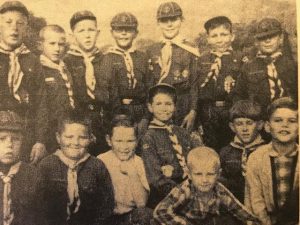
L to R. (Standing) Steven Frank, Robert Hoovan, Billy Arant, Frank Sanchez, David Quick, Terry McDonnell, and Eddie Seidenkranz. (Seated) Mike Murphy, Todd Hillegeist, Jimmy McConnell, Kerry Ryan, Eddie Hoovan, Peter Vargo and Steve Pullen.

As the lengthening shadows fell across the Ojai Valley last Friday night, a tom-tom beat was heard at Camp Willet, calling the Great Akela to the last meeting of the season for Pack 3509.

Standing before the leaping flames of the council fire, Akela (Bob Hoovan) and his second chief (Bill Krips) with painted faces and in full Indian regalia, made a most impressive sight, as they presented the following awards: Bobcat rank, Jimmy McConnell, Michael Grizzard, Eddie Hoovan and Robert Leonard; Greg Herrick, Wolf emblem, gold arrow, two silver arrows; Donald Miller, Wolf emblem, gold arrow; Wolf emblems to Mike Smith, Todd Hillgeist, Ricky Taylor and David Williams; Kerry Ryan, Bear rank, gold arrow, six silver arrows; Terry McConnell, Lion rank, gold arrow, six silver arrows; Mark Rivers and Jeffery Krips, Lion emblem; Billy Arant, Lion emblem, silver arrow.

George Oliver, Webelos Den Leader, accepted four boys, Mark Rivers, Robert Hoovan, Jeffery Krips and Terry McConnell into his den, the last lap of the Cub Scout trail.

The new charter was presented by Joe Tanghetti; new Cubs, Steve Pullen and Eddie Hoovan were introduced to the packs, with their parents. “Akela” presented thank you certificates to Steve and Janice Vargo, outgoing committee man and Den mother. Terry McConnelll presented Janice with a gift from Den 6, her former den.

The dens competed with each other in a new yell. Sally Seidenkranz led the entire assemblage in a number of songs and a skit, “Gripping Episode of Gory Gulch”, in which everyone took part.

The most enjoyable pack meeting of the season closed with the playing of “Taps” by Robbie Johnson, Boy Scout Den 1, den chief. The “echo” of Taps was played from a distant hillside by Ernie Seidenkranz.

Intangible Spirit of The Ojai (No. 1)

The following article first appeared in a newspaper on November 22, 1961 that, eventually, became the “Ojai Valley News”. It is reprinted here with the permission of the “Ojai Valley News”. The author is Ed Wenig. Wenig wrote a series titled “Intangible Spirit of The Ojai”, but failed to title each of his articles in the series. So the “Ojai Valley Museum” has added “(No. 1)” to the title.

Intangible Spirit of The Ojai (No. 1)
by
Ed Wenig

Little six year-old Rudolfo Reyes desperately clung behind his brother Pedro as they rode in a long pack train to their Cuyama home. The year was 1894. Don Rafael Reyes, his wife Maria and their 10 children, all on horseback with a long string of pack animals, were wending their way from Ventura to the Matilija Canyon, up the north fork to Cherry Creek, then over hill and dale to the adobe ranch home. This trail was the only way to reach their destination from Ventura. The present highway was not a reality until the early thirties.

On the large cattle ranch Rudolfo’s older brothers had the exciting job of herding and branding cattle in the spring and fall roundups. Of course, branding in those days consisted of the time-honored method of roping, throwing to the ground, tying, and applying the branding iron to the struggling beast — a far cry from the modern use of the narrowing corral and the chute with the animal locked in fore and aft. Vaqueros from neighboring ranches helped each other. Rudolfo had the original branding iron, in the shape of a wine glass, and also the original registration papers issued to his father, Don Rafael, in 1858.

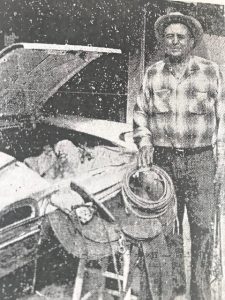
RUDOLFO REYES — Cuyama Vaquero ready to hang up his saddle after 40 years as a cattleman.

All the hardships of the early California pioneers were part of the isolated Reyes Rancho, even into the early part of this century. With only a trail over the mountains to Ventura, and a rough and tortuous wagon road to Bakersfield, acquiring the necessities of life and the care of the sick were a problem. The round trip to Bakersfield by wagon to bring 40 sacks of flour took three or more days.

As in the case of most of the old early California ranches, the latch string was always out for strangers who often stayed overnight. Good and bad people were welcome, with no questions asked. Says Rudolfo: “Once a man working for my father turned out to be an outlaw who had killed several men. When he heard “the law” was after him, he climbed up into the attic of the old adobe. Here he waited as the officers came in. His guns were at “the ready” as they searched the ranch. The officers went away and the outlaw skipped out!”

Sentimental malcontents who prefer fresh air!

The following article first appeared on Wednesday, June 28, 1967 in “The Ojai Valley News and Oaks Gazette”. That newspaper is now the “Ojai Valley News”. The article is reprinted here with their permission. The article’s author was Nick Robertson. Robertson was only a high school senior at Happy Valley School at the time he authored the article.  The photo of Robertson was added to this article by the Ojai Valley Museum.  

Sentimental malcontents who prefer fresh air!
by
Nick Robertson
Happy Valley Senior

Whether the State of California has a right to rip a freeway out of the Ojai valley is another important issue. The State has lost before, and is probably tired of having to deal with sentimental discontents who prefer fresh air and trees to 15 minutes.

The best thing about the freeway is that almost everyone in Ojai hates it, regardless of political persuasion. People who consider many of their neighbors slightly better than the black shirts sign petitions below their neighbors.

It might even pave the way for a healthy round of civil disobedience if the State decides to go along in spite of the will of residents.

Of course, the most important thing is that people are getting visibly upset and concerned over these two things. Generations, all of them, are continually flinging the epithet “the non-involvement generation” at the others, but at the first city council meeting on recreation, people of all ages attended. Petitions against the freeway, or, if you will, the scenic highway (it doesn’t matter, I guess. We got used to “Defense Department” too), are signed by everyone. People are getting as delightfully disgruntled with police as the post-war French.

It only takes a moment to consider all the advantages of local politics. You are there, you know the people involved, no FBI and investigations and phone taps, no federal troops, never an interpreter problem. You can be heard, and read on every local issue no matter how trivial.

True, there are disadvantages, such as an occasional lull in issues. But there are ways, friends, to remedy this. (Just ask Mrs. Gilman!) Send your mayor on a junket, which not only broadens the scope of civic politics, but also gives you a chance to have him slammed and possibly even censured. Attempt to hold a non-middle-class festival, of any sort. Force an investigation. Pull for statements on pressing issues.

And, just for a joke, maybe we can even get enough people to secede.

Fervor, here

While it is doubtful that either of the major political summers – the long hot and Vietnam – will be likely to reach Ojai, it appears that anyone interested in politics can apply themselves with fervor to one of several local issues which are generating interest.

Local politics concern very few people. Bill Donovan of the Stewpot Restaurant tells of a college town in New England, which was governed, of course, by town meetings, where the college students out-numbered the populace. The state, in an attempt to obtain more revenue, decided to charge a $2 poll tax to the non-resident students. The students, naturally indignant, found that this enabled them to attend town meetings. They did – en masse. The students, tremendously out-numbering the town residents, passed two resolutions: first, that the city should build a tower a yard square and a half a mile high, and second, that they should build a covered moving sidewalk to the nearest girl’s college, well over 50 miles away. The poll tax law was, needless to say, repealed, and the citizens were left to spend their nights arguing about water districts, taxes, and school boards again.

Civic politics have a reputation for provinciality, a reputation a recent article in Esquire claimed, stemming form the European tradition. But in my mind, local politics gives everyone a chance to participate, a privilege reserved for actors and millionaires normally.

While it might be true that a youthful Trotskyite, or for that matter, even a young Republican is not likely to be terribly concerned about school boards, water districts and such, it is definitely satisfying to actually be heard above a telegram to a congressman. It almost helps to take away some of the numbness of a bureaucracy.

But Ojai’s current recreation versus budget struggle smacks of political philosophy: it might be a good cause if only for the moral. More conservative groups can clamor about god, or the city council, helping the – excuse me, those – who helped themselves, while at the other pole, people can keep prodding socialism to get up and run in lieu of creeping.

Ojai resident Nick Robertson when he was around 14 years old.

The looking glass

The following article first appeared in “The Ojai Valley News and Oaks Gazette” on Wednesday, June 21, 1967 on page C-1. That newspaper is now the “Ojai Valley News”. The article is reprinted here with their permission.

The looking glass
by
Melba Meredith

Among the many interesting people in our valley there is a well-known and beloved lady who lives life with a purpose, loves her work and has contributed greatly over the years to the “little ones” of the community. She is charming, vivacious Marian Misbeek, a kindergarten teacher at Ojai Elementary school.

Marian has a colorful background. She was born in Honolulu, Hawaii, where her grandfather, Willis T. Knowlin, an engineer of sturdy, New England stock, had previously arrived in a sailing vessel from Boston, around the Horn.

When Marian became of school age, her parents brought her to California for her education, and in due time, in 1922, she came to Ojai as a young, accredited kindergarten teacher from UCLA.

She recalls that back then there were only three Ojai Elementary school teachers, all in an old fashioned building on the corner of Ojai ave. and Montgomery st., and her kindergarten class of nine pupils was held in the dining room of the Woman’s Clubhouse across the street. Word came from the authorities that if the class number became less than seven it would be closed. But that did not happen due to the devoted efforts of Marian Misbeek whose first love has always been the littlest ones.

She saw her one class grow to the present two classes of 30 and 31.

After four years of teaching, she took time off for marriage and children. She has two successful married sons, John and wife, of Linch, Wyo. and Robert and wife and grandchildren, Melissa and Melinda, of Ojai.

While seeing her sons through college, she returned to her kindergarten work 16 years ago and has been at it ever since. She took summer courses in modern teaching and got a degree, and has been given a Life Certificate from the State of California. Her whole life has been dedicated to starting the youngest on the road to education.

She has a special talent with the young.

Her classes are models of attention and decorum. Youngsters who are little monsters at home are angels in her classes, hanging on her every word, while obviously adoring her. The discipline is not too rigid. There is fun without frivolity and games with purpose. The many projects she develops have imagination and creation to appeal to the tots, while encouraging natural courtesy.

As she walks down the street, pupils and former pupils lean out of cars to gaily shout to her, “Hi, Mrs. Misbeek” and this has been going on for two generations.

The philosophy of this gracious and vivacious lady toward the children is best expressed in her own words: “I have an abundance of faith in little children and am conscious of their feelings and ability to respond to their surroundings in naturalness. The goal is to provide love and understanding to these five year olds, most of them away from home for the first time. To give them a true sense of security and happiness, required for and eager-to-learn attitude, to give them appreciation of their endeavors to learn in meaningful experiences, bestow upon them love and praise in their attempts to grow, emphasize the use of their five senses, which at this age is a vital approach to learning. Have them recognize their teacher as a valued friend at school who with an open heart and mind is read to listen to them when they have contributed with work or deed.”

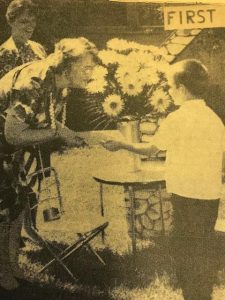
MARVELOUS MARIAN MISBEEK presents a hand-lettered diploma to Clay Segrest, (who will walk through the gate to “First Grade”), at her graduation ceremonies from kindergarten, held on the lawn in front of Ojai Elementary School. Irene Phillips, her year-long faithful assistant, looks on with enjoyment. A bunch of flowers and an American flag completed the simple arrangement for the impressive ceremony, typical of those conducted by the beloved kindergarten teacher — organized, touching and full of joy. (She has held a Fiesta and a Christmas party during the year, both of outstanding quality, which will become permanent memories for 32 tots.)

Surely among the unsung heroes of this world are the many dedicated teachers who give of heart and mind as well as knowledge to our young.

Police mull action to ‘clean up’ park

The following article first appeared in the Sunday, June 4, 1967 edition of the “Ojai Valley News” on the front page. It is reprinted here with their permission

Hippie set
Police mull action to ‘clean up’ park

Ojai police, nettled by a series of provocative acts attributed to members of the Hippie set, were mulling retaliatory action Friday.

Chief James D. Alcorn said his “phone has been ringing off the hook,” with calls from citizens who are plainly disturbed by what they claim are impudent reflections on recent narcotics violations.

Most recent incident was the posting of a sign near the arches fronting Civic Park, proclaiming “Things go better with Pot.” Pot is a slang word for marijuana.

Alcorn said private citizens have also complained about the posting of a routed redwood sign with the capital letters, O-V-D-A, which reportedly stand for “Ojai Valley Drug Addicts.”

He said some of the Hippies hold the sign on their laps as they sit on the wall fronting the park.

Civic Park is a private park, administered by Ojai Civic Association. Alcorn said trustees of the association have been exploring ways of combating the situation, but thus far have failed to find any answers.

In recent discussion of the problem by the Ojai City Council, City Attorney Duane Lyders warned the council that restrictive actions would raise questions of free speech and assembly – thorny issues of civil rights.

As a private park, however, authorities have indicated there might be ways of cleaning up the situation.

The Hippie set has used the front area of the park as a rallying point for some time,, according to Alcorn, but the situation apparently worsened earlier this year when Hippies from coastal cities staged the first of two “Love-ins.”

The first event came off without incident. Barefoot youths with flowers behind their ears strummed on guitars, ate picnic lunches and proclaimed “Love” to all who would listen. It was similar to events conducted quietly in Los Angeles, San Francisco and most recently in an eastern city.

The second “Love-in”, however, had slightly different overtones. Police arrested two visitors on charges of possessing marijuana. One was a girl from Glendale, the other a boy from Los Angeles.

Observers, however, noted that some of the visitors were not so young and some were estimated to be only juveniles who supported the bizarre costumes and deportment of Hippies years older.

Alcorn said the situation was a delicate one. “We have to be careful how we handle this thing,” he warned, “publicity is what most of these people want.”

He said the most his officers could do at present was to see that no laws are broken.

BIGGERS THE BEE MAN: What’s Doin’ in Meiners

The following article first appeared in the Wednesday, June 5, 1968 edition of “The Ojai Valley News and Oaks Gazette” on Page D-1. That newspaper is now the “Ojai Valley News”. The article is reprinted here with their permission. Effie Skelton is the author.  Photos have been inserted into this article by the “Ojai Valley Museum”.  

BIGGERS THE BEE MAN

What’s Doin’ in Meiners
by
Effie Skelton

Meiners Oaks continued to expand. On February 15, 1961, another subdivision was added by Griffin and Son, Inc., consisting of seventy two lots, on South Rice Road. Soon the homes were built and filled with new residents.

On January 2, 1946, Mr. and Mrs. J. B. (Josh) Smith, 221 South Poli Street, arrived from Wichita, Kansas, to visit their friends, the Edward Sorensens, who had recently move here from Wichita. They prevailed upon the Smiths to make this their home. At that time, there were many homes being built and carpenter work was plentiful. Smith purchased three lots and started his home.

Now, they have a well-cared-for neat home, fenced, with grounds that are attractively landscaped. There is hardly room in which to put a single plant; for they have fruit trees, bouganvilla, hibiscus, fuchsias, bottle brush, palm trees and Monterey pines. Any corner of their garden would make a lovely picture.

Smith helped build many homes in Ojai Valley. He is now retired. Their hobby is keeping their home in excellent condition, and they are an example of what two people may do to improve their home and make it an asset to the community.

Mr. and Mrs. George Biggers moved to 223 South Padre Juan in 1938, a couple that have not only raised their own large family, but helped other children. They have lived in a house by the side of the road and been a friend of man, of bees, of agriculture and of nature. Biggers is also pastor of the friendly Church of Christ on the corner of Padre Juan and El Roblar.

Biggers experiences with bees have been written up in newspapers and magazines, large and small. He is a man who collects experiences in life as many others may collect pretty rocks. He works with millionaires and the poor, the industrialist and the worker, the sick and the well, and as in Kiplings poem “If”, he has not lost the common touch.

Biggers was born in Oakland, his father moved to San Francisco soon afterwards, where they experienced the 1906 earthquake, and lost everything. His father came near being shot for looting when he was carrying his sewing machine up Nob Hill and was saved by having a picture in machine drawer. The family moved to Monrovia where the father was promotion manager for Fleischman Yeast Company. Then — on to Santa Paula, where he operated a bakery and bought a ranch on Santa Paula Creek, where a cloudburst wiped out their home and possessions.

Biggers became interested in bees at the age of eight, when during a school lunch hour the bees swarmed on an oak limb, he contained them in a burlap sack. His teacher, Iris McIntyre, whose father was a beekeeper, gave him books on bees to read. His high school paper was on bees.

Biggers states that “Mankind can learn valuable lessons from these hard workers. They only stop work to sleep. They have a highly organized society. Duties are assigned to various individuals; there are workers who gather the honey, nurse bees who clean and cool the hive, the guard bees who protect. When bees are on long trips the hives are not forgotten by the bees. To keep the wax from melting and the young bees from dying, the nurse bees are stationed near the frames, fanning them with their wings, some lines fanning in one direction and others in the opposite direction, creating refrigeration rotation. In addition to being wise administrators, the bees are excellent architects. The octagonal cells in their combs are so perfect that scientists found they do not vary in construction from generation to generation. A company supplying needs for operation produced artificial wax combs had the bees looking them over. The bees rejected them, chewed them to bits, and rebuilt them. A California scientist unpuzzled it, the little cells were a fraction of a degree off from being perfect. When built perfectly they accepted them.”

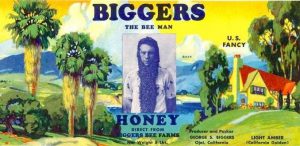
Lucky Oak View resident, Mitch Mashburn, owns this old jar of “Biggers Honey”. (Photo by Mitch Mashburn)

Biggers says that insecticides are wiping out whole colonies of bees, which is creating a danger to American agriculture, as bee pollination is used to increase crops. He moves hives all over California and the western part of the United States. He recently moved 1200 hives to Crowley County, Colorado.


BIGGERS MADE NAME WITH BEE BEARDS: George S. Biggers, famous for wearing a beard of bees that reached from his ears down to his waist, kept a bee farm of more than 1,000 colonies on South Padre Juan in Meiners Oaks in the 1960s and ’70s. He was featured on the television show “Ripley’s Believe it or Not,” three times for his famous bee beard. “He wanted to show people that they don’t need to be afraid of bees,” said his daughter, Esther Livesay, a Mira Monte resident. A photograph of Biggers wearing his famous beard, was used on the label for Biggers Bee Farm honey.