Walker Built Homes on Cutting Edge of Day’s Designby David Mason
“What man has learned about himself in the last five years will, we are sure, express itself in the way he will want to be housed in the future.” Arts & Architecture – January 1945
After World War II, the newspaper and magazine were full of advertisements for new homes being built for the returning servicemen. They were often written to where it seemed as if the postwar houses were, ultimately, what the war had been all about. Only rarely did they use the old, cozy imagery of home and hearth. The magazine, House and Garden wrote in 1945 that modern architecture was “a continuing struggle for growing liberty.” They felt that “For some, if soldiers were to return to old-fashioned houses and enclosed rooms, the fight would have been as good as lost.”
In 1945, the publication; House Beautiful presented a house in Beverly Hills, and wrote that “it was the house to which Johnny dreams of marching home to,” and that this was, “one of the ideals these veterans have fought for and which they can now look forward to attaining.”
The same year, the popular magazine; Arts & Architecture, thinking it might stimulate the sale of their publication and promote house sales, they announced their Case Study program. It was the California sun rather than the hearth that was at the base of the program. A five-acre piece of land was acquired, a site overlooking the ocean on the palisades above Santa Monica Canyon, and nine architects were invited to join the program. There were no restrictions on what type of houses they designed. The Case Study houses were open to the public and introduced experimental materials and the new modern forms. One of the finest designers of this important postwar program was the 35 year old, Rodney Walker.
Although he was born in Salt Lake City in 1910, Rodney was mostly raised in the town of Ely, Nevada.
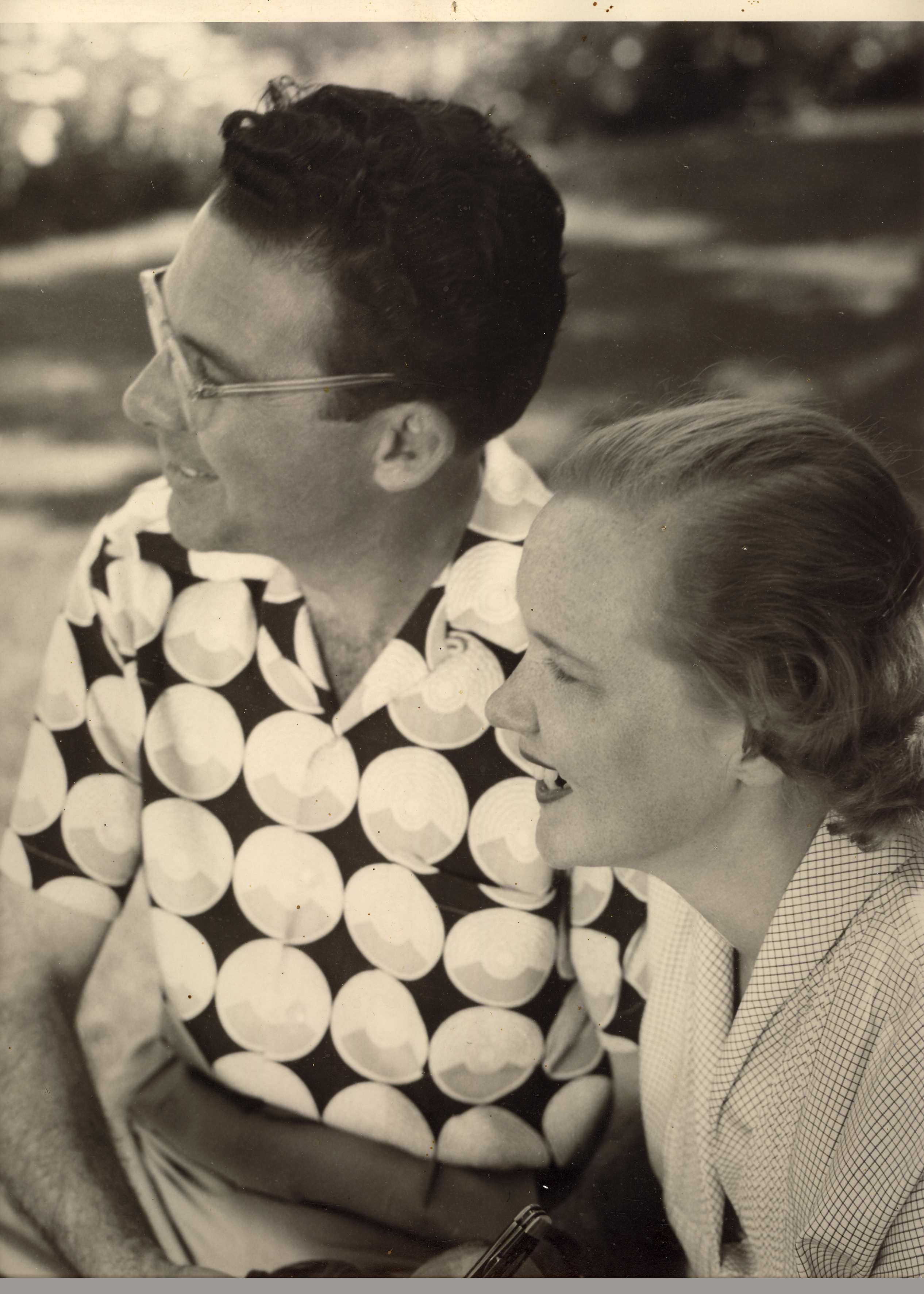
Rodney & Dorothea Walker in 1952
In his younger school years, he showed a great interest in music, dramatics and sports. Walker went to the Pasadena City College to study engineering with the hopes of eventually transferring to Cal Tech. These ideas were changed when he was lucky enough to receive an athletic scholarship to UCLA. At UCLA, Walker studied the arts and during his senior year, he met and married his wife, Dorothea, who was also a UCLA student.
They built their first Los Angeles home in 1937. Rodney Walker did the design, and together with his new wife, they did all the construction work themselves, except for the electrical and plumbing. The satisfaction of completing that first house instilled in Walker that this would be the perfect occupation for him.
By the time America entered into World War II, Walker had designed and built a dozen houses around Los Angeles for his clients. During the war, with construction at a stand still, he worked for an airplane company and continued his architectural studies. Every spare moment was used visiting prominent buildings in the Los Angeles area to familiarize himself with the style and techniques of the city’s major architects.
When the war ended, the young couple were able to purchase a parcel of land in the hills above Beverly Hills, and built a new house for themselves on this important piece of real estate. The house was extremely modern and had over 2000 square foot of floor space with a sweeping view from the city to the sea. It was a striking home.
When the Walkers were asked by Arts & Architecture if their home could be used as one of the original
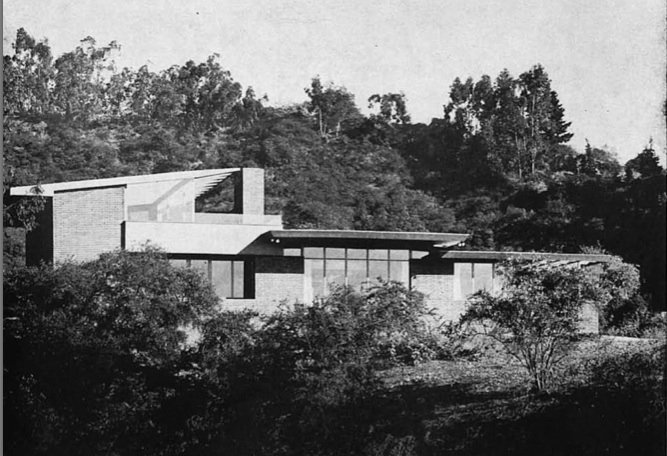
Rodney Walker’s CSH #18
Case Study houses, they consented. The idea of the Case Study houses was that people would not really understand modern architecture unless they saw it, and they weren’t going to see it unless it was built. The Walker’s house would become the first house to be shown to the public and to be covered exclusively in publications. The Walkers enjoyed being in on the ground floor of such an exciting time in California architecture. Within a short time, their home was featured on the cover of the Los Angeles Times Home Section, and the narrow mountain road leading to their home, was congested with an estimated 4000 people driving into the hills to catch a view of this spectacular home.
Walker designed two more of the Case Study houses. He used his own construction crew and he joined them in the actual building of these fine houses.
For the next 10 years, Walker continued to work in the Los Angeles area, mostly building the houses that he had designed, however, occasionally, he would do the design and just supervise the construction. Most of the time, he preferred to do the actual building himself.
One of Rodney Walker’s policies was the construction of two houses at the same time. One would be for the client, and they got top priority, while the second house would be built for spec, and was primarily to keep his crew busy while waiting for the plumber and electricians to finish their jobs.
Walker refused to accept more than two jobs at a time. He enjoyed his time; “in overalls on the job,”
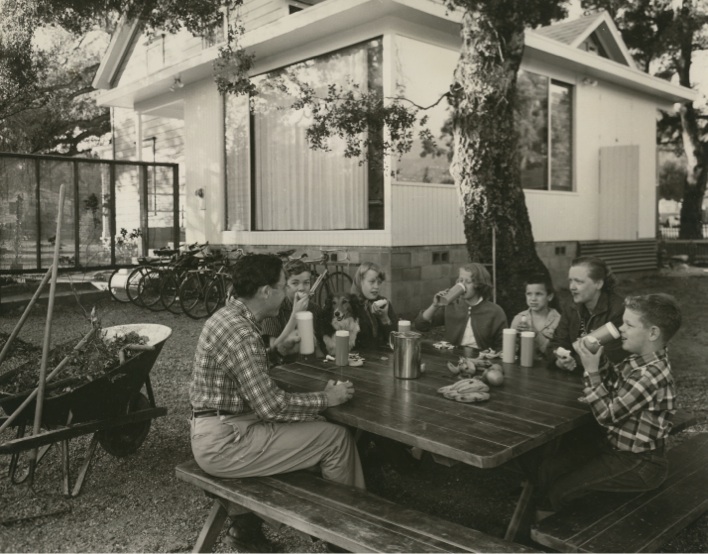
Walker’s Case Study House #16
for it was during these construction times that he felt that he was really able to work out the details of his designs. During this period in time, it wasn’t considered professional for architects to do the actual building themselves, so rather than give up the construction end, which he felt was such an important part of his final architectural product, he chose to remain a builder-designer.
Walker continued to work on various ways to make his houses truly outstanding in design and by using the latest products he was able to make the houses more reasonably priced so that everyone could own and enjoy his art.
UCLA had a gallery showing of his works in 1948 and it brought this designer to the attention of the Southern California media. Home magazines were noticing this very talented designer and many publications were featuring his work. House Beautiful worked for a solid year, photographing the Walker house in the various seasons and holidays in order to devote an entire issue of their magazine to this modern home. After the publication hit the stands, the Walkers received mail from all over the world. The people of the country were ready for a change, and this new modern design was very exciting to them.
In 1955, the Walkers took time off to travel north to Ojai. Their first visit would cause them both to fall in love with the serenity of this valley. The thoughts of purchasing property here became a reality in a very short time.
Walker added this modern addition onto the old farmhouse at 308 Signal.
Their first Ojai property, bought with the idea that it would be used for a week-end house, was an older Victorian on North Signal Street. The remodeling job of this house, featured in Better Homes and Gardens brought the artistic family even more recognition. Their love of the valley was so strong that in 1956, they decided to make Ojai their permanent home. They felt that it was a perfect place to raise their 5 children, and they wanted to get involved in keeping the Ojai Valley the wonderful place that welcomed them when they first arrived.
During the next two years, Walker finished up the commitments he had started in the Los Angeles area, and started accepting a few designing jobs in the Ojai Valley.
One of his early designs was a Thacher Road weekend house for Elsa Pehrson, a resident and doctor of San Francisco, built in 1957. The house is an L shape with wide overhangs. It is constructed of concrete block and floor to ceiling glass walls. The house was oriented on the lot to take advantage of the mountain views and magically, it captured the excitement of the period.
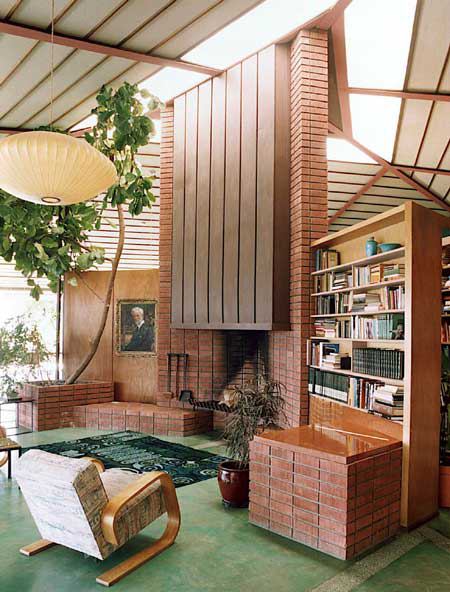
The Walker home in Ojai
Walker then decided to build another house for his own family on a large parcel of land on the west side of the Arbolada. The house would be his masterpiece. It set on top of a low hill that had a breathtaking view of the Ojai Valley. Hexagon in shape, it was constructed of steel and glass. The exterior walls were totally made of glass to provide for an uninterrupted flow from the interior rooms to the outdoor living areas. It is truly a modern palace.
At the same time, another commissions had come his way, the 1959 Ojai Valley home for Dr. David Harvey and his family. This house was also constructed of steel and glass, and featured a prominent projecting roofline on both the front and back. Full-length glass walls produce an open effect. This spectacular building was featured in Sunset Magazine and the Los Angeles Times.
Anther Ojai home was for Dr. Kurt Semmel. This single-story building featured a modern massive pointed roof that sweeps upward and out, extending over a raised wood balcony. The wide brick chimney provides a corner feature, with tall glass walls on either side, so that a view of the Ojai Valley and the rugged landscape below can be enjoyed from inside the house. Walker’s attempts at drawing the outside in, through the use of glass walls, were very successful.
Once Walker’s own personal home and the commissions were completed, he decided to take a rest. The
The Kurt Semel House.
family departed the valley for a year’s trip around the world. During this time that the family was together, Rodney Walker decided to retire from the business of designing houses and work more toward protecting the quality of life that he had come to enjoy in the Ojai Valley.
One of his local projects was the re-opening of The Oaks Hotel. He spearheaded the idea of getting 200 local citizens to chip in and purchase the hotel block that was standing in the center of town, closed. He served as chairman of the board of the hotel for several years, until 1971, when he decided to retire from civic affairs.
In 1971, Mr. and Mrs. Walker opened The Cello Collection, a unique and interesting gift shop in the downtown section of Ojai. Rodney had become an expert at the art of designing gold and silver jewelry, and his works were featured in their stores, here and in Montecito.
The Walkers purchased condominiums in the Hawaiian Islands and with the yearly decorating and other maintenance of the condominiums, and the exquisite jewelry that he was designing, Walker was able to fulfill that wonderful creative and artistic desire that had been the love of this talented man’s life.
The beautiful homes in Southern California, constructed by this famous designer are highly respected by their owners as the great creation of art that they are. One yearly reminder of this highly respected gentleman, are the beautiful Christmas lanterns hanging in the arcade, which were designed by Rodney Walker.
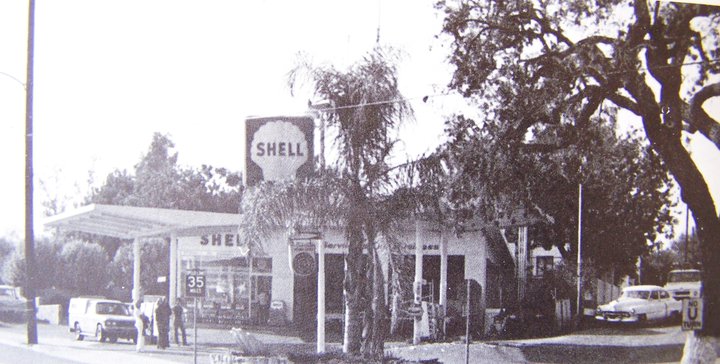
The Faria property along Ojai Avenue is now the location of Cluff Vista Park. The Faria family patriarch, Manuel del Terra Faria, was a Portuguese immigrant from the Azores. The family built their home in Ojai during the 1920s. There was a main house and guest house at the back of the property along Rincon Street. Mrs. Faria couldn’t stand the summer heat in Ojai, so the family moved to a beach house at what is now Faria Beach. They rented their Ojai property to the Erburu family who lived there for many years. Lawrence Erburu, a son, was killed in WWII and is memorialized on the WWII memorial next to the east pergola arch. The other son, Robert, is a retired businessman who once served as President of the Times-Mirror Corporation.
Adamson’s Shell Service Station
Many older Ojai residents will remember when the Faria property was the location of Adamson’s Shell Service Station. It was featured in the film, “Smokey and the Bandit.”
Today, it is Cluff-Vista Park, Ojai’s newest park.
Thanks to David Mason for the photo and information.
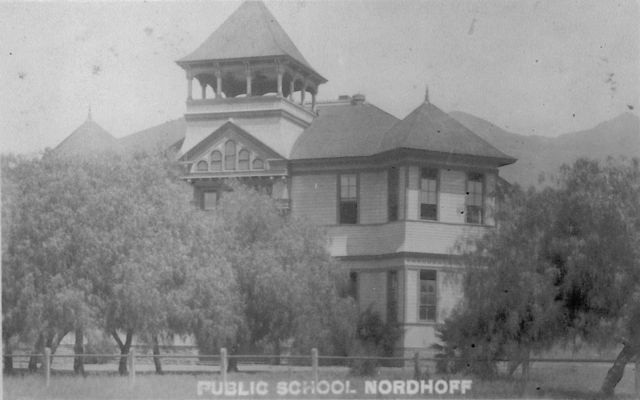
[This week we quote from the chapter School, in the book “Family Album” by Helen Baker Reynolds.]
Norhoff Grammar School, where Miss Baker went to school.
“The grammar school stood just across the road, opposite our side gate. It was a drab, square, two-story building, topped with a cupola housing the school bell, and with two out-houses behind it.
“The schoolyard of hard adobe soil was bare except for one large oak and some pepper tress next to the road, which the girls and the younger children congregated at recess and played tag or drop-the-handkerchief. There also in the spring we played marbles. The marble games were segregated according to sex, since the boys scorned competition with the girls, we being, of course, inferior.
“Playing for ‘keeps’ was forbidden; it was a form of gambling. The ‘bad’ boys sometimes broke the rules,at least, so we suspected. Their ‘smart-alec’ talk about the aggies changing hands was calculated to be not loud enough for a teacher to overhear but audible to the girls nearby, who presumably would be vastly impressed by the enormity of the sin.
“Baseball was the boys’ year-round sport. It was played in the bare yard on the other side of the school, participants daring to slide into base would return at the sound of the school bell, grimy with mud or with dust, according to the season. Because of this invariable result, sliding to base was forbidden. Those who were known to have broken the rule were kept in after school. The crime was not quite bad enough to merit the rawhide strap, but it gave a boy a high standing among his fellows. If often enough, he became an athletic hero.
“I hated school. The freedom of my earlier childhood made long confinement irksome, and the gentle propriety of our home had prepared me not at all for meeting the tough-and-tumble elements which, in our grammar school at that time set the predominant tone.
“On the walls of the outhouse words were scrawled which to me were unfamiliar but which I suspected, with good reason, were simply not nice at all, and some of the children often would giggle at things that made me blush.
“Most of the boys I considered dreadful. They were always yelling and pushing and starting fights in the schoolyard, whereupon Mr. Egerton, the principal, would haul them into the ante room where hung the rawhide strap.
“Mr. Egerton and his rawhide strap assumed in my mind an almost nightmarish quality. Actually he was a virtuous man and a conscientious principal. Toward me he was never harsh. I was even known as Egerton’s pet, being one of the minority who did the assigned homework and more often than not obeyed the rules. I knew at the time that I really ought not to harbor dislike of the principal, but the feeling of aversion persisted nevertheless. It may have been due to my inherent and home-instilled horror of violence, and Mr. Egerton, thanks to a host of obstreperous boys, seemed forever engaged in violence of the rawhide strap variety.
“Slight misdemeanors rated knuckle raps with the ruler; more serious offenses, the rawhide. He would collar the culprit and lead or drag him into the anteroom, from whence would issue horrifying sounds. Most of the boys in the schoolroom and even some of the girls would titter, a few of the boys of the bolder sort letting loose subdued guffaws, but the ‘nice’ girls would look distressed and would try their best not to listen.
“Friday afternoons after recess the whole school had an hour of singing in the assembly hall. Miss Reppy, who taught the primary grades (the one teacher whom the children loved) played the piano accompaniment, and Miss Shaw beat time for our singing, while Mr. Egerton stalked about, keeping order, ruler in hand.
[Editors Note: Mrs. Reynolds entered Nordhoff High School the year it was opened.]
“An excellent faculty had been procured, headed by Mr. Bristol, a competent, scholarly man. The community’s pride in its new school, and the spirit of the teachers, were reflected in the attitude of the 55 students, most of whom were entering high school with more or less serious purpose.
“I loved the school. With ambition and enthusiasm I proceeded to make straight A’s. Every month when I brought home a perfect report card, Father would smile his approval. I never knew at the time, however, what lay behind his invariable remark: “That’s just fine, Helen. That’s just fine. Mother, this little girl is doing all right. Yes, sir, the Ojai Valley is the Best Place in the World.”
This is the third in a series of articles consisting of quotations from passages in Helen Baker Reynold’s book, “Family Album”. The Following is from the chapter, Day’s Ritual.
Our household was a smug little world. Father was its Absolute Monarch, whose cardinal principle in dealing with children was “No Talking Back”. Mother’s cardinal principle was taken from the Bible: “Little Children, Love One Another.” If Father was Absolute Monarch, Mother was High Priestess. Between the two of them the family’s world rode its orbit with the exactitude of any heavenly body.
Breakfast was at seven o’clock. Actually the daily routine was not nearly so arduous as to demand such early hours, but, regarding the principle involved, Father was adamant. To lie abed after six o’clock was, in his judgment, slothful, and his own father always had said, “A slothful man is a sinful man.” So that was that.
Breakfast was the opening Trumpet blast introducing the daily rituals. As we assembled in the sitting room, each greeting the other with a “Good Morning!” which must ring with loving kindness (otherwise Mother would be grieved), Esing (the Chinese servant) would thrust his head in at the door, announcing “Blekfassy he alledy.”
“Good morning, Esing!” we would chorus, and all would troop into the dining room.
Along the sides of the table, with Father and Mother at the two ends, would be ranged as many of the seven children as were not away at school: also Grandmother and usually some visiting relatives or one of the old family friends who came to live with us from time to time. Seldom fewer than seven and more often nine or ten would be seated at the table.
The casual in-and-out breakfast of today, the fast consuming of coffee and toast behind sections of the morning paper, was unknown in our home. Our parents would have thought it rude and unseemly and from the standpoint of nourishment shamefully inadequate.
Breakfast with us was a ritual the pattern of which never varied. It began with a long and fervent “blessing” pronounced by Mother, while we sat with bowed heads. Mother’s blessings were not mere murmured formalities. She went before the Throne of God and took her family with her, earnestly thankful for favors received, leading us willy-nilly, into a day of Christian Goodness.
Our regular fare for breakfast included cooked cereal, bacon, eggs, steak, potatoes, two or three kinds of hot bread, fruit, jam and jelly, and a large assortment of breakfast drinks. Calorie counting was unknown. To be fat was to be healthy. Fortunately obesity did not run in our family.
Breakfast lasted for nearly an hour. It was a time for conversation. Conversation abounded at all of our meals, Esing often joining in. “In Chiny,” he would say from the kitchen doorway, balancing a tray on the palm of his hand and squinting his eyes to slits, “in Chiny we no do sings like you do”. Then he would hold forth on Chinese customs, while we listened with respect. Father sometimes would laugh tolerantly, as if humoring a child, but we young people were taught to be very respectful to servants. Mother never used the word “servant” except in the general sense. A household worker she called “Our Helper”. This was an affectation on her part; it was natural to her, expressing her Christianity.
There were duties for everyone after breakfast. Father would have had the boys up at five-thirty for the early-morning chores, but girls were accorded consideration on account of being delicate.
Of my sisters’ morning assignments the two most dreaded were cleaning and filling the coal oil lamps, a sooty, smelly job and (even worse) servicing the chamber pots. Not until I was ten years old did we have an indoor toilet. For several years after the modern fixture was available and installed in most “good homes,” Father held out against the innovation. His contention was that the things wouldn’t work; hence, they would be unsanitary. Only after one in an outdoor privy had proven its competence beyond the shadow of a doubt was he finally induced to assume the risk of having them inside. Meanwhile he saw nothing unsanitary about the chamber pot. It was time-honored; therefore, it was right.
Most of the routine of cleaning and tidying was done by my mother and sisters. Esing did the entire family laundry, with boilers steaming on the wood stove in the “wash house” outside the kitchen. I always found it fascinating to watch him sprinkle the clothes before ironing. He would fill his mouth with water, then blow in a fine spray. Mother had forbidden this unsanitary method and had shown him how to sprinkle with a whisk broom. Accordingly, Esing kept the whisk broom at hand to use when he heard Mother’s quick, light step approaching. At other times he went back to his own technique. Cheeks bulging, squirrel-like, he would blow out a spray so fine as to be no more than a mist. Between mouthfuls of water he would look at me, who stood watching him, wide-eyed, and would squint his almond eyes to slits with a mischievous, conspiratorial smile. Once in a while he would say to me, “You no tell your mudda.” This admonition always made me feel guilty, for deceiving one’s mother was wicked. I never did make a report, however.
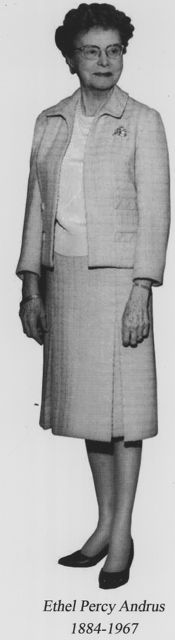
The Age of Reformation: Ethel Andrus and the Founding of AARP
by Craig Walker and Bret Bradigan
from The Ojai Quarterly
As Jack Fay remembers it, it was just a quiet business dinner with six people in a small meeting room at the Ojai Valley Inn. The air wasn’t charged with the momentous changes about to take place. Instead, they discussed legal incorporation issues and health insurance premiums.
Dr. Ethel Percy Andrus organized the meeting. She represented the Grey Gables in Ojai on behalf of the National Retired Teachers Association, and Fay was her lawyer. The others at the meeting were Ruth Lana, Andrus’ long-time lieutenant; Dorothy Crippen, Andrus’ cousin; Leonard Fialco, the assistant to the sixth person present, Leonard Davis, an ambitious if yet only modestly successful insurance broker from Poughkeepsie, N.Y.
During that Ojai evening in 1958, the American Association of Retired Persons was born. And what it meant to grow old in this country changed dramatically. At first, the AARP was structured as a mechanism by which the National Retired Teachers Association, founded in 1947 by Andrus, could sell health insurance to the general public. The NRTA had been selling policies to retired teachers since 1956, and it had proven both profitable and popular. Insurance companies had turned Andrus down 40 times in the past 11 years. Yet in those pre-Medicare days she knew that people over 65 deserved the security and dignity that comes from knowing that they could rely on a doctor’s care.
When Andrus started the NRTA in 1947, 75 percent of people over the age of 65 lived with their relatives and 55 percent lived below the poverty line, according to the National Center for Health Statistics. In 1940, life expectancy was 60.8 years for men, 65.2 for females. In 2007, life expectancy figures were 75.4 and 80.4 respectively.
Some of the increase in lifespan can be attributed to medical advances, which the AARP has advocated and funded. Some could also be plausibly attributed to the dynamic lifestyle that Dr. Andrus pioneered and of which she was a living example: a lifestyle based on exercise, travel, lifetime learning, second careers, political and social activism, volunteering and community service.
Despite its modest origins in Ojai, the AARP now has 40 million members and is considered one of the most powerful nonprofit organizations in the United States. Its magazine has the largest circulation of any periodical. Its lobbying arm in Washington, D.C, is considered the most formidable. The organization extends into every area of aging, from leading-edge research to group travel discounts.
Fay, a former Ojai mayor and city councilman, is still practicing law. He is the sole survivor of that meeting since the death of Davis in 2001.
“As the meeting broke up, Davis took me by the shoulder and whispered to me, “You’ll never get anywhere in life if you don’t think big,” Fay recalls. “And I thought that was a heck of a good idea. So, I started thinking big. It didn’t work for me, but it did work for Davis.”
Leonard Davis convinced Continental Casualty to start up a pilot program for selling policies to everyone over the age of 65, not just retired teachers. It proved an immediate success. It went nationwide, with Davis as the sole broker. “He had the whole country as a fertile field to sell his health insurance,” Fay says. “So he made the best of it.”
Davis put up $50,000 in startup money. Dr. Andrus founded Modern Maturity magazine, now AARP Magazine, which lobbied for the interests of the elderly and, perhaps not coincidentally, served as an excellent marketing vehicle for the health insurance policies in those pre- Medicare years.
Within a year, the number of policies written went from 5,000 to 15,000. Within a few decades, Forbes magazine listed Davis as one of its 400 wealthiest Americans, with a personal fortune estimated at $230 million at the time he sold his Philadelphia-based Colonial Penn Group in 1984.
“I remember that evening vividly,” Fay says, “But I don’t think any one of us realized the import. Who could have predicted it?”
If anyone could have predicted it, it would likely have been Dr. Andrus, who founded the NRTA in 1947 before moving to Ojai from Glendale in 1954 to open a revolutionary new retirement home for teachers at Grey Gables.
A daughter of the progressive movement
She was born in San Francisco in 1884, the daughter of what she described as “a struggling young attorney” and “his proud and admiring helpmate.” She graduated with a bachelor’s degree from the University of Chicago in 1903 and began her long and storied teaching career at the Lewis Institute, the first junior college in the country, now the Illinois Institute of Technology.
She volunteered regularly at the nearby Hull House, founded by prominent reformer Jane Addams, who in 1930 became the first woman to win the Nobel Prize. At the time of Andrus’ volunteer service, however, the Hull House, founded just a few years earlier in 1897, was still an open experiment in social democracy, providing spiritual and educational uplift for its neighborhood of newly arrived immigrants in some of Chicago’s poorest neighborhoods. Each week, as many as 2,000 people came to the settlement house for night school classes, kindergarten classes, its famed public kitchen, its art gallery, gym, bookbindery, drama groups and library.
Dr. Andrus might be seen as a product of the Progressive Movement, which arose in the late 19th century as a socially responsible response to the abject poverty in which many of the new wave of immigrants lived, as well as against the greed of the Gilded Age of robber barons and growing economic inequality. Crusading journalists like Ida Tarbell and Frank Norris brought attention to the dangers and humiliations faced by factory workers and farmers. In 1906, during Dr. Andrus’ service at the Hull House, Upton Sinclair’s The Jungle, about Chicago’s meatpacking plants and stockyards, was published. With its nauseating descriptions of filthy practices and labor abuse, it led to such reforms as the Pure Food and Drug Act. The story of a Lithuanian immigrant and his family living in squalor and abuse, The Jungle intimately described many of the people for whom Addams, and Andrus, sought to provide a ladder out of poverty.
“I learned there to know life intimately and to value folks of different races and creeds,” Dr. Andrus wrote. “I saw there wonderful examples, not only of rehabilitation but of resurrection as well.”
Return to California
Her father’s failing health and eyesight brought her back to California. She took a teaching position at Santa Paula High School, which may have been her first exposure to Ojai, though she is said to have selected Ojai for her endeavors after giving a talk at Nordhoff High School in 1953.
In 1916, she was offered the assistant principal position at East Los Angeles High School. The following year, the principal retired and she was offered the job. At age 32, Ethel Percy Andrus had become the first female principal of a large, urban high school in the state of California.
With her flaming red hair and intense purpose, Andrus cut a memorable figure. One of her students, the actor Robert Preston of The Music Man fame, said, “The big iron scroll at Abraham Lincoln High School through which we passed said “Opportunity.” Isn’t it amazing that we didn’t know until we walked out: Opportunity had red hair!”
The lessons Ethel Percy Andrus learned at Hull House would serve her well over the next 28 years.
The school was notorious for its high rates of social dysfunction and juvenile delinquency. Despite the grand homes on the bluff overlooking the Los Angeles River, the district was also crowded with coldwater flats and tarpaper shacks from immigrant influxes: Chinese, Japanese, Italian and Mexican families particularly.
Lincoln Heights, considered the oldest neighborhood in Los Angeles, was always ethnically diverse, and racial clashes were common. It was the setting for the infamous Zoot Suit Riots, which began in 1942 because a Hispanic youth named Jose Diaz was allegedly murdered in Sleepy Lagoon in nearby Williams Ranch.
Asians, Latinos and Italians mixed with affluent founding families as well as Russian refugees from a Christian sect. Andrus wrote, “They lived in the flats near City Hall. They were an interesting people, led by an epileptic and financed by the elder Leo Tolstoi.”
Lincoln’s Legacy
Dr. Andrus’ first task was to find some concepts to unify these immigrants and starchy patricians into a community. “Our faith became an obsession,” she wrote. “We must keep our many nationalities conscious and proud of their racial and national background, of the contributions made to the American dream, and to the insistent obligation they, the youngsters, must themselves accept in raising their own coming families with a double loyalty; respecting their own roots and the traditions alike of America and the land and faith of their forefathers.”
Every school day, at auditorium call, the students repeated these words: “I hold these truths to be self-evident; that all men are created equal. God hath made of one blood all races of men, and we are his children, brothers and sisters all.”
Her father’s hero was Abraham Lincoln. Her nephew was named Lincoln. Lincoln was also the hero of her mentor, Jane Addams, whose father was one of the founders of the Republican Party and a personal friend of the Great Emancipator. In 1919, Dr. Andrus was instrumental in having the neighborhood renamed from East Los Angeles to Lincoln Heights, and the 2,000-student school renamed Abraham Lincoln High School.
One of the anecdotes told about Lincoln was that after he gave a conciliatory speech about the Confederacy, a woman in the audience said, “But Mr. President, we must destroy our enemies!” Lincoln replied, “Yes, ma’am. But do I not destroy my enemies when I make them my friends?”
Dr. Andrus took that story to heart, always working to defuse tensions in the multiethnic community and build a shared sense of purpose. She forged strong connections. She worked with Los Angeles County Community Hospital to train nurses at the school. She encouraged civic associations like the Optimists to sponsor education awards and scholarships. Former athletes came back as coaches. Standout students went to college and came back as teachers. Besides Robert Preston, among her renowned alumni were actor Robert Young (who played Marcus Welby, M.D.) and Cardinal Robert Mahoney.
It didn’t take long before Dr. Andrus’ reforming zeal stirred up controversy, and delivered results. For example, she dropped Latin and Greek, and added vocational courses. “The discipline and faith routinely ingrained by the school reduced juvenile delinquency and brought a citation from the Superior Court,” wrote Scott Hart in “The Power of Years,” an Andrus biography commissioned by the NRTA and the AARP.
Among her proudest achievements was founding the Opportunity School with but one other certificated teacher, but with a staff of vital teachers: engineers, salesmen, preachers and the like. It later became the Lincoln Heights Adult Evening School,” she wrote. It served as a focal point for a community fractured along ethnic and economic lines.
Dr. Andrus said, “It was not a revolutionary idea–except in practice–to realize that the sons and daughters of folk pouring in from every corner of the globe had now some kind of common background, something to hold them together, a community pride.”
A lifelong learner, Dr. Andrus received her M.A. in 1928, and, in 1930, became one of the first women to receive her Ph.D. from the University of Southern California.
She also brought her faculty together into a tight-knit team. Ed Wenig, her drama teacher, moved to Ojai after his retirement to help her with the NRTA. Wenig became an esteemed local historian as well as a columnist for Modern Maturity magazine.
Wenig’s daughter, Patty Atkinson, was five in 1956 when the family moved to Ojai. “She was an imposing woman–she commanded a lot of authority,” Atkinson says of Andrus. Atkinson says her father adored Dr. Andrus, serving on many boards with her, including the NRTA, and helping with her many writing and publishing ventures after moving to Ojai.
Atkinson remembers her father, who had quite a peripatetic career including a stint teaching in the Philippines before joining forces with Dr. Andrus, talking about the day in 1942 that the Japanese students were rounded up to go to internment camps. “As the buses passed the school, the entire student body stood outside and waved,” she recalls. That measure of human respect was directly due to Andrus’ influence.
She also says her father would herd the students into assemblies and stage radio plays while the faculty held meetings. Often, Wenig would have to frisk students for weapons as they filed into the auditorium.
Even as Lincoln High School became nationally recognized for excellence, Dr. Andrus’ methods were studied and encouraged by the National Educational Association, her priorities changed to the very local near the end of the school year in 1944.
“My resignation came to Lincoln and myself as a sudden surprise,” she said. That morning the nurse attending my mother told me of her belief that my mother was to be a hopeless invalid. On the way to school, I determined that I could give to her the loving care she had given to my father during his blindness.”
Dr. Andrus was 60 years old, with a full life of significant achievements. But it was while caring for her mother that she became acutely aware of the problems faced by aging people. And so she launched the second, and most enduring, role of her career.
The Chicken Coop
In the AARP’s current television ads, the camera lens takes in a decrepit chicken coop, with the narration: “The unlikely birth place of a fundamental idea… Ethel couldn’t ignore the clear need for health and financial security, and it inspired her to found AARP.”
The chicken coop incident came not long after her retirement. While she was caring for her mother, Dr. Andrus kept busy with professional associations. She was named director of welfare for the Southern Section of the California Teachers Association, charged with seeing to the material needs of thousands of retirees.
It was a job she took personally, having learned that her pension, after 40 years in education, was $61.49 a month plus another $23.93 a month in an annuity, barely even a living wage. While she could rely on family money and other sources of income, she realized that very few teachers had such privileges waiting for them after their careers were over. Most retired teachers in those days were women, who were left especially destitute when widowed.
One day a local grocer asked Dr. Andrus if she would check on an old woman he hadn’t seen in several days. He gave Ethel the woman’s address. The people who lived there didn’t recognize the name, but then said, “Oh, you must mean the old woman living out back.” That’s when Andrus discovered that one of her retired teachers was living in a chicken coop. The woman was gravely ill, but had no money to visit a doctor. It was a moment that would charge Ethel Percy Andrus’ life with a new purpose.
She set about this new mission with great deliberation. The first step was to organize teachers nationwide in an effort to boost their collective clout. On Oct. 13, 1947, the 125 members of the California Retired Teachers Association present in Berkeley voted unanimously to form the National Retired Teachers Association.
That long journey eventually led to Ojai. Dr. Andrus began stumping the country, giving talks about the issues of aging, about the great gifts that elderly people could contribute to society, and about the means and mechanisms by which that pent-up potential would be realized. She brought an evangelical zeal to the task, repudiating the well-meaning social workers, retirement home activity directors, and even retirees themselves who fill the days of retired people with recreational activities like bingo or shuffleboard.
Older people need purpose in their life, meaningful and productive work, Dr. Andrus said. She objected to the term ‘senior citizen’ as isolating and demeaning. “We wouldn’t call 45-year-olds junior citizens,” she would say.
Friends and associates noticed a marked difference in Dr. Andrus. “She might talk with nostalgia of
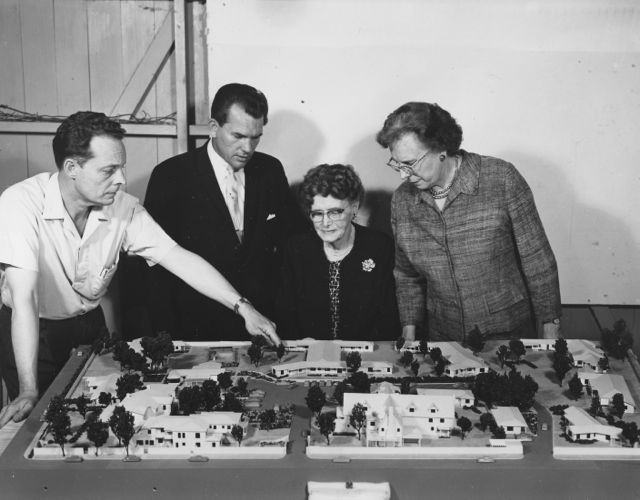
Model of Grey Gables used at the 1964 New York World’s Fair.the halls of ivy, and hours later with iron firmness about a business matter. Her ability to listen equaled her gift for quick brisk speech, everyone left her company feeling good about themselves, according to Power of Years.
the halls of ivy, and hours later with iron firmness about a business matter. Her ability to listen equaled her gift for quick brisk speech, everyone left her company feeling good about themselves,” according to The Power of Years.
Fay says that being in her presence “was an amazing feeling. She was an idealist and a visionary, and her lieutenants, Dorothy and Ruth, did the nuts and bolts work, and I did the legal work. She was a leader in the true sense of the word. She had great charisma, very articulate, although soft-spoken. She had such an aura about her, that I’ve been with her on several occasions when as soon as she walked into a room, silence came over it, and they looked at her in awe.”
One of the goals she set for the NRTA was to provide a model facility for active retirement. As she began casting about for a location, she might have remembered Ojai for its warm, dry air and bright sunshine from her days as a teacher in nearby Santa Paula; or she might have had conversations with local residents about the idea after giving a talk at Nordhoff High School, then located on El Paseo Drive.
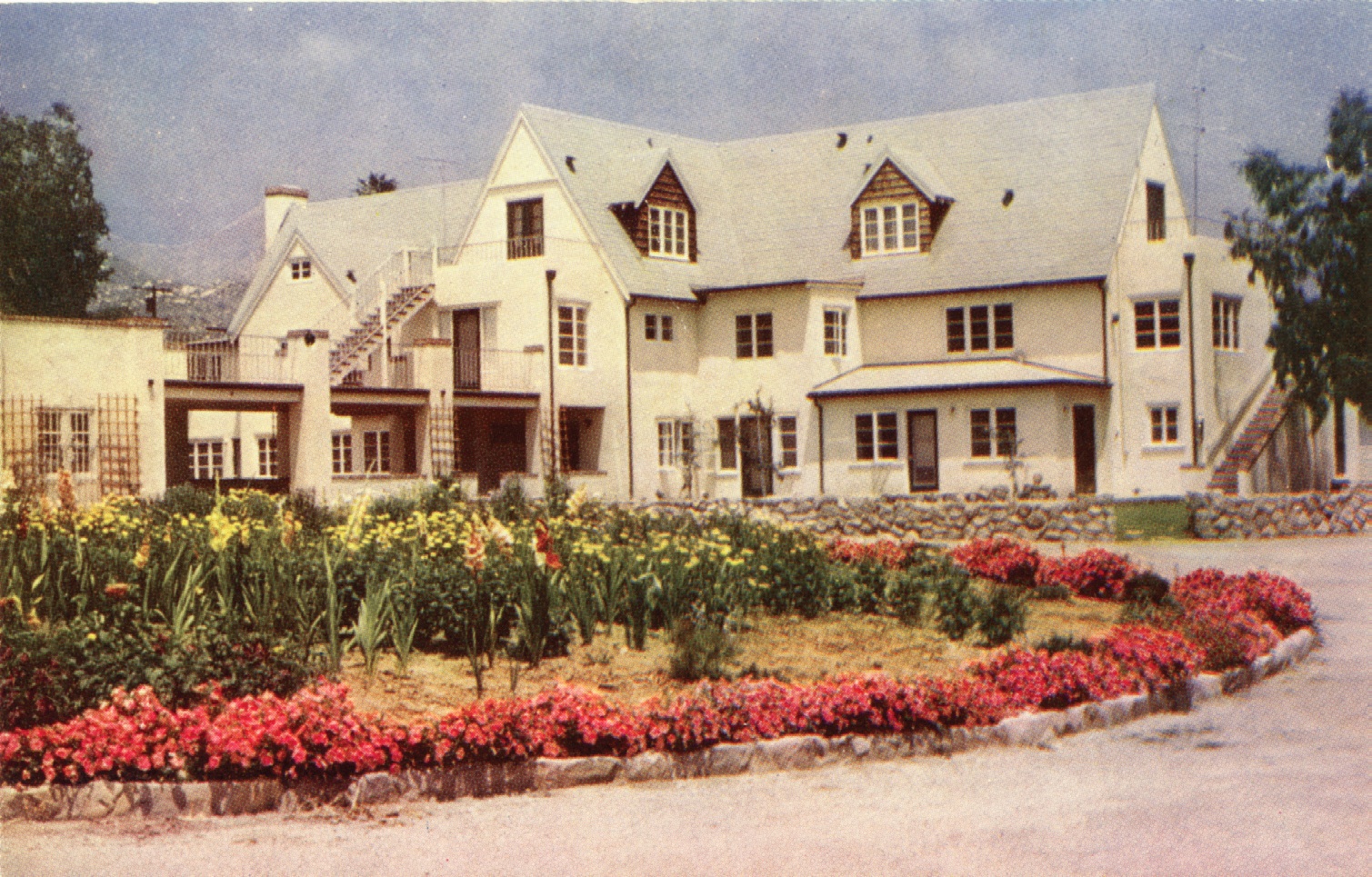
Grey Gables of Ojai
Quiet Town, Big Changes
The morning after her Nordhoff talk in 1953, she saw two buildings for sale; a house on the corner of Montgomery Street and Grand Avenue, and a three-story building behind it. The property, Grey Gables, already had several small apartments, common living areas, a library and a large music hall. The NRTA put in an offer.
She had a grander vision of what retirement living could be than anything that had come before. Dr. Andrus foresaw a nursing home where the elderly might receive 24-hour care, and where they would actively work, volunteer and participate in the life of their community.
The city was skeptical. There were two other applicants for the site: Sam Sklar, who had recently bought Wheeler Hot Springs, and planned to operate the Gables in conjunction with his resort; and Alcoholics Anonymous, looking for a rest home for people in recovery. “The City was also not eager for us, grudgingly granting us the license which was essential to the sale only after being forced to decide between the claims of Alcohol[ics] Anonymous, a resort of uncertain moral standards and a retirement home. Finally, at long last, the City Council felt our institution was the least worst, and Grey Gables was in the forming,” Andrus wrote. Obstacles loomed, however.
The previous owners proved difficult. “The Sanfords were unpredictable; they wanted badly to sell, but
Grey Gables in 1954
they hated the necessity of foregoing their dream,” Andrus wrote.
But the sale was a necessity. The Sanfords were about to be foreclosed on, owing $80,000 on the property. (Alee Sanford had her own, parallel vision for the property when she built it in the late 1940s, as a resident teachers’ club and library, with subsidized housing for local teachers.)
The first five years were a whirlwind of activity. Dr. Andrus brought Lana to Ojai as her trusted advisor, and they set to work “often substituting sheer energy for cash, and nervous energy for cash,” she later wrote. They created the menus, arranged the activities and attended the phones 24 hours a day.
The first resident, Emma McRedie Turner, from Chicago, arrived on July 17, 1954. “I was absolutely alone here, but the patrol car came by regularly,” she was quoted as saying in The Power of Years. Within 10 years, it had 85 residents.
“We of Grey Gables are certain that this project will be a pilot one, the first perhaps of many to prove to the world that retirement can be a dynamic adventure in gracious living,” Andrus wrote.
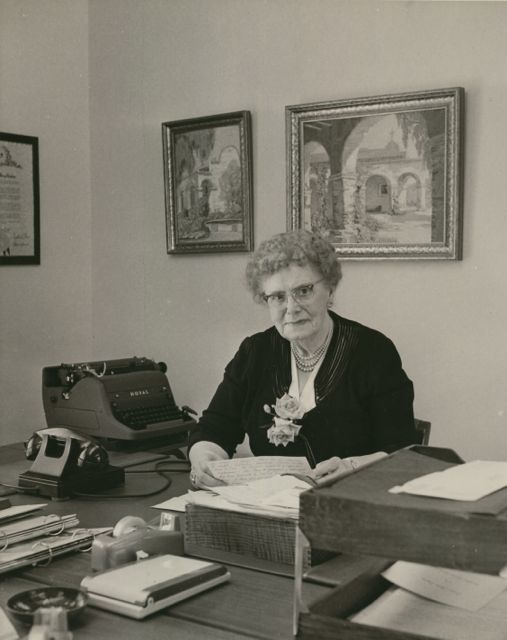
Dr. Andrus at her desk in Ojai
Jack Fay remembers his initial encounter with the red-haired dynamo. “In 1955, I first met Dr. Andrus at a City Council meeting, where I was representing an applicant for a land-use proposition, and she was there with her attorney, opposing my client, and it was a very contentious hearing, but not with her. I was just fine with her. I lost that case. She won it. Within a week, Andrus called me and said, ‘I wish you’d be my attorney.’ So I said, ‘Fine!'”
Little did I know what I was getting into. Dr. Andrus brought a large crew of people with her to Ojai from her former home in Glendale, including Ruth Lana, herself a former teacher. Ruth’s daughter, Lora, spent several years in Ojai, first as a student at Happy Valley School, then as an employee of the NRTA and AARP. “I remember opening these countless envelopes and shaking out the $2 [AARP membership fees] inside,” she said. The AARP grew from its first member in 1958 to about 400,000 in 1962, when the membership office was moved to Long Beach. The organization continued to be headquartered in Ojai until 1965, when the entire operation was moved first to Long Beach, then to Washington D.C.
Early residents of Grey Gables were attracted by Ethel’s vision of an active life of service, and so the Gables soon became an important asset to the community. Its residents served on local boards, tutored in the schools, taught classes at the Art Center and volunteered throughout the valley.
In 1959 the Ojai City Council, which had originally balked at the project, awarded Ethel Andrus and her Grey Gables residents a city proclamation honoring their many contributions to the community.
While she was busy lobbying politicians in Washington, D.C. (Lora Lana remembers her mother and Andrus living out of suitcases for weeks at a time), she also kept close touch with her people in Ojai. When a Nordhoff teacher, Herb Smith, and his wife were stricken with polio, Ethel spearheaded the fund-raising effort that paid for their house to be retrofitted for the wheelchair-bound couple.
Andrus cut quite a figure around town, says Anne Friend Thacher, who began working for both the NRTA and the AARP maintaining membership files. “No one called her Ethel. She had this striking red hair and was a very smart person.”
Dr. Andrus also brought her nephew, Lincoln Service, along with his young daughters, Barbara and Suzanne (Sandy) Andrus Service, to Ojai in 1954. The girls were seven and eight. Dr. Service served as the Gables’ medical staff. “We just loved Ojai,” Barbara says. “It was rural, and very beautiful, and very different from Glendale.” Even with Ojai’s laid-back country feel, Dr. Andrus insisted on proper decorum in dress and bearing. “One time she drove me down to Long Beach to go clothes shopping,” Sandy Service says. “We went into several stores where I would sit on the sofa and they brought out clothes for me to try. She would always pick these fancy silk suits. I said, ‘Nana, people in Ojai don’t dress like that.” She said, “A lady is a lady no matter where she lives.”
Thacher was a student at Happy Valley School at the time. Lora Lana was a year ahead of her. Thacher was promoted to secretary and continued to work for both organizations while a student at Berkeley. “They employed a lot of local people. The pay was pretty terrible,” she says. “One of my jobs was to correspond with people who had questions. One of the questions was, “How do you pronounce Ojai?”
Dr. Andrus was known for hiring young people. both to keep the former teachers in touch with youth, and also to allow the residents to use their wisdom and experience to guide young people. “Youth can and should be courted,” she wrote. “Youth will, in dividends of gratitude, pay high for the investment of the oldster’s time, interest and thoughtful attention.”
As the NRTA and AARP grew into national powerhouses, the local offices expanded. In 1954, the NRTA purchased Sycamore Lodge, a motel next to Grey Gables that fronted Grand Avenue; later, several apartments were added on the back and west side of the property. The Acacias nursing home was built in 1959.
Dr. Andrus set out the vision for the Acacias in an article for Modern Maturity in 1959, shortly after its purchase:
“The Acacias hopes to be more than a nursing facility, more than a convalescent home; it is a health center that will demonstrate the potency of helping older people discover the basis of their trouble and through care, friendly concern, and expert service find the right channels to recovery. The Acacias in its freshness and beauty of building and setting is in itself a strong factor in the attainment of this goal; its lines are restful; its colors refreshing; its furnishing modern and effective.”
Though she was instrumental in many causes of the day–working to end mandatory retirement and age-related discrimination, and to establish the now ubiquitous senior discounts–Dr. Andrus did so in an entirely non-adversarial manner. She didn’t lead marches, sit-ins, political campaigns, etc. It was all done through education, research, advocacy and programs by her own membership organizations.
Through the research arm of AARP, she exploded many commonly held myths, stereotypes and assumptions about aging. She used this new knowledge about aging to promote a new image of growing older and retirement … from the end of one’s creative life to the beginning, from isolation to involvement, from deterioration to continued growth, from a time to be feared to a time of opportunity and renewed productivity.
Leonard Davis and Dr. Andrus made a formidable team, lobbying tirelessly for the passage of Medicare in 1965.
Davis died at age 76 in 2001. Despite a few scrapes with regulators and Congressional investigative arms (he lost his lock on being the sole insurance broker for the AARP during the 1970s), he was a generous benefactor to many causes. In addition to the many millions he and his wife Sophie gave to universities, museums and cultural centers, he endowed the Andrus Gerontology Center at the University of Southern California, the first center in the country devoted to training medical staff to treat elderly patients.
Dr. Andrus died July 13, 1967, active to the end, mourned by many and replaced by none. Though she had unlocked the vast wealth held by retired people as they were brought out of isolation and into the mainstream of America, her personal fortune, according to Fay, was valued at less than $100,000.
She was eulogized by President Lyndon Johnson as well as by Ojai friends and neighbors. “In Ethel Percy Andrus,” he wrote, “humanity had a trusted and untiring friend. She has left us all poorer by her death. But by her enduring accomplishments, she has enriched not only us, but all succeeding generations of Americans.”
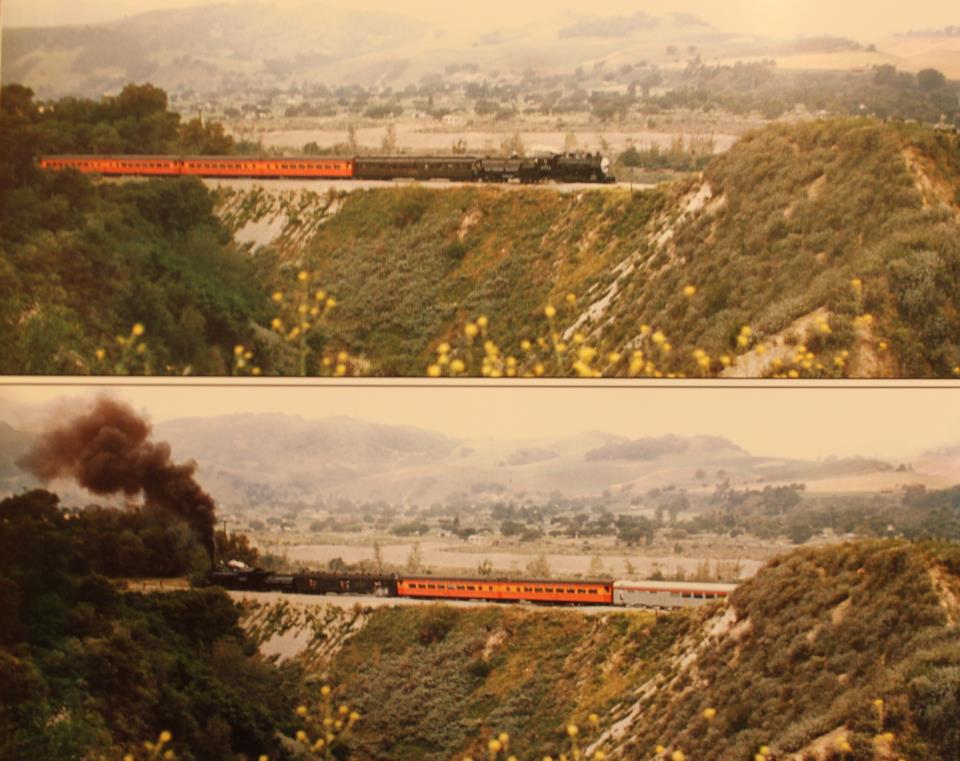
These pictures are from the book Southern Pacific’s Scenic Coast Line – A Color Pictorial by Tom Dill. They were taken by Stan Kisler. The last steam run up the Ojai Branch occurred on May 22, 1955. This was an early form of “push-pull” operation with the 2771 on one end and the 2367 on the other as the special works up the steep grade on the big fill near Oak View.”
We’re not sure when this photograph was taken; perhaps shortly after the Arcade was completed in 1917. That’s the Isis Theater in the background. Note the sunshades on the arches!
Nordhoff and vicinity is in a ferment of excitement over the hiding place of an immense ledge of gold-bearing quartz which runs from the Coyote and Matilija canyons to the Sisar Canyon. Old miners say they believe it to be an extension of the Piru district strike, and are trying to locate the leads on the ledge, while the greenhorns are generally staking out claims at random.
The Ojai on March 13, 1897.
The gold fever had started the previous Wednesday afternoon when some old prospectors from the Wilsie ranch in the east valley appeared with some likely looking rock, the main street of Nordhoff was literally crowded with men, hot with the gold fever. The editor of THE OJAI announced to the crowd on the street that he would print some location blanks for use in posting possible claims. By 10 p.m. they were off the presses and were sold to the waiting crowd which had gathered in his shop during the evening. The editor was wakened at frequent intervals during the night to make further sales, and by 7:30 a.m. on Thursday he had disposed of 163 location blanks. (By noon the following Saturday he had sold over 380.)
A Mining Camp
In describing what took place on Thursday, the editor wrote:
The usually quiet little village of Nordhoff has suddenly become an excited mining camp. Fully seven-eights of the male population of the village were scouring the Chaparral. Many struck out in the middle of the night to get ahead of the “other fellow.” And in the early morning they dotted the hills like a flock of blackbirds in a cornfield.
Some came back early from the hills discouraged, but when some one came into town with some bits of gold, all would rush off again to the hills. Sometimes they seem to go stark, raving mad, –plumb crazy, reported the newspaper. Rumors added to the confusion. One such indicated that the Southern Pacific was getting ready to sell through tickets to the Ojai mines. Already men from Ventura, Santa Paula and Santa Barbara had arrived. That evening at a mass meeting in the office of George Stewart, plans were laid to form the Ojai Mining District. The boundary of the district was to include the territory of all the school districts in the valley, including Sisar, Upper Ojai, and Santa Ana. The United States Mining Laws were to govern the district. The following prominent men were among those who signed the resolution: W. E. Wilsie, George R. Coe, Earl Soule, W. F. Parrish, B. Ward Blumberg, John J. Burke, J. F. Dennison, S. B. Rose, and D. J. Raddick. Unfortunately for Mr. Stewart, by the close of the meeting, someone had made off with a little nugget he had placed in a showcase.
Shot full of Holes
The Ojai Gold Rush had both its dramatic and humorous sides. A miner from Santa Paula put up this notice on his claim site: Anybody who attempts to jump this claim will be shot full of holes. Commented E. S. Thacher, “How can a free silver man expect a hearing when he undertakes to suppress the new-kindled desire of our community for gold? Wee may vote for silver, some of us, but when it comes to posting notices and digging, and pounding, we all want gold, and we are determined to have it.” Dan Smith startled a crowd on the street by saying he had a claim that went $30 a ton at one foot below the surface. When asked for proof, he pulled a big potato from his pocket! For the next three weeks, except for an item about the Ojai Mining District assay of $11.30 to the ton, the newspaper was strangely silent about gold mining activities. Then in the issue of June 12 appeared the statement:
The gold miners of the Ojai Valley have been weighed in the balance and found wanting. It develops that apparently gold is not present in sufficient quantity to pay for the working, and as a consequence the mines have petered out.
Within weeks, Ojai pioneers were back to normal, listening to the gramophone at George Mallory’s store, planning a concert of the Ojai band, and participating in community dances. Years after the gold boom John Dron Sr. reported uncovering in the foothills a can containing a mining location blank which had been filled out by some disappointed miner. So far as is known, all mining stakes have disappeared from the Ojai Valley.
Source: Ed Wenig, “Ojai succumbs to its own gold rush”, The Ojai Valley News, March 11, 1970
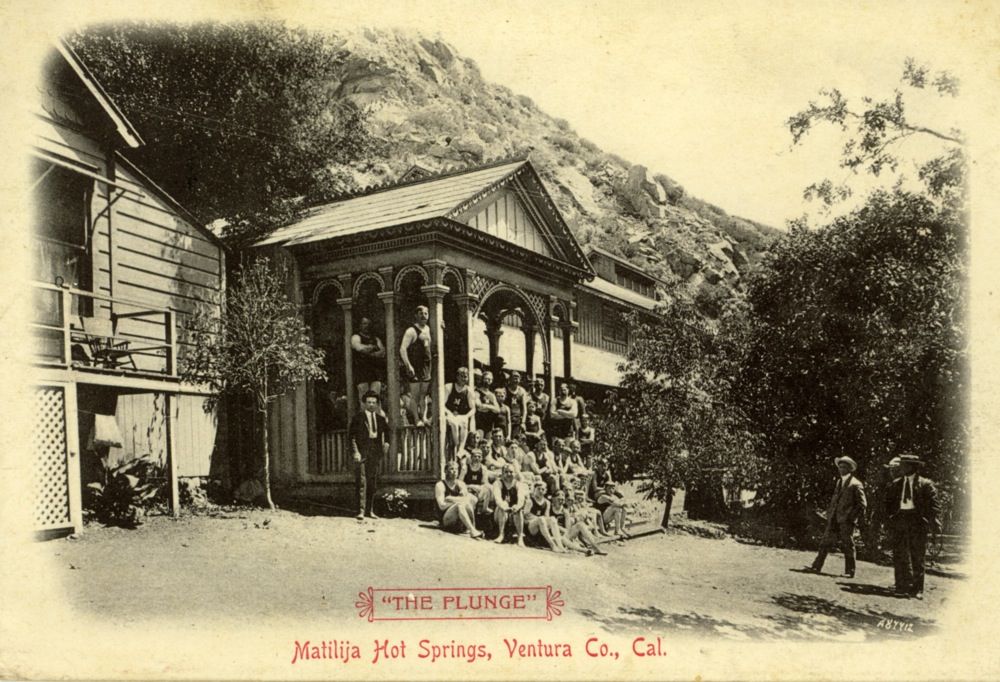
Matilija Hot Springs swimming pool when it was enclosed
Bathers on the Steps of the Plunge. The Ojai newspaper reported in March 1902 that “Work on the building to surmount the plunges at Matilija Hot Springs has been begun, and the frameworks will be up in a couple of weeks with propitious weather.” The indoor pool was 150 feet long and 65 feet wide. Individual dressing rooms accommodated 70 people. Electric lights illuminated the grounds, and there was a covered dance pavilion.
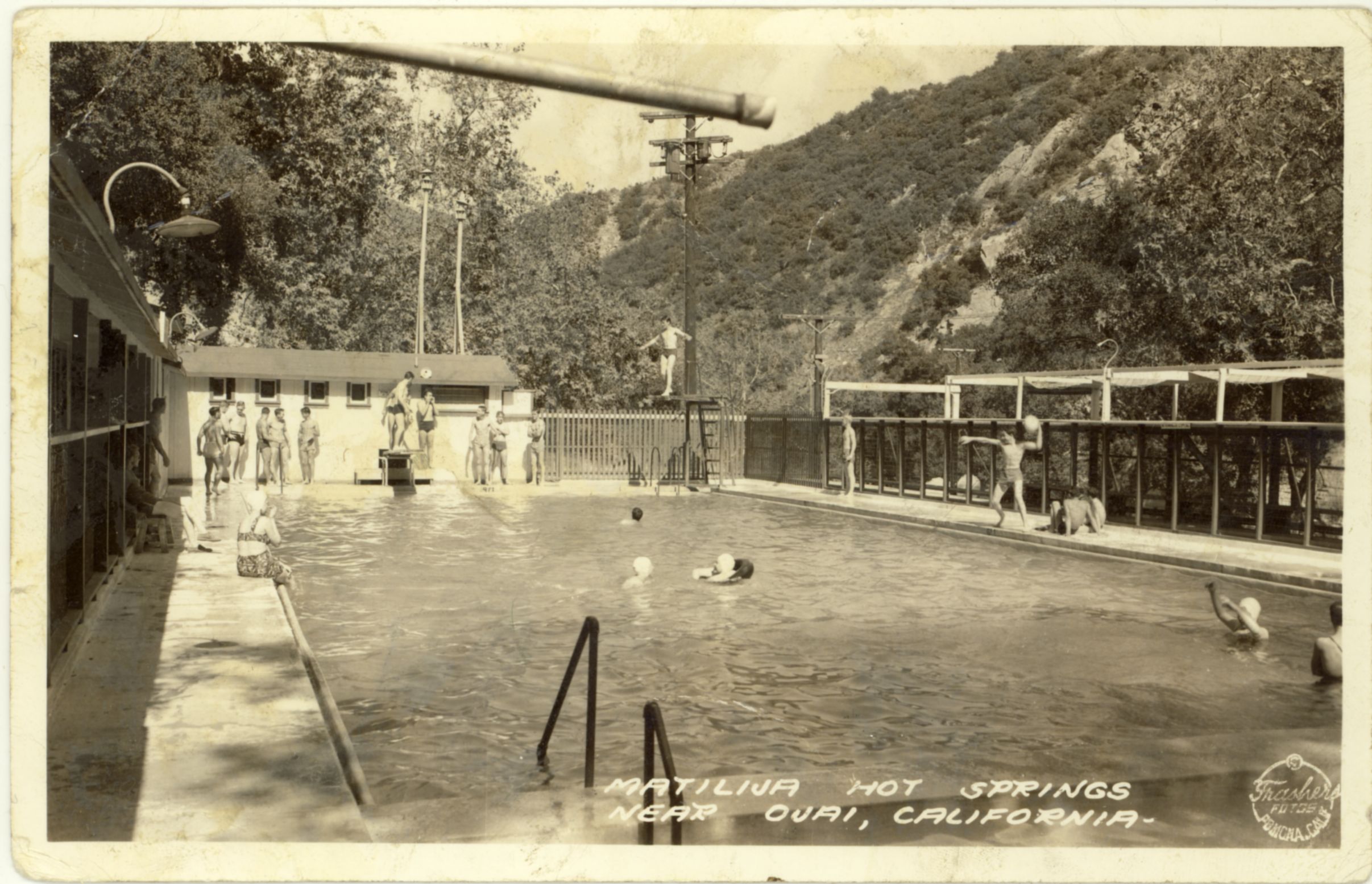
Matilija Hot Springs swimming pool in the 1950s.
Later Open Pool at Matilija Hot Springs. Buildings and facilities at each of the Matilija Canyon camps were replaced over time, often due to the fact that one or the other had been destroyed by flood waters. Here we see a replacement to the earlier plunge at Matilija Hot Springs. The scarcity of swimming pools elsewhere in the county resulted in lots of summer traffic to the pools in Matilija Canyon.
The above is an excerpt from Ojai: A Postcard History, by Richard Hoye, Tom Moore, Craig Walker, and available at Ojai Valley Museum or at Amazon.com.
 After World War II, the newspaper and magazine were full of advertisements for new homes being built for the returning servicemen. They were often written to where it seemed as if the postwar houses were, ultimately, what the war had been all about. Only rarely did they use the old, cozy imagery of home and hearth. The magazine, House and Garden wrote in 1945 that modern architecture was “a continuing struggle for growing liberty.” They felt that “For some, if soldiers were to return to old-fashioned houses and enclosed rooms, the fight would have been as good as lost.”