This article was in the Thursday, October 27, 1960 edition of “The Ojai Press.” The author is unknown. “The Ojai Press” was acquired by the “Ojai Valley News.” The article is reprinted here with the permission of the “Ojai Valley News.”
GUN CLUB TIDIES UP SHELF ROAD SHOOTING SITE
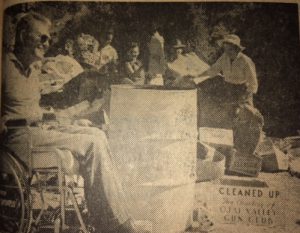
GOOD SKATES USE RAKES — To help the community, members of the Ojai Valley Gun Club went Saturday with rakes and cleaned up the area on Shelf Road where a lot of practice shooting is done. Left to right are Bud Creswell, treasurer of the club; C. T. Johnson, vice-president; Cherie Johnson; Ric Johnson, president; and Audrey Hoyt.
Over the weekend a group of members of the Ojai Valley Gun Club cleaned up the site on Shelf Rd. where most Valley shooters do their practicing. Two pickup truck loads of junk were collected and hauled to the dump and a trash barrel was placed at the site.
Next Sunday from 10 a.m. until 2 p.m. at the Casitas Recreation Area the Gun Club will hold a .22 caliber rifle shoot for youngsters from 12 to 17 years of age. Each group or individual entering must be sponsored by an adult and provide his own .22 rifle and ammunition. Anyone interested may obtain information by contacting Ric Johnson, MI 6-2284 or Hugh McBride, MI 6-3185.
Ventura River Municipal Water District has given permission for .22 rifle shoots at the Casitas Dam Recreation Area and the Gun Club, with the cooperation of Glen Todd, director of the area, has held several shoots there. The club is still searching for a suitable range convenient to the Valley so that they can do all types of shooting.
The regular meeting of the group will be held Nov. 3 at 7:30 p.m. in Room 2 at Nordhoff High School.
A program will be put on by representatives of the Winchester Arms Co. and manufacturers of loading tools and components. It will be a “hand-loaders” clinic.
This story is from Walter W. Bristol’s 1946 book, “THE STORY OF THE OJAI VALLEY.” It is assumed Bristol authored this story.
CIVIC PROGRAM
by
Walter W. Bristol
The fist civic organization in the Ojai Valley so far, at least, as my research went, was known at the Committee of Fifteen. It was organized in October, 1903 as a response to a need for law and order. The Committee was headed by Sherman Thacher and included the well known names of that day. The work of the Committee was that of vigilantes in a mild way. No gallows was erected on which to hang miscreants, but they did have a struggle to stay the illegal sale of liquor in the community. In their rather infrequent meetings the Committee discussed a variety of matters connected with the welfare of the valley.
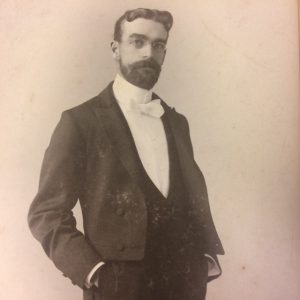
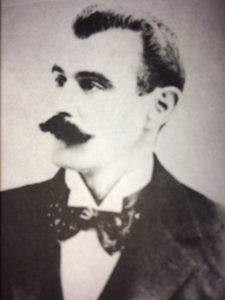
Sherman Day Thacher
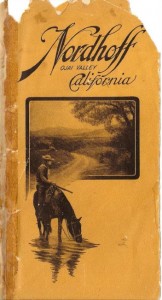
The Committee of Fifteen, wishing to change its complexion and enlarge its scope so as to invite the world to share the wonders of the Ojai Valley, appointed a committee on November 21, 1906, to perfect arrangements for the organization of a Board of Trade, and “moved to insert a notice in ‘The Ojai’ calling a meeting of the citizens on November 28th to effect the said organization.” Forty members signed up after paying fifty cents initiation fee and one dollar in advance as dues for the year. The first board of directors was E. S. Thacher, H. Waldo Forster, C. E. Gibson, E. F. Baker, W. C. Hendrickson, Joseph Hobart, F. P. Barrow, Dr. B. L. Saeger, J. J. Burke. The first officers were E. S. Thacher, president, H. W. Forster, vice-president, J. J. Burke, secretary, and E. F. Baker, treasurer. Advertising and Transportation Committees were appointed. Booklets were prepared with which to contact the world and were paid for by the county.
At one of its first meetings the board asked the merchants to write letters to the Southern Pacific Co. asking for better freight and passenger service, and suggested that “the merchants have all their freight come by water, which might be used as a lever to bring the So. Pacific Co. to time.” I wonder how many nights’ sleep the S. P. Co. officials lost over that dire threat.
In 1907 the possibility of getting electricity in the valley was discussed. The artesian wells along Ojai Avenue were deemed a menace to health. Four kerosene street lamps were ordered placed from the railroad station to Ojai Ave. and $25 was voted for this improvement. In 1908 subscriptions were taken to build a bridge across the San Antonio river near the Gally cottages. On April 1st, 1910, the Board of Trade directors favored unanimously the bonding of the county for good roads to the extent of $1,000,000, providing the Ojai Supervisorial District got its share. T. S. Clark was then our supervisor. The subject of building a high school, the minutes read, brought out the statement from Principal W. W. Bristol that a building built in the bungalow style, exclusive of the grounds could be constructed for $15,000. He thought it would be ten years before the school would have 100 pupils. (There were about 70 in 1920; the great fire of 1917 played havoc with any increase in population.) The last minutes of the Board of Trade were on October 11th, 1911.
Howard Bristol
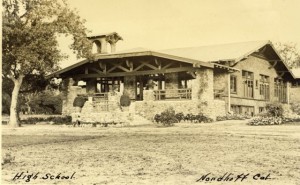
In the meantime the new high school was built and opened in the fall of 1911. The struggle over the site of the school was rather strenuous as between the east and the west side of town. When the people expressed their will at the polls the present site was chosen and like good Americans the fight was soon forgotten.
The “new” campus in 1910.
One day in the fall of 1912 Mr. Frank Weir called upon the writer and proposed a new organization whose purpose was the welfare and growth of the community. He proposed to call it “The Ojai Valley Civic League” and asked me to undertake the secretaryship. Mr. Weir was a very sick man, but energetic and full of enthusiasm for the Ojai Valley. He had in mind the opening of an office in Los Angeles to contact tourists and direct them this way. We collected from both men and women about $400.00. The matter of the Los Angeles office was out of the question. The money was spent mainly for 12 electric lights and their upkeep so long as the money lasted. Mr. Weir and the organization perished with him.
While we are waiting for another civic organization to spring up I wish to give you a picture of the rather crude conditions of living in the valley in the first decade of the twentieth century.
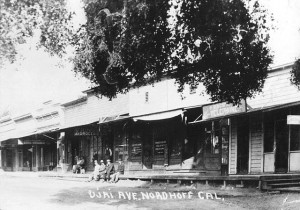
We had a telephone system. It was very intimate service. Central was the clearing house of the whole community and the operators were most patient and gracious in giving information. The time of day, the location of a fire, the time of Jones’ funeral, the time the mail arrives, has Mrs. Scott had her operation? have you seen my dog on the street? and so on. Sometimes we had to wait a good while to get our number, but on the whole it was a good service. There was no electricity in the valley. Kerosene and acetylene gas were used. In 1913 a local electric plant was set up. There were frequent break downs and the service closed at 10 o’clock. All evening affairs were regulated by that arrangement. The water supply was so uncertain that the householders had to have settling tanks to insure a constant supply. Joe Berry, walking up Ojai Ave. to the pump followed by his dog, was a familiar sight. Transportation was by stage and train. The stage came form Ventura via Creek road with no bridges to span the many crossings. In winter the valley was often completely isolated—sometimes for days at a time. The train had a morning leaving time, but there was not certainty as to when it would get back. Main street in Ojai was a mud hole in winter and terribly dusty in summer. There were very few automobiles owned locally. The stores were all wooden and some of them mere shacks. The wooden sidewalks were on different levels.
Waiting for the train to arrive.
About 1914 Edward Drummond Libbey came on the scene in a magnificent way, but that is another story.
On April 24, 1914, a great meeting of the men of the valley was held at the village hotel— the Ojai Inn. Eighty-seven men were present. Sherman D. Thacher presided, and speaking and music was the order of the evening plus the memorable dinner arranged by Manager Joe Linnell, E. S. Thacher, J. J. Burke, L. R. Orton, Judge Wilson, E. D. Libbey and E. L. Wiest took part. The purpose of the meeting was to formulate some kind of a civic organization in succession to the Board of Trade. Since the Ojai Valley Woman’s Club was very helpful along civic lines, it was thought best not to ask them for support, hence the name Ojai Valley Men’s League came into being. Seventeen directors were elected on that night. The directors in turn elected Sherman D. Thacher, president, and Walter W. Bristol, secretary-treasurer. The directorate changed more or less every year, but the above named executive officers remained the same until 1927 when Mr. Thacher resigned and the writer was elected in his stead. At that time also the name was changed to the O. V. Chamber of Commerce.
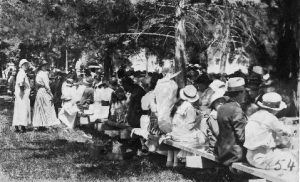
To discuss the work of the Men’s League in full would be out of place here. Aside from lighting and cleaning the streets it stood ready to take the lead in every worthy enterprise. I will cite the year 1917. On April 6th of that year the Men’s League planned a day of celebration in honor of Edward D. Libbey, who had done so much to put the Ojai Valley on the map. The plan was to make it an annual affair to be called “Libbey Day.” Mr. Libbey did not accept this suggestion and it was thereafter celebrated, but was designated “Ojai Day.” It took the form of a basket picnic and was held in the Civic Center.
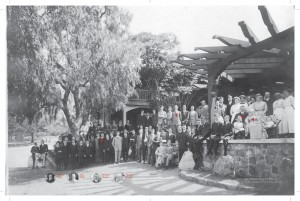
This photo is of the first “Ojai Day”. It was held in Civic Center Park (now, Libbey Park) on April 7, 1917.
On this particular day in 1917 people came from all over the county. There was band music and community singing. A speaker’s stand was erected near the tennis courts. Mr. Libbey spoke and T. C. Stevens of Los Angeles, a warm friend of Mr. Libbey, was the principal speaker of the day. the climax of the celebration was a procession of about one hundred cars (quite a sight for that time) which, starting from the civic center, wound over the roads of Arbolada.
Edward Drummond Libbey
Just a few days before this celebration, March 30, 1917, the community met in the high school auditorium to honor Charles M. Pratt for the splendid gift to the community of manual training and domestic science buildings at the high school with complete equipment for each. The speakers were County Superintendent J. E. Reynolds, Felton Taylor, president of the student body, Principal Bristol and Sherman Thacher who presided.
The League under the able direction of its president, Sherman Thacher, did a good work in providing for the victims of the Spanish influenza. The Boyd Club was taken over for a hospital. Loring Farnum and Miss Sarah McMillian should be remembered for their services in this strenuous time.
In 1918 the League collected $374.00 for the purpose of a curb to curb pavement through town. About this time the directors of the League began agitation for the incorporation of the village. The boundaries were determined, the election called and incorporation was successfully carried in 1921.
It was the custom from the first for the League to have an annual dinner meeting. As I look back over the years these meetings stand out not only as one of the most important and enjoyable events of the year, but as a means of promoting a sense of unity and good feeling. The Chamber of Commerce still exists and should be a constantly greater agency for community betterment.
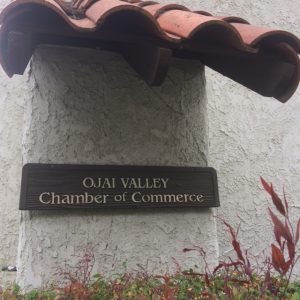
This sign is posted facing East Aliso Street even though the Ojai Valley Chamber of Commerce is located at 206 N. Signal St., #P in downtown Ojai, California. That’s because it’s in a complex that houses several business offices.
We today cherish the memory of the men and women who in days past established in the Ojai Valley a tradition of culture and local pride. This tradition must be carried on if this community is not to lose its distinctive qualities. Eternal vigilance is the price of such an achievement. “Where there is no vision the people perish.”
This story is in Walter W. Bristol’s 1946 book, “THE STORY OF THE OJAI VALLEY.” It is assumed that Bristol is the author.
WATER PROJECTS
By Walter W. Bristol
The Gridley
One of the first, if not the first, efforts to get gravity water for domestic purposes was started in 1912 when O. W. Robertson, C. M. Pratt, E. D. Libbey, William Ladd, F. H. Osgood, H. T. Sinclair and John Burke bought the Gridley ranch in order to secure its water rights.
The water source is a tunnel in a canyon about 1,000 feet higher than the ranch house. The water is piped from there about three miles and supplied the homes of all the original shareholders. Later, Mr. Libbey turned in his interest, which was bought by the remaining owners.
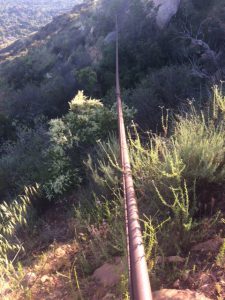
This old waterline ran three miles from the Gridley Ranch to several homes on Foothill Road. It was built and operated by the Gridley Mutal Water Company which was formed in 1931.
The company was incorporated in 1931 as the Gridley Mutual Water Company. The water is charged to the stockholders each year on an estimated budget for the coming year, according to the amount of water each stockholder has used the previous year.
Richard Phillips was the superintendent for many years. Howard Bald is acting in that capacity now. Helen Robertson is president and William Simonds is secretary-treasurer.
The company eventually sold the ranch house and a few acres to Dr. Ida Stambach, who came to the valley many years ago with her nephew and niece, Henry and Alice Nixon. Both of the Nixons have been, and are, prominent citizens of the valley. Henry is a director of the Ventura County Chamber of Commerce, trustee of the Presbyterian Church and member of the Lions Club.
The Thacher Project
In the 1920’s, due to increased pumping and short rainfalls the water table throughout the valley reached a level which was alarming. The average rainfall, William Bowie informs the writer, from 1920 to 1929, inclusive, was 17.88 inches. This means that in some of these years the rainfall was far below normal.
In April or May of 1925, S. D. Thacher called a meeting at the school of prominent citizens to discuss the subject of an increased water supply for the valley, both upper and lower. The subject before the meeting was primarily the way to do it and the means with which to get it done.
It was decided to raise money enough to engage the engineering firm of J. P. Lippincott to present a plan which provided for the damming of the Sespe river at Cold Springs and piping the overflow water through the mountain to the valley. This would cover a drainage area of 66 square miles and impound 50,000 acre feet of water, which would be enough to irrigate a minimum of 15,000 acres.
The estimated cost was $3,262,000. He estimated that the generation of electric power would bring to the district $105,000 annually. At this time he also made a survey of the Matilija for dam sites, but concluded that the cost per acre just for Ojai alone would be prohibitive.
The matter hung fire for some time. The depression of 1929 put a stop to the matter and it never came to a vote by the people.
About this time A. E. McAndrew, at his own considerable expense, had check dams built on the side of the mountain near the Senior Canyon area. A heavy storm a year or two later swept all these away.
Senior Canyon Mutual Water Company
In May, 1929 work was begun on the project of drilling a tunnel to develop water in the Senior Canyon. It met with surprising success.
The initial drilling of 1,550 feet brought out 50 inches of water. Since that time the tunnel has been lengthened to about 2650 feet. Owing to sedimentation, however, the output has considerably decreased.
This water is a godsend to water users, both domestic and commercial, in the district from San Antonio School to and including the Topa Topa ranch.
The first officers of the company were Philip Pierpont, president, Denham Lord, vice-president, Hal Gorham, secretary-treasurer, A. L. Dodge and J. Myrick, Jr.
There are about fifty stockholders. Water is distributed by meter control and amount of water is allocated in accordance with the amount of stock held.
The 1929 Project
On August 2, 1929 another project for the development of water was launched. The object of this endeavor was to develop a water supply mainly for irrigation purposes, although provision was made for city participation if desired. The territory included a wide area in the vicinity of Ojai and Ventura.
The immediate plan was to call an election in this area to form a district with power to levy a tax on the property involved for the purpose of an extensive survey. The election, set for January 14, 1930, failed to carry.
The prime mover of the project in this section was Gird Percy. Mr. Percy was a splendid type of citizen and very popular. He served a term as president of the Lions Club.
The 1938 Project
On the evening of November 22, 1938, a meeting of the citizens of Ojai was called under the auspices of the Ojai Valley Chamber of Commerce. The meeting took place in the high school auditorium and was called to order by Dr. Charles T. Butler, president pro-tem of the Chamber of Commerce.
The purpose of the meeting was to discuss feasibility of taking advantage of Federal aid under certain congressional enactments concerning the establishment of districts for the purpose of water conservation by check dams, spreading or otherwise, and also pertaining to drainage development. There was considerable discussion after John Dron explained the details of the act.
The following persons were selected to arrange the preliminaries: R. S. Dennison, H. W. Gerry, John Barnard, Charles T. Butler and Clarence Mattson. This committee elected Dr. Butler its chairman.
In the good old American way an opposition group developed, led by Alfred Reimer. All through the year 1939 the controversy pro and con went on, occupying a great deal of newspaper space and creating a certain amount of bitterness. In December of 1939 the matter was argued before the supervisors to determine whether or not they would approve the calling of an election to settle the case. The supervisors turned it down and that was that.
The 1945 Project
The latest effort for water development was made in the summer of 1945 when it was proposed to put to the vote of the people the formation of the Ventura County Flood Control District. Ventura and Ojai were put in Zone 1 of the district.
The plan was to build two dams in the Matilija Canyon to control the flood waters for the use of Ventura and Ojai. Meetings were held to explain the matter and on October 16, 1945, an election took place in Ventura and Ojai calling for a bond issue of $3,400,000. The vote was in the affirmative by the narrow margin of 85.
This article appeared in the Thursday, February 9, 1961 edition of THE OJAI PRESS which eventually became The Ojai Valley News. It is reprinted here with their permission.
Vast Reaches of Los Padres Forest Excite Visitor’s Imagination on Ranger Inspection
By Polly Bee
Beyond our Ojai horizons are the vast and exciting lands of Los Padres National Forest, protected and nurtured under the zealous eye of the United States Forest Service. Comprising 51 percent of the total land in Ventura County, the forest’s rugged 516,000 acres excites the mind and invites the senses.
It is a land of hiking, riding, camping; canyons, meadows, cliffs, astounding views; home of the condor and refuge of wild life; land of wind and silence.
Recently I was privileged to accompany John Parkinson, Ojai district ranger, on one of his inspection trips to the Nordhoff lookout tower. We turned off highway 399 at the Wilcox Cabins, unlocked a gate, and started our rocky, bumpy ascent along a narrow road bordered with spectacular drop-offs.
Such access roads are open to hikers and horseback riders, but not to public automobiles, as easements over private property are involved in many sections. The roads are built under private contracts, although the forest maintains one grader and two bulldozers for clearance work.
Pointed Out Trail
As we wound our way up, Parkinson pointed out parts of the state riding trail, which presently terminates at Highway 399 but will eventually continue along the CCC built, fire access road of Camino Cielo Ridge. The trail starts at the Mexican border and bifurcates in Los Angeles, where one section leads to the high Sierras and the other passes through Ventura County headed for Monterey and San Francisco. Both sections will terminate in Oregon.
Existing trails are used when possible, and in this area the Pratt trail is utilized. Monies are appropriated from the State Department of Beaches and Parks for this project.
With the aid of a map Parkinson pointed out key peaks, commenting that it literally takes an act of Congress to change any names. They are the same recorded by early settlers. He noted there are five sites called Pine Mountain, not to be confused with Mt. Pinos, which designates an entirely different district of the forest.
Near the summit of Nordhoff, some 4477 foot elevation, we stopped to look at the thrilling panorama of the Ojai and Santa Ana Valleys lying in a topographical study below. The wind, the quietness and the vastness are wondrous to behold.
Traveled to Town
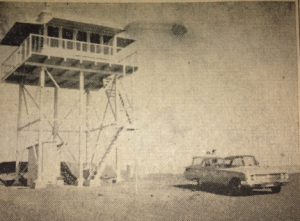
We traveled on to the lookout tower where amiable Cliff Runte greeted us with a hospitable grin. His home here is a square room atop a tower, glassed on all sides with the simple furnishings of stove, table, bed and chairs arranged around a circular fire-finder in the center. Here Mr. Runte commands a 360-degree view which is recorded every 15-minutes. A lookout for 16 years, he was stationed at this particular site during the 1948 fire when the tower burned to the ground.
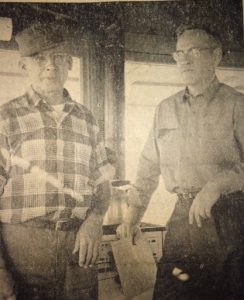
INSIDE TOWER — Within the tower are Cliff Runte (left), who for the past 16 years has viewed mountain terrain from a glassed-in room. With him is Ojai Ranger John Parkinson.
He spoke of lightning striking during a November 1960 storm, which literally made things jump in the tower. An independent type, Runte enjoys his summit solitude yet has plans for extensive travel some day.
With the aid of a map drawn in the dirt, Ranger Parkinson surveyed the district lands and explained to me the need of further access roads in order to penetrate the mountains effectively. He spoke with enthusiasm of the changing concept of national forests, which has progressed from a viewpoint of forests as strictly a reserve, to today’s concept of public enjoyment and utilization of forest areas.
Recreation to Grow
Predicting that by 1970 the industry of recreation in Ventura County would be second only to oil, he spoke of the minimum funds available for campsite equipment and expressed hope that through cooperative efforts with the county, more forested areas would be available for public use.
He told me of the great Sespe Wildlife Area, closed except for the public Oak Flat Road from Fillmore. Entailing a separate management plan, this area is a reserve approved by the Secretary of the Interior for preservation of the condor. A governing board of three men (the president of the Audubon Society, the wildlife manager of the regional office in San Francisco, and one other person, usually a specialist in ornithology) must approve any activity in the area, such as road building, gas and oil leases, open corridors for fishing sites, or grazing permits. The National Audubon Society contributes to the salary for an officer in this area.
We talked a little of the PUMA county road plan which will utilize Seabee activity in the Rose Valley for a highway coming from Route 99 and joining with Route 399 as a direct inland route to the coast. Possible dam sites in the Sespe basin will further open up the now inaccessible areas.
I was interested in a map which showed private property within the forest and learned that zoning in these areas is within county jurisdiction, but most are in an A-1 designation at present. Private ownership in the Forest dates to the Teddy Roosevelt administration when the 1890 Homestead Act was discontinued.
May Trade Land
There is a plan whereby property owners may trade their holdings within the forest for lands on the boundaries, thus consolidating national property. Parkinson touched on the need of cooperative planning along the borders toward compatible uses with county land planning.
The district’s land use plan, which is revised every five years, includes the following primary components:
1) Fire Plan, 2) Recreation Resources Inventory, 3) Wildlife Management, 4) Grazing Plan, 5) Five-year New Construction in Recreation, 6) Trail Construction Program.
Of county concern are the flood control districts for fire prevention and watershed protection for the Casitas and Matilija Lakes areas. County funds contribute to salaries of officers in these districts.
I inquired as to whether trees had ever grown on the rugged slopes of the range and learned that indications of redwood and ponderosa pine have been found. In Ventura County part of a redwood tree was discovered while drilling at the 5,000 foot level.
Parkinson spoke of the plans for reseeding and said that 250 redwoods had been set out in twelve different areas as a trial planting.
Anticipating little success with these, however, he hoped that a good rainy season would allow the planting of 500 Arizona cypress and big-coned firs for further experiment.
He told me of conversion methods whereby an area can become less of a fire hazard through chemical, mechanical and burning controls. The chemical method is an expensive process but might be used in an area such as surrounds Ojai, where fire danger to the city is eminent.
Meets With Boys
In addition to management problems Ranger Parkinson last year addressed 57 organizations, 7 high schools and many Scout troops. He meets with boys interested in forestry as a career and had organized a learning program in cooperation with the schools whereby two or three students from each high school actually work with the forestry personnel for one week doing fire prevention work, range management, campground reconstruction and trail maintenance.
“This is a healthy interest among county children in conservation and forestry,” he stated, and cited an example of 250 students last year rehabilitating a campground near Santa Paula, using their own tools and raising the necessary funds. He spoke with deep conviction and enthusiasm of the concept of the National Forest as a dynamic county inventory and mentioned that in actuality he represents the largest landowner in the third supervisorial district.
His pride is contagious, and as we ricocheted our way down I felt I had been introduced to a new world whose horizons beckon with adventures beyond the confines of our Valley.
EVER ALERT — This is the Nordhoff Lookout Tower from which watch is kept with observations recorded every fifteen minutes in the constant vigil against forest fire.
The following article was in the “Ojai Valley – California” brochure in about April of 1958. It was published by the Ojai Valley Chamber of Commerce. The author is unknown.
No publication date is printed on or in this brochure, but “APR 21 1958” was stamped on the front cover by the VENTURA COUNTY FREE LIBRARY. This brochure is in the Ojai Valley Museum’s research library.
Recreational Facilities
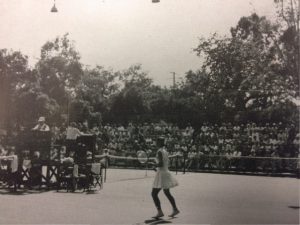
One of the outstanding highlights of the year is the annual Ojai Valley Tennis Tournament, sponsored by the Ojai Valley Tennis Association. Housing the players and staffing the event is a community project of major proportions. One of the oldest tournaments in the United States to be held continuously in the same location, its 50th anniversary was celebrated in 1957.
Scene at the 57th annual Tennis Tournament…note capacity crowd.
Included in the five to six hundred who participate each year are prominent families of the tennis world, with third and fourth generations still returning to play in The Ojai. Among those families are such famous names as Sutton, Bundy, Sinsabaugh, Vines, Connolley, Falkenberg, Browne, Kramer, Brough, Flam, Cheney, Fleitz, Betz, Olmeda, Franks, and Douglas.
The competition covers all age groups, with twenty contests being played simultaneously on the many private, school and public courts throughout the Valley.
The theme of the tournament is “Sportsmanship First.” It is the only large tournament in which an eleven-year-old is on an equal footing with a Davis Cup player; a school girl may play before the same gallery on the same No. 1 Court just vacated by a Wimbledon champion.
The Ojai Valley Trails Association, Inc., an organization of nearly five hundred members, is dedicated primarily to the development and maintenance of the network of trails in the mountain ranges surrounding the Valley. The promotion of pleasure riding, horse shows, camping and hiking is a secondary aim of the association.
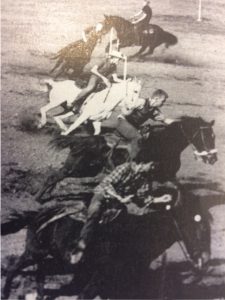
A public gymkhana and practice field on a five-acre site on Bryant Street was donated through a lease agreement by the Richfield Oil Company and has been developed as a practice field for gymkhana events and as an arena for public riding events.
During the year the Association puts on at least one official outing a month, including moonlights rides, steak barbecues and brunch and breakfast rides. Twice a year the riders take a two-day overnight camp trip into the mountains.
The Association sponsors two horse shows a year. Other annual events are the gymkhanas sponsored, twice a year by the Thacher School, and the shows conducted by the Skirt and Quirt Riding Group, an organization of women and girls.
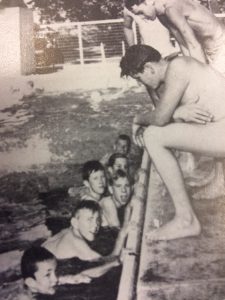
The Ojai Valley Summer Recreation Program includes an intensive swimming program led by the American Red Cross. This activity is held every year at the Matilija Pool with four of five hundred children receiving instruction. Private swimming instruction is offered each year of the Ojai Valley School and the Ojai Valley Inn. There are public swimming pools at Wheeler Hot Springs, Matilija and Ojala – all located in the canyon area.
All Ojai children learn to swim.
The recently organized Ojai Police Boys’ Club, with a gymnasium on South Montgomery Street, features boxing, wrestling, weight-lifting and pool. Baseball, basketball and football are being added to the program. One of the novel features of the program is the appearance of top figures in the Southern California boxing and wrestling world at many of the matches conducted in the Boys’ Club. This has been possible because Soper’s Training Camp in Matilija Canyon is the training base for many of these notables.
The boys of the Valley are also provided an exceptional baseball program under the Ojai Valley Recreation Council. There are fourteen teams in three classes –- Farm, Twilight and Pony Leagues. They average more than fifteen boys per team, ranging in age from nine to fourteen, in the latter two groups. The Farm teams comprise more than one hundred boys under the age of nine.
More than 55 men work with these boys. Each team gets over 300 man hours of supervision per week. The schedule for each league totals 18 games. Uniforms and equipment are furnished by merchants of the Valley.
Three diamonds –- in Oak View, Meiners Oaks and Ojai –- are in use constantly from May to early September. The annual season winds up with three All-Star games and contests played with teams from other cities from up and down the West Coast.
Each year has seen more and more boys participating in this program. Wives, who have to serve supper two hours late three days a week, not only have become reconciled to it but are rabid fans for their offspring’s team.
In the Ojai Civic Center Park are excellent tennis courts open to the public and maintained by the Ojai Valley Tennis Club. This facility provides a beautiful open-air bowl with stage and seating accommodations for over 700 persons.
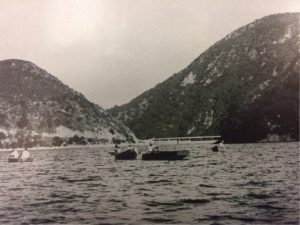
In the canyon area, on Highway 399, fishermen find Matilija Lake and Dam, a camping and fishing paradise, with an excellent stock of trout, bass, bluegill and catfish. Rowboats are permitted and available for rent. The lake and camp area covers approximately two hundred acres, with barbecue pits, tables, restrooms, trailer accommodations and campsites.
Matilija Lake and a quiet fishing scene. No motor boats or outboards here to frighten the fish.
At the base of Matilija Dam is Matilija Hot Springs. Here are found hot sulphur baths, a pool, barbecue pits, tables and a wonderful trout stream reserved for children under 16 years of age.
Camp Comfort, located on Creek Road, offers about 40 acres of park area with forty barbecue pits, three hundred tables, a pavilion, volleyball courts, horseshoes, swings and slides, restrooms, concession stand and game rentals.
Within the city limits of Ojai is Sarzotti Park, jointly run by the city and county, with barbecue pits, tables, restrooms, swings and playground equipment and a baseball diamond. The Jack Boyd Club, located on this 11-acre park, is a community center for all age groups, community and service organizations. This club is supervised by a full-time director who operates a year-round recreation program supported by funds provided for in the City budget.
In the upper valley, on highway 150, overlooking the Ojai, is Dennison Park with camping, trailer parking, barbecue pits, tables, playground equipment, etc.
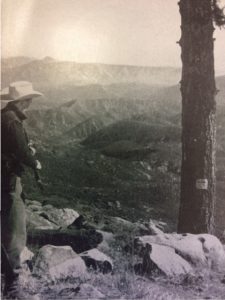
The northern and eastern boundaries of the Valley join the 284,744 acres of Los Padres National Forest. Approximately 67,000 acres are open to deer hunting and fishing streams extend over about 150 miles.
A hunter overlooks the rugged valley of the Sespe River. Behind that range of mountains beyond the river is Ojai.
There are closed areas, due to fire hazards, during the dry season and the Sespe Wildlife Area remains a closed area at all times. This is perhaps the largest remaining nesting area of the condor of North America. Latest count reveals some 50 to 60 birds in the Whiteacre Peak Area.
Camp grounds within the forest include Wheeler Gorge (70 camp units) and Lion Canyon (20 units), where water is good at all times; Sespe Gorge (12 units), Sandstone, Pine Mt. Area (6 and 17 units). Throughout the forest, where trails have been developed, are at least 64 camp grounds suitable for trail camps in open season.
On each side of the Valley are privately owned trout farms.
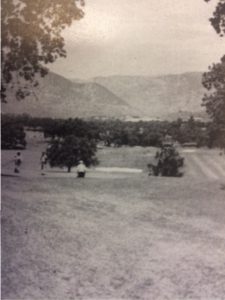
Available to members and guest of the Ojai Valley Inn and Country Club is one of the best 18-hole golf courses in the country.
Mountain views rival the golf at Ojai Valley Inn & Country Club. The course’s back nine is world famous.
Many auditoriums and halls are used for parties, dances and varied program activities, including the school auditoriums, the Ojai Valley Grange Hall, American Legion Hall, Ojai Art Center Gallery, Woman’s Clubhouse and the Masonic Hall.
Many quiet road and country lanes provide safety for the cyclist or the person who prefers to just stroll in an uncrowded rural community.
This story came from W. W. Bristol’s book, “THE STORY OF THE OJAI VALLEY” which was published in 1946. It is assumed Bristol is the author of the story.
SINGULAR CHARACTERS
BY W. W. Bristol
Among the early settlers in the valley were many singular characters. Of these John Montgomery wrote very entertainingly.
There was a case in early days of a German nobleman stranded on the Lichtenberg ranch four miles from Nordhoff, who in desperation attempted to hatch eggs in the heat of the sun or by artificial heat long before incubators were invented.
To the same ranch came in 1874 two families who appeared as much out of place as the German baron, and so were objects of curiosity and criticism to the sparse country population. They were fresh from New York City and had pronounced city ways, and seemed wholly ignorant of everything pertaining to country life. As these people fill a place in history of the valley we will describe them. Col. Wiggins was a tall spare man of fifty years with a diminutive wife of twenty. His companion, Wiseman, was a stout hearty man of thirty with a refined, delicate, city wife and several children. He was the son of a rich druggist, and had lived, it was said, with both hands in the old man’s bags. After living sometime on the Lichtenberg ranch the two families separated, Wiggins going to Nordhoff while Wiseman squatted with his little family in the wild brush east of the Bennett place. A more unsuitable place for such people could not be found, and they had a hard time in their little clearing surrounded by dense brush, the home of wild animals and rattlesnakes, and a bear trap sunk in the earth not far from their little shanty. And there Wiseman sweat and bungled and blistered, hauling water from a distance, running in debt and waiting for paternal drafts the never came—’til one day his pistol went off, accidentally, when his wagon turned over into a barranca and poor Wiseman’s squat was once more open to homestead entry. He was the pioneer of that lower section now covered by orange groves and for this he finds a place in this sketch.
Col. Wiggins had in the meantime settled in Nordhoff. He purchased from Surdam the Nordhoff townsite and from Blumberg the hotel. He passed for a millionaire and had for a partner a member of the Louisiana legislature, a cotton merchant of New Orleans. Col. Wiggins was a man of much dignity of character as suited the man of military antecedents and had his own ideas of running a hotel. He treated his guests as if they owed him an apology, and the offense could not be condoned by their silent submission to a heavy board bill, consequently he soon had the house all to himself. In 1878 he joined his friend Wiseman in the shadowy land, and his disconsolate little widow shared her sorrows with a second husband in San Francisco. Thus passed away another of the Valley’s pioneers, and eccentric, but honest man.
Shortly after Wiggins’ demise the writer as owner of the hotel, received a visit from a strange lady who made the startling proposition to open an academy for young ladies in the building. She was a veteran in the business and highly recommended, and the establishment was to be first class. In a few weeks glowing circulars were scattered over California announcing the grand opening and detailing the various branches and strict rules of decorum, guaranteed moral safety and payment in advance. Four professors from San Francisco, loaded with accomplishments and burning to impart their knowledge, took charge of their departments. The doors were thrown open and only the presence of the sweet lady graduate was necessary to make everybody happy; but, alas, she came not, and a financial stringency in the local market brought things to a crisis and howls of despair. The rupture of a solitary greenback and its distribution among the professors assuaged their ruffled tempers, and under the leadership of the Professor of Oriental Literature they departed to luxuriate in a deck passage to San Francisco.
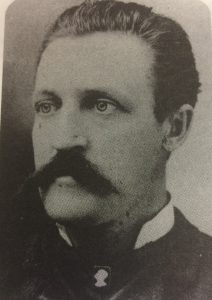
It has been said that Wiseman was the pioneer of the lower orange district of the valley, but S. S. Buckman had settled previously on the present Thacher place. This Buckman was a Vermonter who came to the county in 1872, and through his good looks and qualities secured the position of County Superintendent of Schools. Rambling in the wilds he discovered water in the canyon and concluded it could be utilized on the open land below. This would cost a heavy outlay; but he had an immense capital of pluck and courage. By hook and crook he constructed his long and costly flume and attacked the dense brush forest, fighting for every foot of clearing and planting the first citrus trees in the valley. He taught school in Nordhoff, worked at home Saturdays and planted on Sundays. Never a word of encouragement did he get from his neighbors, he was a crank in their estimation—a young Vermonter with a hobby.
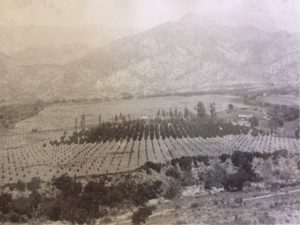
The older orange trees in the center of this photo were planted by F. S. S. Buckman in 1875. This was the first orange orchard planted in the Ojai Valley. This photo was taken in 1912. The ranch became known as the “Topa Topa Ranch”.
It was a strange sight to see him as black as a chimney sweeper from the burning brush, ragged and soiled from hard work, and then glance at his framed diploma hanging from the bare wall bearing in Latin from far off “Monte Verdis” a guaranty of his classical attainments, such incongruity is seldom seen outside of California.
F. S. S. Buckman
His efforts were crowned with a splendid competence which he did not long enjoy, for the deadly bullet of an assassin laid him low at San Francisco—another tragic ending of a valley pioneer.
Written and compiled from various sources by Tony Thacher.
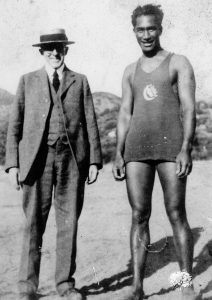
Sherman Day Thacher and Duke Paoa Kahanamoku at The Thacher School in 1922.
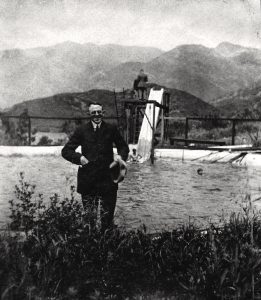
On a dry and dusty afternoon in late October of 1922 this unlikely pair were captured on film standing near the top of the alluvial fan emanating from Horn Canyon in the northeast corner of the Ojai Valley. Sherman Day Thacher, as headmaster of the school he founded 33 years before, is shown flanked by Olympic swimming gold medalist Duke Paoa Kahanamoku of Honolulu, Hawaii. Duke had been invited to come up from Los Angeles to give a demonstration and instruction in swimming to the assembled student body in the Thacher School’s pool. In reality this crude concrete structure was a rather murky irrigation and fire reservoir full of biota from the creek that filled it.
Duke’s swimming skills, superb physique and good looks had already made him a star both in and out of the water. And his gold medals and promotion of board surfing had made his reputation as the “Father of Modern Surfing” and the “Ambassador of Aloha.” From almost the moment of his birth on August 24, 1890 in Honolulu, Kahanamoku’s life revolved around the warm Pacific waters surrounding Oahu. While that on its own might not have been a particularly unusual accomplishment for an Hawaiian Islander of the time, what was unusual was his speed through the water. In the first officially sanctioned Amateur Athletic Union (AAU) swim meet in Hawaii in August of 1911, Duke knocked over 4 seconds off the world record for the 100-yard open water event, causing stateside AAU officials to declare there must have been an error and refusing to sanction the time.
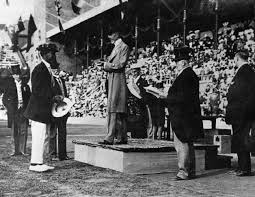
Although not used to swimming in a pool, Duke continued his winning ways in the water stateside. At the Olympic games of 1912 held in Stockholm, there was no mistaking Duke’s incredible speed and power, and he won the 100-meter freestyle, again breaking the world record and easily taking the Gold medal. Over the next few years, Kahanamoku’s reputation grew to new heights as he continued shattering world aquatic records in various competitions around the globe. Duke Kahanamoku continued swimming for the rest of his life, winning his last Olympic medal at the age of forty-two. His remarkable twenty-one year career as an Olympic champion remains today a record achievement.
Duke Kahanamoku (holding hat at left) at the 1912 Olympic Games in Stockholm, Sweden.
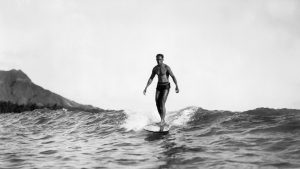
At the same time, he was credited for popularizing the sport of surfing. In a series of widely attended demonstrations around the world, Duke would ride the waves on his handmade long board to the delight of onlookers, and thus the ancient sport was revitalized along the coasts all over the world.
Duke Kahanamoku surfing with Diamond Head at left in the background on Oahu Island in the Hawaiian Islands.
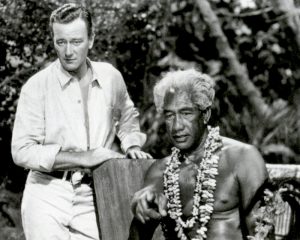
As someone identified with the Hawaiian Islands it is easy to forget that Duke Kahanamoku ever spent significant time anywhere else, yet he was a regular presence in Southern California throughout the 1910’s and 1920’s. The Southland was equally charmed with Duke making many friends and becoming a particular favorite of the movie colony. And, of course, his worldwide fame and good looks didn’t go unnoticed by the studios. In 1925, Famous Players-Lasky (Paramount) offered Duke a film contract. However, his promising film career was hobbled by an ironic twist – he couldn’t appear on-screen doing what the world best knew him for – swimming. AAU rules strictly prohibited Duke from accepting money for swimming. And Duke had no intention of giving up his amateur standing in athletics just for Hollywood film making, which he considered nothing more than a fun lark. So the studios found themselves with a non-swimming swimming star and were forced to come up with creative ways to use him in non-aquatic roles. They tried their best and over the next few years, Duke made appearances in a number of films. Without being able to be seen as the aquatic champion, his career in movies in the ‘20’s quickly fizzled. However, in later years, Duke would return to the screen on several notable occasions. In 1948 he played a native chieftain opposite another famous “Duke,” John Wayne, in The Wake of the Red Witch, and in 1955 he again played a native chief in the John Ford-directed Mister Roberts with Henry Fonda and James Cagney.
Kahanamoku left a legacy in his native Hawaii, where he became its most revered citizen and goodwill ambassador. For more than twenty years he served as Sheriff of Honolulu and after Hawaii became the 50th State in 1959, he was made the State’s official “Ambassador of Aloha.” Kahanamoku died at the age of seventy-seven, just three weeks after greeting Hawaii’s one-millionth visitor.
TWO DUKES: John “The Duke” Wayne and Duke Paoa Kahanamoku.
Today, there are many memorials and monuments to Duke Kahanamoku on the Hawaiian Islands, outside Sydney Harbor and elsewhere, but all too few stateside. However, in Ojai, it’s Sherman Thacher’s unheated and untreated irrigation reservoir that can still be linked to the legendary swimmer and surf rider, Duke Paoa Kahanamoku.
Sherman Day Thacher at The Thacher School swimming pool which was really a reservoir.
The following article is from the book “Portrait of a Community –– Ojai: Yesterdays and Todays” by Ellen Malino James. It is reprinted here with the permission of the publisher, Ojai Valley News.
THE SPANISH SETTLERS
By Ellen Malino James
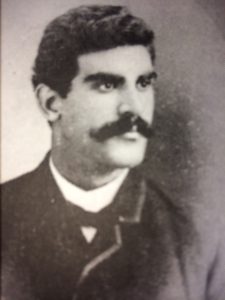
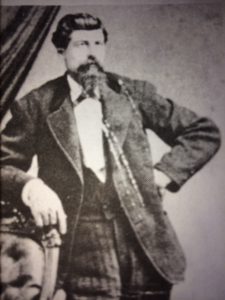
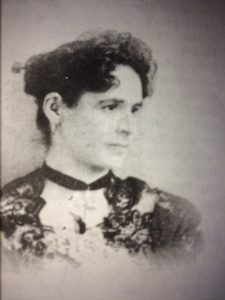
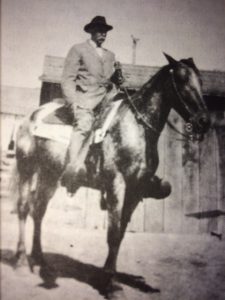
For services performed in the Buenaventura Mission, Fernando Tico obtained Rancho Ojay in 1837 as a land grant from the Mexican government which had only a few years before secularized the missions and all the lands held by the church. Tico was born in San Francisco where his father, a native Catalonia, had come as a volunteer soldier for the King of Spain. In 1853, shortly after California was admitted to the Union, Tico sold his entire holdings in Ojai, some 18,000 acres, to speculators for a few thousand dollars.
Don Fernando Tico circa 1840, a decade after he settled in Ojai. (photo courtesy of Juanita Rodriguez Callendar, who is a direct descendant of the Tico family, and OVM)
One of Don Fernando Tico’s sons, Edward. (photo courtesy of Juanita Rodriguez Callendar and OVM)
One of Don Fernando Tico’s sons, Fernando. (photo courtesy of Juanita Rodriguez Callendar and OVM)
Eldefrida Tico married William Elwell of Ventura. (photo courtesy of Juanita Rodriguez Callendar and OVM)
Jose Ignacio Rodriguez, grandson of Don Fernando Tico. (photo courtesy of Juanita Rodriquez Callendar and OVM)
The Spanish, who first came to this coast in the sixteenth century, discovered in Alta California a climate much like that of the Mediterranean, the land heavy with the grapevine and other fruit, flowers, and honey. Even after Mexico established a separate republic from Spain in the 1820s, the Spanish at Ventura continued to identify with the Californio, not the Mexico, experience. With Tico’s arrival in Ojai, this valley became a Spanish town, part of the California regional expression of rancho life. When the United States acquired California by war with Mexico in 1848, the Spanish character of the region remained unchanged until several years after the American Civil War in the 1860s when the first Anglo-Americans began to arrive in the territory in search of oil, land and other riches. Only then did the peoples who lived here for centuries before, find themselves cast as a minority.
Rancho Ojay took its name from a Chumash village which, if it can be translated into English at all, probably means month or lunar cycle, according to Ojai Art Center Director Cary Sterling who has studied Indian lore. Berkeley scholar James D. Hart, in A Companion to California (1978) accepts the view of virtually all experts that Ojai to the Chumash meant “moon.” Arthur E. Woolman in The Ojai Valley: Gateway to Health and Happiness (1956) calls Ojai the “Valley of the Moon,” but then suggests that Ojai means “nest.” Travel writers, boosters, and the town’s newspaper continued to use the words “moon” and “nest” interchangeably but, as time went on, preferred the metaphor of the nest. Commenting on this controversy, which never fails to arouse the interest of old-timers, departing school superintendent Albert Marley and his wife Jacque said recently: “Regardless of what the historians and other scholars may say about the meaning of the word ‘Ojai,’ we still like the notion that it means ‘Nest.’ We feel safe in ‘the nest’.”
Spanish settlers reported a pink glow lighting the surrounding mountains to the east. This “pink moment” is a reflection of the setting sun and remains one of the valley’s prime attractions.
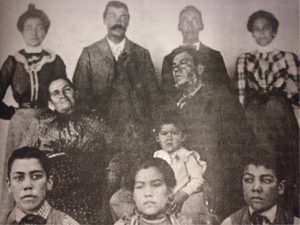
The Reyes family circa 1897. (Howard Bald collection, courtesy of OVM). Jacinto Damien Reyes, (third row, second from left) retired in Ojai in the 1930s after three decades as a forest ranger, explorer, and trail-maker in the Sespe wilderness. Reyes Peak, rising 8400 feet in the Cuyama, is named for him. A hero in the great Matilija-Wheeler Canyon fire of 1917, Reyes also did much to redeem the reputation of the “badlands” along the old Maricopa road from the legendary bandido gangs. The son of Don Rafael Reyes and Dona Maria Ortega (pictured here, second row) Jacinto Reyes grew up on a ranch in Cuyama, now part of the Los Padres National Forest. Presidents William McKinley and Theodore Roosevelt visited the Reyes Ranch in 1901 and 1905. The family is descended from Francisco Reyes, original holder of the San Fernando Valley land grant in the 1780s, and the equally illustrious Ortegas of Ventura County.
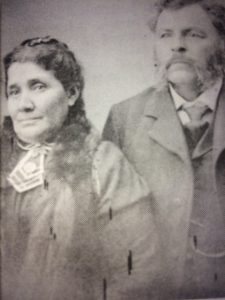
Jose Jesus (Chino) Lopez and Ramona Esquivel Lopez, 1890s. The Lopez family owned land stretching from Foothill Road to Matilija Canyon Road. The old adobe at the mouth of Matilija Canyon was once part of the original Ayala land grant from the King of Spain to Francisco Lopez. The son of Chino and Ramona, Francisco and his wife Matilda raised a family in Ojai. Many Lopez descendants still live here. (photo courtesy of OVM)
The following story is from Walter W. Bristol’s 1946 book, “THE STORY OF THE OJAI VALLEY”. Therefore, it is assumed that Bristol is the author.
THE THACHER SCHOOL
By Walter W. Bristol
This famous school began in 1889 under the direction of Sherman D. Thacher. The location of the school is fortunate—far enough from the town to exclude its concerns and adjacent to mountains, hills and canyons which stimulate interest in riding, hiking, camping, and other out-of-doors activities, which the school capitalized to the fullest extent. This fact led in time to the unique requirement that each boy own and care for a horse.
The scholastic requirements are high and each student must stand on his own abilities, since Mr. Thacher refused the privilege of the accredited system in force in the California Universities, substituting instead the College Board examinations.
Sherman Thacher
The Commencement exercises in the Thacher Bowl are most interesting and attract capacity audiences.
The red arrows point at the two Wilder brothers and Mr. & Mrs. Sherman Thacher.
Wm. L. Thacher came to the valley in 1895 and became the Associate Headmaster. Upon the death of Sherman Thacher in 1931, Morgan Barnes succeeded, and in 1936 Anson S. Thacher became Headmaster.
The school was incorporated in 1924. For many years the limit of students at the school was placed at sixty. Ignoring parental pressure and an increased revenue Mr. Thacher preferred quality to quantity. Of late years provision has been made for an increase of fifteen students.
At the Presbyterian Church on March 20, 1939, the Fiftieth Anniversary Memorial Service was held. Morgan Barnes, who came especially from his home in Pennsylvania, presided. Men prominent in the educational field from different parts of the country participated in the significant event both at the church and at the school during the year. Among them were:
Dr. Charles Seymour, President of Yale.
Dr. Ray Lyman Wilbur, President of Stanford.
Dr. Monroe E. Dentsch, Vice-President of University of California.
Dr. Robert A. Millikan, Chairman of the Executive Council of the California Institute of
Technology.
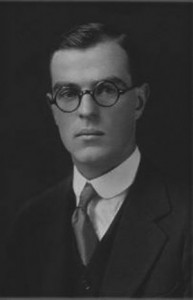
It is interesting to note that in the 57 years of the school’s history 1103 students have passed through its portals. A score of more of the alumni have attained distinction in education and administration, and two outstanding in literature, viz; Thornton Wilder, twice-winner of the Pulitzer Prize and Charles B. Nordhoff, co-author of “Mutiny on the Bounty” and other works. [Charles B. Nordhoff was the grandson of Charles Nordhoff for whom Ojai was originally named.]
The following story was printed in the book “Portrait of a Community (Ojai – Yesterdays and Todays)” by Ellen Malino James in 1984. It is reprinted here with the permission of publisher Ojai Valley News.
WHAT’S NEW DOWNTOWN [in 1984]?
By Ellen Malino James
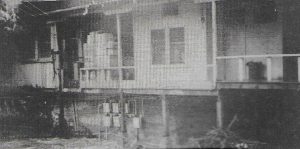
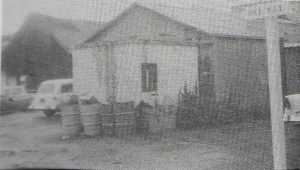
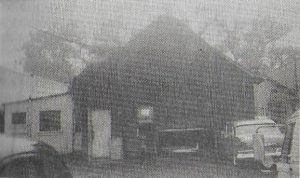
When Edward Drummond Libbey started the Arcade in 1917, he agreed to share the cost of upgrading the front footage with Ojai merchants. Nobody considered the rear of the Arcade. While the street fronts of the Ojai Avenue stores were united by the Mission style of architects Mead and Requa’s original plan, the back doors stood for fifty years in a haphazard jumble of old wood shacks, some dating back to the original 1870’s town of Nordhoff. The front arches continued to grace the picture postcards, the Arcade having become a kind of façade, like a Hollywood set. Behind it, lay a deteriorating shambles of old Western clapboard buildings.
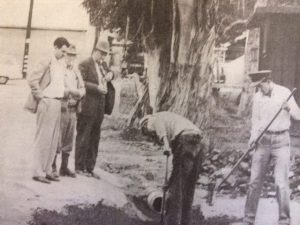
In January, 1954, Mayor Ken Praire, City Engineer Major John Dron, and another official watch workers fix the parking lot drainage behind the Arcade. (Bill Klamser, Jr. photo, OVN)
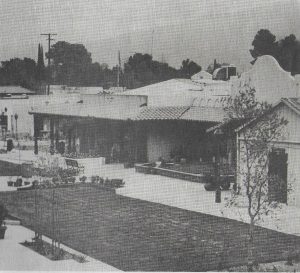
Architect Zelma Wilson and others foresaw that, with imagination and planning, the rear of the Arcade could become a “focal point of community life” – a village where residents and tourists alike could shop and socialize. The original plans of the Downtown Business Committee in 1971 called for plazas, fountains, covered walkways, and new shops and offices, all blending into a relaxed village atmosphere spanning the block from Signal to Montgomery Street behind the Arcade. Now, a decade later [1984], the Arcade Plaza is a local project, paid for without state or federal money. An ingenious application of the state law allowed for increased tax revenues within the redevelopment area to go exclusively for the benefit of this project.
When John Johnston came to Ojai as city manager in 1971, he recalls, “my great concern at that time was to prevent Ojai from turning into another San Fernando Valley.” Johnston, then in his late twenties, had just completed a term as City Manager of Artesia and Cerritos, where uncontrolled growth had transformed dairy farms into what was then the world’s largest indoor shopping mall.
“In Ojai,” says Johnston, “I ran into a city council that stopped this sort of development on its heels.” With Councilman Hal Mitrany and others, Johnston met with Ojai’s downtown merchants to explore ways to redevelop a “shambles” of old structures. In the back alley behind the Arcade, buildings were collapsing, Johnston recalls, “but what could we do? The city was too poor to do it on their own.”
AS A FIRST step, Johnston urged the city to form a parking and improvement district. The merchants then went to Architect Zelma Wilson, A.I.A. to design an expanded Arcade. Johnston then, in early 1972, asked Robert Hill of the California Department of Housing and Community Development to visit Ojai and to outline for the city council how the state redevelopment law could be applied specifically to Ojai’s needs.
Plans were laid for upgrading the downtown core and putting in public improvements with money from tax increments. Each time a property owner increased the value of his land and buildings within the 135-acre boundary of the agency, local tax money flowed into the coffers of the new redevelopment agency.
“So the project came out as originally hoped for,” said Johnston. “It just took a lot longer.” Ten years, in fact, from the original conception in 1972 to the dedication in April, 1982.
OJAI REMAINS one of the few towns to apply the state law on redevelopment in this novel and constructive way to its downtown area. The amount of money available to the redevelopment agency proved to be more than originally hoped for, because property values increased during the past decade beyond anybody’s wildest dreams. Yet with Proposition 13 and the inevitable decline in real estate values, the redevelopment agency idea is not as desirable as a tool as it once was.
Crucial to the redevelopment plan was the timing and local leadership in Ojai. “It is unlikely that the project would have taken place,” says Johnston, “if the interest and support were not there.”
Johnston particularly recalls the role of Clifford Hey and James Loebl: “When things got tough, they didn’t back down.” But there were many others. “Hundreds of people from all walks of life made this happen.” Just one example: Alan Rains invested in sidewalks outside his store long before the plans for the surrounding area took shape. What the redevelopment agency did was to create confidence in the community.
Behind the Arcade: Before
Walk-through at Matilija Street Plaza in 1938, Floodwaters running through the street. (Photo courtesy of the late Lois Heaton)
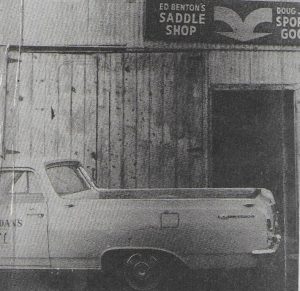
Back door of Ojai Realty [Love Heals in 2017, at 260 E. Ojai Ave], to the left of The Hub, on this same site since 1917 when the front of the Arcade was begun. Previously, the Ojai State Bank stood here. (Photo, circa 1950s, courtesy of Alan Rains)When David Mason, owner of the Village Florist, opened his store more than a decade ago, he remembered how he used to play on that spot as a toddler. The Village Florist stands on the site of Doug Jordan’s next to Ed Benton’s. The mural on the wall of the Village Florist dates from the 1950s when David Mason would accompany his mother, Maxine Miller Mason, to work in the store. [The Village Florist was located at 242 E. Ojai Ave; in 2017 it is Osteria Monte Grappa.]Rear view of Ojai Gift store with outhouse as it looked in the 1950s. (Photo courtesy of Alan Rains)
Behind the Arcade: After
Merchant Alan Rains recalls: “Our concern was that we did not want to see Ojai follow the same route as the San Fernando Valley with shops starting at Woodland Hills and running fifteen miles to wherever. Ojai had not been growing in a healthy pattern for several years and it was felt something needed to be done to revitalize the original shopping area.”
The plaza looking east with new lanterns and landscaping. (OVN staff photo)
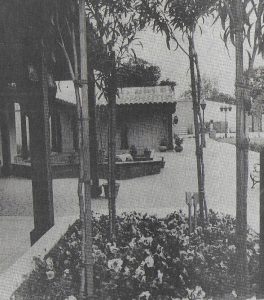
Attractive benches, flowers, and places to rest, much in the tradition of a European town square. (OVN staff photo)
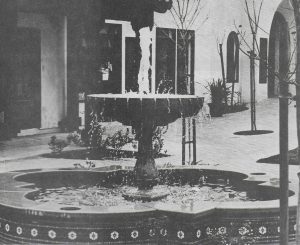
The area behind the Arcade is no longer an eyesore, but an attractive showplace. (OVN staff photo) [This fountain was removed in the late 1990s.]No more false fronts, no more shambles at the rear.