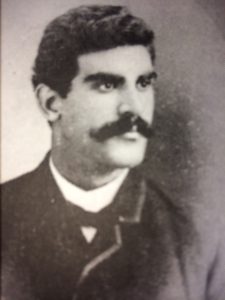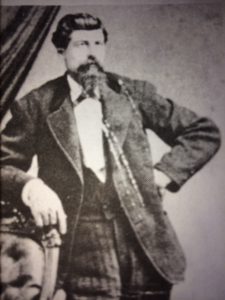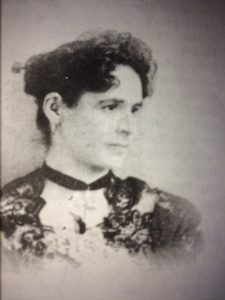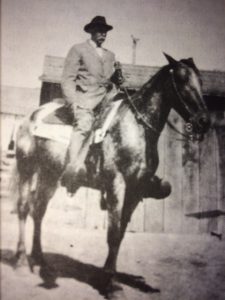
SINGULAR CHARACTERS

This story came from W. W. Bristol’s book, “THE STORY OF THE OJAI VALLEY” which was published in 1946. It is assumed Bristol is the author of the story.

SINGULAR CHARACTERS
BY W. W. Bristol

Among the early settlers in the valley were many singular characters. Of these John Montgomery wrote very entertainingly.

There was a case in early days of a German nobleman stranded on the Lichtenberg ranch four miles from Nordhoff, who in desperation attempted to hatch eggs in the heat of the sun or by artificial heat long before incubators were invented.

To the same ranch came in 1874 two families who appeared as much out of place as the German baron, and so were objects of curiosity and criticism to the sparse country population. They were fresh from New York City and had pronounced city ways, and seemed wholly ignorant of everything pertaining to country life. As these people fill a place in history of the valley we will describe them. Col. Wiggins was a tall spare man of fifty years with a diminutive wife of twenty. His companion, Wiseman, was a stout hearty man of thirty with a refined, delicate, city wife and several children. He was the son of a rich druggist, and had lived, it was said, with both hands in the old man’s bags. After living sometime on the Lichtenberg ranch the two families separated, Wiggins going to Nordhoff while Wiseman squatted with his little family in the wild brush east of the Bennett place. A more unsuitable place for such people could not be found, and they had a hard time in their little clearing surrounded by dense brush, the home of wild animals and rattlesnakes, and a bear trap sunk in the earth not far from their little shanty. And there Wiseman sweat and bungled and blistered, hauling water from a distance, running in debt and waiting for paternal drafts the never came—’til one day his pistol went off, accidentally, when his wagon turned over into a barranca and poor Wiseman’s squat was once more open to homestead entry. He was the pioneer of that lower section now covered by orange groves and for this he finds a place in this sketch.

Col. Wiggins had in the meantime settled in Nordhoff. He purchased from Surdam the Nordhoff townsite and from Blumberg the hotel. He passed for a millionaire and had for a partner a member of the Louisiana legislature, a cotton merchant of New Orleans. Col. Wiggins was a man of much dignity of character as suited the man of military antecedents and had his own ideas of running a hotel. He treated his guests as if they owed him an apology, and the offense could not be condoned by their silent submission to a heavy board bill, consequently he soon had the house all to himself. In 1878 he joined his friend Wiseman in the shadowy land, and his disconsolate little widow shared her sorrows with a second husband in San Francisco. Thus passed away another of the Valley’s pioneers, and eccentric, but honest man.

Shortly after Wiggins’ demise the writer as owner of the hotel, received a visit from a strange lady who made the startling proposition to open an academy for young ladies in the building. She was a veteran in the business and highly recommended, and the establishment was to be first class. In a few weeks glowing circulars were scattered over California announcing the grand opening and detailing the various branches and strict rules of decorum, guaranteed moral safety and payment in advance. Four professors from San Francisco, loaded with accomplishments and burning to impart their knowledge, took charge of their departments. The doors were thrown open and only the presence of the sweet lady graduate was necessary to make everybody happy; but, alas, she came not, and a financial stringency in the local market brought things to a crisis and howls of despair. The rupture of a solitary greenback and its distribution among the professors assuaged their ruffled tempers, and under the leadership of the Professor of Oriental Literature they departed to luxuriate in a deck passage to San Francisco.

It has been said that Wiseman was the pioneer of the lower orange district of the valley, but S. S. Buckman had settled previously on the present Thacher place. This Buckman was a Vermonter who came to the county in 1872, and through his good looks and qualities secured the position of County Superintendent of Schools. Rambling in the wilds he discovered water in the canyon and concluded it could be utilized on the open land below. This would cost a heavy outlay; but he had an immense capital of pluck and courage. By hook and crook he constructed his long and costly flume and attacked the dense brush forest, fighting for every foot of clearing and planting the first citrus trees in the valley. He taught school in Nordhoff, worked at home Saturdays and planted on Sundays. Never a word of encouragement did he get from his neighbors, he was a crank in their estimation—a young Vermonter with a hobby.
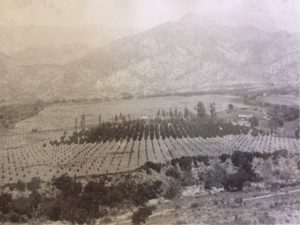
The older orange trees in the center of this photo were planted by F. S. S. Buckman in 1875. This was the first orange orchard planted in the Ojai Valley. This photo was taken in 1912. The ranch became known as the "Topa Topa Ranch".
The older orange trees in the center of this photo were planted by F. S. S. Buckman in 1875. This was the first orange orchard planted in the Ojai Valley. This photo was taken in 1912. The ranch became known as the “Topa Topa Ranch”.

It was a strange sight to see him as black as a chimney sweeper from the burning brush, ragged and soiled from hard work, and then glance at his framed diploma hanging from the bare wall bearing in Latin from far off “Monte Verdis” a guaranty of his classical attainments, such incongruity is seldom seen outside of California.
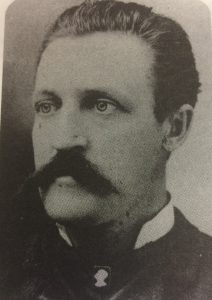
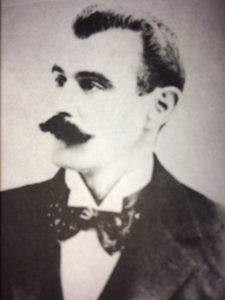
F. S. S. Buckman
F. S. S. Buckman

His efforts were crowned with a splendid competence which he did not long enjoy, for the deadly bullet of an assassin laid him low at San Francisco—another tragic ending of a valley pioneer.
The Duke Comes to Ojai

The Duke Comes to Ojai

Written and compiled from various sources by Tony Thacher.

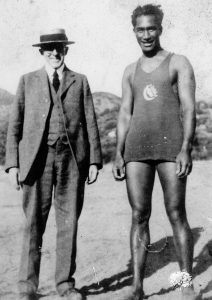
Sherman Day Thacher and Duke Paoa Kahanamoku at The Thacher School in 1922.

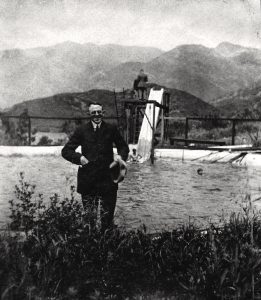
On a dry and dusty afternoon in late October of 1922 this unlikely pair were captured on film standing near the top of the alluvial fan emanating from Horn Canyon in the northeast corner of the Ojai Valley. Sherman Day Thacher, as headmaster of the school he founded 33 years before, is shown flanked by Olympic swimming gold medalist Duke Paoa Kahanamoku of Honolulu, Hawaii. Duke had been invited to come up from Los Angeles to give a demonstration and instruction in swimming to the assembled student body in the Thacher School’s pool. In reality this crude concrete structure was a rather murky irrigation and fire reservoir full of biota from the creek that filled it.

Duke’s swimming skills, superb physique and good looks had already made him a star both in and out of the water. And his gold medals and promotion of board surfing had made his reputation as the “Father of Modern Surfing” and the “Ambassador of Aloha.” From almost the moment of his birth on August 24, 1890 in Honolulu, Kahanamoku’s life revolved around the warm Pacific waters surrounding Oahu.  While that on its own might not have been a particularly unusual accomplishment for an Hawaiian Islander of the time, what was unusual was his speed through the water. In the first officially sanctioned Amateur Athletic Union (AAU) swim meet in Hawaii in August of 1911, Duke knocked over 4 seconds off the world record for the 100-yard open water event, causing stateside AAU officials to declare there must have been an error and refusing to sanction the time.

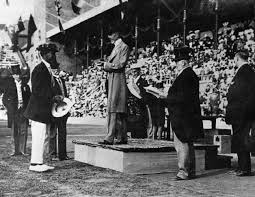
Although not used to swimming in a pool, Duke continued his winning ways in the water stateside. At the Olympic games of 1912 held in Stockholm, there was no mistaking Duke’s incredible speed and power, and he won the 100-meter freestyle, again breaking the world record and easily taking the Gold medal. Over the next few years, Kahanamoku’s reputation grew to new heights as he continued shattering world aquatic records in various competitions around the globe. Duke Kahanamoku continued swimming for the rest of his life, winning his last Olympic medal at the age of forty-two. His remarkable twenty-one year career as an Olympic champion remains today a record achievement.

Duke Kahanamoku (holding hat at left) at the 1912 Olympic Games in Stockholm, Sweden.

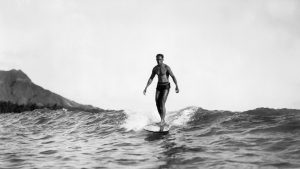
At the same time, he was credited for popularizing the sport of surfing. In a series of widely attended demonstrations around the world, Duke would ride the waves on his handmade long board to the delight of onlookers, and thus the ancient sport was revitalized along the coasts all over the world.

Duke Kahanamoku surfing with Diamond Head at left in the background on Oahu Island in the Hawaiian Islands.

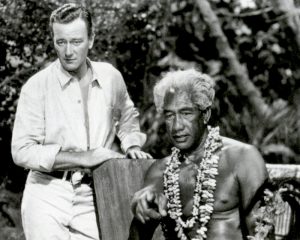
As someone identified with the Hawaiian Islands it is easy to forget that Duke Kahanamoku ever spent significant time anywhere else, yet he was a regular presence in Southern California throughout the 1910’s and 1920’s. The Southland was equally charmed with Duke making many friends and becoming a particular favorite of the movie colony. And, of course, his worldwide fame and good looks didn’t go unnoticed by the studios. In 1925, Famous Players-Lasky (Paramount) offered Duke a film contract. However, his promising film career was hobbled by an ironic twist – he couldn’t appear on-screen doing what the world best knew him for – swimming. AAU rules strictly prohibited Duke from accepting money for swimming. And Duke had no intention of giving up his amateur standing in athletics just for Hollywood film making, which he considered nothing more than a fun lark. So the studios found themselves with a non-swimming swimming star and were forced to come up with creative ways to use him in non-aquatic roles. They tried their best and over the next few years, Duke made appearances in a number of films. Without being able to be seen as the aquatic champion, his career in movies in the ‘20’s quickly fizzled. However, in later years, Duke would return to the screen on several notable occasions. In 1948 he played a native chieftain opposite another famous “Duke,” John Wayne, in The Wake of the Red Witch, and in 1955 he again played a native chief in the John Ford-directed Mister Roberts with Henry Fonda and James Cagney.
Kahanamoku left a legacy in his native Hawaii, where he became its most revered citizen and goodwill ambassador. For more than twenty years he served as Sheriff of Honolulu and after Hawaii became the 50th State in 1959, he was made the State’s official “Ambassador of Aloha.” Kahanamoku died at the age of seventy-seven, just three weeks after greeting Hawaii’s one-millionth visitor.

TWO DUKES: John "The Duke" Wayne and Duke Paoa Kahanamoku.
TWO DUKES: John “The Duke” Wayne and Duke Paoa Kahanamoku.

Today, there are many memorials and monuments to Duke Kahanamoku on the Hawaiian Islands, outside Sydney Harbor and elsewhere, but all too few stateside. However, in Ojai, it’s Sherman Thacher’s unheated and untreated irrigation reservoir that can still be linked to the legendary swimmer and surf rider, Duke Paoa Kahanamoku.

Sherman Day Thacher at The Thacher School swimming pool which was really a reservoir.

THE SPANISH SETTLERS

The following article is from the book “Portrait of a Community –– Ojai: Yesterdays and Todays” by Ellen Malino James.  It is reprinted here with the permission of the publisher, Ojai Valley News.

THE SPANISH SETTLERS
By Ellen Malino James

For services performed in the Buenaventura Mission, Fernando Tico obtained Rancho Ojay in 1837 as a land grant from the Mexican government which had only a few years before secularized the missions and all the lands held by the church. Tico was born in San Francisco where his father, a native Catalonia, had come as a volunteer soldier for the King of Spain. In 1853, shortly after California was admitted to the Union, Tico sold his entire holdings in Ojai, some 18,000 acres, to speculators for a few thousand dollars.

Don Fernando Tico circa 1840, a decade after he settled in Ojai. (photo courtesy of Juanita Rodriguez Callendar, who is a direct descendant of the Tico family, and OVM)


One of Don Fernando Tico's sons, Edward. (photo courtesy of Juanita Rodriguez Callendar and OVM)
One of Don Fernando Tico’s sons, Edward. (photo courtesy of Juanita Rodriguez Callendar and OVM)


One of Don Fernando Tico's sons, Fernando. (photo courtesy of Juanita Rodriguez Callendar and OVM)
One of Don Fernando Tico’s sons, Fernando. (photo courtesy of Juanita Rodriguez Callendar and OVM)


Eldefrida Tico married William Elwell of Ventura. (photo courtesy of Juanita Rodriguez Callendar and OVM)


Jose Ignacio Rodriguez, grandson of Don Fernando Tico. (photo courtesy of Juanita Rodriquez Callendar and OVM)

The Spanish, who first came to this coast in the sixteenth century, discovered in Alta California a climate much like that of the Mediterranean, the land heavy with the grapevine and other fruit, flowers, and honey. Even after Mexico established a separate republic from Spain in the 1820s, the Spanish at Ventura continued to identify with the Californio, not the Mexico, experience. With Tico’s arrival in Ojai, this valley became a Spanish town, part of the California regional expression of rancho life. When the United States acquired California by war with Mexico in 1848, the Spanish character of the region remained unchanged until several years after the American Civil War in the 1860s when the first Anglo-Americans began to arrive in the territory in search of oil, land and other riches. Only then did the peoples who lived here for centuries before, find themselves cast as a minority.

Rancho Ojay took its name from a Chumash village which, if it can be translated into English at all, probably means month or lunar cycle, according to Ojai Art Center Director Cary Sterling who has studied Indian lore. Berkeley scholar James D. Hart, in A Companion to California (1978) accepts the view of virtually all experts that Ojai to the Chumash meant “moon.” Arthur E. Woolman in The Ojai Valley: Gateway to Health and Happiness (1956) calls Ojai the “Valley of the Moon,” but then suggests that Ojai means “nest.” Travel writers, boosters, and the town’s newspaper continued to use the words “moon” and “nest” interchangeably but, as time went on, preferred the metaphor of the nest. Commenting on this controversy, which never fails to arouse the interest of old-timers, departing school superintendent Albert Marley and his wife Jacque said recently: “Regardless of what the historians and other scholars may say about the meaning of the word ‘Ojai,’ we still like the notion that it means ‘Nest.’ We feel safe in ‘the nest’.”

Spanish settlers reported a pink glow lighting the surrounding mountains to the east. This “pink moment” is a reflection of the setting sun and remains one of the valley’s prime attractions.

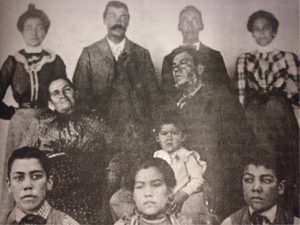
The Reyes family circa 1897. (Howard Bald collection, courtesy of OVM). Jacinto Damien Reyes, (third row, second from left) retired in Ojai in the 1930s after three decades as a forest ranger, explorer, and trail-maker in the Sespe wilderness. Reyes Peak, rising 8400 feet in the Cuyama, is named fro him. A hero in the great Matilija-Wheeler Canyon fire of 1917, Reyes also did much to redeem the reputation of the "badlands" along the old Maricopa road from the legendary bandido gangs. The son of Don Rafael Reyes and Dona Maria Ortega (pictured here, second row) Jacinto Reyes grew up on a ranch in Cuyama, now part of the Los Padres National Forest. Presidents William McKinley and Theodore Roosevelt visited the Reyes Ranch in 1901 and 1905. The family is descended from Francisco Reyes, original holder of the San Fernando Valley land grant in the 1780s, and the equally illustrious Ortegas of Ventura County.
The Reyes family circa 1897. (Howard Bald collection, courtesy of OVM). Jacinto Damien Reyes, (third row, second from left) retired in Ojai in the 1930s after three decades as a forest ranger, explorer, and trail-maker in the Sespe wilderness. Reyes Peak, rising 8400 feet in the Cuyama, is named for him. A hero in the great Matilija-Wheeler Canyon fire of 1917, Reyes also did much to redeem the reputation of the “badlands” along the old Maricopa road from the legendary bandido gangs. The son of Don Rafael Reyes and Dona Maria Ortega (pictured here, second row) Jacinto Reyes grew up on a ranch in Cuyama, now part of the Los Padres National Forest. Presidents William McKinley and Theodore Roosevelt visited the Reyes Ranch in 1901 and 1905. The family is descended from Francisco Reyes, original holder of the San Fernando Valley land grant in the 1780s, and the equally illustrious Ortegas of Ventura County.


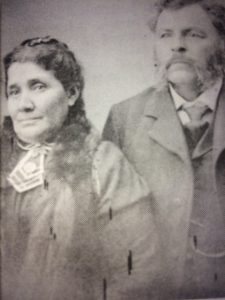
Jose Jesus (Chino) Lopez and Ramona Esquivel Lopez, 1890s. (photo courtesy of OVM) The Lopez family owned land stretching from Foothill Road to Matilija Canyon Road. The old adobe at the mouth of Matilija Canyon was once part of the original Ayala land grant from the King of Spain to Francisco Lopez. The son of Chino and Ramona, Francisco, and his wife Matilda raised a family in Ojai. Many Lopez descendants still live here.
Jose Jesus (Chino) Lopez and Ramona Esquivel Lopez, 1890s.  The Lopez family owned land stretching from Foothill Road to Matilija Canyon Road. The old adobe at the mouth of Matilija Canyon was once part of the original Ayala land grant from the King of Spain to Francisco Lopez. The son of Chino and Ramona, Francisco and his wife Matilda raised a family in Ojai. Many Lopez descendants still live here. (photo courtesy of OVM)


THE THACHER SCHOOL

The following story is from Walter W. Bristol’s 1946 book, “THE STORY OF THE OJAI VALLEY”. Therefore, it is assumed that Bristol is the author.

THE THACHER SCHOOL
By Walter W. Bristol

This famous school began in 1889 under the direction of Sherman D. Thacher. The location of the school is fortunate—far enough from the town to exclude its concerns and adjacent to mountains, hills and canyons which stimulate interest in riding, hiking, camping, and other out-of-doors activities, which the school capitalized to the fullest extent. This fact led in time to the unique requirement that each boy own and care for a horse.

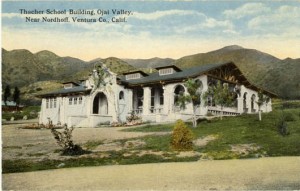
Thacher Admin Building

The scholastic requirements are high and each student must stand on his own abilities, since Mr. Thacher refused the privilege of the accredited system in force in the California Universities, substituting instead the College Board examinations.

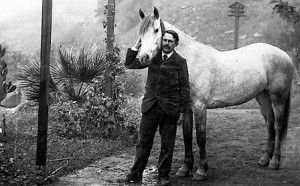
Sherman Thacher
Sherman Thacher

The Commencement exercises in the Thacher Bowl are most interesting and attract capacity audiences.

The red arrows point at the two Wilder brothers and Mr. & Mrs. Sherman Thacher.

Wm. L. Thacher came to the valley in 1895 and became the Associate Headmaster. Upon the death of Sherman Thacher in 1931, Morgan Barnes succeeded, and in 1936 Anson S. Thacher became Headmaster.

The school was incorporated in 1924. For many years the limit of students at the school was placed at sixty. Ignoring parental pressure and an increased revenue Mr. Thacher preferred quality to quantity. Of late years provision has been made for an increase of fifteen students.

At the Presbyterian Church on March 20, 1939, the Fiftieth Anniversary Memorial Service was held. Morgan Barnes, who came especially from his home in Pennsylvania, presided. Men prominent in the educational field from different parts of the country participated in the significant event both at the church and at the school during the year. Among them were:

Dr. Charles Seymour, President of Yale.
Dr. Ray Lyman Wilbur, President of Stanford.
Dr. Monroe E. Dentsch, Vice-President of University of California.
Dr. Robert A. Millikan, Chairman of the Executive Council of the California Institute of
Technology.

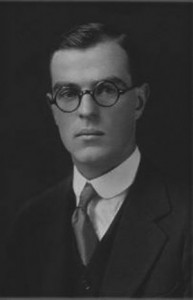
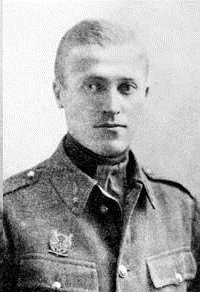
It is interesting to note that in the 57 years of the school’s history 1103 students have passed through its portals. A score of more of the alumni have attained distinction in education and administration, and two outstanding in literature, viz; Thornton Wilder, twice-winner of the Pulitzer Prize and Charles B. Nordhoff, co-author of “Mutiny on the Bounty” and other works. [Charles B. Nordhoff was the grandson of Charles Nordhoff for whom Ojai was originally named.]

Thornton Wilder at Yale.


Charles B. Nordhoff in 1918.

WHAT’S NEW DOWNTOWN?

The following story was printed in the book “Portrait of a Community (Ojai – Yesterdays and Todays)” by Ellen Malino James in 1984. It is reprinted here with the permission of  publisher Ojai Valley News.

WHAT’S NEW DOWNTOWN [in 1984]?
By Ellen Malino James

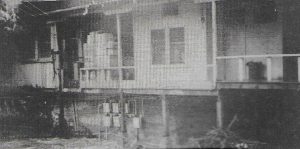
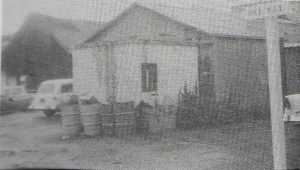
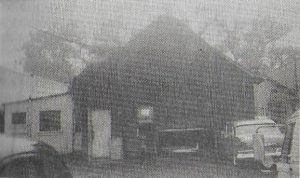
When Edward Drummond Libbey started the Arcade in 1917, he agreed to share the cost of upgrading the front footage with Ojai merchants. Nobody considered the rear of the Arcade. While the street fronts of the Ojai Avenue stores were united by the Mission style of architects Mead and Requa’s original plan, the back doors stood for fifty years in a haphazard jumble of old wood shacks, some dating back to the original 1870’s town of Nordhoff. The front arches continued to grace the picture postcards, the Arcade having become a kind of façade, like a Hollywood set. Behind it, lay a deteriorating shambles of old Western clapboard buildings.

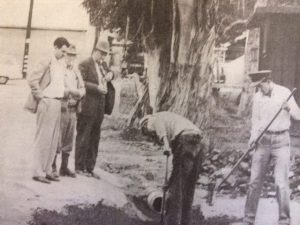
In January, 1954, Mayor Ken Praire, City Engineer Major John Dron, and another official watch workers fix the parking lot drainage behind the Arcade. (Bill Klamser, Jr,, photo, OVN)
In January, 1954, Mayor Ken Praire, City Engineer Major John Dron, and another official watch workers fix the parking lot drainage behind the Arcade. (Bill Klamser, Jr. photo, OVN)

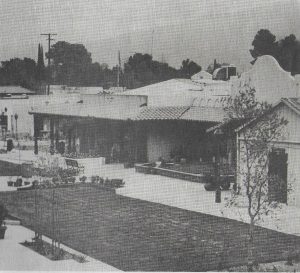
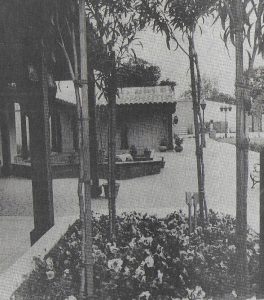
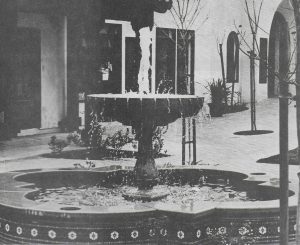
Architect Zelma Wilson and others foresaw that, with imagination and planning, the rear of the Arcade could become a “focal point of community life” – a village where residents and tourists alike could shop and socialize. The original plans of the Downtown Business Committee in 1971 called for plazas, fountains, covered walkways, and new shops and offices, all blending into a relaxed village atmosphere spanning the block from Signal to Montgomery Street behind the Arcade. Now, a decade later [1984], the Arcade Plaza is a local project, paid for without state or federal money. An ingenious application of the state law allowed for increased tax revenues within the redevelopment area to go exclusively for the benefit of this project.

When John Johnston came to Ojai as city manager in 1971, he recalls, “my great concern at that time was to prevent Ojai from turning into another San Fernando Valley.” Johnston, then in his late twenties, had just completed a term as City Manager of Artesia and Cerritos, where uncontrolled growth had transformed dairy farms into what was then the world’s largest indoor shopping mall.

“In Ojai,” says Johnston, “I ran into a city council that stopped this sort of development on its heels.” With Councilman Hal Mitrany and others, Johnston met with Ojai’s downtown merchants to explore ways to redevelop a “shambles” of old structures. In the back alley behind the Arcade, buildings were collapsing, Johnston recalls, “but what could we do? The city was too poor to do it on their own.”

AS A FIRST step, Johnston urged the city to form a parking and improvement district. The merchants then went to Architect Zelma Wilson, A.I.A. to design an expanded Arcade. Johnston then, in early 1972, asked Robert Hill of the California Department of Housing and Community Development to visit Ojai and to outline for the city council how the state redevelopment law could be applied specifically to Ojai’s needs.

Plans were laid for upgrading the downtown core and putting in public improvements with money from tax increments. Each time a property owner increased the value of his land and buildings within the 135-acre boundary of the agency, local tax money flowed into the coffers of the new redevelopment agency.

“So the project came out as originally hoped for,” said Johnston. “It just took a lot longer.” Ten years, in fact, from the original conception in 1972 to the dedication in April, 1982.

OJAI REMAINS one of the few towns to apply the state law on redevelopment in this novel and constructive way to its downtown area. The amount of money available to the redevelopment agency proved to be more than originally hoped for, because property values increased during the past decade beyond anybody’s wildest dreams. Yet with Proposition 13 and the inevitable decline in real estate values, the redevelopment agency idea is not as desirable as a tool as it once was.

Crucial to the redevelopment plan was the timing and local leadership in Ojai. “It is unlikely that the project would have taken place,” says Johnston, “if the interest and support were not there.”

Johnston particularly recalls the role of Clifford Hey and James Loebl: “When things got tough, they didn’t back down.” But there were many others. “Hundreds of people from all walks of life made this happen.” Just one example: Alan Rains invested in sidewalks outside his store long before the plans for the surrounding area took shape. What the redevelopment agency did was to create confidence in the community.


Behind the Arcade:  Before

Walk-through at Matilija Street Plaza in 1938, Floodwaters running through the street. (photo courtesy of the late Lois Heaton)
Walk-through at Matilija Street Plaza in 1938, Floodwaters running through the street. (Photo courtesy of the late Lois Heaton)


Back door of Ojai Realty, to the left of The Hub, on this same site since 1917 when the front of the Arcade was begun. Previously, the Ojai State Bank stood here. (photo, circa 1950s, courtesy of Alan Rains)
Back door of Ojai Realty [Love Heals in 2017, at 260 E. Ojai Ave], to the left of The Hub, on this same site since 1917 when the front of the Arcade was begun. Previously, the Ojai State Bank stood here. (Photo, circa 1950s, courtesy of Alan Rains)
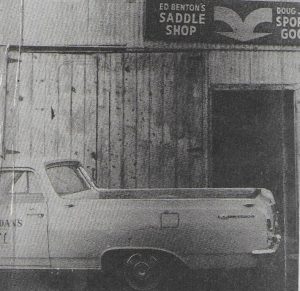
When David Mason, owner of the Village Florist, opened his store more than a decade ago, he remembered how he used to play on that spot as a toddler. The Village Florist stands on the site of Doug Jordan's next to Ed Benton's. The mural on the wall of the Village Florist dates from the 1950s when David Mason would accompany his mother, Maxine Miller Mason, to work in the store.
When David Mason, owner of the Village Florist, opened his store more than a decade ago, he remembered how he used to play on that spot as a toddler. The Village Florist stands on the site of Doug Jordan’s next to Ed Benton’s. The mural on the wall of the Village Florist dates from the 1950s when David Mason would accompany his mother, Maxine Miller Mason, to work in the store. [The Village Florist was located at 242 E. Ojai Ave; in 2017 it is Osteria Monte Grappa.]
Rear view of Ojai Gift store with outhouse as it looked in the 1950s. (photo courtesy of Alan Rains)
Rear view of Ojai Gift store with outhouse as it looked in the 1950s. (Photo courtesy of Alan Rains)

Behind the Arcade:  After

Merchant Alan Rains recalls:  “Our concern was that we did not want to see Ojai follow the same route as the San Fernando Valley with shops starting at Woodland Hills and running fifteen miles to wherever.  Ojai had not been growing in a healthy pattern for several years and it was felt something needed to be done to revitalize the original shopping area.”

The plaza looking east with new lanterns and landscaping. (OVN staff photo)


Attractive benches, flowers, and places to rest, much in the tradition of a European town square. (OVN staff photo)


The area behind the Arcade is no longer an eyesore, but an attractive showplace. (OVN staff photo)
The area behind the Arcade is no longer an eyesore, but an attractive showplace. (OVN staff photo) [This fountain was removed in the late 1990s.]
No more false fronts, no more shambles at the rear.


PUBLIC SECONDARY

The following story is from Walter Bristol’s 1946 book, “THE STORY OF THE OJAI VALLEY.” It is assumed that Walter Bristol is the author.

PUBLIC SECONDARY

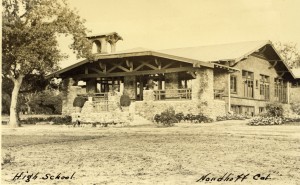
In 1909 a Union High School District was formed. The first trustees were Sherman D. Thacher, Joseph Hobart, Dr. B. L. Saeger, F. H. Sheldon and F. P. Barrows. W. W. Bristol was engaged by Mr. Thacher at their meeting in Berkley to be the first principal. He was assisted the first year by Mabyn Chapman, a teacher of great versatility, and the second year by Ruth Forsyth, in the subjects of science and mathematics.

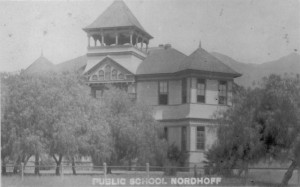
The first two years of the school was conducted in the upper story of the old wooden grammar school. Twenty-four pupils enrolled the first year.

Norhoff Grammar School, where Miss Baker went to school.
The old wooden Nordhoff Grammar School.

In 1910 the principal told the trustees that a new building must be planned for as soon as possible since there was not room enough to carry on. Bonds were voted for $20,000. Since one member of the board, F. P. Barrows, did not agree with the majority as to the site for the new building, it became necessary under the law to call an election to decide on a site. A hot election ensued—one faction wanting it east of town, the other west of town. Fortunately, the western advocates won.

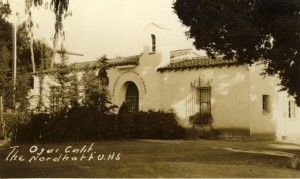
In the fall of 1911 the new building was ready and formally dedicated on November 1st. The first class to graduate was made up of Grace Hobson, Valeditorian, Carolyn Wilson, Salutatorian, Nina Freeman, Ethel Freeman, Edna Leslie, Abbie Cota and Levi Bray.

Nordhoff High School (1911)

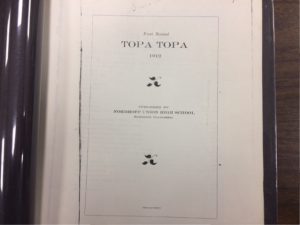
The first annual named “Topa Topa” appeared at the close of 1912-1913 session.

First page of the 1912-1913 Nordhoff Union High School annual (yearbook).

In 1916 the new manual training and Domestic Science buildings were completed and dedicated. In 1919 Principal Bristol resigned. The principals to date were W. D. Gayman, Albert L. Estus, R. M. Wilson, Jack Polski and in 1933 Rudolph H. Drewes.

The new high school was completed in 1929 during the administration of Jack Polski. A large gymnasium was completed in November, 1940.

Buildings designed by Roy Wilson.

Mr. Drewes has established a useful place in the community. He has been district head of the Boy Scouts, director of the Ojai Valley Chamber of Commerce and is now Chairman of the Playground committee and President of the Board of Trustees of the Presbyterian Church.

Matilija Hot Springs has Colorful History

This article was first published in the Ojai Valley News on October 22, 1994. It is used here with their permission. 

MATILIJA HOT SPRINGS HAS COLORFUL HISTORY
By David Mason

“Matilija Hot Springs has had its grand opening for another season. The resort features a first class dining room, hot sulfur baths, medicinal waters, no fog and no winds. Board at the hotel is $12.00 a week and up; in tents, $2.50 a week.”  – THE VENTURA FREE PRESS, MAY, 1904

Fountain of Life, Mother of Eve, Jacob’s Well and Celeste are the names of just a few of the springs that gush from the boulders in the Matilija Canyon.

When the springs were discovered in 1873 by J. W. Wilcox, he thought they might in some way be used for medicinal purposes. Wilcox camped beside the hot springs and bathed in the water for several weeks and discovered that his Mexican-War injury was slowly disappearing.

By 1875, the springs came into the ownership of R.M. Brown. With picks, spades, crowbars and an iron wheelbarrow, Brown set out to create a resort, taking advantage of the natural surroundings and the many hot and cold springs that flowed so freely out of the ground.

During the next two years, Brown built a long rambling building with a porch the entire length of its front and sides. The building became a hotel with 20 rooms to let. He also built six cabins for additional sleeping rooms.

The Arroyo Matilija, now Matilija Creek, ran behind the hotel, and there was a small footbridge to cross the river to a green meadow on the other side. In the meadow was built a large bathhouse with hot showers and sulfur baths. For an additional fee, one could even enjoy a “mud bath.” Brown then constructed a good road to his resort.

The Matilija Springs opened to the public in 1877, but not under Brown’s ownership, for he had sold the whole of the land, buildings and resort to Capt. Gardner even before the buildings were finished. Gardner gave the area the name of Matilija Springs. Gardner brought with him from San Francisco, Captain La Guad as the resorts new manager. La Guad was well known in San Francisco as a very fine chef. The guest and all the employees were very fond of the new manager.

Gardner decided to expand his operation in the canyon by bringing in hundreds of beautiful thoroughbred Angora goats. He felt that within a very short time, he would have a thriving wool-bearing ranch, however he did not take into consideration that with the low and thorny underbrush, the animals silken fur would be ruined. The goats stayed around the resort for a few years, as a great source of amusement for the guests.

In 1881, Gardner sold the springs to a Mr. Wilcoxen, from Arizona, to be used as a private home. The Wilcoxen’s had wanted a place with healing qualities because of the failing health of a grandson, Arnold Carver, who lived with them. The boy died after a serious fall, while out hunting one day. The Wilcoxen’s then opened the springs to other family members and visitors.

The resorts popularity grew as publications about the Santa Barbara and Ventura Counties included the hot springs. In 1883, Thompson and West wrote “These grounds, intersected by limpid streams, seem to have been selected by nature as a spot of earth where the chemistry of her great laboratory for the cure of diseases displays itself in great perfection. There are twenty-two of the springs and it is a remarkable fact that the quantity of water discharged never varies: It is the same in the hottest and driest spells of weather.”

The temperature of the water flowing from the springs was from 35 degrees to 150 degrees. The mountain streams were full of trout and the neighboring hills were the home of deer, quail and rabbits.

As for the health benefits, the papers wrote; “The pure mountain air, freedom from wind and dust, and the equal climate, combined with its healing waters, stimulate nature to her own best restoration processes. The effect on the healthy body of the sojourner here is to incite them to the highest mental and bodily efforts. A wholesome feeling of energy pervades and fits a man for his best and steadiest work.” The Matilija Springs resort was destroyed in the flood of 1884.

A. W. Blumberg who owned the small Blumberg Hotel in the town of Nordhoff, now Ojai, filed a claim on some of the land in the Matilija Canyon, and decided to use the springs to create a new resort and health center, appropriately call Matilija Hot Springs.

Blumberg built several small cozy cottages and furnished them for the comfort of guests. Around these cabins and among the nearby boulders, he placed tents for camping parties, and in another area, he built a stable for horses. He then built a small store for the convenience of campers and another building which was used for an office and dining room.

The new Matilija Hot Springs would now accommodate up to 100 people aside from those who had chosen to live in tents and board themselves.

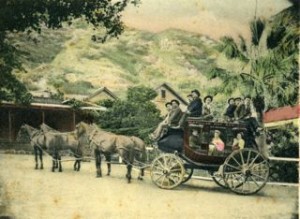
Stagecoaches were the only means of public transportation to the Matilija Hot Springs, and the tourists flocked to the new resort. With so many tourists, it became necessary to open another business, the Matilija Post Office. The post office opened for business on July 22, 1889 and remained in operation for 27 years. The outlook for the future of the springs seemed very bright. All the guests were enthusiastic over the beauty of the canyon and its healing waters.

The Matilija Stage
The Matilija Stage

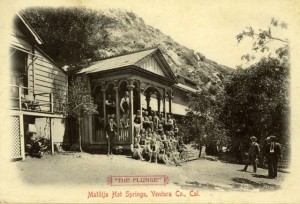
In 1901, the Blumbergs sold the resort to S. P. Creasinger, a real estate broker and developer. Creasinger paid $20,000 for the resort on eighty acres and an additional three hundred and twenty acres. By 1903, Creasinger was advertising his “Popular Summer and Winter Resort” as a “beautiful spot tendered attractive by nature (which) had been made more beautiful by the hand of artifice and the generous expenditure of money. A mammoth pleasure pavilion and numerous new cottages are among the improvements. The grounds were even illuminated by electric lights.”

"The Plunge" at Matilija Hot Springs
“The Plunge” at Matilija Hot Springs

Creasinger lost the Matilija Hot Springs in a bankruptcy hearing in January 1904, and the property came into the ownership of Sim Myers of Oxnard, who purchased the place for $12,000. It would end up costing Myers more than he had anticipated. In July of 1907, Myers was charged with selling liquor without a license.

Mr. A. C. Rallya, of Chicago, a member of the Thiel Detective Agency, brought the charge against the Hot Springs. Rallya stopped at the springs for about a week and claimed to have evidence of infractions of the law. Myers, not contrary to formal charges of like character, offered no defense and the court imposed a fine on him of $300. Other charges being in evidence, the court promised Myers immunity from them, providing he would promise not to sell intoxicating drinks from now on.

The local paper, The Ojai, reporting the incident, said that they “hope that the charming resort has sufficient real attractions to afford Mr. Myers a successful career without evasion of the county ordinance.”

Then another flood raged through the canyon, with damage estimated at $50,000 to the resort’s buildings. This loss caused Myers to lose his investment. The Levy’s Bank of Oxnard took over the resort and leased it for many years, and it turned out to be a financial disaster for the bank.

In 1920, Joe Linnel, who had managed the old Blumberg Hotel in the town of Ojai, took over the Matilija Hot Springs. In 1938, G. E. Mann was in charge of the resort. Mr. and Mrs. Ray Robertson leased the Matilija Hot Springs in 1941 and ran a successful operation until 1949.

Many names of famous guests appeared on the register of the splendid “Old Western Hotel” during its years of public attraction. One of the guests was President and Mrs. Herbert Hoover, who stayed overnight and enjoyed the dining room that had achieved a reputation far and wide for its delicious food served in the atmosphere of splendor that surpassed many of the “big city” restaurants.

In 1946, the Ventura County flood control district bought the springs and the land surrounding it. The county wanted the land to build a dam in order to create a water storage lake behind the resort.

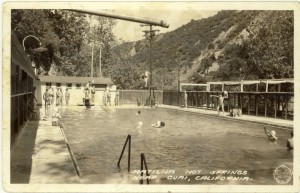
Matilija Hot Springs swimming pool in the 1950s.

In 1965, Mr. and Mrs. Bill Olivas leased the Matilija Hot Springs resort and spa. The 1969 flood did considerable damage to the swimming pool and some of the buildings, but through the efforts of Bill Olivas, the resort was restored to its former glory.

In 1988, the county sold the property to a Santa Barbara man, and it is once more closed to the public.

EL RANCHO COLA

This article was run in VOL. IV (circa 1953-1954) of “’round the clock” published by R. W. Bressler. It is assumed R. W. Bressler is the article’s author.

EL RANCHO COLA

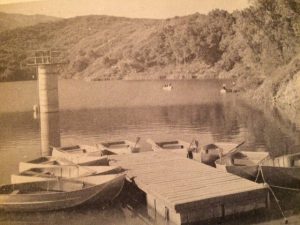
El Rancho Cola Country Club – garden spot of California: Nature has been generous in fashioning the rolling terrain of our 2,075 acres dotted with mammoth oaks, and backed by the majestic Chisamahoo Mountains of the Santa Ana range. Winding through this vast acreage, in the heart of the most healthful section of California, is Coyote Creek, recently dammed to form Deepcat Lake—amply stocked with trout which is the second largest man-made lake in Ventura County. Nestled in the Santa Ana Valley—twelve miles inland from Ventura, and six miles west of Ojai at Highway 150 and Dunshee Rd.—El Rancho Cola offers and eye-appealing picture seen from any angle. “Joyce Kilmer” trees, towering yet comfortable mountains, along with rolling hills similar to Kentucky’s “bid to fame,” lend a distinctive aura of enchantment, and form a perfect backdrop for the ranch settings. It is a mecca for those who revel in the natural beauty that ample water can bring to any Southern California acreage.

Deepcat Lake
Deepcat Lake

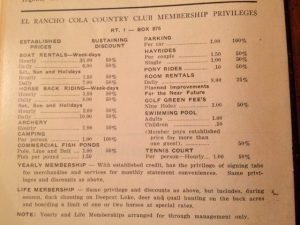
El Rancho Cola Country Club is designed for the entire family, providing fun and activities for all. Though open to the public at average going prices, the Membership Privileges discount these prices as much as 100%. The Yearly Sustaining Membership card at a cost of $15.00 could pay for itself during one weekend if you are entertaining a large family or friends.

El Rancho Cola Country Club Membership Privileges

Many improvements are now under way or in the planning stages, such as a swimming pool and 9 hole Golf Course and 56 Target Archery Range.

The El Rancho Cola Country Club is now open for dining, dancing, cocktails, bungalow rentals, trout fishing, boating, horse-back riding, Shetland ponies for the children, camping, picnicking, hayrides, year round fish ponds, etc.

An early morning trek


MAIN LODGE
MAIN LODGE

Being only seventy two miles from Hollywood, makes it a comfortable drive and point of destination away from the smog and congestion of the big city into one of the most Healthful atmospheres in the world.

Public Elementary

The following story was taken from W. W. Bristol’s 1946 book titled, “The Story of THE OJAI VALLEY – An Intimate Account.” It was printed by The Ojai Publishing Co., Ojai, California. There’s a section in the book called, “THE SCHOOLS” under which this story was included.

PUBLIC ELEMENTARY
by W. W. Bristol

One of the first institutions in any American community is the public school. The earliest public school in the Ojai Valley was opened in 1869 at the foot of the grade about where [Boccali’s] is now.

It was taught by H. J. Dennison—a rancher in the neighborhood. The school facetiously dubbed “The Sagebrush Academy.”

Along about 1875 the first school in the village began its career. It was located on what is now Matilija Street between Montgomery and Signal. To house the school a one-room brick building was constructed—the bricks being made at the south end of what is now the Civic Center.
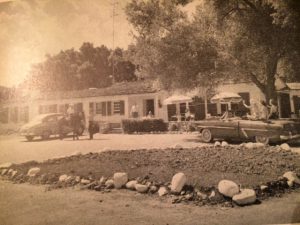
It was at this school that Dr. David P. Barrows learned his A.B.C.’s—a man who became president of the University of California.
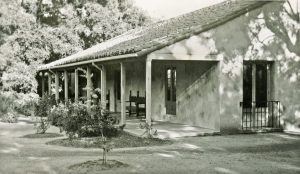
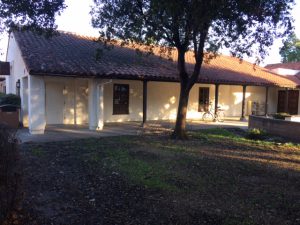
The brick school eventually became inadequate and in 1895 a contract was let to build a two-story frame building on Ojai Avenue. Clara H. Smith was the principal of this school from 1900 to 1902. C. L. Edgerton presided over the school from 1902 to 1912. Roscoe Ashcraft and W. A. Goodman were two principals who served the community before the coming of Mrs. Inez Tarr Sheldon in 1925.

The need for more room to accommodate the growing population became imperative. Consequently, in 1927 the old two-story frame building was moved to the back of the lot and a new school building was started with at first eight classrooms. In 1929 three more classrooms were added and in 1937 three more. In 1938 a large, handsome auditorium with cafeteria facilities was built.

Lloyd Emmert in 1939 succeeded Mrs. Sheldon as superintendent of the elementary school district,–Oak View Gardens and Casitas Springs having been added to the Nordhoff district. In 1941 Albert A. Herman was appointed superintendent. He is a good man in the right place.

Mrs. Sheldon should be remembered for her splendid work in instilling in the minds of her pupils and in the community also…the idea of world fellowship in the promotion of peace. Her pupils exchanged letters and pictures with other pupils in all parts of the world and 32 portfolios embodying this educational effort make an interesting display.

“Good Will Day” was celebrated each year on May 18—the little girl of eight said to her teacher, “Good Will Day is a day to learn how to get along with people.”

Library was the Focus of Community 100 Years Ago

This article first appeared in the Ojai Valley News on April 9, 1999. It is reprinted here with their permission.

Library was the focus of the community 100 years ago
by David Mason

“Ventura house-mover John Brahey is busy moving the Nordhoff Library onto the library (owned) lot south of the present location.”
— Ventura Signal, October 1908

Between 1897 and 1917 philanthropist Andrew Carnegie endowed more than 1,400 public libraries.

He could very well have been inspired by the Ojai Valley’s Library, for by the time Carnegie’s lengthy series of endowments got underway, the town of Nordhoff, now Ojai, had been enjoying a public library for five years.

The library in Nordhoff may not have been a Carnegie library, and Carnegie probably never knew it existed, but the Ojai Valley’s residents were proud of what they had, for they had worked hard to establish this bit of culture in their community.

When the library committee first met in October 1892, it was to discuss plans to raise money to start a library in the town. The people of the valley were so excited about the idea of having a local library that they volunteered many hours to bring it to a reality.

By March 1893 Sherman D. Thacher, founder of The Thacher School, announced that the Thacher family and some friends were willing to donate $500 toward the purchase of books if the people of the little valley could come up with the money for the building and its maintenance. This kind and generous gesture would be the inspiration for an all-out campaign to raise the rest of the needed funds.

After many lawn parties, ice cream socials and teas, the money was raised in a very short time. Construction of the library started in July 1893 and was completed in August, nearly 30 days later.

In 1937 Zaidee Soule, longtime local librarian writing on the history of the library for the community’s newspaper, The Ojai, wrote, “The building was constructed 100 feet south of Ojai Avenue and just east of (Stewart) creek on the Barrow property.”

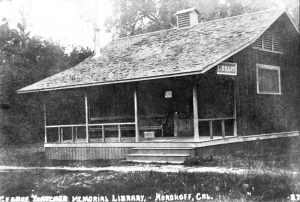
The building, a single room, was only 16 feet by 24 feet, with a porch running along the east side.

The library was named The George Thacher Memorial Free Library. The name came from one of the Thacher boys who had died at an early age and the people of the valley were proud to honor this boy who had touched the hearts of so many.

Nordhoff LibraryCOP 2016.163

The first librarian was Mrs. J.K. Newton and the library was open from 4 to 6 p.m. on Tuesday, Thursday and Saturday and from 7 to 8:30 p.m. on Sunday.

The library was a success from the first day as the people of the valley were anxious to gain new knowledge.

The success of the library became even more evident in 1904. Since the library did not own the land on which it sat, the library board of directors purchased the lot next door, further south on Montgomery Street, and had the building moved onto their own property and added another room.

In January 1916 the library officially became a branch of the Ventura County Library system, the first in the county. The operating expenses, maintenance and upkeep became the responsibility of the county.

After many years, it was apparent that the library was going to outgrow its building and changes would have to be considered. A number of buildings were being built on the south side of the main street, hiding the library from view, so the library board felt that the location would also have to be changed.

The town was growing rapidly, and with Ojai’s greatest benefactor Mr. E.D. Libbey changing the appearance of the downtown, it was only natural that a new library, designed with the same flair as the rest of the town, would be in keeping with the general plan.

The new library committee was headed by Sherman D. Thacher, who had also been instrumental in the founding of the original library in 1893, and it fell to the Ojai Civic Center Association in 1920 to find a buyer for the existing library property.

After some time, part of the library lot was sold to the Ventura County Fire Department for a new fire station, now [the Ojai Vineyard Tasting Room], and a new group in town called The Ojai Community Players, now the Ojai Art Center, took an option on the remaining portion of the land.

The city had come in possession of a lot on the corner of Aliso and Lion streets through the generosity of Mr. and Mrs. Daniel Smith. The city agreed to pay the Smiths $312.50 for the lot because the city had installed new sewers and widened the streets and had ruined the lot for building a house.

However, Mrs. Smith deemed it in the town’s best interest to accept only a $10 gold piece for the property, an amount she said would “make it legal.” The little old library building was then moved onto the small city-owned lot.

With the pending sale of the library property, the committee put the fundraising efforts into full force and the first person to donate was Mr. Libbey who donated $10,000 worth of stock to the fund. Many others joined Libbey with donations in various amounts. Finally, when enough money was raised, definite plans were started. By the time the committee had raised all the needed funds, Mr. Libbey had passed away and his estate owned the land that the library committee had decided upon for their new building. It was a beautiful corner lot at South Ventura Street and Ojai Avenue. The library committee contacted the Libbey estate to ask if the lot could be purchased for the new library. The answer came back from the trustees of the estate saying, “It had always been Mr. Libbey’s dream to have a library at that site, so they wished to present the lot, worth $10,000, as a free gift to the Ojai Community.”

The architect selected by the library committee was the famous Carleton Winslow. Winslow was 42 and well-respected in the state of California. He had first studied architecture at the Chicago Art Institute, and for more advanced training, he spent time at the Beaux Arts Academy of Paris.

Upon graduating, Winslow found employment with the architectural firm of Cram, Goodhue and Ferguson in New York City. The company became responsible for the construction of the buildings for the Panama-Pacific International Exposition in San Francisco in 1915 and sent Winslow to supervise the job.

After the exposition, Winslow remained in California and opened an architectural office in Los Angeles and later in Santa Barbara. He was one of the most influential figures in the realization of the Spanish Colonial Revival and Mediterranean styles of architecture in the state of California.

It was only natural that the Ojai Library Committee would select such a man to design a building that would not only match the downtown architectural style, but would complement and add uniformity to the town center.

Samuel J. Hudiburg was the building contractor. Hudiburg was born in Santa Paula and received his schooling in Ojai. In 1906, he learned the carpenter’s trade from J.C. Leslie, a pioneer contractor in Ojai, and Hudiburg worked for Leslie until 1919, when he went into contracting for himself. During Hudiburg’s years as a contractor, he built many of the finest residences and commercial buildings in the valley.

On Dec. 1, 1927, the plans for the new library were approved and construction started. The building was to include a reading room, 23 feet by 62 feet, and additional small rooms for magazines, a work room, etc.  An 8-foot porch was planned for the front of the building.

On April 15, 1928, the new library was officially opened. Many books being published that year undoubtedly helped to fill the shelves – among them were “West-Running Brook” by Robert Frost, “The Man Who Knew Coolidge” by Sinclair Lewis, “Good Morning America” by Carl Sandburg and “Boston” by Upton Sinclair.

Ojai LibraryCOP 1978.028

By 1979 the need for an additional room to the library was brought to the attention of the Ventura County Board of Supervisors and J.K. “Ken” MacDonald, supervisor from Ojai, would spend the next few years working diligently to accomplish the goal of a new wing.

With the cooperation of John Van Dyke, who owned the vacant lot between his travel agency and the library, the land was secured at a reasonable price.

MacDonald was able to persuade the Board of Supervisors to finance a portion of the project and Friends of the Library, with assistance from librarian Ellen Harmon, were able to secure the needed funds for completion.

The addition was completed in May 1981 and, by a resolution from the Ventura County Board of Supervisors, the new wing was named the “J.K. ‘Ken’ MacDonald Annex.”

LibraryAddition

The original 1893 library building became the clubhouse for the Boy Scouts and they used it for their meetings until 1949, when it was deeded to the Girl Scouts for their use.

In 1989 the Girl Scouts were forced to abandon the building as it was found to be unsafe and would have required a lot of changes to bring it up to health and safety codes.

The majority of the building is still in its original condition, and today, more than 100 years later, the building is preserved and maintained in a fashion worthy of its dignity.